My not-so-secret-anymore-crush Jancis Robinson published an article in the Financial Times recently exploring the pricing of wines, and its correlation – or not – to quality. A rather obvious non-correlation in my book (and it looks like hers as well), but she still takes on the topic from the perspective of newly emerging wineries that decide to go high-end price-wise right away. Yes, I understand that wine is a product and products are up for sale and that clever marketing can work miracles for some producers…Jancis’ point, as I read it, is that we need more education, and more educated wine drinkers to find out the difference between price and quality, a lesson that is as true for America as it is for Europe and Asia.
By taking Asia as an emerging wine consumer market, this also plays on a theme that came up in the discussion to the Reuscher-Haart article I posted. My friend Ernest pointed out that he had watched the movie Red Obsession which details China’s rise as a wine consuming country and how it is distorting prices. My comment was that this is what the US market had done to Italian and French wines since the late 1970s and most importantly the 1980s…that this phenomenon is not exactly new, it is just a repetition of how some US buyers, who through Reaganomics were able to amass huge piles of money, distorted the market by paying incredibly high prices…
Most importantly, this struck me, because it rings true of what some of my winemaker friends in the steep hills of the Mosel have told me before:
“The joke is that wine is not very expensive to make. Production costs of even the grandest red bordeaux are rarely more than €10 a bottle, €30 at most if the château is run on bank borrowings.”
10 Euros, mind you, is $13. Many German Rieslings which are grown and harvested under extreme geographical conditions are produced for less than that, because they sell for 10 Euros in Germany…that is including a 19% sales tax.
This post is part of the Monthly Wine Writing Challenge, which is now in its third round. Sally of My Custard Pie wrote the best piece last month around the theme trouble (this is what I could muster) and threw out the next challenge: Possession. Find the full info on the contest here.
I am a lawyer by training. And sometimes, this training, and the way of thinking it teaches you, can be a curse. So, when I read the theme for this month’s wine writing challenge, possession, my head got stuck on the legal meaning of possession. You see, the law distinguishes between ownership and possession. It is an important distinction, but in colloquial language and understanding, it often gets completely blurred. Now, ownership is a much better right to have, because it gives you exclusive rights over something. Possession, in contrast, only gives you a derived right. Derived, because the thing we are talking about belongs to someone else…
Why did my head get stuck on this distinction when we are talking about a wine writing challenge? Because possession, just like ownership, plays a huge part in the German wine growing world. I remembered a video I watched last year, posted by Denise Medrano, in which Ernst Loosen of the fabled Dr. Loosen winery takes a group through their vineyards in Ürzig, the Ürziger Würzgarten. It’s a long video, and rather boring at times, but what struck me was what he talks about from time mark 4:20 or so until minute 6. That part is not boring!
Ernie is talking about who “owns” which part of the vineyard, and as you can see, it is really tricky. In the most remarkable sentence he states that seven single vines (yes, single vines!) are bordered by four different wineries. What he does not mention is that some of those vines are not even owned by the wineries that work them, the wineries merely have legal possession: they leased the vines.
So much better than Hollywood…yet who owns these vines?
When you think of wine estates, many imagine the large, sprawling wine estates in the New World, where one winery owns hundreds and hundreds of acres of vines, all in neat rows, belonging to that one winery. The situation in a lot of Germany is different (and not just Germany, I think it is similar in other European wine growing countries): Wine has been grown for 2,000 years. Families have split, and with them ownership over land was split. The Catholic Church had huge holdings, which were later dismantled. But quite a bit of that land is actually still owned by the Church. But most bishoprics have given up making wine themselves. Add to that the decline of active wineries in Germany because many cannot make a living, and there is a sizable amount of land under vine that is owned by persons that don’t even make wine.
What do you do with these tracts of land? Most of the land is in steep hills, or in areas that cannot be developed in another way for legal or geographical reasons. But the land might actually be quite valuable. And some people are not interested in a full payment to transfer ownership, they rather get a yearly rent (in money or even wine) and retain ownership. According to statistics by the German statistics office, over 60% of agricultural land under production is leased, not owned! In Rhineland-Palatinate, home to the large wine regions Rheinhessen, Palatinate (Pfalz) and the Mosel, 66% of all agricultural land is leased (I couldn’t find data just on wine).
This leads to a lot of possessive relationships in the vineyards. These are regulated by contracts which stipulate the exact duties (how does the possessor need to take care of the vines? Who is responsible for replanting when the vines grow old and tired? etc.) of lessee and land owner. A short research on Google revealed contract forms by two bishoprics leasing out land under vine. These contracts are many pages long. The contracts run for a set number of years, and it is common that after the end of the lease, the vines are rented to another wine maker…so the one who tended them for, let’s say, 20 years from one day to the other loses the right to use to these vines…
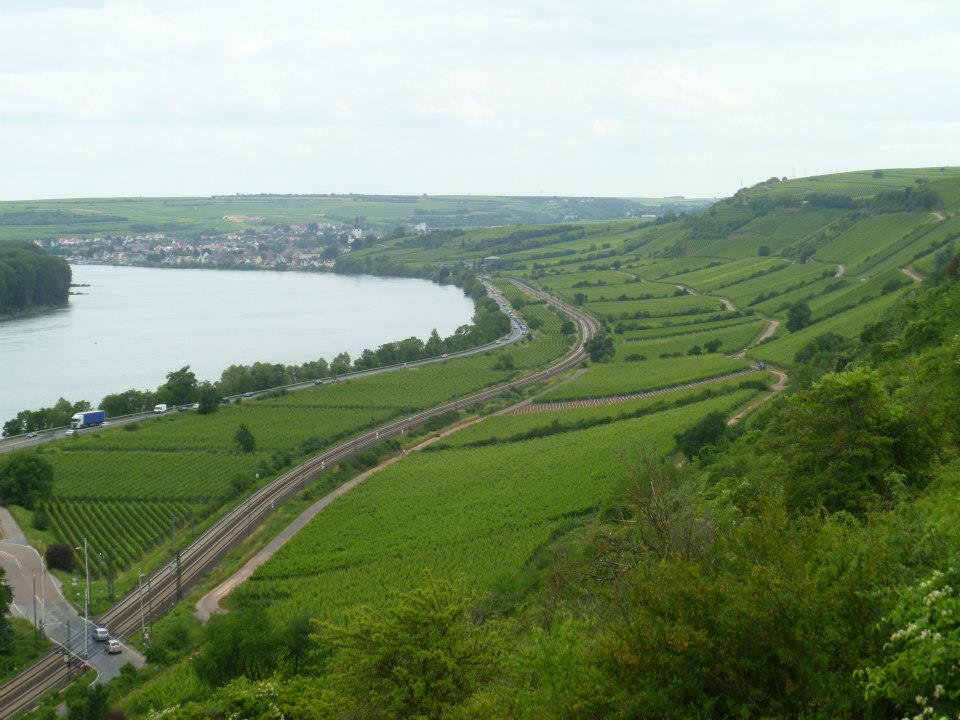
Roter Hang viewed from Nackenheim southwards to Nierstein
These relationships are beneficial for both parties, though. Take my friend Stefan Erbes of Karl Erbes. His family has been making wine in Ürzig since the 1960s, yet the most fabled of vineyards in the neighborhood was out of reach: Erdener Prälat. That tiny little parcel of land actually has seven or eight wineries tending to the vines in it, although ownership might be more obscure. Last year, Stefan was able to lease a teeny tiny bit of vines in the Prälat, and since the vines are already in place, he will be able to make wine from this top trophy vineyard for the first time this year already. On the other hand, the current owner does not lose his or her stake in this piece of land which, very likely, will continue to grow in value.
Well, this got us on quite the tangent, and is not necessarily the first thing that comes to mind when speaking of possession. But I just thought it was an important piece of information about German wineries. That the land they produce their wines from might never have actually been owned by them. Some of them are just possessors…
Rheingau and Mosel: 2011 KM501 Rhein Riesling and Loosen Bros Dr L Riesling
Today I want to compare two entry level Rieslings from Germany: the 2011 Loosen Bros. Dr. L Riesling and the KM501 Rhein Riesling.
I know, summer is over and I should have posted this way earlier, but somehow I only got around to tasting these two wines side by side now. I’ve had the bottle of KM501 in my cellar for a bit now, and I always have a stash of Dr. Ls. I wrote about the 2010 vintage of Dr. L here.
The wines come from the two regions in Germany that have the most clout when it comes to Riesling: the Mosel valley and the Rheingau. While most of you are probably by now bored with my singing the praises of the Mosel, let me introduce the Rheingau, albeit briefly. The Rhine, which this area borders, flows pretty much straight forward North-North-West once it leaves Lake Constance at the German-Swiss border. Except for a stretch of roughly 30 kilometers beginning in my hometown Mainz. There, the Rhine takes like a 100 degree turn to the West and then flows straight West-South-West until Bingen where it does another 100 degree turn and goes North-North-West again. We call it the knee of the Rhine. If you look at the map, you know why.
The Rheingau is north of the Rhine (Map from Google Maps)
This creates quite perfect growing conditions for the Rheingau, which sits atop the Rhine with vineyards facing straight South. In cold climate wine regions, like Germany, it is especially important for grapes to catch all the warmth they can, so south-facing vineyards are great because they get sun all day. Add in the reflection of the sun from the river that hits straight into the vineyards and warms them up and the moderate climate a river provides and things are actually pretty great…at the Mosel, it is also very common for good vineyard sites to be facing South.
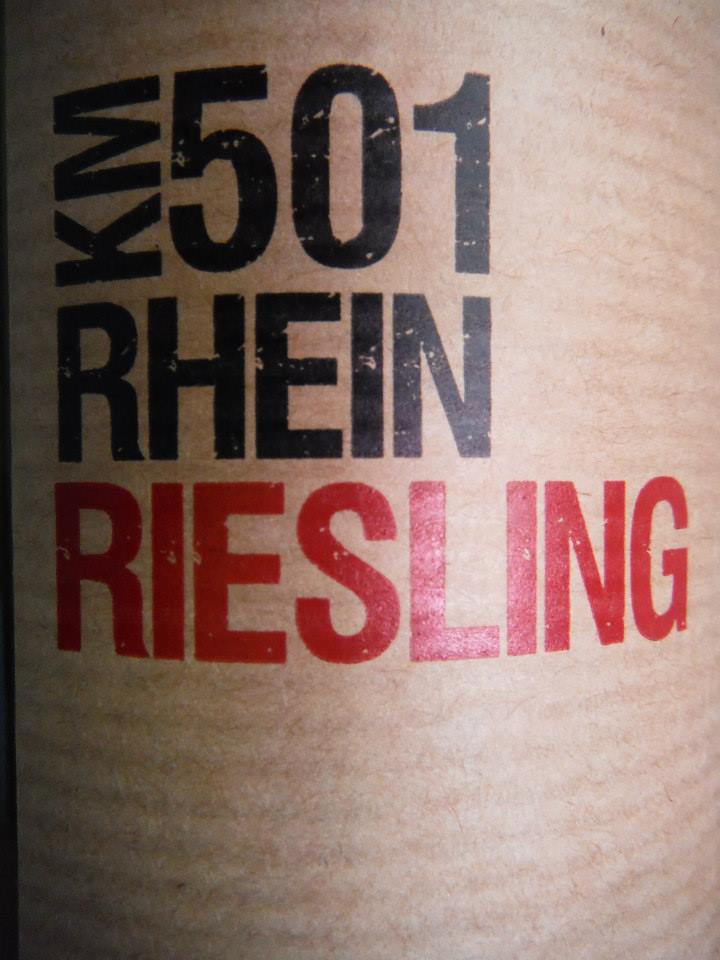
While the Dr. L is made by Ernst Loosen, the KM501 is made by Balthasar Ress, a winery with a long history in the Rheingau (the family’s owned the winery since 1870). Both wines are entry level wines and made with grapes from the area, albeit not necessarily grown by the wineries. KM501 refers to Rhine Kilometer 501 (when traveling along the Rhine you will notice signs that mark every single kilometer of the river as well as the half kilometers in between). The winery picked the name because the Rheingau starts at Rhine Kilometer 501. Both wines are made from Riesling grapes and both are from 2011, a year that saw rather good growing conditions with overall modest acidity in the grapes and therefore resulting wines. Most importantly, both wines don’t break your bank and are available for around $9 to $12 (I paid $9 for each).
2011 KM501 Rhein Riesling
We started with the KM501 Rhein Riesling. You can find more information about the wine on its American importer website here (although it seems weirdly devoid of real information). According to the label, the wine has 9.5% ABV. In the glass, a light yellow wine presented itself, with hints of green. In the nose, I got grapes and citrus, lots of citrus. Nice. On the palate, the light bodied wine tasted like white grapes, was soft, with some peach and pear and residual sugar. Acidity was mild and the wine showed a decent length finish. There were some bitter aromas at the end. All in all, a pretty solid wine in my book. Typical summer afternoon quaffer that one can down a bottle or two without a problem. I was pleasantly surprised by the quality of this wine.
2011 Loosen Bros Dr L
We then opened the Loosen Bros. Dr. L. More information can be found here. The label noted 8.5% ABV. The wine presented itself in a slightly more intense yellow than the KM501. The nose was very fresh (I am using this descriptor again, not sure how else to describe it), with peaches and sweet pear coming in. Lovely. On the palate, the Dr. L showed more residual sugar than the KM501, with peach and apricot coming in. The mouthfeel was soft and silky, but I wished there was a bit more acidity in this. It was just a tad too sweet but still refreshing. The finish was good. I did not get any bitter notes as I did in the KM501. There was also a certain creaminess in the wine, which I enjoyed.
So here we are. Two wines, good producers, different regions. Can I taste the different regions? Not sure. I also don’t think it is likely to be able to taste different regions in these entry level wines. I think they are both well made enough and definitely worth a try if you want to see what an everyday Riesling tastes like to me. I think in the end I would go with the Dr. L because I don’t care much for bitter aromas in Riesling. Nina remarked that while the KM501 had some good notes, the Dr. L seemed to have more depth. Which I can’t really dispute…
But, bottom line: No more excuses not to try affordable, enjoyable Riesling from Germany! KM501 was available at World Market last I checked, and Dr. L is available at Trader Joe’s or Costco.
Oh, and we had them both with the Korean spicy potatoes that we love, and they both nicely held their own. So, once again: Pair Riesling with Korean food!!!
Korean braised potatoes
Have you had either of the wines? Or even tried them side by side? I am curious to know what you think of them…






 the winegetter