Monthly Archives: May 2012

Demystifying German Riesling – WSJ 4 May, 2012

I know, another article, but this one is about German rieslings, and so I feel like I should share it with you.

Is it a trocken? Demystifying German Riesling

The author makes many valid points, among them the following four reasons why riesling is loved by sommeliers in the US:

1) Riesling is wonderfully capable of transmitting the character of a particular terroir of just about anywhere in the world, though arguably no more so than in its native Germany.

2) Ageability: A great German Riesling can age longer than just about any white wine in the world.

3) Affordability, especially relative to other great wines of the world.

4) The German wine-classification system can make the study of Burgundy seem like a proverbial walk in the park and that is why sommeliers seem to be necessary.

The author then goes on trying to explain that there are many German rieslings that are not as sweet as they tend to be perceived. She definitely has a point there. Another aspect she raises is that Americans talk dry, and like off-dry and semi-sweet. My experiences with American friends visiting us in Germany and going wine touring with us was usually the same: They would tell us prior that they wanted dry wines. The off-dryer and sweeter they got during the tasting, however, the more they fell in love. It is because of riesling’s natural acidity, that makes the sweetness play with it in a hugely pleasurable way.

Yet, the author also falls into the traps of German wine labeling that she tries to avoid: In the article she seems to equate kabinett (the lowest class of Praedikat wine, remember my post?) with off-dry or semisweet. That is not entirely true, though. There are many kabinetts that are dry. This problem, again, stems from the confusing German wine labelling. While Mosel riesling kabinetts are usually sweet, if the label does not denote anything you can assume that they will be on the sweeter side. The winemaker labels them “trocken” (dry) or halbtrocken or feinherb (off-dry) if they are not. In other regions, where tradition is different, a kabinett without any extra labelling can be dry…and if it was sweeter that would be put on the label. My point: Don’t assume a kabinett is off-dry or sweet just because it is a kabinett. If it is from the Mosel, you can safely assume it is on the sweeter end.

The article is still a good read.
Tagged , , ,

Summer = white/rosé, winter = red? Think again…

I stumbled across this NYT article yesterday and thought I’d share it here because I agree completely with what the author has to say.

“It’s not color that guides the choice of warm-weather beverages, but weight. Just as woolens give way to cottons and linens, so do heavier wines, beers and spirits yield to beverages with less ballast. What seems robust and warming in the bleak cold now feels ponderous and unwieldy. By contrast, what felt insubstantial back then is now refreshing and energizing.”

Check it out, well worth your time:

Red before Labor Day: summer’s new rules

Tagged , , , , ,

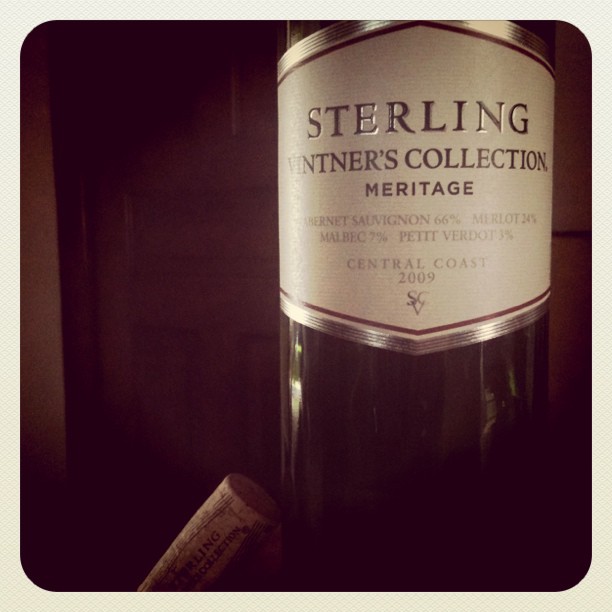
2009 Sterling Vintner’s Collection Meritage

I am just realizing this is my first blog entry on red wine…see, I am not as one dimensional as you thought!

Prior to buying this, I had never seen the name Meritage before, so I checked it out and found this on it: It is a term coined by American winemakers, that stands for Bordeaux-style wines. This means not one or two grape varietals but rather a blend of several varietals to create a complex and harmonious product. Some California winemakers decided to found the Meritage Association (now: Meritage Alliance) in 1988 and you have to be a member to label wines “Meritage”. A clever guy came up with a combination of “merit” and “heritage”, so it is to be pronounced like heritage, just with an “m”…

While modern times have become more and more obsessed with single variety wines (you know what I’m talking about when you look at your supermarket’s or winestore’s wine displays), it is not at all uncommon to blend several grapes into one wine. Bordeaux is the prime example, but also Chianti classico is made of several varietals (until a couple of years ago, they could even include white grapes!) same as a lot of wines from Portugal’s Douro region. It gives winemakers the unique chance of blending different tastes together into one. I personally like blended wines, the rough edges of a cabernet sauvignon can be mellowed by merlot for example. When I once talked to a Douro winemaker friend of mine and mentioned that I had tried and hated a single varietal “tinta barocca” in South Africa, he looked at me in shock. How could anyone make single variety tinta barocca, he asked? It is a classic filler grape for bigger reds…

Now on to this one. Sterling is a huge winery in Napa Valley. You can check out their site here (with elevator music…). The Vintner’s Collection is their “cheap”, really mass label. We paid about $10, I think. This Meritage (thankfully they put that on the label) has 66% Cabernet Sauvignon, 24% Merlot, 7% Malbec, and 3% Petit Verdot in it. Upon pouring, it showed its not overly dark color, which I found surprising. I had expected a way darker red. The nose was strong and full of different smells: initially strawberry hit me, then vanilla and cherry. Somewhere in the middle, herbal and floral notes crept in and I think I smelled some very light tobacco as well. It was awesome. I have not had a bold red in a while, and this reminded me of all things good. The taste was chewy and powerful. Initially smoky, leathery, some black pepper. Then red fruits came in. There was a distinct note of acidity that gave the impression of some unripe grapes in the wine. This acidity also made the wine taste more like plums, which I found appealing. The finish is ok.

I did like this wine. It was bold and not ashamed of it. Especially given that it was mass-produced I did like it. Some imbalances, the acidity, but all in all a very decent wine. Oh, and it went well with the pizza we had, too.

Tagged , , , , , , ,