Tag Archives: review

Traveling the Old World: A European Red Blind Tasting

Some may remember the Malbec tasting Nina and I hosted last month. We had so much fun that night, that in our drunken state of mind we all agreed to have another tasting soon. And so it was, last week, that the same group of friends gathered. We had agreed to make it a blind tasting and had chosen an area as wide as possible, European Reds, so that we could actually play around with the wines and no one would feel intimidated talking about them. Blind tastings can be a very humbling experience if you think you have some wine knowledge at least, and it is a great equalizer as everyone is free to associate as much as they want.

If you are contemplating a tasting with friends at home, here are some tips that I jotted down a while back but are still helpful, I believe.

We met at 6.30pm (I actually went earlier because I just had to play Wii with our hosts’ son). Everyone brought one bottle of wine, which added up to seven bottles because one fellow wino was sick. I had brought a Riesling to clean our palates with after the tasting, the 2003 von Hövel which I wrote about last week. One of our friends had volunteered to arrange the order of bottles and conduct the tasting so that all others were in the dark except for their own wines.

Because it worked, we had the first bottle of wine with a traditional Roman pasta dish, Pasta cacio e pepe. The first wine, a bottle of 2009 Banfi Chianti Classico (13% ABV, Italy – Sangiovese-based), poured in a medium, clear red color. The aroma intensity was on the lower end of moderate, and the wine smelled young. There was not much I could detect in the nose, very subdued. The wine tasted dry, was light with fresh acidity and low tannins which were fairly balanced. I got some cherries and an overall fresh note from this wine with medium length. I thought this was a decent light wine. My guess was a Sangiovese-based Italian, from 2010 or 2009.

Up next was a 2011 Pierre Chermette Beaujolais (France – Gamay-based), which poured in a pale to medium red and was slightly hazed. The nose was aromatic with some age, showing tobacco, cedar wood, hay and some grape aromas. The wine was dry and light bodied, with low tannins and moderate aromas. On the palate it had quite some unpleasant heat, hardly any fruit with a harsh and disappointing finish. It tasted like it had its best days way behind it. I did not care for this wine much, and guessed 2011 Northern France or Austrian wine.
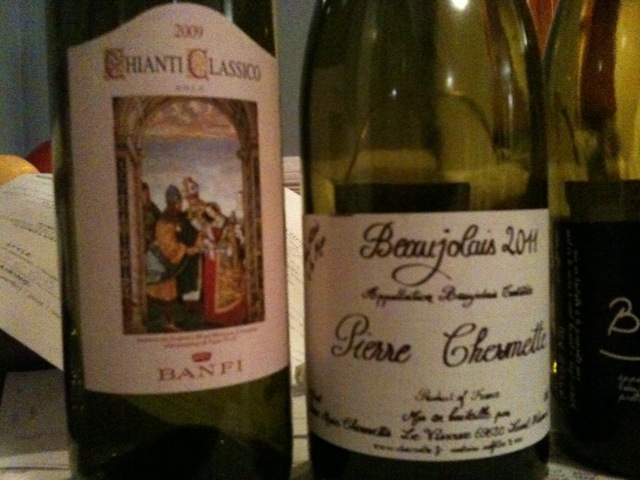
2010 Banfi Chianti Classico and 2011 Pierre Chermette Beaujolais AOC

The third wine was a 2012 Domaine Pral Beaujolais nouveau (France – Gamay-based). It showed a medium ruby red in the glass. Its nose was young and aromatic, with red fruit, jammy raspberry, gooseberry, pear mustard and roses. Quite the nose!! On the palate this dry, medium bodied wine was smooth with medium tannins and great balance. It showed strawberry and red fruit aromas, was floral and had some red currant to it. There was some heat in the end which I did not care for too much, but it was a very yummy wine with a long finish. Very pleasing. My guess was a 2010 Northern French wine.

And up was wine number four: A bottle of 2009 Andrieux et Fils Gigondas Côtes du Rhone (14.5% ABV, France – Grenache, Syrah, Mograve). Of deep ruby red color, the nose was aromatic with some age, and had plum, coffee, earthy aromas and some dark chocolate. Very different from the last wine! The wine tasted dry, with a medium-full body, smooth acidity and medium to high tannins. All in all it was very balanced and flavorful, with a very long fresh finish. It was the most complex wine of the night thus far and impressed pretty much everyone (as far as I remember). My guess was a 2010 Côtes du Rhone.
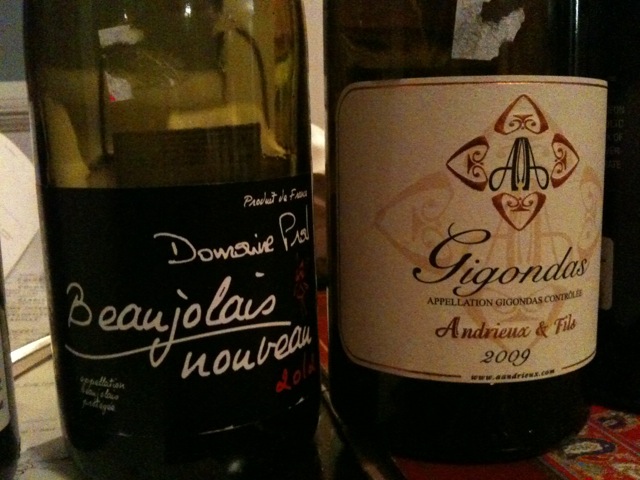
2012 Domaine Pral Beaujolais nouveau and 2009 Andrieux et Fils Gigondas Cotes du Rhone

The fifth wine, a 2010 Bodegas Ateca Atteca Old Vines (15% ABV, Spain – Garnacha), poured as a deep, ruby red and slightly hazy wine. The nose was aromatic, young and very weird: water colors, chalk, cherry and petrol. Not at all what I am used to, very intriguing. The medium bodied wine tasted dry with smooth acidity and medium to high tannins that were fairly well balanced. On the palate it was flavorful, with very ripe aromas, spice box, chocolate, and very juicy. There was a hint of residual sugar which made it absolutely fascinating. I liked this wine a lot, it was probably my favorite of the evening. Pretty early on, I decided in my head that this must be a Merlot from a Southern European area. Not sure about the age, but I kept yelling “This is a Merlot” across the table….

The sixth wine was a 2009 Az. Tilli  Concetto Terre di Chieti IGT (15% ABV, Italy – Merlot). It showed deep to dark ruby red with a slight haze. The aroma intensity was powerful, with berry compote and raisins. Very ripe, very impressive nose. I could have dove into this for longer. The wine was medium-full bodied, with fresh acidity and medium tannins, all very well balanced. On the palate, it had depth and was incredibly smooth, very likable with mostly red berry aromas. The finish was medium long. The Concetto is just a super yummy wine, I like it a lot. This one had to be a Merlot (by that point I knew that it was Nina’s wine, which she had bought in Germany at a wine store we both like with the one purpose of throwing it in at a blind tasting).

2010 Bodegas Ateca Atteca Old Vines and 2009 Az. Tilli Concetto Terre di Chieti IGT

The final wine in the tasting was a bottle of 2008 M. Chapoutier Côtes du Roussillon Villages Domaine de la Bila-Haut L’esquerda (13.5%  ABV, France – Syrah, Grenache, Carignan). It was the wine I had brought, and it proved to be the most controversial. I had bought it during Wines Till Sold Out‘s big sale the week before and it arrived in the mail just in time. I did not have a chance to try it before this tasting. It poured in a very dark, almost purplish red. The nose turned pretty much everyone completely off, and I have to admit it was the most unpleasant nose I have come across in quite a while: dirt, sulphur, manure. That is all one got for the first 30 minutes. With a heavy emphasis on manure. It was, frankly, disgusting. I was very surprised,  had not expected that at all. After 30 minutes, there were some red fruit aromas fighting their way through, but it was still not enjoyable to smell. On the palate, the wine was extremely intense, mostly earthy. There was some cassis, but mostly dry, dusty earth aromas. I still defended it and want to see what it tastes like after an hour or two in the decanter (I have a couple more bottles). What I tasted at this tasting though, was not very enticing…
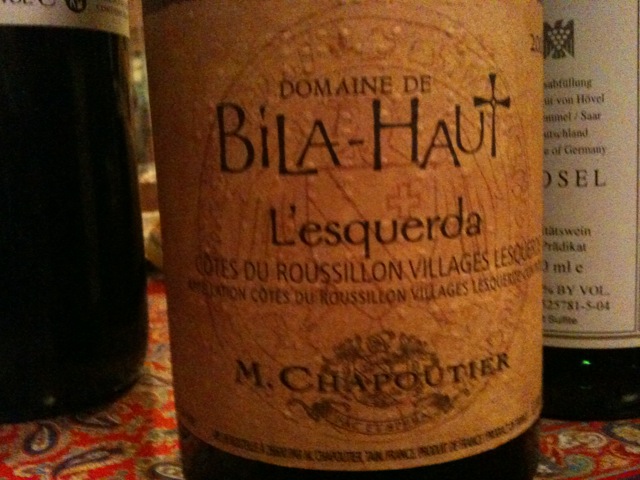
2008 M. Chapoutier Domaine de Bila-Haut L'esquerda

2008 M. Chapoutier Domaine de Bila-Haut L’esquerda

We finished the tasting, as is fast becoming a tradition, with a bottle of German Riesling Spätlese. I reviewed that wine over here.

Overall, I was very impressed with this tasting: Most of the wines were really good, and there were some really great surprises in it for me. We all played the guessing game, and it was fun. The best surprise though was a friend from Nina’s undergrad days who just began working in Detroit. He and a friend of his joined us for some of the wines later on and oh my God, did the friend of the friend play the guessing game. He nailed the last wine, and was pretty much spot on with the others he tried. That was really impressive! Time was just flying by and  I am sure I see another tasting in the not so distant future…


Tagged , , , , , , , , , , , , , , ,

2003 von Hövel Oberemmeler Hütte Riesling Spätlese

2003 von Hövel Oberemmeler Hütte Riesling Spätlese

2003 von Hövel Oberemmeler Hütte Riesling Spätlese

From one of his frequent trips to Germany, a friend of ours brought back a mixed case of German wines that my friend ManSoo had put together for us. It contained some Kurt Hain wines, a sparkler, some 1989 Auslese and three wines by von Hövel, a VDP winery at the river Saar, one of them this 2003 von Hövel Oberemmeler Hütte Riesling Spätlese.

Now, for those not familiar with the Mosel region, the Mosel has two tributary rivers, the Saar and the Ruwer that are part of that wine growing area. The Saar, as I have explained before, meets the Mosel just south of Trier, in the town of Konz. It commences in France and then flows into Germany. It is a mere 246 km (152 miles) long, but only its final stretch in the state of Rhineland-Palatinate is used for growing wine, mostly Riesling. It is known to produce more mineralic, somewhat tarter Rieslings than the middle Mosel. The microclimate is cooler than at the Mosel, so the grapes tend to ripen later and can reach acidity levels without the higher sugar levels you can find on the Mosel, which gives them a distinct character. Most of the vineyards used to belong to the Catholic church, but in the course of secularization in the 19th century, many private investors bought plots and began wine making. Rich families began to settle later in the 19th century which led to the term “Saarbarone” (baronets of the Saar, a term derived from “Ruhrbarone” which was used for the industrialists in the Ruhr area that made a fortune when the industrial revolution took off). A lot of the estates on the Saar are very grandiose, unlike most Mosel estates.

Weingut von Hövel has been owned by the von Hövel family since 1803 (just in time for secularization) and is one such rather big mansion. It is a member of the prestigious German association of quality winemakers, VDP, and owns 11 hectares (27 acres) in the Saar valley which are planted with Riesling only. Its annual production is around 60,000 bottles. Since 2010 Max von Kunow has been the owner of the estate. Besides holdings in the legendary Scharzhofberg, the winery exclusively owns the vineyards Kanzember Hörecker and Oberemmeler Hütte, the vineyard this wine was from. Oberemmeler Hütte is a South-west facing tiny plot of land. Unlike most vineyards in the area, it is quite far removed from the river, on a higher lying plateau. In the 1868 Prussian taxation map, which marked vineyards according to their property value and therefore -indirectly- quality, Oberemmeler Hütte is in the same category as the Scharzhofberg, i.e. very highly ranked.

I was excited to try this wine, because while we lived in Trier, we were only about a 7 minutes drive away from where the Saar meets the Mosel and Oberemmel is pretty close to where that happens. We actually had our wedding celebration in a BBQ hut only a couple of miles away from this particular vineyard. So this is as neighborhood as it gets for Saar wines for us.

The wine poured in a very clear pale, almost white color. Absolutely no ageing was noticeable when looking at it. The nose was delicate, with fresh aromas of citrus, white peach, cream and hints of vanilla. There were some traces of age in the nose, but not prominent at all. On the palate, the wine was light bodied and surprisingly thin in texture. It had a somewhat ethereal feel to it in its lightness in general. The taste was still clean and fresh. There were no citrus aromas, but apple and pear had come in. There was hardly any minerality noticeable which was a bit surprising. The finish was medium long.

The wine was very interesting to me, because it was a combination of still quite fresh, but also seemingly contracted from age, which were the two poles that this wine was tied to. At times, I wanted it to be a bit firmer, and at other times I enjoyed its lightness. It was a type of aged Riesling I don’t think I have experienced in the past. Good to very good, I would say.

Check out the vineyard’s location here.

Tagged , , , , , , ,

2005 Melini Vigneti La Selvanella Chianti Classico Riserva

2005 Melini La Selvanella Chianti Classico Riserva

2005 Melini La Selvanella Chianti Classico Riserva

Sometimes, you luck out in liquor stores. And sometimes you don’t. But I have learned that it is worth trying it out. And with this find, the 2005 Melini Vigneti La Selvanella Chianti Classico Riserva, I definitely lucked out. According to Wine Searcher, the wine retails for $25 and up. I found this lone bottle on the sales shelf for $12. There is always a good chance that an older vintage wine sold in a liquor store (instead of a professional wine store) has gone bad because of poor storage conditions etc. But it is sometimes worth a try, and it all depends on what discount the store is giving you.

Some of you know that I have made Melini’s 2010 Chianti Borghi d’Elsa my go to, everyday Chianti. It is nicely affordable and delivers refreshing, light wines. When bought in the magnum bottle, which are available at Costco, it is hard to beat price wise for a good dinner companion.

Cantine Melini is a big Italian wine producer. The winery was established in 1705 and today covers over 550 hectares of land in Chianti and Chianti Classico. The vineyards reportedly cover 136 hectares divided in 5 farms. While the Borghi d’Elsa is an everyday wine, La Selvanella is on the other end of Melini’s spectrum: It is their top notch wine which has garnered attention by Italy’s leading wine guide, the Gambero Rosso (the 2006 La Selvanella got the coveted 3 glass rating). This vintage received 2 glasses in Gambero Rosso and 4 grapes in the Duemilavini guide. The 2005 vintage was rather difficult as far as the weather was concerned (lots of rain and low temperatures from June to August), but the grapes are said to have ripened enough. The wine is made with 100% Sangiovese grosso grapes which come from 49 hectares around Radda in Chianti, one of the top villages in Chianti. The grapes were harvested in October and after 20 days of maceration it ripened 30 months in French oak. It has 13.2% ABV and the winery gives it 10 to 12 years of ageing potential. (All this information can be found on the winery’s website)

We decanted the wine for about an hour. It poured as a darker red wine with very slight browning on the edges. In the nose, I got raisins, lots of plum and some sweetness as well as herbal aromas. The medium bodied wine showed mostly plums and prunes on the palate, with good acidity and medium tannins which were nicely round. There was some spice going on and it had a medium length finish. The wine was still very, very fresh, which surprised me. It is by far not nearing its end yet.

I really enjoyed this wine. At the price I bought it, it was a steal. It also paired great with the Pecorino Toscano (a young Pecorino with delicate flavors that has none of the ripened Pecorino’s saltiness which I don’t enjoy much) I was able to secure in San Antonio and awesome different, thinly sliced bacons from my favorite sausage maker in town, Biercamp (which is right around the corner). It transported me right back into Tuscany, on a warm fall day afternoon, sitting outside, munching on Pecorino Toscano, prosciutto and panini and having a glass of wine…there is no better compliment I can make a wine.

Tagged , , , , , , , ,