
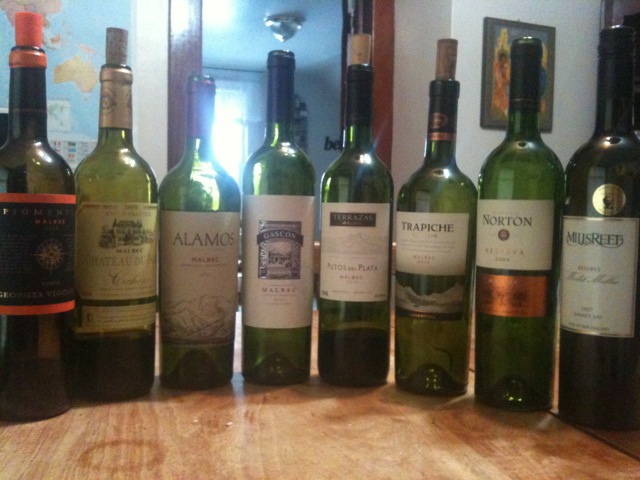
The line up for the Malbec tasting with wines from France and Argentina…and a New Zealander
Two weeks ago, Nina organized a Malbec tasting with friends of ours. Malbecs are some of Nina’s favorite red wines, with their strong and edgy character. It is just what she is looking for in red wines. The tasting had been a long time in the making. Given our usual shoestring budget, she had acquired different, everyday Malbecs that you can find all over the place. To make things interesting, she decided not only to try Argentina Malbecs but also two from France. And in the end, she decided to throw in a Merlot/Malbec blend from New Zealand for the fun of it.
Now, as some of you may know, I am usually not a big fan of “bold” (aka strong) reds. I prefer old world style Pinot Noirs and a more balanced approach to grapes. I also am struggling with understanding red wines in the way I feel I intuitively understand white wines. But I was curious about this tasting, too. Nina’s hope in this endeavor was to figure out what exactly draws her to Malbecs. And, let’s not forget, it’s also tons of fun to have friends over and do a tasting together (for my thoughts on tastings at home, go here). This was the first time we used the tasting sheets provided by De Long Wine Discoveries which I found super helpful (check them out here). With these caveats ahead, please take my reviews with a grain of salt from the perspective of someone who generally prefers milder wines. Also, as I indicated, the wines tasted are on the lower level of of prices and retail between $8 and $17. Each wine was decanted for roughly 30-45 minutes.
We started with the two French Malbecs. I had read prior that Malbecs from the core French Malbec region Cahors tend to be quite tannic so we decided to get them out of the way before we moved to the Argentina Malbecs, which are said to be more fruity.

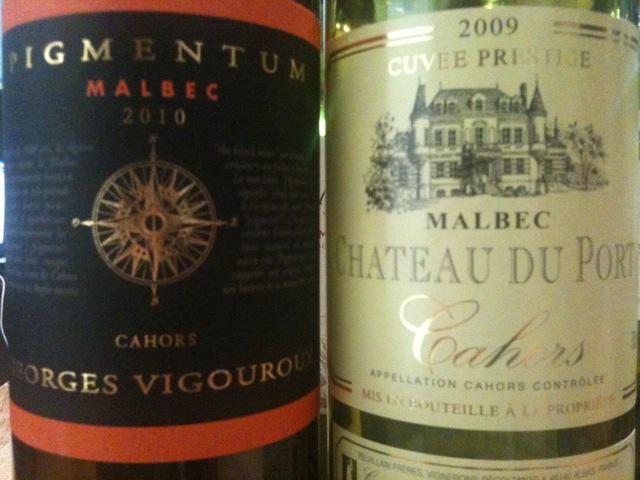
2010 Vigouroux Pigmentum and 2009 Chateau de Port Cuvée Prestige
First up was the 2010 Georges Vigouroux Pigmentum. The wine has 13.5% ABV. It was of dark, clear ruby color. In the nose it was moderately aromatic with alcohol, plum, herbs and hints of tobacco. It was dry, medium bodied, with crisp acidity and quite flavorful. I tasted strong tannins, some red berries and a mineralic note. It was fruitier than I would have expected with a long finish. I thought this was a pretty good start. The wine was less tannic than I thought and fruitier. It also paired well with the soft cheeses we tried. (When retasted two days later, it was still good: more cherry aromas in the nose, with almonds, and great raspberry and blackberry on the palate).
Next up was 2009 Chateau du Port Cuvée Prestige, also from Cahors. This wine has 14% ABV. Of deep, purplish red color, it was aromatic in the nose and showed some age. I got cherries, strawberries, mint and violets and thought the nose was awesome. On the palate, I got a dry, medium bodied and smooth wine with medium tannins. The flavor profile was a bit of a let down, though: I got vegetal notes, but mostly bitter aromas and alcohol notes. It almost tasted a bit green. The nose just promised more than I got in my mouth, which disappointed me. (After two days, this was virtually dead. Bitter aromas had increased, and it smelled musty.)
We then moved on to the Argentina Malbecs. All were from Mendoza.

2011 Catena Alamos and 2011 Gascón Malbec
First up was the ubiquitous 2011 Catena Alamos Malbec with 13.7% ABV. Of medium ruby red color, the wine showed moderate aromas of vanilla, branches and almonds on the nose. I hardly got any fruit (which I found surprising) – others at the table disagreed and got a lot of fruit (stone fruit and red fruit). On the palate, it was dry, medium-bodied and quite smooth acidity-wise. But the tannins were strong and hard and I felt the wine was quite unbalanced. It was very peppery and tasted a bit green. The finish was short and disappointing. It felt quite closed at that point. (When I retried it two days later it was quite the revelation: the nose showed raspberry and currants and was very appealing. On the palate it also showed freshness and black currant aromas that I liked a lot! So, let this one breathe for quite a bit!)
Next up was the 2011 Don Miguel Gascón Malbec with 13.9% ABV. Dark and purplish in the glass, its aroma profile was good and youthful, with raspberries and other red fruit. I wrote down “pleasant nose”. On the palate, it was dry and medium bodied with a crisp acidity. The tannins seemed low and it was fairly balanced to me. Initially, I thought the taste was pleasant but then it got a bitter. It definitely showed more fruit than the two previous wines, but also had some pepper notes. What disturbed me most was its heat. There was just something about it that was too alcoholic for me. (Two days later, this wine showed a great nose of gooseberry, tart raspberries and jasmine. Very pleasant. On the palate, it had lost its bitterness and showed jasmine and green tea aromas and was very herbal. Again, I enjoyed this much more two days later, so: decant or aerate a lot!)

2010 Terrazas de los Andes Altos del Plata and 2010 Trapiche Oak Cask
Next came the 2010 Terrazas de los Andes Altos del Plata Malbec with 14% ABV. Again, deep ruby colors with moderate aromas of oak, mountain flowers and almonds. I found the wine surprisingly sweet with smooth acidity and medium tannins. It showed aromas of pepper, red fruit, mint and some slight bitter notes. It was nicely spicy, but also showed too much heat for me. With a rather short finish. I wrote down “best of Argentinians so far”. (Two days later, this wine was dead.)
We then tried the 2010 Trapiche Oak Cask Malbec with 14% ABV. Deep ruby red color and a quite unpleasant nose of greenness, acidity, crude oil and butter. Not pleasant at all for me. On the dry side, with a light to medium body and crisp acidity, it showed high tannins and felt quite unbalanced regarding alcohol and tannins. It had a lot of heat, was watery and showed no signs of oak. Some red fruit and pepper. I did not like this wine at all. (Two days later, it showed strawberry and blackberry in the nose. It tasted sour with some spice and felt a tad better than initially assessed. Still would not buy this again.)

2009 Norton Reserva and 2007 Mills Reef Reserve
The final single variety Malbec was the 2009 Norton Malbec Reserva with 14.5% ABV. Deep and ruby colored, it showed powerful aromas in the nose. I got toffee, salt, soda, coffee and some cabbage notes. It was dry and medium to full bodied with medium to high tannins. It was nicely balanced, I thought, and flavorful: I got sour cherries, raspberry, lemon curd. Some said they got pie crust as an aroma. The finish was medium to long. All in all, I thought this was an alright wine. Maybe too citric and not as smooth as others felt, but still enjoyable. (Two days later it still tasted fine. The flavor profile showed some vanilla that I did not get initially)
We finished the red tasting with the 2007 Mills Reef Hawkes Bay Merlot Malbec Reserve from New Zealand. A 51% Merlot, 49% Malbec blend that has 14% ABV. Of medium red to garnet color, it was aromatic with some age and showed raspberry, herbal aromas, mint and strawberry. It was dry and medium bodied with fresh acidity, low tannins and was decently balanced. I thought it was quite enjoyable with some wood and slight vanilla aromas. It was a tad sweeter than the previous wines and not very fruity. Again, I thought this was an alright wine but it did not impress me. (Two days later, it had contracted to a thin, sweet wine that reminded me of bad port wine.)
So, who was the winner? I guess from the initial tasting I would go with the first one (Pigmentum from France) and the last wine (the New Zealans blend). However, after enough air got to them, the Alamos and the Gascón were actually quite enjoyable and pretty good value at around $10.

What I preferred: 2010 Kurt Hain Piesporter Goldtröpfchen Riesling Kabinett
We finished the evening with a German Riesling, what else? We had planned for an aged Riesling (a 1991) but when I saw the cork and how wet it was, I decided against opening it. I want to talk to the seller first. So, I threw a 2010 Kurt Hain Piesporter Goldtröpfchen Riesling Kabinett in the freezer. Opened it, and loved it. Notes will follow when I actually am taking notes. It was a wonderful refreshing Riesling from a producer I like a lot. And a great way to end an awesome night with friends, wine and cheese.




 the winegetter