Tag Archives: karl erbes

Michigan vs. Mosel Riesling Tasting with friends

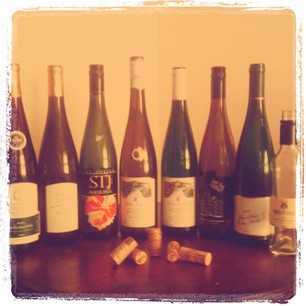
The Michigan vs. Mosel tasting line up

Last Friday (a week ago, I know…) we had our first just-tasting with friends at our place. I have written about my thoughts on doing tastings with friends here. The idea for this tasting was born a while back. Me being the Mosel riesling snob that I am, I have only made small progress into the Michigan riesling scene. Some of them I liked or was intrigued by (see for example here or here or here), some of them, well…Now, two friends of ours got married recently and they decided to spend their honeymoon in and around Traverse City, Michigan’s riesling mecca. While we were talking about that trip, we decided to do a comparison tasting. They had brought some stuff back, and we had some Mosel rieslings to share. We also invited another riesling nut to the tasting, who falls in love with virtually every riesling we serve her, which makes me feel good. And another friend, who was crashing with us, participated as well. To lessen the suspense: We had a blast. We had so much fun, and the comparison went quite well. If we had done that tasting blind, I don’t know whether I would have been able to pick which ones are from there.
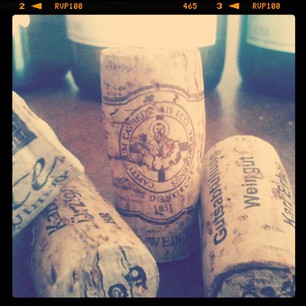
Some cork art. It does not get much fancier…

Here is our line up:

1) 2010 Chateau Grand Traverse Riesling Dry (Michigan)

2) 2011 Brys Estate Dry Riesling (Michigan)

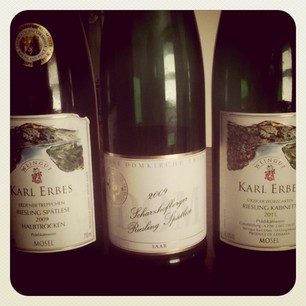
3) 2009 Karl Erbes Erdener Treppchen Spätlese halbtrocken (semi-sweet) (Mosel)

4) 2006 St. Julian Riesling (Michigan)

5) 2011 Left Foot Charley Missing Spire Riesling (Michigan)

6) 2011 Karl Erbes Ürziger Würzgarten Kabinett (Mosel)

7) 2009 Hohe Domkirche Trier Scharzhofberger Spätlese (Saar)

8) 2009 Macquariedale Hunter Valley Late Picked Semillon (Australia)

In blind tastings, it is fun to throw a wine in that not necessarily fits the restrictions on the wines that you imposed prior to tasting. It is something outside the box, to throw you off, and to make the blind tasting even more fun. We usually referred to these as black pirates. The black pirate in this tasting was the Australian dessert wine, which was brought by the friend crashing with us.

But to my thoughts on the wines:

The Michigan line

First up, the 2010 Chateau Grand Traverse Riesling Dry. I do like their semisweet standard wine and their Late Harvest Riesling, so I was excited about trying the dry. Upon opening and pouring, a dark yellow wine showed itself which was bit confusing. Did not expect that from a young dry wine. The nose showed ripe fruit, but not much of it. On the palate, the first noticeable taste was bitterness. There was some slight peach, but hardly discernible. The wine felt quite alcoholic (which was confirmed when we checked the label: 12.5% ABV). The short finish was topped by a burnt taste. In short, it was quite the disappointment. I could never have guessed this was a riesling if tasted blindly, and it seemed way past its prime already.

(Addendum: I received word from the winery in the comments section that the discoloration in the 2010 CGT Riesling Dry indicates that the wine was actually flawed, either by a bad cork or bad storage…I guess I could have guessed that given that I got all the clues: wrong color, bitter notes and burnt taste; I just did not make the connection when tasting.)

Next in line, the 2011 Brys Estate Dry Riesling. The color was lighter straw, with a nose of ripe fruit, peaches and sugar, slightly confusing in a dry wine. The texture was lovely, it gave you a silky mouthful of wine. It had a nice amount of acidity, and first fruit notes I discovered were grapes, yellow apples, pineapple and then citrus. While holding on to my glass and continuing to try, I thought I discerned some vegetable notes in the beginning (maybe squash, maybe zucchini). The wine had a nicely long finish. The 11% ABV were hardly noticeable. In short: This was delicious. It was fresh, and reminded me of German rieslings, albeit not a German dry riesling, it would have been an off-dry in Germany. Very nice wine!!

Up next, the 2009 Karl Erbes Erdener Treppchen Spätlese halbtrocken (semi-sweet). A tad higher in alcohol content than the Brys wine at 11.5% ABV, I was curious how these two would match up. The color was a light yellow with a nose of sweetness and yellow fruit, with ripe aromas. On the palate, the wine had a quite condensed feel to it. It tasted very ripe, older than a 2009 should taste. It had some apricots and vegetal notes, but I could not get over the fact that it might have been flawed. I did not detect a cork flaw, and if so, it was mild. But the wine tasted off. So I really do not feel like I can rate it.
The Mosel line

The next wine was the 2006 St. Julian Riesling. Our friend had been excited when she found the single bottle of this wine in a wine shop and bought it for us to try. She has been fond of older rieslings, and so we wanted to experience this together. Open opening the screw cap and pouring the wine, we saw a lighter, saturated yellow in our glasses. The nose was …mmmmh…. interesting? To me, it smelled of band aids. Others said glue. It also smelled quite musty. It was very unappealing. On the palate, that continued. The wine was clearly way past its prime, probably had been stored in horrible conditions…this one had been dead for a while.
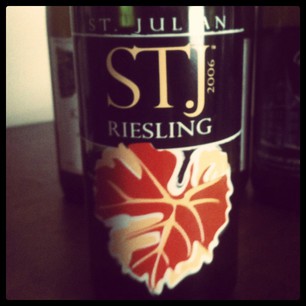
St Julian 2006 – Stay away!

It was on the 2011 Left Foot Charley Missing Spire Riesling to redeem Michigan. And boy, it did!! Of very light and almost water color, it had a beautiful, beautiful nose of grapes and green grass. The taste was floral and herbal (I also wrote down perfumy, but I know that these descriptions do not really help…), with a wonderful creaminess to it. There were some hints of bitterness towards the end. The finish was rather short, though. I found this wine wonderfully refreshing. Its 43 grams of residual sugar and 9% ABV made it a great sipping wine. In its beauty, it did remind me of Prälat wines, but I might have gotten carried away, especially after the two disappointments we tried before. Nina disagreed with me on that assessment, and I suppose she is right.

By that time, we had brought out the cheeses, and that definitely enhanced the tasting as well. Nothing like sweeter rieslings and cheese…

Up next was the 2011 Karl Erbes Ürziger Würzgarten Kabinett. At 8% ABV it had the typical alcohol content of a sweeter Mosel riesling, and I remembered it fondly from our tasting at the winery in June. The color was light straw and the nose had honey and a rather distinct grape note, very fresh. My tasting notes focused on my emotional response rather than the tastes. They read: “refreshing, sweet, honey, warm, nice acidity, deep, not very long, great with cheese”. I admit it, I had already had my fair share of wine, and my tasting capabilities went downhill. The wine just made me smile. It was just so pleasant.

This was followed by my highlight, the 2009 Hohe Domkirche Scharzhofberger Spätlese. You can find the review here (I needed more space for that).

We finished off with the 2009 Macquariedale Hunter Valley Late Picked Semillon from Australia, which is described here.
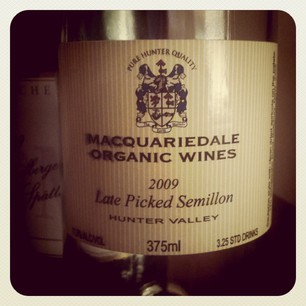
The black pirate

Like I said, it was a great experience. My cousin asked me who won. I really don’t feel like I can declare a winner here. The Brys and the Left Foot Charley were both pretty awesome wines, and so were the Erbes Kabinett and the Scharzhofberger. I think the biggest surprise for me was the quality of the Brys and the Left Foot Charley. They definitely convinced me that there is great riesling in Michigan and I am determined more than ever to go and find them.

Has anyone tried these wines or others from those wineries? Please share!!

Tagged , , , , , , , , , , ,

2011 Karl Erbes Ürziger Würzgarten Kabinett feinherb and Korean food

Moselriesling with Korean food

Having written about the photo exhibition in Seoul in my post last week has made me think of Korea and Korean food a lot. I spent 5 months in Seoul in 2000/2001 and fell in love with Korean cuisine there. Then later, I learned to appreciate the wonderful pairing possibilities that riesling and Korean food have. Especially the off-dry and sweeter rieslings. While Korean food tends to be very hot and also has strong notes of sour (think kimchi, 김치, the Korean marinated and fermented cabbage that tastes very sour), these semi-sweet rieslings bring fruitiness and sweetness to the dishes. This compliments the sour notes heavily. The acidity in the wines makes them refreshing relief from the heat of Korean food. They truly can form a great pair. And it works the other way around, too: Take bulgogi, 불고기, the Korean national dish. It is marinated beef that gets broiled at the table. The marinade is actually quite sweet. That is were the acidity of the rieslings gives a great counter-balance. One cannot help but think ying and yang.

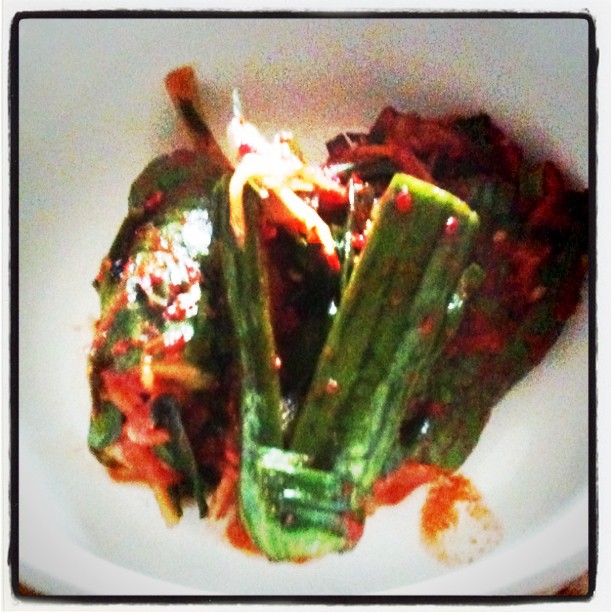
Cucumber kimchi

Luck had it, that I also discovered a Korean grocery store in Ann Arbor and finally biked there. Their selection is fantastic, truly anything a Korean stomach could ever ask for. So I bought kimchi mandu (김치만두, small dumplings filled with kimchi, the Korean fermented cabbage), japchae mandu (잡채만두, dumplings with a glass noodle filling), kimchi fried rice (김치볶음밥) and several of the traditional Korean side dishes, or banchan (반찬): marinated lotus root, radish kimchi, cucumber kimchi, and garlic roots. All of them, except for the japchae mandu were pretty hot.

We opened one of the recently arrived Karl Erbes 2011 wines that a friend of ours had brought from Germany for us. It was the 2011 Ürziger Würzgarten Kabinett feinherb. I prefer the kabinetts with Korean food, because they are a bit lighter and offer more of the refreshing relief than spätlesen. The color of the wine was very light, translucent. In the nose, I smelled the typical Würzgarten. Würzgarten translates to “spice garden” or “perfumy garden”, and these wines tend to have very floral notes in their nose, it is almost a trademark for this hill. Some alcoholic notes, grassy, a bit like the freshness of asphalt after a rain (in a good way!). The texture was velvety. It also tasted rather typical for Würzgarten: floral, some apple, very fresh. The wine seemed a bit off balance, which could be blamed on the fact that it had just travelled for quite a bit and not settled down yet. It is also still very young! It did go quite well with the food. However, a bit more sweetness would probably have helped (and that is more on me for picking a less sweet wine than on this wine!).

The next day, we had some more sips to truly appreciate the wine on its own. It is a very nice wine. The nose was still stunningly beautiful after 24 hours. The taste is incredibly fresh and refreshing. I would love to try this again in 6-9 months. Karl Erbes wine can be bought in the U.S. There are several wine merchants that offer his wines.

Tagged , , , , , , , ,

Wine travelling in Germany

I have mentioned it in passing, but Nina and I will be in Germany for three weeks in June and early July. I cannot tell you how excited we are about this. Not only for seeing friends and family, but also for all the wine tasting opportunities. Wine tasting and travelling in Germany is incredibly pleasant. The wine culture is still very much based on local, small wineries with farm-like structures. Now, I am not saying that the winemakers are mere “peasants”, on the contrary. They are smart businessmen, and they know they produce for a world market. Yet, they have retained a lot of the wonderful ease of access that their fathers established and that is one of the best features of German wine culture. It also gives you super-easy access to winemakers and their knowledge and treasure trove of stories.

Tasting with Stefan Erbes and friends in May 2011

While Nina and I lived in Trier, we would make a habit of wine touring on weekends. We would drive down the Mosel and ring random doorbells at wineries and ask whether we could try their wines. We were never turned down. We had wine tastings in fancy tasting rooms, kitchens, wine cellars and wine storage rooms. The overwhelming majority of winemakers was friendly, and once they realized we cared about wine, they usually opened bottle after bottle to try for us, and we often ended up hours later, with many wines tried. American friends who have taken part in these are usually amazed by the generosity (there is nothing like that twinkle in a winemaker’s eye when he announces that he still has a BA or TBA open for us to try…) and the fun. The winemaker will sit down with us and enjoy his wines with us. For me, it has always been like this, so that is what I expect…As a caveat: That does not necessarily work at the big estates with stellar reputation. But it is true for a lot of the wineries just beneath those.

Also, the tastings are usually free. However, I firmly believe in the principle that since the winemaker opened his cellar and wines for us, courtesy requires that I buy at least a case. The cool thing is, in a tasting you will usually find a wine or two that you like. Rather low prices at German wineries also made this affordable for this usually cash-strapped blogger…

Tasting with Mario Schwang of Reuscher-Haart and friends in May 2011

The 2011 vintage is said to be phenomenal. Check out the German Wine Institute’s vintage report here. After very low yields in 2010, 2011 brought vast improvements in yield and quality. The president of the Wine Growers’ Association announced: “In terms of quality, the 2011 vintage leaves nothing to be desired. Thanks to the textbook autumn a large part of the harvest has reached predicate wine level. Wine lovers will get a lot of 2011 wine for their money and have a great choice in all quality levels.“

So, naturally, I am super-stoked to get to try this vintage at some of my favorite wineries (and then share with you). We currently have made plans with the following wineries (in alphabetical order):

Karl Erbes, Ürzig (Mosel)
Within one wine tasting in May 2011, we became great friends with Stefan Erbes, the maker of beautiful rieslings…

Gunderloch, Nackenheim (Rheinhessen)
THE winery in my hometown. I went to school with the oldest daughter, and now her brother is taking over more and more in this excellent winery.

Dr. Hermann, Ürzig (Mosel)
Christian Hermann is a genius with wine. They produce stellar collection after stellar collection each year.

Klaus Meierer, Kesten (Mosel)
This will be a first for us. Really excited about the opportunity!

Reuscher-Haart, Piesport (Mosel)
Mario Schwang, the winemaker, is one of the coolest wine guys I know and it is always great to get to hang out with him and his great wines.

Vereinigte Hospitien, Trier (Mosel and Saar)
Used to be my go-to winery in Trier, with wines from spectacular locations. This time around we will get a tour of the cellars and try some wines old and new (actually thanks to my post about their 1987 which made the person that sold me the wine invite me!!).

Weiser-Künstler, Traben-Trarbach (Mosel)
One of last year’s biggest discoveries for me. Konstantin and Alexandra’s wines have a depth and finesse that is mind-boggling. Their 2010 dry riesling ranks among the very best dry rieslings I’ve ever had.

We will probably add some more to that list along the way…

If ever you get to go on a wine trip to Germany, give the let’s go and ring a random doorbell approach a try. I have made some great discoveries that way. There are incredible winemakers out there waiting for you to discover their wines.

Tagged , , , , , , , , , ,