Tag Archives: germany

Sunday Read: German Riesling’s Turn in the Spotlight

Some of you might have heard of it: In February, New York City witnessed the first “Rieslingfeier”, an event to celebrate the beauty that is Riesling. It was the first such event, privately organized by Crush and Spirits and some other wine stores in NYC. One cannot say that Riesling isn’t being pushed these days in the US, with events like “Summer of Riesling” and others, and the German wine promotion agency is very much on its toes promoting it more. Still, this event seemed like something very special: With tastings in three wine stores, with winemakers present, and a collector’s dinner to finish the day. I would have loved to join, but this is one of those moments were it sucks to be in the middle of nowhere Ann Arbor: NYC quite far away, Chicago 5 hours away…there’s just not much going on here…

Eric Asimov wrote a thoughtful, yet somewhat restrained (is that the right word?) piece about the event. The article shows what this event is surrounded by, and the attention that all sorts of regions and wines are trying to garner for themselves. And in that light, Riesling is still a smaller light. So I decided to share it, because Riesling needs all the attention it can get.

Happy Sunday!

New York Times: German Riesling’s Turn in the Spotlight

Tagged , , , , ,

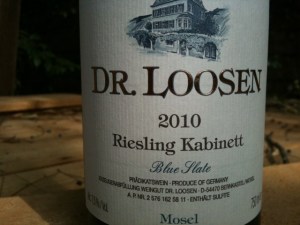
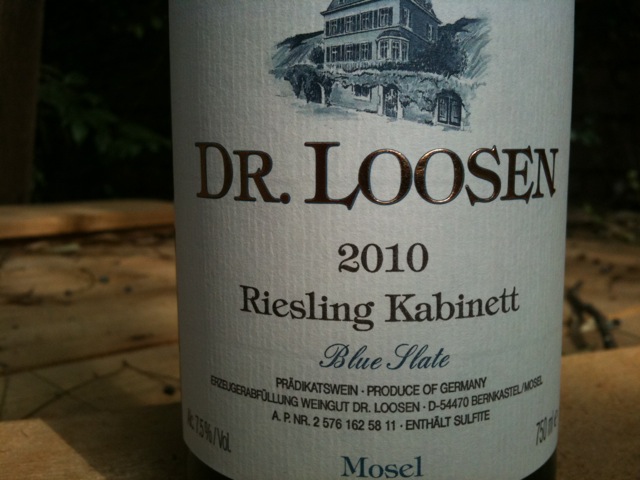
2010 Dr. Loosen Riesling Kabinett Blue Slate

2010 Dr. Loosen Riesling Kabinett Blue Slate

2010 Dr. Loosen Riesling Kabinett Blue Slate

You have read about me drinking Dr. Loosen wines before. I also indicated before that I never drank much of their wines while in Germany, for whatever reasons. But given Dr. Loosen’s prominence in the U.S. and Ernst Loosen’s tireless promotion of Riesling over here, I am finding more and more Loosen wines and try them here. When we went to a wine store and I saw this bottle, we decided to grab it. I am very fond of the crazy 2010 vintage, and I had heard about this particular wine before.

Let me give you some background on the winery: Dr. Loosen is currently owned by Ernst (or Ernie) Loosen. The estate has been family owned for over 200 years. The winery has been a member of the elite winemaker association VDP since 1992 and it owns plots in most of the Mosel’s prestigious vineyards. It is one of the larger estates along the Mosel.

This particular wine is a non-single vineyard Kabinett wine, in the German system the lowest level of quality wine with distinction (if you are not familiar with these denominations, please check out my quick guide here). The winery describes its aim for this wine as producing a light, typical Kabinett style wine. The grapes were sourced from blue slate vineyard sites in Bernkastel, Graach and Wehlen and the wine has 7.5% ABV. You can check out the winery’s description of the wine here.

A greenish yellow in the glass. On the nose subdued aromas of citrus and yellow fruit. On the palate, I got less acidity than I expected (it’s a 2010 after all!), with citrus aromas (grapefruit and tangerine mostly), some melon and early signs of ageing. The noticeable residual sugar gave the wine a medium long finish. The wine seemed a bit thin, though (for lack of other words). All in all, this was a refreshing summer wine, but it was also a bit disappointing: I had definitely expected more minerality and hoped for a stronger expression of flavors. It did pair alright with the Asian food we were having.

Given that we bought it on sale for $15 (it seems to retail for $20 and up) I am not sure the quality to price ratio is right for this wine. Also, keep in mind that for that money you can usually get at least a single vineyard bottle of Kabinett from other established wineries. And, I hate to say it, but their entry level Dr. L Riesling, which can be had for $9 and up, would be my preferred choice, not just for QPR reasons.

The Wine Spectator apparently awarded it 90 points and called it a “smart buy” (noting apple and citrus aromas, with kumquat in the the finish). It also received a Gold Medal at the Los Angeles Wine & Spirits Competition 2012.

Tagged , , , , , ,

Sunday read: Black Forest Chateau

This Sunday, let’s broaden our horizon about German wines a bit further. While I am focused on rieslings mostly, there is another revolution going on in Germany and that is Spätburgunder, aka pinot noir. John Stimpfig wrote a great piece for the Financial Times.

Germany has been growing more and more of this grape variety, many of them clones from Burgundy. This article does a good job at explaining the wonder that these pinots can be. The article starts out fun:

“Should you ever need to accurately calibrate an oenophile’s knowledge of wine, here’s a handy question that will immediately expose them as buff or bluffer. Simply ask them what they think about German Spätburgunder, aka Pinot Noir. The bluffer will either stare at you blankly or snort with derision at such a preposterous idea. In marked contrast, the buff’s eyes will immediately light up before he or she enthusiastically acknowledges that Germany’s top Pinots are unquestionably giving the best of Burgundy a real run for its money.”

But he also dampens expectations with this:

“But as Monego diplomatically points out: “Compared to burgundy, we’ve only just reached Everest base camp, so there’s still a long way to go. German Pinot is a work in progress and there are many different routes to the summit.” What everyone can agree on is that there’s now a much greater recognition of German Spätburgunder beyond its home territory. But before you rush out to stock up on the latest must-have vintages, there are a couple of things you need to know. The first is that some are even harder to find and buy than burgundy. The other is that they’re often just as expensive.”

I for one, am just excited that there are exciting red wines in Germany, too…more choice, more to drink.

Have a great Sunday!

Black Forest Chateau

Tagged , , ,