Tag Archives: 2011

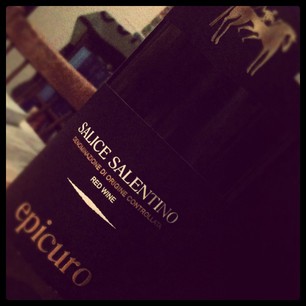
2011 Epicuro Salice Salentino DOC

2011 Epicuro Salice Salentino

2011 Epicuro Salice Salentino

One of my earliest posts in this blog involved one of my go to, bread and butter, affordable reds: the 2007 Epicuro Salice Salentino, which is available at Trader Joe’s for $5.99. I later reviewed the 2009 vintage of that wine (decidedly less exciting than 2007). Upon one of my last Trader Joe’s visits, I realized that the 2011 vintage is now out, so in line with earlier posts, this is my review of that wine. I know this is an industrially produced, mass market wine, but I always had a soft spot for it, so bear with me…

The 2011 Epicuro Salice Salentino DOC is no longer qualified as a Riserva, unlike its predecessors. It is still made of 80% Negroamaro grapes and 20% Malvasia Nera, with 13% ABV.

In the glass, the wine displayed a decidedly lighter color than its predecessors, a watery ruby red that lacked the depth of color in the earlier vintages (I assume that this is due to less ageing in a barrel). The nose showed oriental spices (think mulled wine, a bit weird), wet tobacco leaf and earthy aromas underlying it. All in all a similar nose to earlier vintages, I think. On the palate, though, what struck me immediately was that this vintage has a decided sugary component which is too much for me. I am not looking for a semi-sweet red wine, so this was a downer. There were cherry, leather and tobacco aromas with barely noticeable tannins, so its feels mild and is rather easy to drink.

I think the earlier releases had more depth and character than this vintage. I was quite disappointed, frankly and am not sure I will reach for it again…

Tagged , , , , , , ,

Two Entry Level Rieslings from Reputable Producers

Rheingau and Mosel: 2011 KM501 Rhein Riesling and Loosen Bros Dr L Riesling

Rheingau and Mosel: 2011 KM501 Rhein Riesling and Loosen Bros Dr L Riesling

Today I want to compare two entry level Rieslings from Germany: the 2011 Loosen Bros. Dr. L Riesling and the KM501 Rhein Riesling.

I know, summer is over and I should have posted this way earlier, but somehow I only got around to tasting these two wines side by side now. I’ve had the bottle of KM501 in my cellar for a bit now, and I always have a stash of Dr. Ls. I wrote about the 2010 vintage of Dr. L here.

The wines come from the two regions in Germany that have the most clout when it comes to Riesling: the Mosel valley and the Rheingau. While most of you are probably by now bored with my singing the praises of the Mosel, let me introduce the Rheingau, albeit briefly. The Rhine, which this area borders, flows pretty much straight forward North-North-West once it leaves Lake Constance at the German-Swiss border. Except for a stretch of roughly 30 kilometers beginning in my hometown Mainz. There, the Rhine takes like a 100 degree turn to the West and then flows straight West-South-West until Bingen where it does another 100 degree turn and goes North-North-West again. We call it the knee of the Rhine. If you look at the map, you know why.

The Rheingau is north of the Rhine (Map from Google Maps)

The Rheingau is north of the Rhine (Map from Google Maps)

This creates quite perfect growing conditions for the Rheingau, which sits atop the Rhine with vineyards facing straight South. In cold climate wine regions, like Germany, it is especially important for grapes to catch all the warmth they can, so south-facing vineyards are great because they get sun all day. Add in the reflection of the sun from the river that hits straight into the vineyards and warms them up and the moderate climate a river provides and things are actually pretty great…at the Mosel, it is also very common for good vineyard sites to be facing South.

While the Dr. L is made by Ernst Loosen, the KM501 is made by Balthasar Ress, a winery with a long history in the Rheingau (the family’s owned the winery since 1870). Both wines are entry level wines and made with grapes from the area, albeit not necessarily grown by  the wineries. KM501 refers to Rhine Kilometer 501 (when traveling along the Rhine you will notice signs that mark every single kilometer of the river as well as the half kilometers in between). The winery picked the name because the Rheingau starts at Rhine Kilometer 501. Both wines are made from Riesling grapes and both are from 2011, a year that saw rather good growing conditions with overall modest acidity in the grapes and therefore resulting wines. Most importantly, both wines don’t break your bank and are available for around $9 to $12 (I paid $9 for each).
2011 KM501 Rhein Riesling

2011 KM501 Rhein Riesling

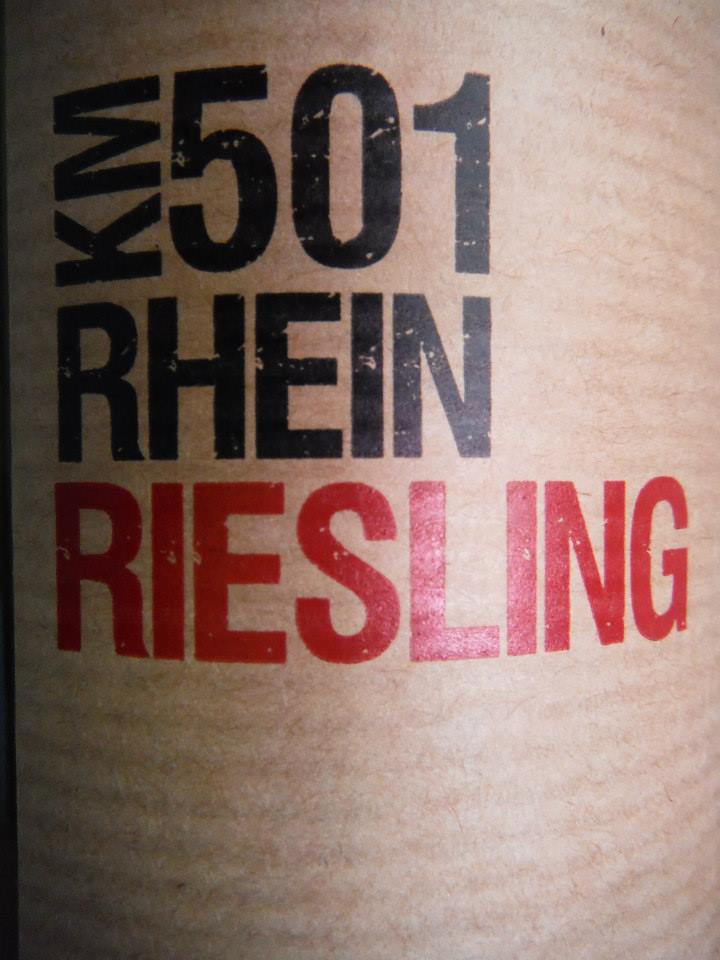
We started with the KM501 Rhein Riesling. You can find more information about the wine on its American importer website here (although it seems weirdly devoid of real information). According to the label, the wine has 9.5% ABV. In the glass, a light yellow wine presented itself, with hints of green. In the nose, I got grapes and citrus, lots of citrus. Nice. On the palate, the light bodied wine tasted like white grapes, was soft, with some peach and pear and residual sugar. Acidity was mild and the wine showed a decent length finish. There were some bitter aromas at the end. All in all, a pretty solid wine in my book. Typical summer afternoon quaffer that one can down a bottle or two without a problem. I was pleasantly surprised by the quality of this wine.

2011 Loosen Bros Dr L

2011 Loosen Bros Dr L

We then opened the Loosen Bros. Dr. L. More information can be found here. The label noted 8.5% ABV. The wine presented itself in a slightly more intense yellow than the KM501. The nose was very fresh (I am using this descriptor again, not sure how else to describe it), with peaches and sweet pear coming in. Lovely. On the palate, the Dr. L showed more residual sugar than the KM501, with peach and apricot coming in. The mouthfeel was soft and silky, but I wished there was a bit more acidity in this. It was just a tad too sweet but still refreshing. The finish was good. I did not get any bitter notes as I did in the KM501. There was also a certain creaminess in the wine, which I enjoyed.

So here we are. Two wines, good producers, different regions. Can I taste the different regions? Not sure. I also don’t think it is likely to be able to taste different regions in these entry level wines. I think they are both well made enough and definitely worth a try if you want to see what an everyday Riesling tastes like to me. I think in the end I would go with the Dr. L because I don’t care much for bitter aromas in Riesling. Nina remarked that while the KM501 had some good notes, the Dr. L seemed to have more depth. Which I can’t really dispute…

But, bottom line: No more excuses not to try affordable, enjoyable Riesling from Germany! KM501 was available at World Market last I checked, and Dr. L is available at Trader Joe’s or Costco.

Oh, and we had them both with the Korean spicy potatoes that we love, and they both nicely held their own. So, once again: Pair Riesling with Korean food!!!

Korean braised potatoes

Korean braised potatoes

Have you had either of the wines? Or even tried them side by side? I am curious to know what you think of them…

Tagged , , , , , , , , , , , , , , , , , ,

2011 von Hövel Scharzhofberg Riesling Kabinett

2011 von Hoevel Scharzhofberg Riesling Kabinett

2011 von Hövel Scharzhofberg Riesling Kabinett

After the Finger Lakes Virtual Tasting last Saturday, we opened another bottle from my beloved Scharzhofberg. For those unfamiliar with the vineyard, let me use the explanation I gave in my review of the Bischöfliche Weingüter Scharzhofberger:

The Scharzhofberg is a vineyard along the Saar, a tributary to the Mosel. The Saar meets the Mosel just south of Trier, in the town of Konz. It springs in France and then flows into Germany. It is a mere 246 km (152 miles) long, but only the final parts in the state of Rhineland-Palatinate are used for growing wine, mostly Riesling. The Saar is known to produce more mineralic, somewhat tarter Rieslings than the middle Mosel. The micro climate tends to be cooler than at the Mosel, so the grapes usually ripen later and can reach acidity levels without the higher sugar levels you can find on the Mosel, which gives them a distinct character. Most of the vineyards belonged to the church, but in the course of the secularization in the 19th century, many private investors bought plots and began wine making. Rich families began to settle later in the 19th century which led to the term “Saarbarone” (baronets of the Saar, a term derived from “Ruhrbarone” which was used for the industrialists in the Ruhr area that made a fortune when the industrial revolution took off). A lot of the estates on the Saar are very grandiose, unlike most Mosel estates.

The Saar boasts many prime vineyards that you might have heard of: Kanzemer Altenberg, Ockfener Bockstein, Ayler Kupp and also, the most prominent among them, the Scharzhofberg. Technically belonging to the village of Wiltingen, the vineyard is so prominent that the wineries do not have to list the village name on their labels. They proudly just use “Scharzhofberger”. The vineyard stretches over 28 hectares (around 70 acres) in steep slopes (30 to 60 degrees) facing south, the soil consisting of slate and rocky soil with high amounts of iron and clay. Only Riesling is grown here by a few producers that read like the who is who: Egon Müller-Scharzhof, van Volxem, Reichsgraf von Kesselstatt, Bischöfliche Weingüter, Vereinigte Hospitien, Johannes Peters, Weingut Resch and also the winery that produced this wine: von Hövel. The wines from this vineyard are prized and it is easily the most famous vineyard of the Saar.

Weingut von Hövel has been owned by the von Hövel family since 1803 (just in time for secularization). It is a member of the prestigious German association of quality winemakers, VDP, and owns a total of 11 hectares (27 acres) in the Saar valley which are planted with Riesling only. Its annual production is around 60,000 bottles. Since 2010 Max von Kunow has been the owner of the estate. Besides holdings in the legendary Scharzhofberg, the winery exclusively owns the vineyards Kanzember Hörecker and Oberemmeler Hütte.

But on to the wine: In the glass, we found a very pale, light yellow color. The nose showed floral and herbal aromas, with some overlying fruit (apple maybe?). But all in all it was a rather restrained nose, clean and focused. On the palate, the wine was light-bodied and luckily a typical Kabinett style sweet wine. When I say Kabinett style I mostly refer to its lightness and how refreshing and clear it was, despite it being a sweet wine. I just really like that combination of lightness and sweetness. However, I always struggle with describing these wines from vineyards that are especially dear to me. There was something that made me think it reflected the terroir quite well. I believe I would recognize a Scharzhofberger in a blind tasting (don’t dare me, though). I do believe the wine could have used a bit more acidity, but then again it was a 2011 where a lot of the grapes suffered from low acidity levels. The finish was very nice, with decent length.

In my view, this is a very good wine for someone interested in trying a Scharzhofberger without breaking the bank and at the same time finding out what all the fuss is about the Kabinett wines. This von Hövel also showcased the 2011 vintage nicely, which is already where drinkable and accessible for the wine drinker.

Tagged , , , , , , , , ,