Tasting with Friends: Unexpected Pinot Noirs

It had been way too long since we conducted one of our fairly regular wine tastings with friends. The rules are always the same: The host sets a topic (we did “European Reds“, “Strange Fruit“, “French and Argentinian Malbecs“, “Michigan vs. Mosel” and others in the past; you can find links to all of them here), and then guests bring a wine bottle each. The wines are usually accompanied by cheeses and meats, and as of late we try to taste them blindly.

Two of our friends had to move out of town for work, so we had been missing them dearly. When one of them came to town for a visit, we made sure to have a tasting. Since I was hosting, I had the honor of setting the rules. I called the tasting “Unexpected Pinot Noirs” and explained that I would like to try Pinot not from France or the U.S. usual suspects Oregon and California (but guests were free to ignore that rule). I am a huge fan of Pinot Noir and was looking for a chance to expand my palate.

We paired the wines with cheeses and meats from my local go to sausage maker Biercamp. These guys just know what they are doing: I got several bacons thinly sliced, including duck and lamb bacon, a wonderful garlic and herbs de Provence sausage with a nice kick, as well as smoke sticks from them. Delicious pairing options for sure.

Blind tasting has its own trappings, and I am always a bit weary of it because it is the most humbling experience you can imagine. You try to whittle down where the wine is from, and while doing that more often than not I convince myself that it is a particular style or region or vintage and then look for arguments to support that, thus closing off my mind. Nina tends to be way better than me at picking up nuances and determining characteristics about wine. She definitely owns me in blind tastings, and so it was with this one:
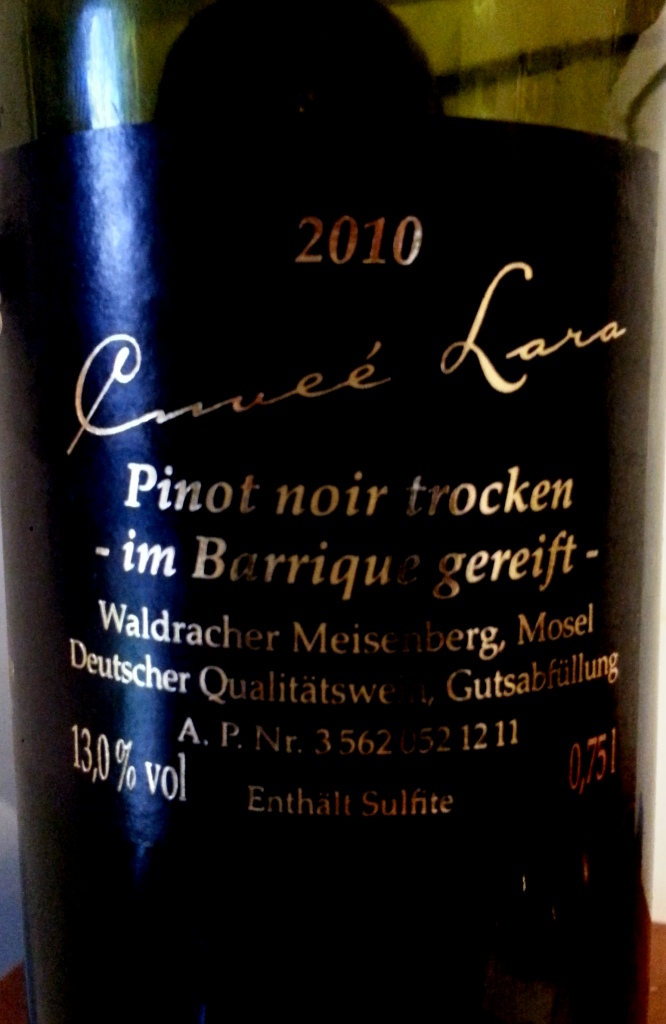
A Pinot from the Ruwer valley

A Pinot from the Ruwer valley

The first wine we tried was a German Pinot Noir (called Spätburgunder, literally “late Burgundy”), a 2010 Heinrich Mertes Waldracher Meisenberg Cuveé Lara. My friend Mansoo had sent me this bottle a while back (as well as the other bottle we entered into the race), and I was eager to try it. Heinrich Mertes winery is located in the Ruwer valley, a small tributary to the Mosel river. The wine showed a medium-light red color. The nose was perfumy with currants and some heat. It wasn’t exciting at all. The heat was actually quite disturbing. On the palate, though, this wine shone: raspberry, red currant and tobacco aromas, and an awesome kick of acidity. The puzzling and intriguing thing about this wine was that the fruit tasted very ripe, yet the acidity kept it wonderfully fresh. This was a strong beginning. The nose not so much, but the flavor profile was awesome. For me, the acidity gave it away: Because I knew there was a 2010 from Germany in the race, a year with quite high acidity in general, I took my chances and guessed right (so did Nina).

Quite the label, huh?

Quite the label, huh?

Next up, a 2007 Arno Kruft Veldenzer Grafschafter Sonnenberg from the Mosel (our second entry). The color was in stark contrast to the first wine: dark, purplish red. The nose showed wet dirt, some rotting branches and what others described as compost aromas. Not very pleasant. I think the compost descriptor came from hyper-ripe fruit aromas, but I couldn’t nail down which fruit. On the palate, the first noticeable thing was that it was way chewier than the first wine. It also was somewhat smoky, with cherries and cranberry aromas as well as a bit of vanilla. In my mind, this was totally a new world Pinot with a lot of the characteristics I have encountered in some California Pinot Noir: too potent, too strong, no restraint. But I want my Pinot Noir less potent, less strong and with more restraint. I did not like this wine. I guessed it was from somewhere pretty warm, and definitely new world. Boy was I wrong.
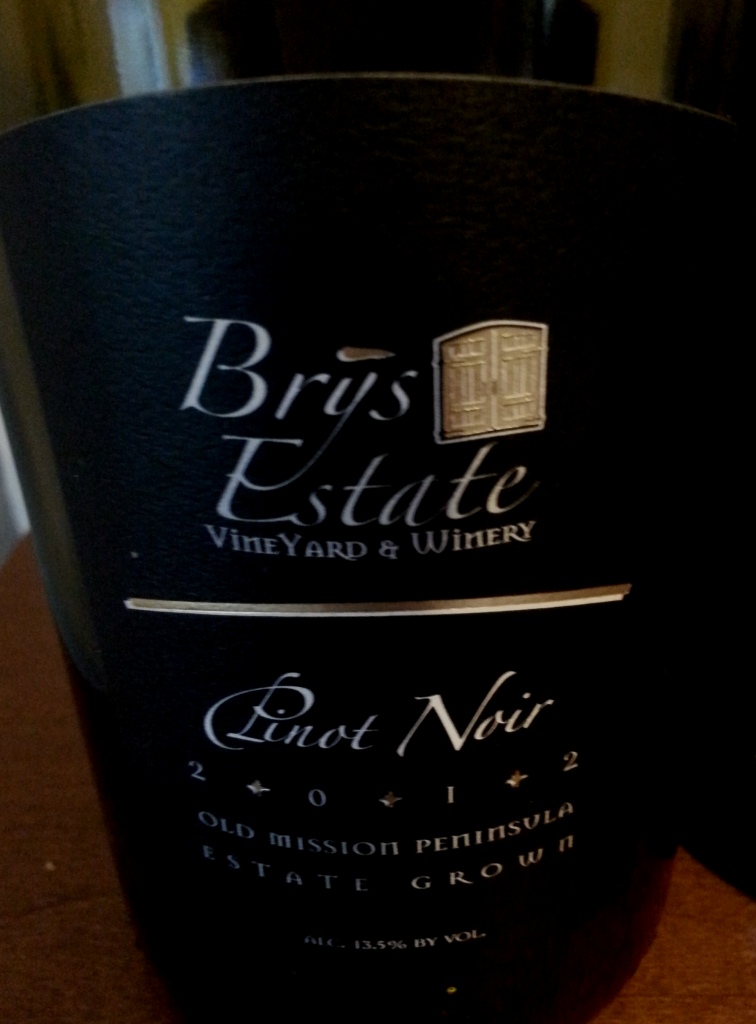
Michigan high end winery with South African winemaker

Michigan high end winery with South African winemaker

The third wine of the evening was a 2012 Brys Estate Old Mission Peninsula Pinot Noir from Michigan. Apparently, Michigan winemakers consider 2012 one of the best Pinot Noir vintages yet, so this should be exciting. The color on this one was gorgeous: a red currant red, darker than wine 1, much lighter than wine 2. The nose was flowery, with some strawberry, rather intense smoke, but seemed quite closed at this point. On the palate, the wine felt creamy and heavy, which gave it a wonderful mouthfeel. But it is a mouthfeel I don’t expect or particularly cherish in a Pinot Noir, which I want more light footed and delicate. Still a solid showing. Nina guessed Michigan correctly, I had no clue.

Another established Michigan winery

Another established Michigan winery

Up next, a 2011 Black Star Farms Arcturos  Pinot Noir, also from Michigan. Again, the color was spectacular, a bright and shiny red currant. The nose was full of roses, almonds and cedar wood, with hints of red berries. I thought the nose was gorgeous. The palate also started off nicely, with spice and pepper aromas, and a light footed feel to it. But then the palate turned out to be a bit harsh: There were bitter aromas kicking in that were rather striking. It also felt like the wine had a bit too much alcohol (which was not the case, we checked later and it clocked in at only 12% ABV, but felt more like 14), and that really turned me off. I couldn’t get over the harshness in the wine. My guess was, because of the perceived high alcohol, a warm climate wine, maybe Southern Italy.

A New Zealand surprise and an Oregon Pinot

A New Zealand surprise and an Oregon Pinot

Second to last came a 2011 Oya Pointe Pinot Noir from New Zealand’s Marlborough Valley. New Zealand has definitely gained some serious street cred for its Pinot production. The color was similar to the previous wine, and the nose was awesome: strawberry jam with rosemary and sage aromas. It was crazy, but good crazy! I loved it. The palate was very herbal as well, thyme, rosemary and sage aromas, with strong acidity with some iron aromas, great lightness to it and some red berries. This was very unique and therefore impressive wine. I hadn’t come across such an herbal Pinot before. This was an exciting wine. Because of the iron aroma that I had come across before in an Oregon Pinot Noir, I decided to guess Oregon…

The final wine was a 2012 Grochau Cellars Commuter Cuveé Pinot Noir from Oregon’s Willamette Valley. The color was more purplish, maybe black currant. The nose was chalky, intensely perfumy, with cocoa aromas. On the palate, the wine seemed rather bland: some cherries, some strawberries, plum, not very expressive though. Straight-out fruit forward style, but all a bit thin. I would not have recognized it as a Pinot Noir if I hadn’t know it had to be one, maybe more of a Grenache or so. I just didn’t find much that excited me about this wine. Not bad, but quite standard. My guess, because it was a bit heavy, was California.

So, recap: My guesses were mostly off. My ranking of the wines from best to least favorite, is 1 (2010 German), 5 (2011 New Zealand), 4 (2011 Michigan), 3 (2012 Michigan) and 2 (2007 Germany) and 6 (Oregon) – the last two share the spot, I couldn’t decide.

Combined with the others rankings (6 points for favorite down to 1 point for least favorite), this is the likability ranking:

First place: 2010 Heinrich Mertes Cuveé Lara – 23 points (ranked first by three people out of four)

Second place: 2011 Oya Pointe Pinot Noir (New Zealand) – 17 points (ranked second twice)

Third place: 2012 Brys Pinot Noir and 2011 Black Star Farms Arcturos Pinot Noir – 16 points each (with the Arcturos being ranked first once)

Fifth place: 2012 Grochau Cellars Commuter Cuveée Pinot Noir – 6 points

Sixth place: 2007 Arno Kruft Veldenzer Grafschafter Sonnenberg – 5 points (ranked last by three out of four)

The tasting was fun, and it was kind of interesting to have a German Pinot Noir ranked first and last. The Heinrich Mertes was just such a great expression of the grape, to me it was a rather easy winner. The New Zealand Pinot Noir was unique in a good way, expressing some aromas that were unfamiliar, yet seemed befitting to the grape.

The pretty clear winner
The pretty clear winner

Tagged , , , , , , , , , , , , , , , , , , , , , ,

Monthly Wine Writing Challenge #9: Fear

MWWC LOGO

This is my entry in the ninth installment of the Monthly Wine Writing Challenge (short MWWC) competition. You can find more information about the challenge here (I am just now realizing its About page needs a bio badly!). Last month’s winner, Jeff aka The Drunken Cyclist gave us the topic “fear”

Fear is an all too common emotion associated with wine. Sometimes it marks itself as a certain uneasiness when you feel like you have no clue what to look for. Sometimes it is the horror of staring at row after row after row of wines in a wine store. Sometimes it shows itself in frustration when you look at a wine label and wish you understood what these things meant, and then you just give up. Sometimes it is this terrifying feeling of being invited to a wine party and you wonder what to bring…the list is endless. A wine culture and culture of wine writing that clouds itself in mystery in order to be needed to “enlighten” the few and the many has done its part in keeping this fear alive.

Having grown up with wine and surrounded by vines, although my family does not own any vineyards, might have prevented me from ever feeling this way. Also, being a native speaker that can understand the world’s most confusing wine labels, Germany’s, has made me confident that I can figure out any wine label…

So let “fearless me” share my manifesto (hey, I lived in Karl Marx’ city of birth for almost 10 years…that’s gotta have some influence on me) that I live by when it comes to wine that might help alleviate a fear you might have:

1) YOU are what matters when it comes to wine. Wine is a tasting experience, and we all have different taste buds, different likes and not so much likes, preferences and bring certain experience to the table. Don’t let anyone tell you what you have to like or what you should avoid. After all, what does a 100 point rated wine do for you if you don’t like it?

2) If something is normal, fear usually subsides. So take this: Wine is just a drink. Some might disagree, and while there is definitely an art and craft going into it, what it boils down to is that it is a drink. Just like beer or cocktails.

3) For me, wine is also a grocery, a staple food (in German we have this great term for staple foods and drinks: “Lebensmittel” aka “goods of/for life”). That means I incorporate wine into my daily (ok, perhaps not every day, but most day) routines. Making wine a normal part of your life makes you feel easier around it.

4) Regularity and routine gives us the strength to go further and overcome fear. For me, having wine for dinner regularly gives me the possibility to explore more, which is the true fun of wine: Drinking Riesling or Cabernet Sauvignon or Sangiovese every night of the year would soon be boring (on second thought, maybe not Riesling for me…sigh). But still: Go ahead and try new wines. Try to pair them with your food. Be creative. If you don’t like the wine, that’s unfortunate but also good because:

5) How do you know what your favorite beer is? How do you know what your favorite cocktail is? You must try different drinks to find that out. Take the grapes as the starting base because they are, after all, the key ingredient in wine. Seek out new grapes that you have not heard of before. The Wine Century Club, which provides lists of different grape varieties, might be a good helper in that regard.

6) Not being alone is a good way to overcome fear (we remember that from early childhood, right?). Ask around, there might be friends that are interested in trying wines with you. Or sharing their experiences with wine. Wine is a social drink, and it is best appreciated with others.

7) Knowledge is a great way of overcoming fear. I don’t want to force anyone to read wine books (although I love them, with a glass of wine by my side), but why not talk about what you experience when you try a wine. If you have no one to talk to (I feel for you!), take some notes: What do you like about the wine? Is it the flavors? Is it how it feels in your mouth? Does it smell good? Is it sweet or dry? Do you like how it tastes after you swallowed it? This way you will build a sort of database that helps you remember what you liked. From that base, you will soon find out what types of wines you like: drier or sweeter, younger or older, fruitier or dirtier. You work out a matrix of what works for you and you might find that you are expanding from it over time.

8) When fear is too strong, find allies. I was just at a huge wine store in Eastern New York state the other day. The selection was overwhelming. So I went and asked one of the salespeople to show me some wines I was looking for. They steered me into a wine direction, and the talk was fun and educating. They knew a lot about the wines (which is how it should be, they make a living from it!), so I gained a lot from talking with them. Don’t be afraid to seek help. While it is a plus if you have an idea if you like fruity wines or dry wines, a good salesperson in a wine store will help you find something for you.

9) When fear kicks in, trick it. There is an easy to remember rule of thumb when it comes to picking a wine in a wine store and you don’t want help or help is not available: The lower the alcohol level, the sweeter the wine. An alcohol level under 10% ABV usually tastes sweet, between 10% and 11.5% somewhere in the middle, and over 12% is usually a dry tasting. This sets the base line for whether you will like the wine or not.

10) Be adventurous! It is all too easy to go back to a wine you liked, and often that will be just what you need and that is fine. But I strongly encourage you to take wine as a vehicle to get to know the world. I am a traveler at heart, and those many days that I cannot be on the road, I can let a wine bring a distant region or an exotic grape into my day. It makes for awesome stay at home travel.


Tagged , , , , , , , , , ,

#WineStudio Session XII: Germany’s Lesser Known Varieties

The wines discussed in this article were provided as samples by Rudi Wiest Selections.

I remember talking with my good friend Stefano of Clicks and Corks sometime earlier this year, and we were talking about blogging and samples we sometimes receive. He was astonished that I did not seem to get as many samples as he receives (he blogs mostly about Italian wines), and I had to inform him that there are simply not that many distributors of scale that carry German wines: Rudi Wiest and Terry Theise being the two big ones, with several smaller importers like vom Boden filling in the niches. I told him I wish I could get to try some of Rudi Wiest of Terry Theise’s portfolio, but that it was unlikely, being rather far away from the bigger markets.

Imagine my surprise and happiness when I was approached by Tina Morey of Protocol Wines, the host of #WineStudio and #WineChat, informational weekly wine chats on Twitter, asking whether I was interested in participating in the #WineStudio they were organizing in cooperation with Rudi Wiest Selections to highlight some lesser known varieties from Germany!! I happily obliged. If you’re into German wine, it is hard not to have had wines that Rudi Wiest imports. Their list is not very extensive, but they boast some of the best producers in Germany.

#WineStudio is Protocol Wines’ wine education program in which wineries and distributors get a chance to provide a deeper look into what they or their area is doing wine-wise. The discussions are a lot of fun, I have to say, so it is usually worth checking out even if you don’t have the wines to try along.

While Germany doesn’t have the grape variety that Portugal or Italy or Greece have, there are still a bunch of grapes that are not really well known abroad but drunk by a significant number of Germans. This was our chance to explore these more.

We tried and discussed a total six wines over the course of four weeks, and in my book this was hands down the best #WineStudio event yet. I guess my predisposition for German wines and some background knowledge made this a really great exercise. Let me tell you about the wines, because they pretty drinkable! Also, they were all dry wines and I get many questions about which dry wines from Germany I can recommend, so this is a good list.

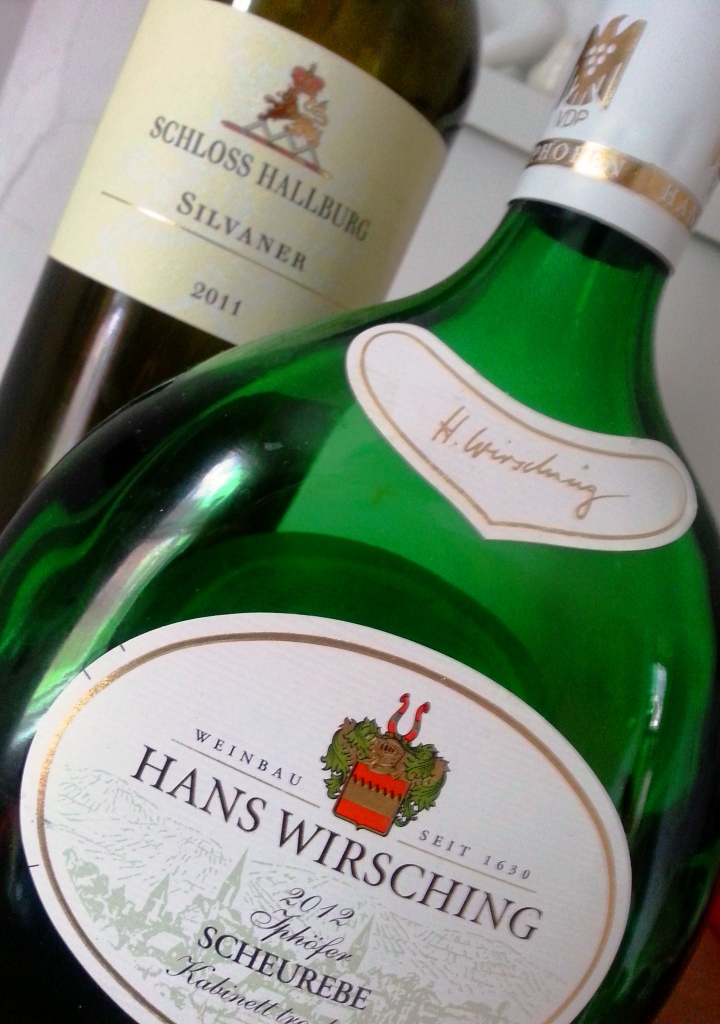
Schloss Hallburg Silvaner and Wirsching Scheurebe

Schloss Hallburg Silvaner and Wirsching Scheurebe

We started with a 2011 Graf von Schönborn – Schloss Hallburg Silvaner Dry and the 2012 Hans Wirsching Iphöfer Scheurebe Kabinett Dry, both from Northern Bavaria’s region Franconia (Franken). Silvaner, a cross between Traminer and Österreichisch-Weiss (literally “Austrian White”), rules in Franken. I have heard frequently that Silvaner is the grape for people that cannot deal with the acidity in Riesling but like Riesling aromatics, and it is widely used in Germany as a very food friendly wine. Scheurebe was created in 1916 by Mr Scheu by crossing Riesling with an unknown wild variety and is considered highly aromatic.

The 2011 Graf von Schönborn – Schloss Hallburg Silvaner Dry (12.5% ABV) was quite expressive in the nose, with tons of peach aromas, with melon and pear and some baked apple complementing the picture. On the palate, the wine showed hints of coconut, good balance, and a certain creaminess. I was missing some acidity, but that is just something I want in my whites, and 2011 wasn’t kind to those loving acidity…All in all a tasty wine that should be great with sushi from what I heard from others.

The 2012 Hans Wirsching Iphöfer Scheurebe Kabinett Dry (pronounced Shoy-ray-buh, 12.5% ABV) weirdly reminded me of a Gewürztraminer in the nose: I got lychee, papaya, then some grapefruit and lime. Intensive, intensive nose. Couldn’t stop smelling. On the palate, the wine showed a nicely tickly mineralitywith a light mouthfeel. The lychee persisted, with pineapple coming to the mix, what an interesting wine. I knew Scheurebe as a rather boring wine from my early youth, usually way too sweet and gooey, but this one had a great dry finish, and still brought out all those amazing aromatics….if you want to surprise friends, this would be a good choice, also for the bottle shape, which is the typical bottle in Franken called Bocksbeutel (which means “goat’s scrotum”), makes for a conversation starter…

Rebholz Pinot Blanc and Schloss Hallburg Pinot Gris

Rebholz Pinot Blanc and Schloss Hallburg Pinot Gris

The following week, we tried the 2012 Rebholz Pinot Blanc Dry from the Pfalz (Palatinate) and the 2012 Graf von Schönborn – Schloss Hallburg Pinot Gris from Franken. In German these grapes are known as Weissburgunder (Pinot blanc) and Grauburgunder (Pinot gris), and I have had good experiences with the two grapes in the past when they don’t make an appearance as a bland Pinot grigio or Pinot bianco. In Germany, these wines tend to be fruitier, which I appreciate…

The Rebholz Pinot Blanc (13.5% ABV) had a fresh nose with stone fruit, pear and melon as well as hints of vanilla (I doubt it saw any wood in the production process, though). On the palate, the wine was warming yet crisp, with coconut, liquorice, lychee and pear aromas. There was a good balance in the wine, despite the significant alcohol it still felt light-footed and had good length. The wine was made from mostly 70 year old vines, which is pretty impressive for an entry level wine. I liked this expression of the grape.

The Schloss Hallburg Pinot Gris (12.5% ABV), in contrast, was much more subdued on the nose. I got lemon, apples, almonds, and in general the aromas seemed more ripe than in the Pinot Blanc. The wine had a great mouthfeel to it, it was deep and drawing me in, with good heft and good acidity. The aromas I mostly got were peaches and melon paired with nice creaminess. This wine was rich, and yet remained refreshing. The interesting thing was that it felt heavier than the Pinot Blanc, despite having significantly less alcohol.

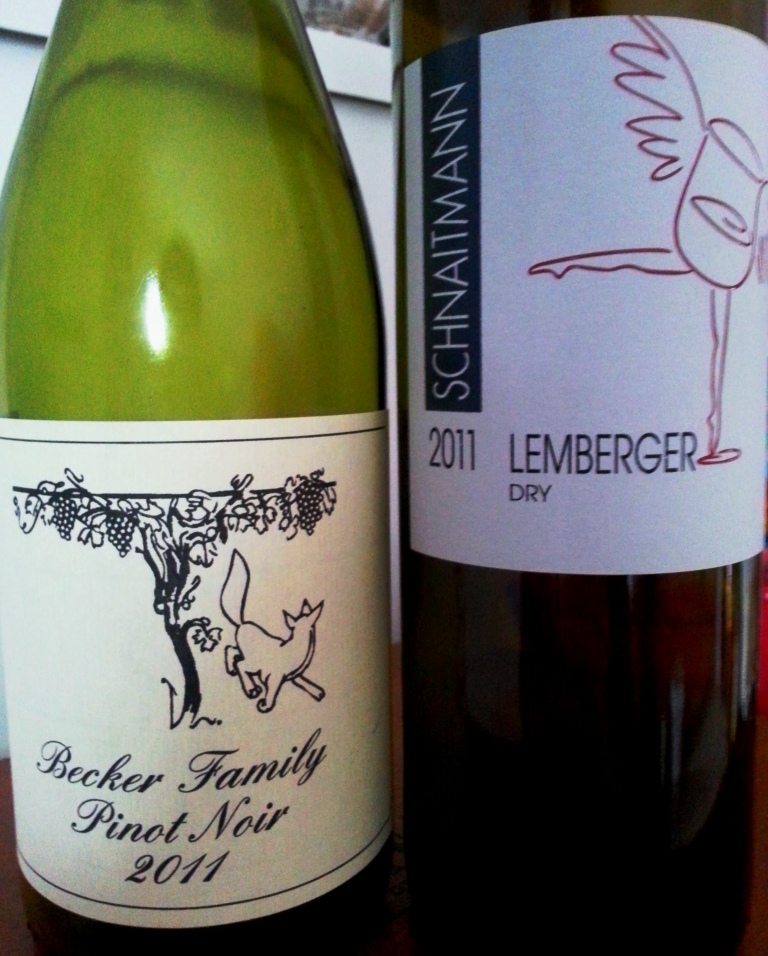
Becker Pinot Noir and Schnaitmann Lemberger

Becker Pinot Noir and Schnaitmann Lemberger (weird labels, huh?)

The final week was dedicated to two red wines: A 2011 Becker Pinot Noir Dry (from the Pfalz) and a 2011 Schnaitmann Lemberger Dry (from Württemberg). Germany has actually been making great strides in producing Pinot noir (also known as Spätburgunder in Germany), and it is always exciting trying more of these. Lemberger is prominent grape in the Southern-most parts of Germany.

The Becker Pinot Noir (13.5% ABV) poured in a surprisingly dark cherry red. I loved its nose, which was full of gummibear aromas (open a bag and stick your nose in, it’s divine!) and cooked cherries. On the palate, it was initially soft and pleasing, with good acidity. Then, it became spicy, with tons of cassis and red currant aromas, some branchiness with was welcome, and some smoke. The currant aromas persisted throughout the finish, and that made me like the wine. It might have been a bit rough around the edges, and there were some bitter aromas in the finish, but overall a decent wine.

The Schnaitmann Lemberger (13% ABV) poured as dark as a Napa Cabernet Sauvignon, and its nose was full of flowers, raspberries and blackberries. What a great way to end a night! On the palate, very fruity, with strawberry and raspberry and all-spice and good vanilla aromas that gave it body. This was really, really tasty. As in want more of this right away tasty and the rather low alcohol ensures you won’t be in trouble for it. It remained refreshing all throughout, and this was Nina’s favorite of all the wines by an arms length…

All in all? It’s seriously worth trying other grapes from Germany. Will that replace my love for Riesling? Nope. Will I ever think as highly of a white grape as I do of Riesling? Nope. But the wine universe is full of interesting grapes that make for good switch ups when you want to expand your palate. Always worth it. And, if you’re on track for the Wine Century Club, some of these grapes will surely help you cross the finish line and you won’t suffer for it! :)

Tagged , , , , , , , , , , , , , , , , , , , , , , ,