Category Archives: Year

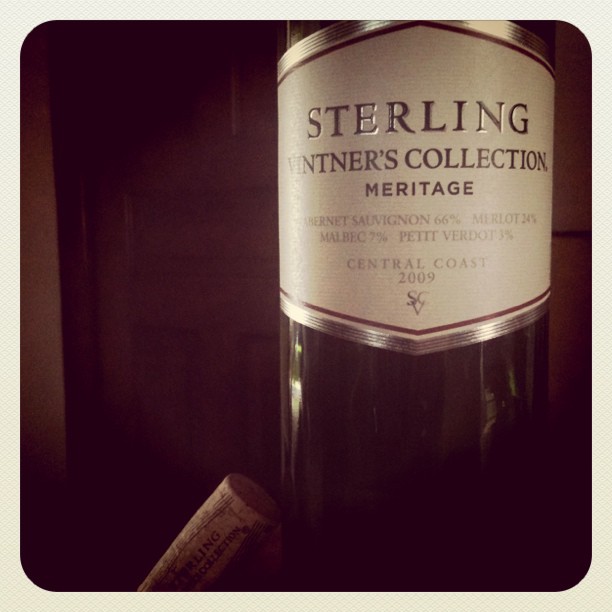
2009 Sterling Vintner’s Collection Meritage

I am just realizing this is my first blog entry on red wine…see, I am not as one dimensional as you thought!

Prior to buying this, I had never seen the name Meritage before, so I checked it out and found this on it: It is a term coined by American winemakers, that stands for Bordeaux-style wines. This means not one or two grape varietals but rather a blend of several varietals to create a complex and harmonious product. Some California winemakers decided to found the Meritage Association (now: Meritage Alliance) in 1988 and you have to be a member to label wines “Meritage”. A clever guy came up with a combination of “merit” and “heritage”, so it is to be pronounced like heritage, just with an “m”…

While modern times have become more and more obsessed with single variety wines (you know what I’m talking about when you look at your supermarket’s or winestore’s wine displays), it is not at all uncommon to blend several grapes into one wine. Bordeaux is the prime example, but also Chianti classico is made of several varietals (until a couple of years ago, they could even include white grapes!) same as a lot of wines from Portugal’s Douro region. It gives winemakers the unique chance of blending different tastes together into one. I personally like blended wines, the rough edges of a cabernet sauvignon can be mellowed by merlot for example. When I once talked to a Douro winemaker friend of mine and mentioned that I had tried and hated a single varietal “tinta barocca” in South Africa, he looked at me in shock. How could anyone make single variety tinta barocca, he asked? It is a classic filler grape for bigger reds…

Now on to this one. Sterling is a huge winery in Napa Valley. You can check out their site here (with elevator music…). The Vintner’s Collection is their “cheap”, really mass label. We paid about $10, I think. This Meritage (thankfully they put that on the label) has 66% Cabernet Sauvignon, 24% Merlot, 7% Malbec, and 3% Petit Verdot in it. Upon pouring, it showed its not overly dark color, which I found surprising. I had expected a way darker red. The nose was strong and full of different smells: initially strawberry hit me, then vanilla and cherry. Somewhere in the middle, herbal and floral notes crept in and I think I smelled some very light tobacco as well. It was awesome. I have not had a bold red in a while, and this reminded me of all things good. The taste was chewy and powerful. Initially smoky, leathery, some black pepper. Then red fruits came in. There was a distinct note of acidity that gave the impression of some unripe grapes in the wine. This acidity also made the wine taste more like plums, which I found appealing. The finish is ok.

I did like this wine. It was bold and not ashamed of it. Especially given that it was mass-produced I did like it. Some imbalances, the acidity, but all in all a very decent wine. Oh, and it went well with the pizza we had, too.

Tagged , , , , , , ,

1987 Vereinigte Hospitien Erdener Treppchen Spätlese

Photo taken from the winery’s homepage

I mentioned this wine in an earlier post, when I was talking about how German rieslings can age. I think it is proper to describe the wine in full.

The Vereinigte Hospitien (“Unified Hospices”) winery in Trier has a loooooong history and tradition. Its name stems from the fact, that until German Mediatisation in the early 1800s, most hospitals were run by the Catholic church. The Trier hospitals, that were also called hospices at the time, were unified into one corporation under public law in 1804 by Napoleon. A lot of these hospitals financed themselves by owning vineyards and selling the wine (just like universities at the time). The Vereinigte Hospitien are still a corporation under public law, maintaining several hospitals and nursing homes, and are a big employer. But they also never gave up winemaking, though. Through the church possessions, they own property in some of the most prestigious hills along the Mosel and Saar rivers. Most notable is the Scharzhofberg, one of the most famous German vineyards at the river Saar, but also Piesporter Goldtröpfchen, Wiltinger Kupp and others.

The winery has a tasting room were you can try the wines for free. Even better, ask for a wine tasting with friends in their cellars, which are among the oldest in Germany…dating back to Roman walls of the fourth century AD. I have been quite fond of their good but affordable quality wines. If ever you get to Trier (be it for its Roman ruins, medieval history, or any other reason), I recommend you go and check out this winery.

The bottle with the deteriorated cork

Now, this 1987 I got at the winery shortly before I left for Ann Arbor. It happens to be Nina’s birthyear (not a very good year for German wines), and Erdener Treppchen, a vineyard in the central Mosel valley, is one of my favorite. To me, there is something special about old wines. I immediately have to think about what happened in that year, and it feels like the wine gives me access to a time that is passed. It is like a captured moment in time, that has aged as well, and will be gone when I finish (or pour out) the bottle. It is almost magical.

We opened it for Nina’s birthday party.  I decanted it for about half an hour. As you can see on the photo, the cork had deteriorated quite a bit, but when I pulled it, it was clear that it had not destroyed the wine. The color was a lighter rhine stone. The nose seemed quite complex, I smelled honey as the strongest. The taste was surprisingly fresh, with a well boiled down alcoholic tone. Unfortunately, and I guess this owes to the rather weak vintage in general, acidic notes were strong and dominated the palate to a degree that some found objectionable. I thought it was still an acceptable level…it was yummy!

Cork art

With older wines, it is interesting to see how they taste after they have been open for a while. So, we preserved some and after two days, tobacco and leather smells started dominating the nose, but with beautiful hints of strawberry. It just kept wowing me.

And to give you an idea why I am often surprised by the wine prices in the U.S. I think I paid about 15 euros for this bottle, that is $20. For German standards, that is already a rather expensive wine…

Tagged , , , ,

2009 Hans Lang Rheingau Riesling Spaetlese – Edition Maximilian

Quite the disappointment…

I have decided to not even take a picture of this bottle. If you have to see it, go here. This is a wine by one of the “better” winemakers in Germany, Hans Lang (strangely, I could not find a homepage for them), and it is readily available through Trader Joe’s for a very enticing $8.99. Now, this really low price for a spaetlese already tells you that it is probably not one of the first rated wines of this winery. The name – “Edition Maximilian” – should also be an indication of that…however, the winemaker is a member of the prestigious VDP (an elite club of winemakers in Germany that selects its own members that then have to adhere to higher quality standards), so I thought the wine should at least have some potential, because even more basic wines can be good.

Well, not this one. At first there was an unimpressive, alcoholic and slightly sour smell that mellowed out after a while. The wine was of clear, light yellow color. I could taste some strawberries, some vanilla, pear. The acidity in the wine seemed rather high, and in total not very well balanced by some hints of sweetness. The finish is short, with again, hints of vanilla. I could not help but think that the winemaker was not sure where to go with this wine: sweeter, not so sweet, spaetlese or rather not? It is not a bad wine, but it also seemed to lack so much. Especially when you consider that the winemaker probably knows what he is doing, and that a spaetlese should be stunner, not a bummer. It feels like he was going for a simple wine that would be a quick sell. Seems like a lost opportunity.

If this was my first German riesling spaetlese, I would have no clue what all the fuss was about and would stay away. I’ll sure stay clear of this one.

To be fair: Others do think differently, see e.g. here (calling it “delicious”).

Tagged , , , , ,