Category Archives: 2010

2010 Osél Ruchè di Castagnole Monferato DOCG

2010 Osél Ruchè di Castagnole Monferrato

2010 Osél Ruchè di Castagnole Monferrato

One of the finds during our Wine Century Club quest (see here) was this wine: the 2010 Osél Ruchè di Castagnole Monferato, a red wine in the highest Italian qualification tier: the DOCG. It is also one of the newest DOCGs, only having been induced in 2010.

It was Nina’s birthday (as I seem to have informed about everyone multiple times by now…sorry about that), and she wanted something low-key, so I decided to make her the best burgers ever, and I mean ever. I had gotten great hamburger meat from our local butcher, I stopped using the colored cardboard they sell at the supermarkets pretty much immediately after I first arrived in the US, and I had gotten the buns Nina loves. I found ripe avocados (a true feat in Michigan!), so I was going to make my own guacamole. The right lettuce would top things off, add in our variety of mustards. We’re both no big fans of pickles, so those were out. Then I added bacon to the mix. A good burger needs bacon. And then, in a whim, I decided to buy big Portobello mushroom heads, trim them to medium thick slices and roast them in the bacon grease as the bottom layer on the bun, under the patties. The burgers were bbqed on our grill out in the snow. I also made homemade sweet potato fries with a mayo-kochujang dip.

Sorry, no photos of the burgers…

Why am I telling you this? Because, to pair with wine, this is a total nightmare: Greasiness from the meat and bacon, heartiness from the meat. Sweetness from the ketchup, heat from the chilis in the guacamole and the mustard. Sourness from the lime in the guacamole. And again sweetness in the buns. Bitterness from the lettuce and roasted onions (which I forgot to mention)…you see where I am headed? It’s a nightmare. There is a reason why people drink beer with burgers. But, it was our Wine Century Club quest anniversary, so there had to be wine. (And I dislike beer).

So I did my thinking, I did my research. I didn’t want a Zinfandel, I didn’t want a Cabernet Sauvignon. It would have been best to find a grape variety we had not had. I settled on a few wine types that I could imagine going with this dish: Barbera and Nero d’Avola were my first choices. But then I decided to just head over to a small, local grocery store right across the street, which has a pretty decent wine collection. I imagined this was the moment were it would be great to talk to their wine guy and get his recommendations.

I ventured over, and, in what seemed like a total first, the wine guy was nowhere to be found. Ugh, that sucked. I know people need not be at work all the time, but I needed him! Well, I just started checking what they had. I appreciate their small selection because it is less overwhelming. So I kept looking at this wine and at that, I think I read pretty much every label. There was no Barbera and no Nero d’Avola. I was growing a bit restless (which usually doesn’t happen to me in a wine shop) and then this one caught my eye: A Ruchè. I had no clue about it. And I don’t own a smartphone, so no way to check. The heck. It said it was good for meat and spice and Asian foods…so that kinda sealed the deal.

Once home, I looked it up: Ruchè is a grape grown in Italy’s Piedmont region. Ruchè di Castagnole Monferrato is one of the smallest DOCGs in Italy, with only about 40 hectares (100 acres) under vine. It is said to have similarities to Nebbiolo and the wines are said to have slightly bitter aftertaste.

The wine is sold under the label Osél, which is produced by Siema Wines, an importer and distributor into the US. They have currently over 500 wines in their portfolio. According to the website, it was produced by grapes from one farmer in the region. Apparently, David McIntyre liked this wine in the past, saying it is cheaper than most Ruchès and an “extra-good value” (I paid around $15). It is wholly made from Ruchè grapes and has 13.5% ABV.

It poured in a lighter red with some hints of brick. The nose was floral and perfumy with cherry and jammy notes. Rather enticing. The flavor profile of this light to medium bodied wine was very intense, with again cherry and some earthy aromas. There was noticeable residual sugar, maybe a tad too sweet. It had a peppery and slightly bitter finish that was rather short.

I liked this wine a lot, especially in its pairing with the burgers. It worked. It stood up to the food, but did not overpower the burger, and it held its own against all those crazy assaults from left and right. I was quite amazed how well it worked.I am not sure this would work on its own, though. But if you can find a bottle, give it a try!
Tagged , , , , , , ,

Traveling the Old World: A European Red Blind Tasting

Some may remember the Malbec tasting Nina and I hosted last month. We had so much fun that night, that in our drunken state of mind we all agreed to have another tasting soon. And so it was, last week, that the same group of friends gathered. We had agreed to make it a blind tasting and had chosen an area as wide as possible, European Reds, so that we could actually play around with the wines and no one would feel intimidated talking about them. Blind tastings can be a very humbling experience if you think you have some wine knowledge at least, and it is a great equalizer as everyone is free to associate as much as they want.

If you are contemplating a tasting with friends at home, here are some tips that I jotted down a while back but are still helpful, I believe.

We met at 6.30pm (I actually went earlier because I just had to play Wii with our hosts’ son). Everyone brought one bottle of wine, which added up to seven bottles because one fellow wino was sick. I had brought a Riesling to clean our palates with after the tasting, the 2003 von Hövel which I wrote about last week. One of our friends had volunteered to arrange the order of bottles and conduct the tasting so that all others were in the dark except for their own wines.

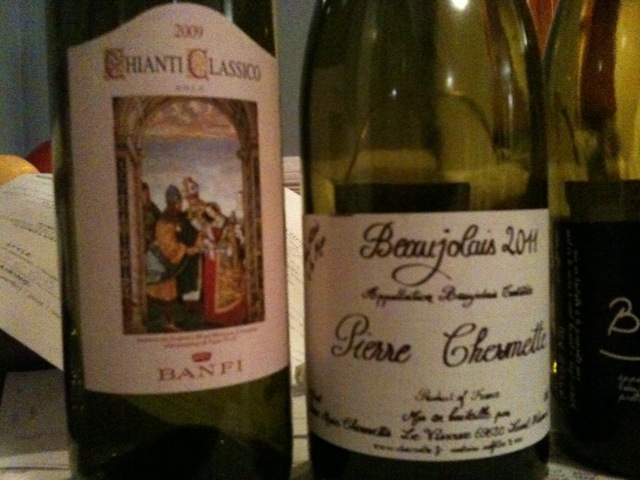
Because it worked, we had the first bottle of wine with a traditional Roman pasta dish, Pasta cacio e pepe. The first wine, a bottle of 2009 Banfi Chianti Classico (13% ABV, Italy – Sangiovese-based), poured in a medium, clear red color. The aroma intensity was on the lower end of moderate, and the wine smelled young. There was not much I could detect in the nose, very subdued. The wine tasted dry, was light with fresh acidity and low tannins which were fairly balanced. I got some cherries and an overall fresh note from this wine with medium length. I thought this was a decent light wine. My guess was a Sangiovese-based Italian, from 2010 or 2009.

Up next was a 2011 Pierre Chermette Beaujolais (France – Gamay-based), which poured in a pale to medium red and was slightly hazed. The nose was aromatic with some age, showing tobacco, cedar wood, hay and some grape aromas. The wine was dry and light bodied, with low tannins and moderate aromas. On the palate it had quite some unpleasant heat, hardly any fruit with a harsh and disappointing finish. It tasted like it had its best days way behind it. I did not care for this wine much, and guessed 2011 Northern France or Austrian wine.

2010 Banfi Chianti Classico and 2011 Pierre Chermette Beaujolais AOC

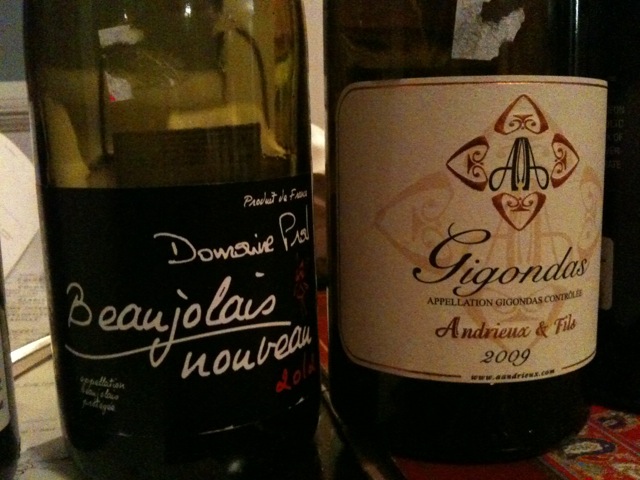
The third wine was a 2012 Domaine Pral Beaujolais nouveau (France – Gamay-based). It showed a medium ruby red in the glass. Its nose was young and aromatic, with red fruit, jammy raspberry, gooseberry, pear mustard and roses. Quite the nose!! On the palate this dry, medium bodied wine was smooth with medium tannins and great balance. It showed strawberry and red fruit aromas, was floral and had some red currant to it. There was some heat in the end which I did not care for too much, but it was a very yummy wine with a long finish. Very pleasing. My guess was a 2010 Northern French wine.

And up was wine number four: A bottle of 2009 Andrieux et Fils Gigondas Côtes du Rhone (14.5% ABV, France – Grenache, Syrah, Mograve). Of deep ruby red color, the nose was aromatic with some age, and had plum, coffee, earthy aromas and some dark chocolate. Very different from the last wine! The wine tasted dry, with a medium-full body, smooth acidity and medium to high tannins. All in all it was very balanced and flavorful, with a very long fresh finish. It was the most complex wine of the night thus far and impressed pretty much everyone (as far as I remember). My guess was a 2010 Côtes du Rhone.

2012 Domaine Pral Beaujolais nouveau and 2009 Andrieux et Fils Gigondas Cotes du Rhone

The fifth wine, a 2010 Bodegas Ateca Atteca Old Vines (15% ABV, Spain – Garnacha), poured as a deep, ruby red and slightly hazy wine. The nose was aromatic, young and very weird: water colors, chalk, cherry and petrol. Not at all what I am used to, very intriguing. The medium bodied wine tasted dry with smooth acidity and medium to high tannins that were fairly well balanced. On the palate it was flavorful, with very ripe aromas, spice box, chocolate, and very juicy. There was a hint of residual sugar which made it absolutely fascinating. I liked this wine a lot, it was probably my favorite of the evening. Pretty early on, I decided in my head that this must be a Merlot from a Southern European area. Not sure about the age, but I kept yelling “This is a Merlot” across the table….

The sixth wine was a 2009 Az. Tilli  Concetto Terre di Chieti IGT (15% ABV, Italy – Merlot). It showed deep to dark ruby red with a slight haze. The aroma intensity was powerful, with berry compote and raisins. Very ripe, very impressive nose. I could have dove into this for longer. The wine was medium-full bodied, with fresh acidity and medium tannins, all very well balanced. On the palate, it had depth and was incredibly smooth, very likable with mostly red berry aromas. The finish was medium long. The Concetto is just a super yummy wine, I like it a lot. This one had to be a Merlot (by that point I knew that it was Nina’s wine, which she had bought in Germany at a wine store we both like with the one purpose of throwing it in at a blind tasting).

2010 Bodegas Ateca Atteca Old Vines and 2009 Az. Tilli Concetto Terre di Chieti IGT

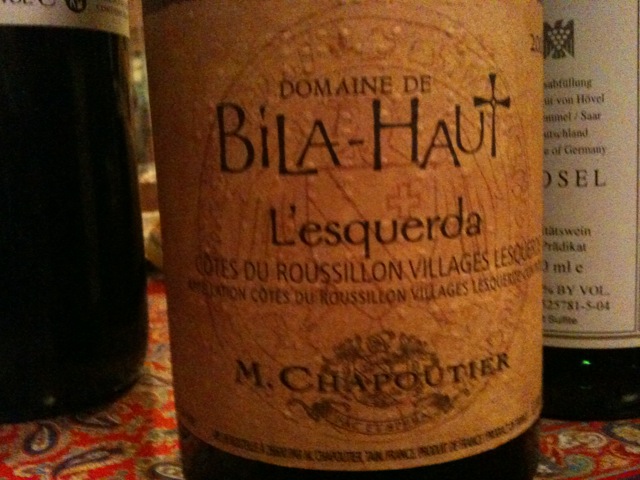
The final wine in the tasting was a bottle of 2008 M. Chapoutier Côtes du Roussillon Villages Domaine de la Bila-Haut L’esquerda (13.5%  ABV, France – Syrah, Grenache, Carignan). It was the wine I had brought, and it proved to be the most controversial. I had bought it during Wines Till Sold Out‘s big sale the week before and it arrived in the mail just in time. I did not have a chance to try it before this tasting. It poured in a very dark, almost purplish red. The nose turned pretty much everyone completely off, and I have to admit it was the most unpleasant nose I have come across in quite a while: dirt, sulphur, manure. That is all one got for the first 30 minutes. With a heavy emphasis on manure. It was, frankly, disgusting. I was very surprised,  had not expected that at all. After 30 minutes, there were some red fruit aromas fighting their way through, but it was still not enjoyable to smell. On the palate, the wine was extremely intense, mostly earthy. There was some cassis, but mostly dry, dusty earth aromas. I still defended it and want to see what it tastes like after an hour or two in the decanter (I have a couple more bottles). What I tasted at this tasting though, was not very enticing…

2008 M. Chapoutier Domaine de Bila-Haut L'esquerda

2008 M. Chapoutier Domaine de Bila-Haut L’esquerda

We finished the tasting, as is fast becoming a tradition, with a bottle of German Riesling Spätlese. I reviewed that wine over here.

Overall, I was very impressed with this tasting: Most of the wines were really good, and there were some really great surprises in it for me. We all played the guessing game, and it was fun. The best surprise though was a friend from Nina’s undergrad days who just began working in Detroit. He and a friend of his joined us for some of the wines later on and oh my God, did the friend of the friend play the guessing game. He nailed the last wine, and was pretty much spot on with the others he tried. That was really impressive! Time was just flying by and  I am sure I see another tasting in the not so distant future…


Tagged , , , , , , , , , , , , , , ,

Wines from Texas, Seriously? Seriously.

I’ve been spending some time in San Antonio visiting good friends of ours over the last weeks. While seeing the friends and their dogs was the main reason, the sunny weather was definitely also very welcome. Sitting on the porch in a T-shirt definitely beats Michigan at the moment…but today, I am heading back to snowy Michigan so it was time to publish this piece.

As you may know, I have been quite intrigued by the fact that every single state in the US now produces wine (they count fruit wines as wines, that is why!). So I was naturally curious to try some Texan wines. And I did. And I did have some good experiences that I want to share.

According to the Texas Wine And Grape Growers Association, Texas was the site of the first winery in North America. Yes. Franciscan priests established it in 1662. Today, it has 4,400 acres (1,780 hectares) of land under vine. 273 wineries and over 400 growers produce 1.4 million cases of wine, which makes it the fifth largest wine producer in the US. I was quite impressed when I read those numbers: The area under vine is more than half the area that forms the Rheingau region in Germany. Apparently, the climatic conditions are compared to Portugal, with sunny and dry weather. The harvest time is usually at the end of July, two months earlier than in California!

I tasted a couple of wines, but want to talk about three in particular. I naturally opted for reds because white wines grown in hot climates often have a hard stand with me. Plus, let’s face it, I am a Riesling nut…

2011 Becker Vineyards Iconoclast Fascination

2011 Becker Vineyards Iconoclast Fascination

The first wine I picked up at Trader Joe’s: the 2011 Becker Vineyards Iconoclast Fascination Red. The wine has 13.2% ABV. Weirdly, the wine is not featured on the company’s website. The label just states it is a blend of their red varietals. The wine poured dark red and the initial nose was dominated by oak, and the first taste rather harsh. We dumped the wine in a decanter for a good 45 minutes, and then retried. It had worked. The smokiness was now nicely integrated with dark fruits. The wine had some interesting spice aromas which reminded me of a forest. This herbal spiciness was a distinguishing factor for that wine and helped it a lot. I thought for 10 bucks this was a great value. The winery told me later via Twitter that this is their bestselling “not so bold” red. I told them that the “not so boldness” was what I liked about it.

2010 Becker Vineyards Iconoclast Merlot

2010 Becker Vineyards Iconoclast Merlot

During my next visit to Trader Joe’s, we picked up another of Becker Vineyards wines, the 2010 Becker Vineyards Iconoclast Merlot. The wine has 13.92% ABV. Again, this wine is not featured on the winery’s website. The wine poured in a lighter red. On the nose, it is quite jammy, with sugar and cherry aromas, maybe some red berries. On the palate, this medium bodied wine proved itself quite aromatic, with intense flavors of wood (quite smoky, but not unpleasant), tobacco, pepper, and some residual sugar which nicely balanced the smokiness. With a healthy acidic touch, it was different from your usual mellow Merlot. The finish was medium long. In a way, this wine reminded me of how I imagine the rougher countryside of Texas: some edges, some smoke, but sturdy and holding its ground. I don’t know whether that is just my imagined Texas, but to me it made sense. Would not be my go to red, but definitely a good experience. My friend, who likes smoky wines, enjoyed this quite a bit.

Becker Vineyards website is here.

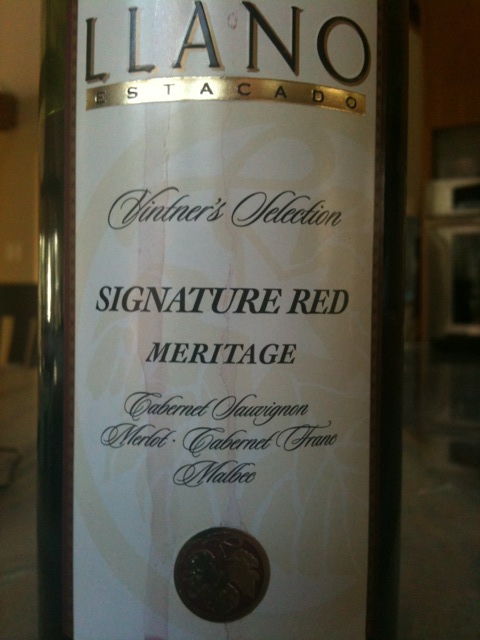
NV Llano Estacado Vintner's Selection Signature Red Meritage

NV Llano Estacado Vintner’s Selection Signature Red Meritage

The third bottle comes from Llano Estacado Winery, their NV Llano Estacado Winery Vintner’s Selection Signature Red Meritage. The wine has 12.9% ABV and is composed of the classic combination for a Meritage: 52% Cabernet Sauvignon, 31% Merlot, 10.5 Cabernet Franc, and 6.5% Malbec. In the glass, a surprisingly light colored red wine presented itself. In the nose there were sweet cherries, some light smoke and hints of liver sausage (don’t laugh!). Initially, the wine showed rather strong bitter aromas, which were actually not a turn off (even for me, who normally does not appreciate that!). These were filled up with cherries and some acidity. The finish was very short, leaving just aromas of bitterness (in that case unpleasant). All in all it was pretty disappointing. I would not even have guessed that this wine was a blend of Bordeaux grapes. It seemed flat and not very inspired. From a quick glance around the net, other reviewers seem to have mixed feelings about this wine, too.

Llano Estacado Winery’s website is here.

We also had the chance to attend the San Antonio Stock Show and Rodeo which was most of all fun! Imagine me surrounded by Stetsons, belt buckles and leather boots. It was quite hilarious! One of the cool things was that they also had a wine garden where organizers were showcasing wines that participated in their annual competition. Staff there was very attentive and enthusiastic, but I wish the organizers would take a couple of things into consideration for next year:
First, even if you have to charge money for even a sampling under Texas liquor laws (which seem the insanest that I have yet come across, but the I am certain there are even crazier ones out there) you simply cannot offer a thimble for $2. That’s just not gonna work…and charging $8 for a glass is also pretty steep.

Second, I wish they had a larger selection of Texas wines on offer. When we asked for Texan wines specifically, it turned out that of the 20+ wines on tab there were only two bottles from Texas, both from the same winery Messina Hof (which, frankly, I found quite disappointing). Their reasoning was that they only served gold medal winners in the wine garden, which seems like a good idea until you realize that most of the wines there were standard wines from California and other places a lot of which are easily available in any random supermarket: from Cupcake to Kendall-Jackson…If these won gold, I probably don’t want to try the Texas wines. However, I feel like more regional pride should prevail here (also, isn’t Texas one of the proudest states??). So, even if Texas wines don’t make the “gold medal” cut, why not still have a selection of maybe a third of the wines on offer reserved for Texas wines, even if they are only silver or bronze medal winners. There has to be some local interest into local wineries…

And third, I wish the organizers would stick to their published schedules. It happened to us twice in one day that we showed up for a tasting only to be told that it was going to start an hour later…that is kind of annoying during a fair when you walk around and plan your activities accordingly.

I realize all this is just a tiny glimpse into a big wine producing state. It was definitely exciting, and there were some nice surprises. Is there any more fun in the wine world than trying stuff from regions or areas you have never had wine from and be positively surprised? Well, yeah, for me probably a bottle of German Riesling. But that other thing comes in a very close second…

Tagged , , , , , , , , ,