Category Archives: 2009

Traveling the Old World: A European Red Blind Tasting

Some may remember the Malbec tasting Nina and I hosted last month. We had so much fun that night, that in our drunken state of mind we all agreed to have another tasting soon. And so it was, last week, that the same group of friends gathered. We had agreed to make it a blind tasting and had chosen an area as wide as possible, European Reds, so that we could actually play around with the wines and no one would feel intimidated talking about them. Blind tastings can be a very humbling experience if you think you have some wine knowledge at least, and it is a great equalizer as everyone is free to associate as much as they want.

If you are contemplating a tasting with friends at home, here are some tips that I jotted down a while back but are still helpful, I believe.

We met at 6.30pm (I actually went earlier because I just had to play Wii with our hosts’ son). Everyone brought one bottle of wine, which added up to seven bottles because one fellow wino was sick. I had brought a Riesling to clean our palates with after the tasting, the 2003 von Hövel which I wrote about last week. One of our friends had volunteered to arrange the order of bottles and conduct the tasting so that all others were in the dark except for their own wines.

Because it worked, we had the first bottle of wine with a traditional Roman pasta dish, Pasta cacio e pepe. The first wine, a bottle of 2009 Banfi Chianti Classico (13% ABV, Italy – Sangiovese-based), poured in a medium, clear red color. The aroma intensity was on the lower end of moderate, and the wine smelled young. There was not much I could detect in the nose, very subdued. The wine tasted dry, was light with fresh acidity and low tannins which were fairly balanced. I got some cherries and an overall fresh note from this wine with medium length. I thought this was a decent light wine. My guess was a Sangiovese-based Italian, from 2010 or 2009.

Up next was a 2011 Pierre Chermette Beaujolais (France – Gamay-based), which poured in a pale to medium red and was slightly hazed. The nose was aromatic with some age, showing tobacco, cedar wood, hay and some grape aromas. The wine was dry and light bodied, with low tannins and moderate aromas. On the palate it had quite some unpleasant heat, hardly any fruit with a harsh and disappointing finish. It tasted like it had its best days way behind it. I did not care for this wine much, and guessed 2011 Northern France or Austrian wine.
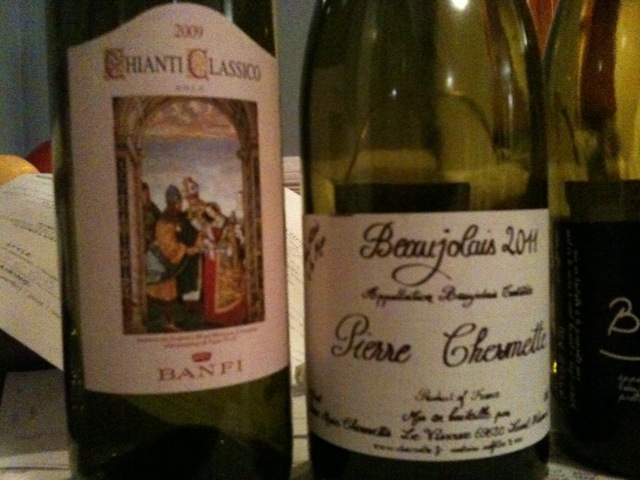
2010 Banfi Chianti Classico and 2011 Pierre Chermette Beaujolais AOC

The third wine was a 2012 Domaine Pral Beaujolais nouveau (France – Gamay-based). It showed a medium ruby red in the glass. Its nose was young and aromatic, with red fruit, jammy raspberry, gooseberry, pear mustard and roses. Quite the nose!! On the palate this dry, medium bodied wine was smooth with medium tannins and great balance. It showed strawberry and red fruit aromas, was floral and had some red currant to it. There was some heat in the end which I did not care for too much, but it was a very yummy wine with a long finish. Very pleasing. My guess was a 2010 Northern French wine.

And up was wine number four: A bottle of 2009 Andrieux et Fils Gigondas Côtes du Rhone (14.5% ABV, France – Grenache, Syrah, Mograve). Of deep ruby red color, the nose was aromatic with some age, and had plum, coffee, earthy aromas and some dark chocolate. Very different from the last wine! The wine tasted dry, with a medium-full body, smooth acidity and medium to high tannins. All in all it was very balanced and flavorful, with a very long fresh finish. It was the most complex wine of the night thus far and impressed pretty much everyone (as far as I remember). My guess was a 2010 Côtes du Rhone.
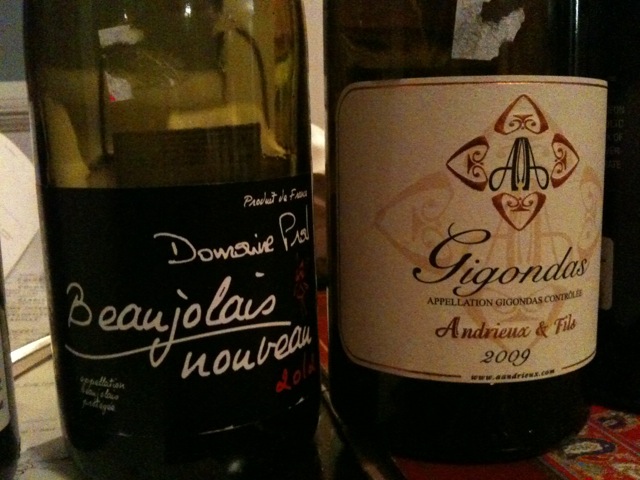
2012 Domaine Pral Beaujolais nouveau and 2009 Andrieux et Fils Gigondas Cotes du Rhone

The fifth wine, a 2010 Bodegas Ateca Atteca Old Vines (15% ABV, Spain – Garnacha), poured as a deep, ruby red and slightly hazy wine. The nose was aromatic, young and very weird: water colors, chalk, cherry and petrol. Not at all what I am used to, very intriguing. The medium bodied wine tasted dry with smooth acidity and medium to high tannins that were fairly well balanced. On the palate it was flavorful, with very ripe aromas, spice box, chocolate, and very juicy. There was a hint of residual sugar which made it absolutely fascinating. I liked this wine a lot, it was probably my favorite of the evening. Pretty early on, I decided in my head that this must be a Merlot from a Southern European area. Not sure about the age, but I kept yelling “This is a Merlot” across the table….

The sixth wine was a 2009 Az. Tilli  Concetto Terre di Chieti IGT (15% ABV, Italy – Merlot). It showed deep to dark ruby red with a slight haze. The aroma intensity was powerful, with berry compote and raisins. Very ripe, very impressive nose. I could have dove into this for longer. The wine was medium-full bodied, with fresh acidity and medium tannins, all very well balanced. On the palate, it had depth and was incredibly smooth, very likable with mostly red berry aromas. The finish was medium long. The Concetto is just a super yummy wine, I like it a lot. This one had to be a Merlot (by that point I knew that it was Nina’s wine, which she had bought in Germany at a wine store we both like with the one purpose of throwing it in at a blind tasting).

2010 Bodegas Ateca Atteca Old Vines and 2009 Az. Tilli Concetto Terre di Chieti IGT

The final wine in the tasting was a bottle of 2008 M. Chapoutier Côtes du Roussillon Villages Domaine de la Bila-Haut L’esquerda (13.5%  ABV, France – Syrah, Grenache, Carignan). It was the wine I had brought, and it proved to be the most controversial. I had bought it during Wines Till Sold Out‘s big sale the week before and it arrived in the mail just in time. I did not have a chance to try it before this tasting. It poured in a very dark, almost purplish red. The nose turned pretty much everyone completely off, and I have to admit it was the most unpleasant nose I have come across in quite a while: dirt, sulphur, manure. That is all one got for the first 30 minutes. With a heavy emphasis on manure. It was, frankly, disgusting. I was very surprised,  had not expected that at all. After 30 minutes, there were some red fruit aromas fighting their way through, but it was still not enjoyable to smell. On the palate, the wine was extremely intense, mostly earthy. There was some cassis, but mostly dry, dusty earth aromas. I still defended it and want to see what it tastes like after an hour or two in the decanter (I have a couple more bottles). What I tasted at this tasting though, was not very enticing…
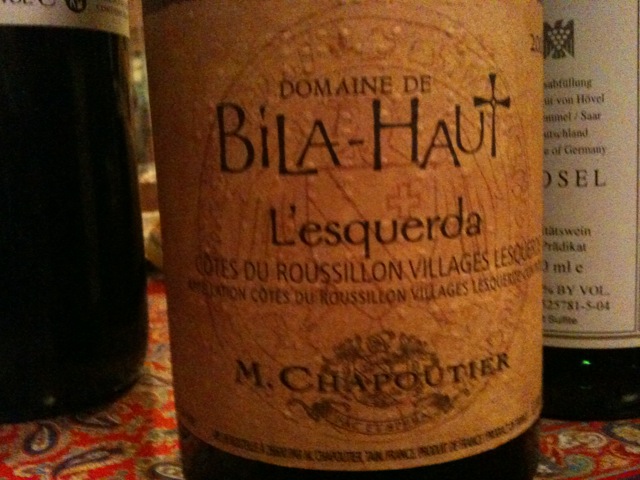
2008 M. Chapoutier Domaine de Bila-Haut L'esquerda

2008 M. Chapoutier Domaine de Bila-Haut L’esquerda

We finished the tasting, as is fast becoming a tradition, with a bottle of German Riesling Spätlese. I reviewed that wine over here.

Overall, I was very impressed with this tasting: Most of the wines were really good, and there were some really great surprises in it for me. We all played the guessing game, and it was fun. The best surprise though was a friend from Nina’s undergrad days who just began working in Detroit. He and a friend of his joined us for some of the wines later on and oh my God, did the friend of the friend play the guessing game. He nailed the last wine, and was pretty much spot on with the others he tried. That was really impressive! Time was just flying by and  I am sure I see another tasting in the not so distant future…


Tagged , , , , , , , , , , , , , , ,

A Tale of France and Argentina: A Malbec Tasting

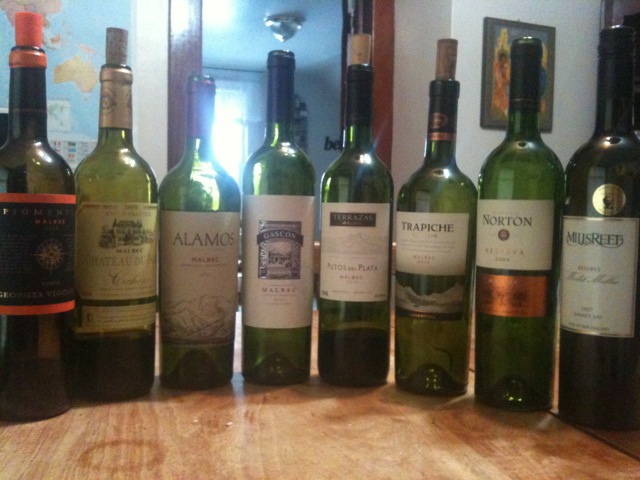
The line up for the Malbec tasting with wines from France and Argentina...and a New Zealander

The line up for the Malbec tasting with wines from France and Argentina…and a New Zealander

Two weeks ago, Nina organized a Malbec tasting with friends of ours. Malbecs are some of Nina’s favorite red wines, with their strong and edgy character. It is just what she is looking for in red wines. The tasting had been a long time in the making. Given our usual shoestring budget, she had acquired different, everyday Malbecs that you can find all over the place. To make things interesting, she decided not only to try Argentina Malbecs but also two from France. And in the end, she decided to throw in a Merlot/Malbec blend from New Zealand for the fun of it.

Now, as some of you may know, I am usually not a big fan of “bold” (aka strong) reds. I prefer old world style Pinot Noirs and a more balanced approach to grapes. I also am struggling with understanding red wines in the way I feel I intuitively understand white wines. But I was curious about this tasting, too. Nina’s hope in this endeavor was to figure out what exactly draws her to Malbecs. And, let’s not forget, it’s also tons of fun to have friends over and do a tasting together (for my thoughts on tastings at home, go here). This was the first time we used the tasting sheets provided by De Long Wine Discoveries which I found super helpful (check them out here). With these caveats ahead, please take my reviews with a grain of salt from the perspective of someone who generally prefers milder wines. Also, as I indicated, the wines tasted are on the lower level of of prices and retail between $8 and $17. Each wine was decanted for roughly 30-45 minutes.

We started with the two French Malbecs. I had read prior that Malbecs from the core French Malbec region Cahors tend to be quite tannic so we decided to get them out of the way before we moved to the Argentina Malbecs, which are said to be more fruity.

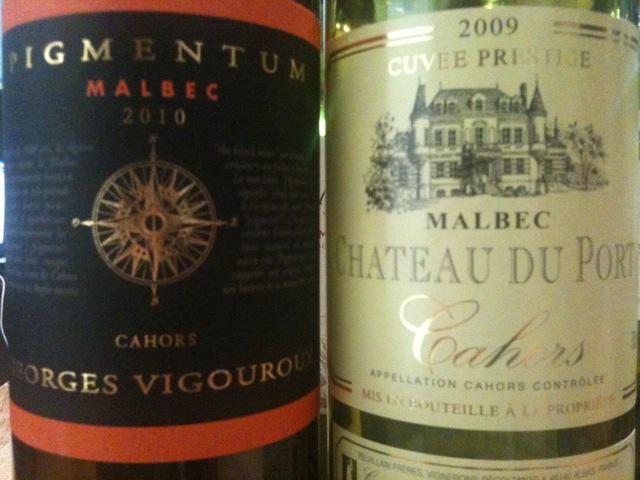
2010 Vigouroux Pigmentum and 2009 Chateau de Port Cuvée Prestige

2010 Vigouroux Pigmentum and 2009 Chateau de Port Cuvée Prestige

First up was the 2010 Georges Vigouroux Pigmentum. The wine has 13.5% ABV. It was of dark, clear ruby color. In the nose it was moderately aromatic with alcohol, plum, herbs and hints of tobacco. It was dry, medium bodied, with crisp acidity and quite flavorful. I tasted strong tannins, some red berries and a mineralic note. It was fruitier than I would have expected with a long finish. I thought this was a pretty good start. The wine was less tannic than I thought and fruitier. It also paired well with the soft cheeses we tried. (When retasted two days later, it was still good: more cherry aromas in the nose, with almonds, and great raspberry and blackberry on the palate).

Next up was 2009 Chateau du Port Cuvée Prestige, also from Cahors. This wine has 14% ABV. Of deep, purplish red color, it was aromatic in the nose and showed some age. I got cherries, strawberries, mint and violets and thought the nose was awesome. On the palate, I got a dry, medium bodied and smooth wine with medium tannins. The flavor profile was a bit of a let down, though: I got vegetal notes, but mostly bitter aromas and alcohol notes. It almost tasted a bit green. The nose just promised more than I got in my mouth, which disappointed me. (After two days, this was virtually dead. Bitter aromas had increased, and it smelled musty.)

We then moved on to the Argentina Malbecs. All were from Mendoza.

2011 Catena Alamos and 2011 Gascón Malbec

2011 Catena Alamos and 2011 Gascón Malbec

First up was the ubiquitous 2011 Catena Alamos Malbec with 13.7% ABV. Of medium ruby red color, the wine showed moderate aromas of vanilla, branches and almonds on the nose. I hardly got any fruit (which I found surprising) – others at the table disagreed and got a lot of fruit (stone fruit and red fruit). On the palate, it was dry, medium-bodied and quite smooth acidity-wise. But the tannins were strong and hard and I felt the wine was quite unbalanced. It was very peppery and tasted a bit green. The finish was short and disappointing. It felt quite closed at that point. (When I retried it two days later it was quite the revelation: the nose showed raspberry and currants and was very appealing. On the palate it also showed freshness and black currant aromas that I liked a lot! So, let this one breathe for quite a bit!)

Next up was the 2011 Don Miguel Gascón Malbec with 13.9% ABV. Dark and purplish in the glass, its aroma profile was good and youthful, with raspberries and other red fruit. I wrote down “pleasant nose”. On the palate, it was dry and medium bodied with a crisp acidity. The tannins seemed low and it was fairly balanced to me. Initially, I thought the taste was pleasant but then it got a bitter. It definitely showed more fruit than the two previous wines, but also had some pepper notes. What disturbed me most was its heat. There was just something about it that was too alcoholic for me. (Two days later, this wine showed a great nose of gooseberry, tart raspberries and jasmine. Very pleasant. On the palate, it had lost its bitterness and showed jasmine and green tea aromas and was very herbal. Again, I enjoyed this much more two days later, so: decant or aerate a lot!)

2010 Terrazas de los Andes Altos del Plata and 2010 Trapiche Oak Cask

2010 Terrazas de los Andes Altos del Plata and 2010 Trapiche Oak Cask

Next came the 2010 Terrazas de los Andes Altos del Plata Malbec with 14% ABV. Again, deep ruby colors with moderate aromas of oak, mountain flowers and almonds. I found the wine surprisingly sweet with smooth acidity and medium tannins. It showed aromas of pepper, red fruit, mint and some slight bitter notes. It was nicely spicy, but also showed too much heat for me. With a rather short finish. I wrote down “best of Argentinians so far”. (Two days later, this wine was dead.)

We then tried the 2010 Trapiche Oak Cask Malbec with 14% ABV. Deep ruby red color and a quite unpleasant nose of greenness, acidity, crude oil and butter. Not pleasant at all for me. On the dry side, with a light to medium body and crisp acidity, it showed high tannins and felt quite unbalanced regarding alcohol and tannins. It had a lot of heat, was watery and showed no signs of oak. Some red fruit and pepper. I did not like this wine at all. (Two days later, it showed strawberry and blackberry in the nose. It tasted sour with some spice and felt a tad better than initially assessed. Still would not buy this again.)

2009 Norton Reserva and 2007 Mills Reef Reserve

2009 Norton Reserva and 2007 Mills Reef Reserve

The final single variety Malbec was the 2009 Norton Malbec Reserva with 14.5% ABV. Deep and ruby colored, it showed powerful aromas in the nose. I got toffee, salt, soda, coffee and some cabbage notes. It was dry and medium to full bodied with medium to high tannins. It was nicely balanced, I thought, and flavorful: I got sour cherries, raspberry, lemon curd. Some said they got pie crust as an aroma. The finish was medium to long. All in all, I thought this was an alright wine. Maybe too citric and not as smooth as others felt, but still enjoyable. (Two days later it still tasted fine. The flavor profile showed some vanilla that I did not get initially)

We finished the red tasting with the 2007 Mills Reef Hawkes Bay Merlot Malbec Reserve from New Zealand. A 51% Merlot, 49% Malbec blend that has 14% ABV. Of medium red to garnet color, it was aromatic with some age and showed raspberry, herbal aromas, mint and strawberry. It was dry and medium bodied with fresh acidity, low tannins and was decently balanced. I thought it was quite enjoyable with some wood and slight vanilla aromas. It was a tad sweeter than the previous wines and not very fruity. Again, I thought this was an alright wine but it did not impress me. (Two days later, it had contracted to a thin, sweet wine that reminded me of bad port wine.)

So, who was the winner? I guess from the initial tasting I would go with the first one (Pigmentum from France) and the last wine (the New Zealans blend). However, after enough air got to them, the Alamos and the Gascón were actually quite enjoyable and pretty good value at around $10.

What I preferred: 2010 Kurt Hain Piesporter Goldtröpfchen Riesling Kabinett

What I preferred: 2010 Kurt Hain Piesporter Goldtröpfchen Riesling Kabinett

We finished the evening with a German Riesling, what else? We had planned for an aged Riesling (a 1991) but when I saw the cork and how wet it was, I decided against opening it. I want to talk to the seller first. So, I threw a 2010 Kurt Hain Piesporter Goldtröpfchen Riesling Kabinett in the freezer. Opened it, and loved it. Notes will follow when I actually am taking notes. It was a wonderful refreshing Riesling from a producer I like a lot. And a great way to end an awesome night with friends, wine and cheese.

Tagged , , , , , , , , , , , , ,

“Raindrops on Rotwein” Flight at Crush Wine Bistro in Anchorage

I indicated in my article on the wine bistro Crush in Anchorage, Alaska that we had their Austrian reds flight called “Raindrops on Rotwein”. The flight consisted of three Austrian reds made with typical Austrian red grapes: St. Laurent, Blaufränkisch and Zweigelt. All wineries have garnered some sort of international acclaim, be it in Falstaff magazine or Wine & Spirits. The flight was also really well composed, because the three grapes are connected:

The St. Laurent grape is in the same family as pinot noir. It is described as highly aromatic and is mostly grown in the Czech Republic, Austria and Germany. Blaufränkisch (literally “Blue Frankish”, also known as Lemberger) is a late ripening red grape rich in tannin, that is mostly grown in Central Europe. And finally, Zweigelt is a cross breed of the other two grapes which was created in 1922 by Mr. Zweigelt. It is now the most widely grown red grape in Austria.

I am not familiar at all with Austrian wines, let alone red wines. From what I gathered over the last years, Austria has made a tremendous comeback from its crisis days in the 1980s and a lot of my friends are really excited about Austrian wines. The few wines I have tried were Grüner Veltliner and Rieslings (what else?). My hometown winemaker also produces a St. Laurent that is decent, Nina likes it a lot. So when we saw that flight on the list, Nina and I decided to give it a try: two more grapes to knock off on our Wine Century Club application and the chance to try some reds from a region we knew practically nothing about drew us in.

Let me begin by saying that the tasting really challenged both of us. The wines were quite intense and different in many ways and not necessarily pleasantly so. It might be my underdeveloped palate or maybe I was just not expecting what ride I was in for…but to the wines:

Photo taken from the winery’s website

The first was a 2009 Sattler St. Laurent from Burgenland region. The Weingut Erich Sattler owns vineyards in what it describes as gravelly soil in the hot Burgenland region of Austria, around the village of Tadten. According to the website, the St. Laurent vines are over 40 years old. The winery’s stated goal is to make dense wines, and the St. Laurent ripened in steel tanks, staying on the lees for six months. It had 13% ABV.

In the glass, the St. Laurent was of a lighter red color, similar to a pinot noir. In the nose it was quite alcoholic, with plum and strawberry aromas. It smelled a bit unripe. In the beginning, this lighter bodied wine had a smooth mouthfeel to it, but soon peppery and bitter aromas came in that were increased by a significant amount of acidity. Add to that some burnt notes and the wine seemed quite unbalanced to me. When re-tasted later, the wine showed a bit more fruit (berries) and had a decent finish, but also seemed rather thin.

Photo Wine-Searcher

The second wine was a 2008 Prieler Johanneshöhe Blaufränkisch, also from the Burgenland region. Weingut Prieler is located in Schützen am Gebirge and its history goes back over 150 years. Prieler owns 20 hectares (around 50 acres) of vineyards. This particular vineyard is described as having brown loam soil with red pebbles, high in iron content. It also had 13% ABV.

In the glass, the wine had a ruby red color and showed beautiful viscosity. On the nose, I got earthy aromas of mushrooms and plum. The wine had a good, velvety texture but rather harsh tannins. The aromas we got were quite confusing: I thought I tasted salami (I swear to God!) and there seemed to be a cheesy note to it, too. Really weird. The finish was very short and quite bitter. All in all, this was a pretty harsh wine to me. It just did not work. Nina thought it was overripe overall.

Photo: CellarTracker

The third and last wine in the flight was a 2009 Glatzer Zweigelt Riedencuvée from the Carnuntum region. Weingut Glatzer is located in Göttlesbrunn in this Roman settled area of Southern Austria. Glatzer owns 54 hectares (133 acres) in a number of different vineyards. It focuses on red wines, with the largest crop being Zweigelt (20 hectares). This particular wine was grown on sandy loam soils and had between 12.5 and 13% ABV. It was aged for 9 months in 2000 liter casks.

In the glass, we got a darker ruby red wine. The nose was quite pungent, with aromas of sauerkraut, damp earth and burnt rubber. On the palate, this one had more weight to it than the other two. It had a velvety texture, but I could not get over the taste of burnt rubber that reminded me of everything that can go wrong in a pinotage; Nina remarked that she tasted ash. There were aromas of sour cherries and herbs, but the racing acidity in the end did not help it either. After 45 minutes I did get some strawberries, but the wine was just too sour for my taste.

I am not sure I went away from this tasting with a favorable view on the three wines we tried (re-reading my notes, I am pretty certain I did not). In hindsight, the first of the three was the most pleasant for me. Too bad that I thought it could only get better from there. Naturally, I was quite disappointed. I am now eager to try more Austrian wines, because these definitely did not cut it for me and I am sure there are some out there that are better suited for me. Having no real experience with Austrian reds, and also knowing a number of German reds that I find sub par, it is hard to know whether it is me or the wines…it was puzzling.

Has anyone tried Austrian reds and can point me to some I should try?

Tagged , , , , , , , , ,