Category Archives: 2006

A Vertical Tasting at Ridge Vineyards

Ridge Vineyards winery

Ridge Vineyards winery

Nina and I are low-key planners when it comes to our trips. Just like our California trip to see family, until we arrived, all we had were the tickets and a place to stay. The rest usually comes naturally. And so it did. During a dinner with one of Nina’s cousins, he mentioned that one of his cousins is a vineyard manager at Ridge Vineyards…I did not take notice immediately, but then I saw a Ridge label in a wine store and realized: Wait a second, I have heard of the winery before!! This is not some local hack, this is actually pretty decent California wine royalty.

So we pestered cousin 1 to get in touch with his cousin 2 and see what he could do to get us to the winery. I know, I know. I am a sucker for good wine, and I wanted to see whether we could get a decent tasting. And a decent tasting we got. Turned out that the day we were in the region (we were in San Jose, while the winery and tasting room is in Cupertino), they were having a Wine Club exclusive tasting. And that tasting included a vertical of Ridge’s Bucchignani Ranch Carignane. We naturally made ourselves available for this and ended up on the guest list, together with two friends of ours.

Let me tell you about the winery: Ridge Vineyards was founded in 1962, but its roots go back further. In the 1880s, a doctor bought land in the Monte Bello Ridge, a mountainous slope near Cupertino. These vineyards were later bought by the then owners of Ridge in the 1960s, and Monte Bello is still their flagship vineyard. Apparently, the winery has been owned by a pharmaceutical company since the 1980s (weird!!). It now mostly has holdings in Napa and Sonoma (north of the San Francisco Bay), with Monte Bello still being part of its portfolio. It became famous when during the Judgment of Paris in 1976, a blind tasting in Paris that compared California and Bordeaux reds as well as California and Burgundy chardonnays, it came in fifth with its 1971 Monte Bello, an outstanding achievement (the first wine was a California, then three Bordeuax, then Ridge). In a re-enactment 30 years later, Ridge came in first with its wine!!

The label (Photo credit: www.ridgewine.com)

The label (Photo credit: http://www.ridgewine.com)

Let me say this first: I love the bottles for their iconic, simple labels. They’re just really stylish.

The drive up to the tasting room is gorgeous in itself. You wind the car up and up and up and then reach the winery, which overlooks Silicon Valley. It’s just spectacular.

But off to the vertical. As I indicated, we had a vertical of 2006, 2007, 2008 and 2011 Ridge Bucchignani Ranch Carignane. Bucchignani Ranch was added to Ridge’s portfolio in 1999. The vineyard is located in the northwestern edge of Alexander Valley. The majority of the Carignane vines in this vineyard were planted in the 1940s, with oldest dating back to 1927 and the youngest to 1952.

We started with the 2006 Ridge Bucchignani Ranch Carignane. In the glass, the wine showed a lighter red with slight browning at the edges. The nose was enticing, with blueberry pie, salt caramel and sweet almond aromas. Quite unexpected, very pretty. On the palate, the wine was light bodied, with firm tannins that were nicely balanced. The wine was showing some contraction, with rather low fruit aromas. However, it felt a bit thinnish to me. It got more impressive when paired with the salty cheese that ridge was providing. I’d say a good to very good wine. Not impressive, but solid.

Next up was the 2007 vintage. The pourer informed us that 2007 was a very hot year. The wine presented itself in a darker, ruby red color. The nose was very intense, it was hard to focus on what aromas I got: it was perfumy, one of our friends remarked on butter scotch, although I am not sure I got that. To me, there were meaty aromas going on…whatever that says. So, yeah, definitely interesting nose. On the palate, the wine was medium-bodied, with a surprising amount of acidity and lots of tannins. Very different from the previous vintage. It felt rather balanced, but was a bit all over the place. What I liked most about this wine was the taste after you swallowed. About 20 seconds in, aromas became jammy and fruity. I really enjoyed that finish. For my flavor profile, though, this might have been a bit too strong. I could see it go well with food, though!

Us with our good friend in the tasting room

Us with our good friend in the tasting room

We then moved on to the 2008 vintage, which was of a lighter ruby red color. In the nose, we got orange peel, cloves, I detected some sweat. Not a bad nose (despite the sweat). The great thing about this wine, though, was its structure. Unlike the other two wines, it was spicy right in the beginning, not the end. There was very good balance in the wine. I detected some chalk in the mid-section that leads over to well developed flavor in the back. Very good, lingering finish that wraps up the wine well. I thought this was very good.

The final wine in the vertical was the 2011 Ridge Bucchignani Ranch Carignane. A bit more powerful in color, this wine showed very young aromatics in the nose, with balsamic vinegar, stone fruit and blackberry. Again, a nose that was very nice to linger in for a while. In the mouth, this wine was medium bodied with strong acidity, but the flavors were dominated by its jammy-ness. Later I got vanilla and scone batter. I noted down that this wine was very refreshing. It might have been a bit unbalanced still with the rather strong acidity, but I still thought this was a very good wine. And give it a few years and the acidity will calm down a bit, too.

All in all, it was a good tasting. The wines were definitely interesting and diverse and gave a good impression of the skill that is going on at Ridge. The wines are definitely a reason why this winery has a good reputation. I’d come back any time. :)

The wines from this line are apparently only sold to members of the Wine Club. The 2011 vintage is being sold at $26, which seems a fair price when compared to other California wines.

Goofing off, Silicon Valley in the background

Goofing off, Silicon Valley in the background
Tagged , , , , , , , ,

2006 Vecchia Cantina di Montepulciano Vino Nobile di Montepulciano Redi Argo et Non Briareo Riserva

2006 Vecchia Cantina Vino Nobile Redi Argo et Non Briareo Riserva

2006 Vecchia Cantina Vino Nobile Redi Argo et Non Briareo Riserva

Phew, this is probably the longest wine name I ever wrote down…who complains about German wine labels when they see this? I like to call the wine simply Briareo.

This wine review is right in line with my recent praises of this wonderful community I have found through blogging (see here). Some of you know my constant complaining (and might actually be sick of it by now) about the absurdity that is the U.S. wine pricing system. I still cannot get over how expensive “better” wines are in this country. Blame the stupid three tier system, blame the high prices of French and Italian wines that the market somehow adopted for pretty much anything else, blame whatever you want. I still don’t think it is just the shipping that makes wines so expensive, because containers are not that expensive anymore…but, end of rant.

Several months ago, I realized that my wine friend Anatoli over at Talk-a-vino kept mentioning this wine site Wines Till Sold Out (or short WTSO). It is a site that sells one wine at a time, usually at a steep discount. Shipping is free if you buy a couple of bottles (usually between 2-4, depending on the wine). I started eyeing that website and realized that besides the usual suspects of California Cabernet Sauvignons and Burgundy whites, they also sell a lot of Italian reds. And the prices are actually quite good. Given that, including shipping, you usually end up with a price tag of somewhere above 70 bucks for between 2-4 bottles, it is still a considerable amount of money for this Germany spoiled imbiber. So I never bought anything.

Then, shortly before Christmas, WTSO was offering this wine, the 2006 Briareo and I simply had to buy it, as in HAD to buy it. I visited that winery (actually it is a cooperative) when I was in Montepulciano in 2005 and I LOVED, LOVED, LOVED their standard Vino Nobile (we took a case back to Germany). Back then, the Briareo didn’t seem to offer much better quality than the standard, and the standard was considerably lower priced (I think 12 euros per bottle instead of the 19 per bottle they wanted to the Briareo). But now, that did not matter: This was a winery I had visited and whose wines I remembered fondly, and that wine was selling for $18!! Incredible. So, I ordered four bottles to fulfill the minimum requirement for shipping.

The wines arrived after we returned from our Alaska trip in mid January. And have been sitting in the wine rack since. I have to say, I was actually hesitant to open a bottle. I remembered their wines so fondly, but this was a different vintage etc. etc. etc. What if I was going to be totally disappointed? (I can be a worrier…) Sunday night we decided to open a bottle. The heck, we still have three left after that one! Plus, I left Ann Arbor for a couple of weeks to help out a good friend of mine with some stuff in San Antonio, Texas, so why not make this a good last evening before I left?

The wine, as a proper Vino Nobile, is made from a mix of Sangiovese grapes (in Montepulciano that grape is called Prugnolo Gentile and a Vino Nobile needs to have a minimum of 70% of that grape in it) and Canaiolo. While a standard Vino Nobile gets to age two years in oak, a Riserva spends a minimum of three years in oak.

The crazy name “Argo et Non Briareo” is actually a reference to a medieval Latin inscription that is in one of the winery’s walls. It translates to “Argus and not Briareus”. Now that is not very helpful, right? Let me help you a bit with Roman and Greek mythology: Argus is a giant with a hundred eyes. (In German, a saying translates to “You have eyes like Argus.”) Briareus, in contrast, is a giant with just one eye. The inscription means it is better to be Argus with a hundred eyes than Briareus with one eye. According to the winery, they picked that inscription for the wine’s name because the wine is also better enjoyed with a hundred eyes because of its depth and sophistication than just one eye. Kind of cute that story. I have actually seen that inscription on the outside of their cellar walls.

Vecchia Cantina, the cooperative, was founded in 1937 by fourteen winemakers. You can find their website here.

But enough, enough of the gibberish. Let’s dive into this wine. I decanted it and oh boy, did this wine need decanting! We followed the wine over the course of 2 1/2 hours and its development was fascinating. It poured in a pale red to garnet color, very light. The initial nose was dominated by cherries, tobacco (lots of it) and floral aromas. After 30 minutes of decanting, the flavor was dominated by acidity and quite an amount of peppery heat which was really weird and disconcerting. I got violets, tobacco, leather and some plums. It was a thin, not very interesting wine.

So we decided to let it stand for a bit. And after 90 minutes in the decanter it finally began opening up: The cherry notes became more prominent in the nose, the heat was virtually gone from the wine. It was deep and interesting while at the same time retaining that refreshing lightness.

After two hours, the nose got super fruity, with a lingering tobacco aroma and some dark chocolate. It even seemed like the color had changed to a darker red, almost ruby. Now I finally enjoyed the wine. Its finish was long and enticing. I still think it should have had a little more heft to it given that it is a Riserva, but it was really yummy. And the best thing was how much Nina enjoyed it. She LOVED the Briareo and couldn’t get enough of it.

Just for those curious: The Wine Spectator rated this wine with 93 points and states its ageing potential as 2012-2025. According to their notes, there is dried cherry and berries, floral aromas, licorice, spices and leather aromas in the nose as well as on the palate. Long finish with ripe fruit and flowers.

Now I wish I had bought more bottles, because the price tag ($18) was great and if I want to taste it once a year within the suggested drinking window, I need to get a couple more to make it to 2025…:) Thank you, Anatoli!

Tagged , , , , , , , , , , ,

Michigan vs. Mosel Riesling Tasting with friends

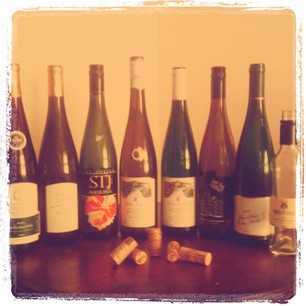
The Michigan vs. Mosel tasting line up

Last Friday (a week ago, I know…) we had our first just-tasting with friends at our place. I have written about my thoughts on doing tastings with friends here. The idea for this tasting was born a while back. Me being the Mosel riesling snob that I am, I have only made small progress into the Michigan riesling scene. Some of them I liked or was intrigued by (see for example here or here or here), some of them, well…Now, two friends of ours got married recently and they decided to spend their honeymoon in and around Traverse City, Michigan’s riesling mecca. While we were talking about that trip, we decided to do a comparison tasting. They had brought some stuff back, and we had some Mosel rieslings to share. We also invited another riesling nut to the tasting, who falls in love with virtually every riesling we serve her, which makes me feel good. And another friend, who was crashing with us, participated as well. To lessen the suspense: We had a blast. We had so much fun, and the comparison went quite well. If we had done that tasting blind, I don’t know whether I would have been able to pick which ones are from there.

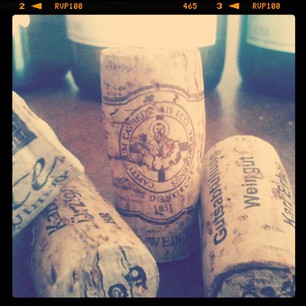
Some cork art. It does not get much fancier…

Here is our line up:

1) 2010 Chateau Grand Traverse Riesling Dry (Michigan)

2) 2011 Brys Estate Dry Riesling (Michigan)

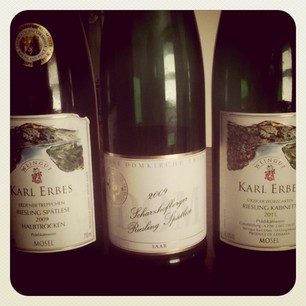
3) 2009 Karl Erbes Erdener Treppchen Spätlese halbtrocken (semi-sweet) (Mosel)

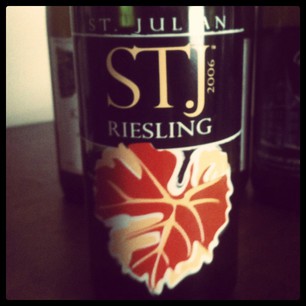
4) 2006 St. Julian Riesling (Michigan)

5) 2011 Left Foot Charley Missing Spire Riesling (Michigan)

6) 2011 Karl Erbes Ürziger Würzgarten Kabinett (Mosel)

7) 2009 Hohe Domkirche Trier Scharzhofberger Spätlese (Saar)

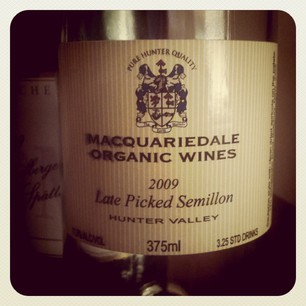
8) 2009 Macquariedale Hunter Valley Late Picked Semillon (Australia)

In blind tastings, it is fun to throw a wine in that not necessarily fits the restrictions on the wines that you imposed prior to tasting. It is something outside the box, to throw you off, and to make the blind tasting even more fun. We usually referred to these as black pirates. The black pirate in this tasting was the Australian dessert wine, which was brought by the friend crashing with us.

But to my thoughts on the wines:

The Michigan line

First up, the 2010 Chateau Grand Traverse Riesling Dry. I do like their semisweet standard wine and their Late Harvest Riesling, so I was excited about trying the dry. Upon opening and pouring, a dark yellow wine showed itself which was bit confusing. Did not expect that from a young dry wine. The nose showed ripe fruit, but not much of it. On the palate, the first noticeable taste was bitterness. There was some slight peach, but hardly discernible. The wine felt quite alcoholic (which was confirmed when we checked the label: 12.5% ABV). The short finish was topped by a burnt taste. In short, it was quite the disappointment. I could never have guessed this was a riesling if tasted blindly, and it seemed way past its prime already.

(Addendum: I received word from the winery in the comments section that the discoloration in the 2010 CGT Riesling Dry indicates that the wine was actually flawed, either by a bad cork or bad storage…I guess I could have guessed that given that I got all the clues: wrong color, bitter notes and burnt taste; I just did not make the connection when tasting.)

Next in line, the 2011 Brys Estate Dry Riesling. The color was lighter straw, with a nose of ripe fruit, peaches and sugar, slightly confusing in a dry wine. The texture was lovely, it gave you a silky mouthful of wine. It had a nice amount of acidity, and first fruit notes I discovered were grapes, yellow apples, pineapple and then citrus. While holding on to my glass and continuing to try, I thought I discerned some vegetable notes in the beginning (maybe squash, maybe zucchini). The wine had a nicely long finish. The 11% ABV were hardly noticeable. In short: This was delicious. It was fresh, and reminded me of German rieslings, albeit not a German dry riesling, it would have been an off-dry in Germany. Very nice wine!!

Up next, the 2009 Karl Erbes Erdener Treppchen Spätlese halbtrocken (semi-sweet). A tad higher in alcohol content than the Brys wine at 11.5% ABV, I was curious how these two would match up. The color was a light yellow with a nose of sweetness and yellow fruit, with ripe aromas. On the palate, the wine had a quite condensed feel to it. It tasted very ripe, older than a 2009 should taste. It had some apricots and vegetal notes, but I could not get over the fact that it might have been flawed. I did not detect a cork flaw, and if so, it was mild. But the wine tasted off. So I really do not feel like I can rate it.

The Mosel line

The next wine was the 2006 St. Julian Riesling. Our friend had been excited when she found the single bottle of this wine in a wine shop and bought it for us to try. She has been fond of older rieslings, and so we wanted to experience this together. Open opening the screw cap and pouring the wine, we saw a lighter, saturated yellow in our glasses. The nose was …mmmmh…. interesting? To me, it smelled of band aids. Others said glue. It also smelled quite musty. It was very unappealing. On the palate, that continued. The wine was clearly way past its prime, probably had been stored in horrible conditions…this one had been dead for a while.

St Julian 2006 – Stay away!

It was on the 2011 Left Foot Charley Missing Spire Riesling to redeem Michigan. And boy, it did!! Of very light and almost water color, it had a beautiful, beautiful nose of grapes and green grass. The taste was floral and herbal (I also wrote down perfumy, but I know that these descriptions do not really help…), with a wonderful creaminess to it. There were some hints of bitterness towards the end. The finish was rather short, though. I found this wine wonderfully refreshing. Its 43 grams of residual sugar and 9% ABV made it a great sipping wine. In its beauty, it did remind me of Prälat wines, but I might have gotten carried away, especially after the two disappointments we tried before. Nina disagreed with me on that assessment, and I suppose she is right.

By that time, we had brought out the cheeses, and that definitely enhanced the tasting as well. Nothing like sweeter rieslings and cheese…

Up next was the 2011 Karl Erbes Ürziger Würzgarten Kabinett. At 8% ABV it had the typical alcohol content of a sweeter Mosel riesling, and I remembered it fondly from our tasting at the winery in June. The color was light straw and the nose had honey and a rather distinct grape note, very fresh. My tasting notes focused on my emotional response rather than the tastes. They read: “refreshing, sweet, honey, warm, nice acidity, deep, not very long, great with cheese”. I admit it, I had already had my fair share of wine, and my tasting capabilities went downhill. The wine just made me smile. It was just so pleasant.

This was followed by my highlight, the 2009 Hohe Domkirche Scharzhofberger Spätlese. You can find the review here (I needed more space for that).

We finished off with the 2009 Macquariedale Hunter Valley Late Picked Semillon from Australia, which is described here.

The black pirate

Like I said, it was a great experience. My cousin asked me who won. I really don’t feel like I can declare a winner here. The Brys and the Left Foot Charley were both pretty awesome wines, and so were the Erbes Kabinett and the Scharzhofberger. I think the biggest surprise for me was the quality of the Brys and the Left Foot Charley. They definitely convinced me that there is great riesling in Michigan and I am determined more than ever to go and find them.

Has anyone tried these wines or others from those wineries? Please share!!

Tagged , , , , , , , , , , ,