Category Archives: Something about wine…

MWWC #3: Possession

wine-stain1-2

Monthly Wine Writing Challenge #3

This post is part of the Monthly Wine Writing Challenge, which is now in its third round. Sally of My Custard Pie wrote the best piece last month around the theme trouble (this is what I could muster) and threw out the next challenge: Possession. Find the full info on the contest here.

I am a lawyer by training. And sometimes, this training, and the way of thinking it teaches you, can be a curse. So, when I read the theme for this month’s wine writing challenge, possession, my head got stuck on the legal meaning of possession. You see, the law distinguishes between ownership and possession. It is an important distinction, but in colloquial language and understanding, it often gets completely blurred. Now, ownership is a much better right to have, because it gives you exclusive rights over something. Possession, in contrast, only gives you a derived right. Derived, because the thing we are talking about belongs to someone else…

Why did my head get stuck on this distinction when we are talking about a wine writing challenge? Because possession, just like ownership, plays a huge part in the German wine growing world. I remembered a video I watched last year, posted by Denise Medrano, in which Ernst Loosen of the fabled Dr. Loosen winery takes a group through their vineyards in Ürzig, the Ürziger Würzgarten. It’s a long video, and rather boring at times, but what struck me was what he talks about from time mark 4:20 or so until minute 6. That part is not boring!

Ernie is talking about who “owns” which part of the vineyard, and as you can see, it is really tricky. In the most remarkable sentence he states that seven single vines (yes, single vines!) are bordered by four different wineries. What he does not mention is that some of those vines are not even owned by the wineries that work them, the wineries merely have legal possession: they leased the vines.

So much better than Hollywood

So much better than Hollywood…yet who owns these vines?

When you think of wine estates, many imagine the large, sprawling wine estates in the New World, where one winery owns hundreds and hundreds of acres of vines, all in neat rows, belonging to that one winery. The situation in a lot of Germany is different (and not just Germany, I think it is similar in other European wine growing countries): Wine has been grown for 2,000 years. Families have split, and with them ownership over land was split. The Catholic Church had huge holdings, which were later dismantled. But quite a bit of that land is actually still owned by the Church. But most bishoprics have given up making wine themselves.  Add to that the decline of active wineries in Germany because many cannot make a living, and there is a sizable amount of land under vine that is owned by persons that don’t even make wine.

What do you do with these tracts of land? Most of the land is in steep hills, or in areas that cannot be developed in another way for legal or geographical reasons. But the land might actually be quite valuable. And some people are not interested in a full payment to transfer ownership, they rather get a yearly rent (in money or even wine) and retain ownership. According to statistics by the German statistics office, over 60% of agricultural land under production is leased, not owned! In Rhineland-Palatinate, home to the large wine regions Rheinhessen, Palatinate (Pfalz) and the Mosel, 66% of all agricultural land is leased (I couldn’t find data just on wine).

This leads to a lot of possessive relationships in the vineyards. These are regulated by contracts which stipulate the exact duties (how does the possessor need to take care of the vines? Who is responsible for replanting when the vines grow old and tired? etc.) of lessee and land owner. A short research on Google revealed contract forms by two bishoprics leasing out land under vine. These contracts are many pages long. The contracts run for a set number of years, and it is common that after the end of the lease, the vines are rented to another wine maker…so the one who tended them for, let’s say, 20 years from one day to the other loses the right to use to these vines…
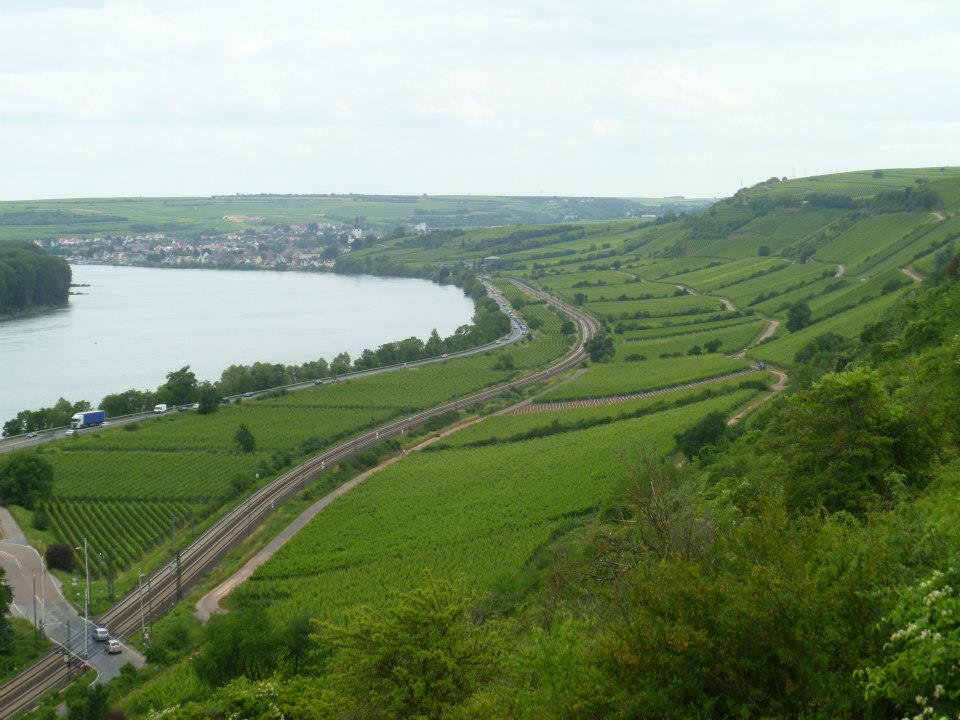
Roter Hang viewed from Nackenheim southwards to Nierstein

Roter Hang viewed from Nackenheim southwards to Nierstein

These relationships are beneficial for both parties, though. Take my friend Stefan Erbes of Karl Erbes. His family has been making wine in Ürzig since the 1960s, yet the most fabled of vineyards in the neighborhood was out of reach: Erdener Prälat. That tiny little parcel of land actually has seven or eight wineries tending to the vines in it, although ownership might be more obscure. Last year, Stefan was able to lease a teeny tiny bit of vines in the Prälat, and since the vines are already in place, he will be able to make wine from this top trophy vineyard for the first time this year already. On the other hand, the current owner does not lose his or her stake in this piece of land which, very likely, will continue to grow in value.

Well, this got us on quite the tangent, and is not necessarily the first thing that comes to mind when speaking of possession. But I just thought it was an important piece of information about German wineries. That the land they produce their wines from might never have actually been owned by them. Some of them are just possessors…

Tagged , , , , , , , , , , , ,

Sunday Read: Which is more important for Fine Wine, Terroir or Technique?

Fine wines and premium Scotch too!

Disclaimer: I entered into a tentative agreement with the online wine retailer Wine Chateau under which they sponsor two of my posts per month. Wine Chateau has no influence on the topic I select for the post or its content. Opinions expressed are all mine.

Steve Heimoff published this excellent article, which becomes even better as you read the comments, in May and it has been sitting on my Sunday Read list for a while now…

As terroir is still one of the buzz words in the wine world, and as I for one am a proponent of it (remember my waxing poetically about how I can recognize a Scharzhofberger? Or how much I love an Erdener Treppchen, no matter who made the wine?), it is still a delicate question. How does one detect terroir in the first place? And does a good plot of land automatically mean a good wine (as the Premier and Grand Cru in Burgundy or the Classification in Bordeaux suggest)? But what about the winemaker?

These are interesting questions, and Steve Heimoff delves into them quite well, trying to find a balance.

Happy Sunday!

Steve Heimoff: Which is more important for fine wine, terroir or technique?

Tagged , , , , ,

Aged Wines are like Old Friends

I know, I have been quite silent lately. This is likely to continue for a couple more weeks. I will try to post when I can, and more importantly have something to say, but we’re not really drinking wine right now and my cousin is coming to visit so we will also be traveling a bit. Maybe that is why I am going a bit deeper today…

The exchanges with my cousin over the last weeks reminded me of something. We were talking about what wines he should bring for us. He had a couple of suggestions and we still had some bottles stored at my mother’s. It reminded me of those bottles, and it also made my excitement about the wines he is bringing rise. It reminded me of a discussion I had with my friend Tracy a while back, and that I had jotted down some ideas about it in one of my guest posts on the German expatriate website Go-Ra-Ra.

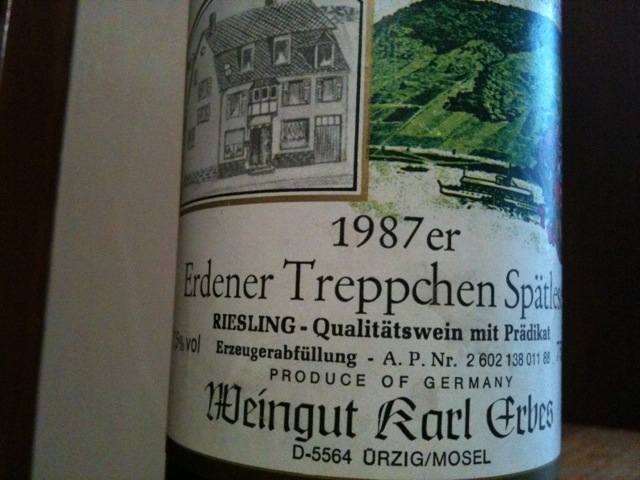
1987 Karl Erbes Erdener Treppchen Riesling Spätlese

1987 Karl Erbes Erdener Treppchen Riesling Spätlese

Wines have a unique and particular quality that I just find fascinating and it is quite singular to them: They are perfect bridges into the past.

You might say that smells, too, can carry this magic because they have the ability to transport us back to fond memories and special moments. For me, one immediate example would be the aroma that arises from baking bell peppers – it will always remind me of my beloved grandma making her awesome Stuffed Peppers.

That brings us to food, which seems to do that, too. When I visit Germany nowadays, the first thing I long for is bread and ‘Wurst’, insufficiently translated as lunch meats or cold cuts. It is what makes me feel at home. And don’t get me started on the taste of actual, real bread…

And finally, music appears to be similar: Every time I hear a particular song by The Killers, one that I obsessively listened to two years ago when working on a paper, I start re-arguing the case in my head all over again. And we all know these songs that make our hearts swell because of the connotations our brain has from when we listened to them for the first time, or many times in a row.

But there is a caveat: These three triggers for our senses cannot function as true bridges, because – in my book at least – they do not take the process of ageing or evolving into account. They lock in memory from the past, the way it was.

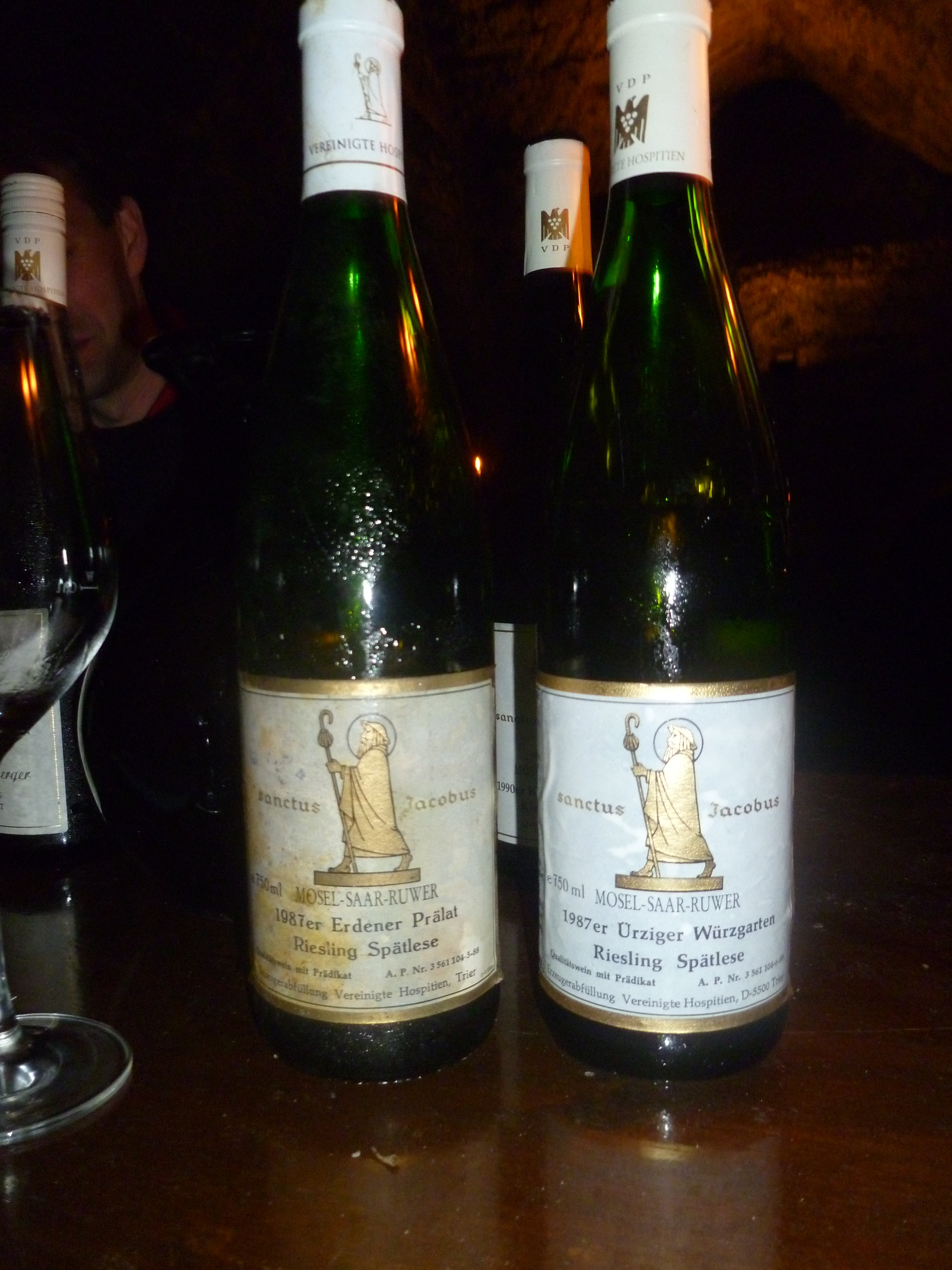
Two beauties, meant for each other

Two beauties, meant for each other

A bottle of wine from a particular year offers more than food, music or smells can offer: It offers me a taste of something that was produced at a certain time, and that did not stay the same. A substance that, just like me, has aged since it was first created. We both evolved and we both are not what we were at the time the wine was made.

But still, it brings back memories: The name of the winery will remind me of past experiences with it; the name of the vineyard might remind me of a hike in this particular hill. Or I might even have enjoyed this particular wine in the past, and just like me it has evolved since then and is not the same.

Two beauties

Two beauties

A bottle of wine gives me a chance to think of the grand scheme of things. What happened during this specific year? How did the German national team do? Or, on a more personal level, I might consider my life: Where was I at this point in time … physically … emotionally … spiritually? What has happened since? A lot of history, all captured in one sip, if you will. I love this about wine.

And there we are: This wine that transports me back in my head, it meets me in the here and now at the same time. It is a messenger from the past, that is not just a memory in my head, it is actually here. Ready to meet me and engage with me…

In that sense, a bottle of wine is like an old friend, that evolves with us, that grows with us, but still connects us to our past. So just like old friends, they are true bridges into our past.

OW5

Best buddies.

Tagged , , ,