Category Archives: Guest Blogging

Tracy Lee Karner: 2011 Forster Kirchenstück Riesling inspires happiness

Somewhere, beyond the SeaThis is the fifth installment in my guest blogger series “Somewhere, Beyond the Sea”. For this post, I asked the author, life enjoy-er, honorary German (at least in my book), and good friend Tracy Lee Karner to contribute. I met Tracy through her blog, when, on a whim, I decided to comment on her post about whether blogging is just another cherry-berry pie in the sky back in August 2012. The ensuing conversation led to more contact, and by now I consider her and her husband Ken pretty much family. What I love about her blog is that you never know what to expect when you head over there. Sometimes it is writing advice, sometimes memorization help or language tips, and sometimes just plain fun. Tracy embraces life, and her blog shows it. Also, she is among my top commenters which says something about her commitment. Long story short: Go check out her blog. Thank you, Tracy!

Sometimes it's wine, sometimes it's water that makes us happy enough to yodel...

On a fine day in May, a good drink might make a person happy enough to yodel.

“Then, because of the [wine] and mostly and mainly because we were for that one moment in all time a group of truly happy people, we began to yodel.” (M.F.K. Fisher, H is for Happiness.)

I had spent an exceedingly fine May day with my husband, my dear friend Kai and his wife, with blue skies, wispy clouds, and apple-blossom scented sea breezes. Its magnificence echoed the last May day Kai and I had been together–same weather; same invigorating realization that the season of cooing doves and joyful air has sprung; same sweet and easy friendship.

The last time in 1979 in Hamburg, we were sixteen, walking, shopping, eating and talking, talking, trying not to mention that we didn’t know when or if we would ever see each other again. I was leaving soon to live the rest of my life in America.

In the present re-creation of that wonderful day, we again knew time was short. He and his wife would end their visit and return to Germany.

But for the moment we were together and blissful, gathered around a small marble-topped table in a cafe on Federal Hill in Providence, drinking cappuccino, sharing a lusciously layered chocolate torte. I resisted that urge to yodel because it would have annoyed the people who were there to buy fresh pasta, Italian cheese, salami or olives. Besides, I’m an incredibly poor yodler.

But I was that happy, I could have raised my voice in spontaneous, merry song.

The day ended as all such days end, with tearful embraces. And then they were gone.

We had our memories and a bottle of wine, 2011 Forster Kirchenstück Riesling Kabinett Trocken (dry) Deutscher (German) Prädikatswein (quality wine with specific attributes).

Before we opened it, I asked the amazing-riesling-expert Winegetter what should I know to appreciate this gift? He willingly shared his expertise, explaining that the grapes were grown in a 3-1/2 hectares vineyard behind the Forst village church on the wine road (that’s near Kai’s home).

Recently Ken and I opened the Forster Kirchenstück as an aperitif, according to Oliver’s suggestion.

Small bottle, long skinny neck with a too-long cork, unusually difficult to open (slightly annoying). I, however, was determined to love this wine. Kai gave it to us!

In the glass: Tinged the color of a nearly-ripe yet slightly green bartlet pear, so pale as to appear almost clear. Crystal transluscence.

Nose: Faint blossoms–apple & honeysuckle. Uncomplicated. Hint of fresh grass.

Mouth: Thinnish. Fresh, quick taste of tart apple, crisp mineral undertone, short lemon finish. I’d love this with fresh-shucked raw oysters.

Overall: Nice–but Ken found a flaw. On the middle-to-back sides of his tongue, a bitter-pucker sensation, the residue of green apple peels. Recommended therefore with some reservation. Less than perfect, but pleasant enough, drinkable and refreshing.

(Thank you, Stefano Crosio, for introducing me to the Italian Sommelier Association guidelines for wine review. I really like this 3-pronged method!)

More subjectively–and why I liked the wine despite the flaw: it opened a magical window into timelessness, taking me back to Germany, October 1978. I was telling Ken all the details, about picking grapes for a vineyard near Forster Kirchenstück and eating deliciously earthy, pit-roasted potatoes out of my hand, whole, with nothing but salt.

His turn to talk: in the twenty years of our marriage, he frequently mentioned his time as sous-chef at The Wagon Wheel Lodge, but had never before described the German butchers Heinrich and Albert who educated him about Riesling.

Albert looked something like a blond, not-quite-so-plump Ed Asner. Heinrich was taller, nearly six feet, with piercing pale blue eyes. Dark brown short, side-parted hair and a face not unlike Martin Luther’s.

Those were the guys who taught Ken sausage-making, and how to drink dry Riesling (with Weisswurst, or boiled cod, and sometimes with a dense white bread, toasted, topped with an egg poached medium).

With our next sip we, of course, drank to friendships–old and new.

So what do you think? Would you like this wine? And if not, is there a particular Riesling (or any wine) that could make you yodel like Franzl Lang? (you have to click here, really you have to hear happiness!)

Tagged , , , , , , , ,

Talk-a-Vino: Liquid Pleasures Beyond Wine – Rum

Somewhere, beyond the Sea

Somewhere, beyond the Sea

This is the fourth post in my summer 2013 guest blogging series with the theme “Somewhere, Beyond the Sea”. Let me briefly introduce today’s blogger: Anatoli Levine, the man behind Talk-a-Vino. In his blog, that seems to have been around since the earliest days of wine blogging, Anatoli explores his passion for wine and everything surrounding it. He is a fountain of knowledge, and the saying among some of us that “following Anatoli’s advice means you’re on a good way” could not be truer. What impresses me most on his blog is the number 470. The current count of grapes he hast tried. Isn’t that amazing? I was excited when Anatoli offered me to republish this post which was originally written for the now-defunct Art of Life Magazine in 2011, because I do have a weak spot for rum. Thank you, Anatoli, for always broadening my horizon!

Liquid Pleasures Beyond Wine – Rum

In this series exploring the world of liquid pleasures beyond wine , we already talked about Cognac, Scotch and Whiskey – is there anything else left in the world of spirits which deserves our attention? Yes, there are still quite a few things worth our attention. Particularly, today we will take a look at past and present of Rum.

Interestingly enough, Rum has probably most significant involvement into the history of humankind, more than any other spirit. Bold claim, you say? Let’s take a look.

History of Rum starts at around 1500s, when sugar cane was brought to Caribbean islands by Spanish conquistadors. Caribbean islands happened to have an ideal climate for growing the sugar cane, and the area became a big producer of sugar. After sugar is made, the retaining mass, called molasses, was still containing a lot of sugar. Mixed with water and left under the tropical sun, it was found to start fermenting. Once distilled, this is what became known as Rum.

Rum became a drink of choice for the sailors. During the long sea voyage, water supply was quickly getting spoiled with algae. In order to make water more palatable to drink, some amount of beer was added. Sometime in the middle of 17th century, the Rum started to make its way on board of Britain Royal Navy ships – it stayed as an official Royal Navy drink until 1970, even though the ration was quite diluted with water over time. As you might remember from the folklore, pirates also embraced Rum as their symbolic beverage, which finds its reflection even in the songs, such as “Yo ho ho and a bottle Rum”.

Sad part of the Rum’s history is related to the slave trade, a triangle of sorts. Molasses had being shipped to England, where they had being used to produce Rum. Rum then was sent to Africa, where it was exchanged for the slaves, which were in turn sent to Caribbean to work on sugar cane plantations. This triangle was broken with American Revolution. At about the same time, making sugar from beets became economically feasible in Europe, which reduced the need for cane sugar and subsequently lead to lesser production of molasses. Also Whiskey started to increase in popularity in United States. All these events lead to substantial drop in demand for Rum, reaching all times minimum in the first half of the 20th century.

Increase in tourism in the second half of the 20th century, coupled with improvements in methods and technology, lead to gradual increase of the interest in Rum in the second half of the 20th century. As many other spirits, Rum started to be aged in different types of the wooden casks, which lead to increased availability of sipping Rums.

Rum production and classification is not really regulated, as each Caribbean island has its own style of production. In general, Rum is made either from molasses or sugar cane juice, which is fermented with additional of water and different types of yeast. After fermentation, the liquid is distilled (again, there are no specific requirements for the number of distillations or the distillation methods). Once distilled, there are few choices for making the final product. If so called Light Rum is being produced, then different batches can be blended together to produce beverage with consistent taste. If Dark Rum is desired, process of ageing in the oak barrels will take place after distillation. Ageing can take anywhere from 3 to 23 or 25 years. After ageing, additional blending process is still possible, again, depending on the style. One more popular style is called Spiced Rum, which is produced by adding spices to so called Gold Rum, which is a lightly aged version of Light Rum. Both Light Rum and Spiced Rum are typically used in the cocktails, while Dark Rum are perfect for sipping in most of cases.

Practically all islands in Caribbean produce their own versions of Rum, with Appleton Estate being one of the most famous rums producers on Jamaica; Mount Gay Distillery is one of the most famous producers from Barbados, also probably one of the oldest in the world (operating from second half of the 17th century). Dominican Republic, Trinidad, Haiti, Guatemala and many other islands produce Rum of different styles and ever increasing quality. If you only had Rum in the cocktails until now, this is about the time to change it. Go find a bottle of 21 years old Zafra from Panama or 23 years old Ron Zacapa from Guatemala and see for yourself how good Rum might taste. Cheers!

Choices, choices...

Choices, choices…

Tagged , , , , , ,

The Armchair Sommelier: Drinking Carmenere with the Devil

Somewhere, beyond the Sea

Somewhere, beyond the Sea

This is the third installment of my summer 2013 guest blogging series with the theme “Somewhere, Beyond the Sea”. Today’s blogger is Kirsten, “The Armchair Sommelier“. Kirsten is married to a German and has spent considerable time in Germany, to be more precise, Bavaria. But that is not the reason why I asked her for a contribution to this series. As you will be able to tell from this post, she has a wonderfully chatty tone that keeps me floating right through her blog. It is a quality I enjoy a lot. She mixes information with impressions and keeps you entertained while at it. Most of all, I am drawn in by her awesome food and wine pairings, which have put me on a mission to get myself invited to her table. One of these days…Thank you, Kirsten!

Drinking Carmenere with the Devil

I always thought the Devil lived on a cul-de-sac in Hell.  He doesn’t.  He lives in a wine cellar at the Concha y Toro winery in Santiago, Chile.  A couple of years ago, I visited The Devil’s Cellar (El Casillero del Diablo).  The Devil and I hit it off, and before I knew it, we were drinking Carmenere together.

This is the Devil’s Cellar, and there’s the Devil, pitchfork and all.  This picture makes me think about that little kid from The ShiningRedrum  Redrum  Redrum.  Creeptastic.

So how did the Devil wind up living in a wine cellar in Chile? 

Don Melchor de Santiago Concha y Toro founded his eponymous winery in 1883.  Many of the first grapes he planted were vines he brought from Bordeaux.  That will be an important detail in about 4 paragraphs, so stay with me.

According to legend, over 100 years ago, Don Melchor hid some of his finest wines deep in his cellar.  Over time, some of those bottles started disappearing.  Don Melchor was convinced the locals were stealing his wine.  And, knowing the locals were a highly superstitious lot, he started a rumor that the Devil lived in his wine cellar . . . and the stealing stopped.  Cue dramatic music.

The bars on the cellar amuse me.  Like bars are going to keep the Devil inside.

Bars

The bars

Even without the Devil’s red party light, this kind of dark and creepy makes the hairs on the back of my neck twitch.  Would you steal the Devil’s wine??

The cellars

The cellars

When Don Melchor wasn’t hanging out in his wine cellar with the Devil, he and his family lived in this Devil-free manor house.  Not too shabby, eh?

The mansion

The mansion

After we emerged unscathed (mostly) from The Devil’s Cellar, our tour guide told us the story of the Carmenere grape – a story that reads like a CSI script.

Before phylloxera decimated French vineyards in the 1860s, Carmenere was considered one of the great red wine grapes of Bordeaux.  When French vineyards replanted with phylloxera-resistant North American rootstock, Carmenere didn’t take well.  And so it was written off as collateral damage — lost forever.  Nobody even bothered to put Carmenere’s picture on a milk carton.

BUT . . . rewind.

Back in the 1850s, some pre-phylloxera Carmenere vines had been exported to Chile.  People in Europe forgot all about those vines because they were so distracted by the phylloxera plague.  Don Melchor planted some of those Carmenere vines at Concha y Toro.  And because Chile’s terroir is largely immune to phylloxera, Carmenere survived . . . and thrived.

But Carmenere can’t catch a break.  Somehow, the Carmenere got lost in a Merlot vineyard, and everyone just thought it was Merlot.  Whose job was it to babysit the Carmenere vines?  My money is on the Devil.

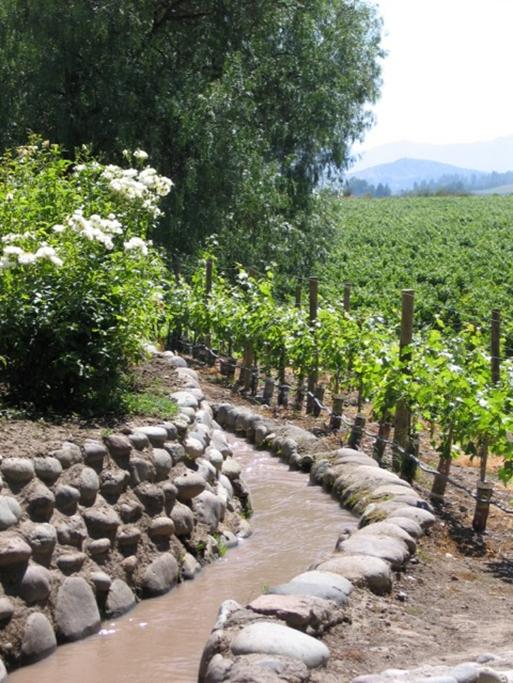
Can you find the Carmenere?

Carmenere Vineyards

Carmenere Vineyards

Chilean wineries unwittingly sold and marketed Carmenere as Merlot for over 100 years.  Until about a decade ago, when a few folks with ultra-sensitive palates noticed that Chilean Merlot had stronger and spicier flavors than Merlot from anywhere else in the world.

Several DNA tests later, Chilean “Merlot” was identified as Carmenere.

Pre-phylloxera Carmenere.  Carmenere wasn’t extinct –- it had survived the phylloxera plague!  This is the viticultural equivalent of finding a dinosaur egg in your backyard.

Just to clarify, this is not the Devil.  This is the Devil’s Hostess.  She poured us a glass of Carmenere from The Devil’s Cellar.

Tasting Carmenere

Tasting Carmenere

And you know what?  Carmenere from the Devil’s Cellar is pretty tasty.  For a bargain red ($10ish US dollars), it’s tough to beat.  I’ve been buying Casillero del Diablo Carmenere as my party red for years now.  It’s not overly complex, but always reliable and fun.  It’s also widely exported, so you can find it almost anywhere.

Casillero del Diablo

Casillero del Diablo


So the next time you’ve got $10 burning a hole in your pocket, pick up a bottle of Casillero del Diablo Carmenere . . . and have a drink with the Devil!

Salud!


Special thanks to Oliver at The Winegetter for inviting me to write a guest post for his blog.  I had fun writing it . . . I hope you have run reading it!

Tagged , , , , ,