Category Archives: Germany

2005 Studert-Prüm Wehlener Sonnenuhr Kabinett

A liquor store find

Do you know those moments when you are browsing through the lined up wines in a liquor store or wine store and you make a find that has you intrigued? Well, this was one of them. While I was browsing the rather random collection of wines displayed at the local liquor store a couple of weeks back, some of the wines quite overpriced, others weirdly underpriced, some of them stellar wines, others I was wondering, I saw this lonely bottle on their riesling shelf.

An aside: I understand that it is easier for liquor stores to group their wines by grape variety, but I still am not really happy with it. I would much prefer to have them grouped regionally…but that might just be me.

Studert-Prüm winery is part of Germany’s elite winemaker guild VDP (Verein deutscher Prädikatswinzer), an association which you can only join by being suggested and voted into by its members. They have certain, higher/stricter requirements for growing their wines (like less hectoliters per hectar etc.). The winery is located in  Wehlen, now a suburb of Bernkastel. According to their website, they produce about 40,000 bottles per year from their 5 hectares of land. It is an exclusively riesling producing winery in the 12th generation (producing wines since 1581), with holdings in the top vineyards Wehlener Sonnenuhr, Graacher Dompropst and Graacher Himmelreich, as well as Bernkasteler Graben. 80% of their vines are non-grafted.

Wehlener Sonnenuhr is a top vineyard on the Mosel. The name means “Sundial of Wehlen”, and it is named after a sun dial that was installed in the vineyard in the 1800s. You can find a couple of sun dial vineyards (Brauneberger Juffer Sonnenuhr, Zeltinger Sonnenuhr, even the Ürziger Würzgarten has a sun dial in its core) along the Mosel, and most of them are pretty good. Unfortunatley, as all too many vineyards on the Mosel, later, what used to be about 5 hectares just around the sun dial, was expanded to a 45 hectare vineyard, because other winemakers wanted to profit from the name. The idea of terroir seems to have completely eluded folks back then. Similar things happened to the Piesporter Goldtröpfchen, the Ürziger Würzgarten and many others. So, it is always good to know whether the grapes actually come from around the sun dial or further away…

My friend Man-Soo (who else?) introduced me to their wines and I have always liked them. So, when I saw this bottle, marked down from $22 to $13, I figured why not give it a try. There are some issues with liquor stores, mainly how they store their bottles (standing rather than lying, the temperature in the store…), but at that price it was worth a try…most newer riesling kabinetts are not necessarily made for ageing, so it was also unclear how this one was intended to be. On the other hand, 2005 is considered a spectacular vintage in Germany, so why not try it?

We decided to open it with a riesling loving friend of ours, whose husband has recently discovered that he finds older rieslings interesting. We classicly paired it with a cheese platter of gruyere, goat gouda, goat cheese and a brie type soft cheese.

Upon opening, the wine poured clear and lightly yellow. It had a somewhat dusty smell to it, overall a quite subdued nose. On the palate, it had contracted quite a bit, with initial petrol notes. As the wine opened up, it showed more citrus flavors and the dust settled down a bit. There were signs of ripe grapes. The wine was probably past its peak (which I would blame on the storing rather than the wine itself), but still it paired exceptionally well with the cheeses, especially the brie type, where the slight moldiness of the cheese met with the dust and citrus flavors. They greatly complimented each other, but it also worked well with the gruyere, the saltiness of the cheese pairing off with the citrus.

It was an interesting experience. I would love to try this wine when it was properly stored. It was the last bottle they had at the store, so I also am not tempted to go back and try another bottle.

Check out the vineyard here: http://www.weinlagen-info.de/#lage_id=1585.
Tagged , , , ,

Comparing Kabinett and Spätlese via 2011 wines by Weiser-Künstler

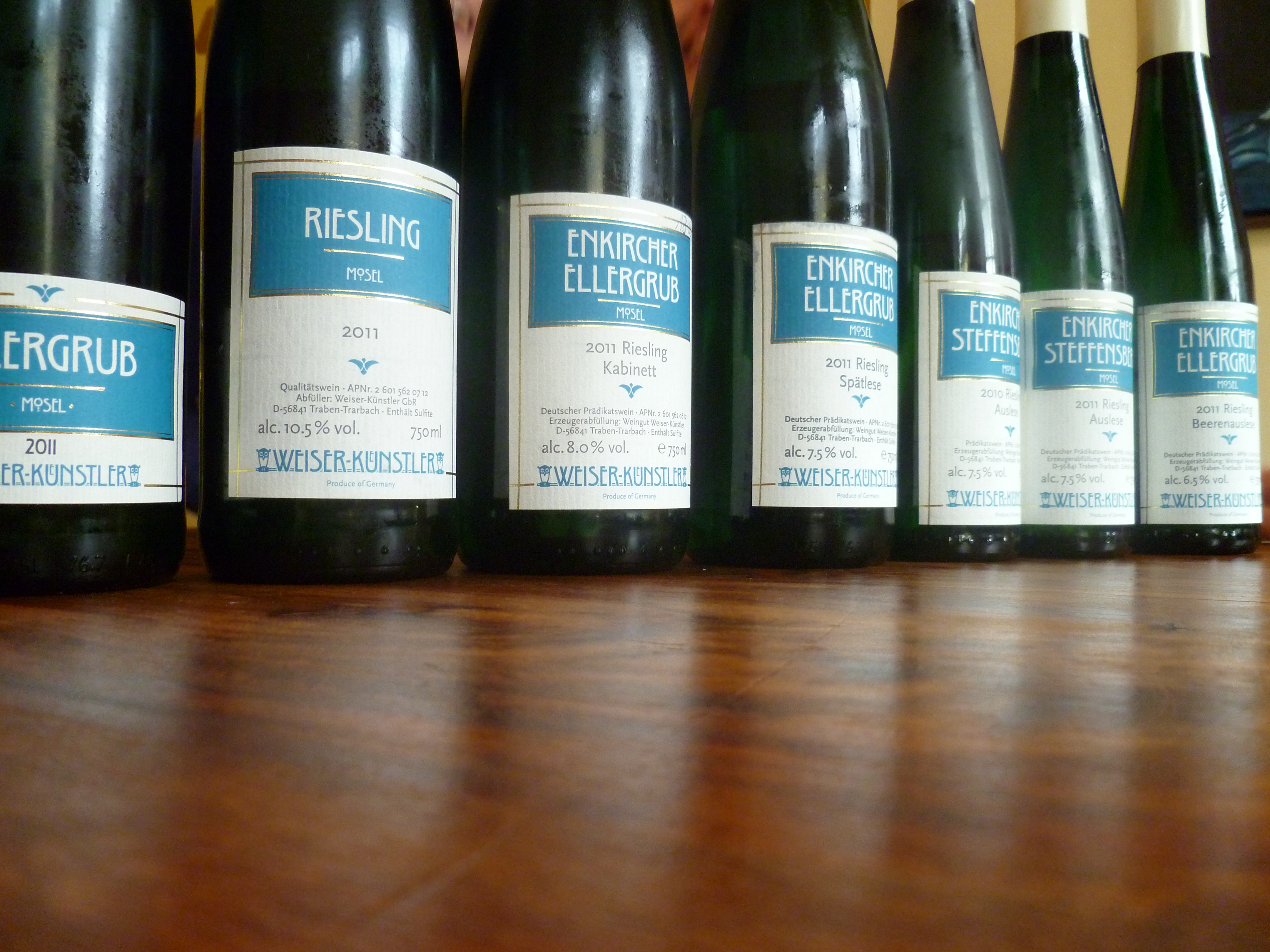
The row

Way back in August when I wrote about my winery visit at Weiser-Künstler in Traben-Trarbach (see here), I promised to write a comparison of the kabinett and spätlese styles from the same vineyard, the Enkircher Ellergrub, because I feel like they show the difference in the two styles very well and it gives me a chance to explain these two a bit more.

Kabinett and spätlese are two levels in the German wine classification system, kabinett being the entry level wine with distinction (Qualitätswein mit Prädikat), and spätlese the next level. Technically, they are defined by the German Wine Act of 1972, and this classification is only based on the residual sugar in the grapes at harvest time (defined by degrees on the Oechsle scale). The winemakers measure that with a so-called refractometer in the vineyard, measuring the density of the grape juice that is dripped onto the instrument. When the grapes reach the required sugar level (Kabinett: minimum 70 degrees Oechsle for the Mosel; Spätlese minimum 76 degrees Oechsle for the Mosel), the winemaker can harvest them. That is why the different levels of distinction can come from one and the same vineyard. The winemaker simply harvests batches as they ripen. Usually, the more sugar in the grape, the longer the grapes where on the vine and exposed to the sun. But if it rains a lot, the grapes can also soak in more water and therefore have lower sugar levels, so rains at harvest time can be detrimental for the classification.

You might have noticed that the levels of distinction only know minimum values: 70 degrees for kabinett, and 76 for spätlese (both at the Mosel). That means that a winemaker can designate a wine a kabinett that technically could be labelled spätlese or even auslese. It happens frequently and has led to much confusion among wine drinkers. Now, why would a winemaker do that? With the temperatures continuously rising in Germany over the last decades, we have seen Oechsle measurements rising as well. In the 1970s, when the Wine Act was passed, 76 degrees oechsle was a lot. Nowadays, it is standard, and would be considered a low measurement. That puts winemakers in a bind. If you harvest too early, when the sugar content in the grape is still low, the grape is also not ripe, which leads to aromas in the wine that you really don’t want. But if you only produce auslesen, consumers and restaurants will not buy your wines,  because an auslese does not sell very well in a restaurant, being a typical dessert wine. So, a lot of winemakers have begun down-labelling their wines.

On the one hand, that is great for consumers, because you get wines that would normally be more expensive at the price of a kabinett. But on the other hand, it also produces heavy weight kabinetts, that have nothing in common with the lighter, fresher image that kabinett has. And that can be frustrating if you open a bottle with a certain expectation, and then find a spät- or even auslese in there. If you know what you get, that is fine, but if you have not had the wine before, it can ruin your plans with that bottle.

True kabinetts are remarkable wines, and it is harder and harder to find them. One of my favorite Mosel wine review teams (Moselfinewines, more on them in a separate post) lately admonished wine makers to produce these beauties again. They argued that it is easy these days to make spätlesen and auslesen, but that the true challenge is producing classical kabinett wines and that winemakers that want to shine, should focus on these, because there is definitely demand for them.

How much nicer is it, when you actually find two distinct wines in a winery portfolio that highlight the difference in the two wine styles in amazing precision. And that is where Konstantin Weiser of Weiser-Künstler comes in. He produced a very clean kabinett from the Enkircher Ellergrub and you can compare it with the spätlese from the same hill.

The 2011 Weiser-Künstler Enkircher Ellergrub Riesling Kabinett had a nose of spontaneous fermentation, something I will write about in another post in more depth. Suffice it to say that the wines initially are more smelly/stinky when poured than you expect, which levels out after a bit. On the palate, the wine was lean, with yellow fruits and enough acidity to carry it. The wine held a perfect balance of acidity and sugar and was just great to drink. It was refreshing and easy to drink.

The 2011 Weiser-Künstler Enkircher Ellergrub Riesling Spätlese, which just like the Kabinett was harvested from exclusively fully ripe grapes without any noble rot, in contrast already showed a higher viscosity in the glass with peach notes dominating. Upon reaching my palate, it became broad, filling out my whole mouth. It had a wonderfully silky texture, with strong aromas of peach and a nice level of acidity (impressive in the 2011s!). It had a long finish, and just showed wonderful elegance, beauty and depth.

What a difference a couple of degrees Oechsle can make…give both of them a try, if you get a chance.

PS: After writing this, I checked the Moselfinewine review, and apparently they are of the opinion that the Kabinett has a spätlese feel to it and the Spätlese an auslese feel…hmmm. I am not sure I agree, the tasting was back in June and my notes do not read that way. That said, they both got raving reviews: 93 points for the Kabinett and 92 for the Spätlese.

See the vineyard here: www.weinlagen-info.de

Tagged , , , , , , ,

Sunday read: 800 years Schloss Vollrads in the Rheingau

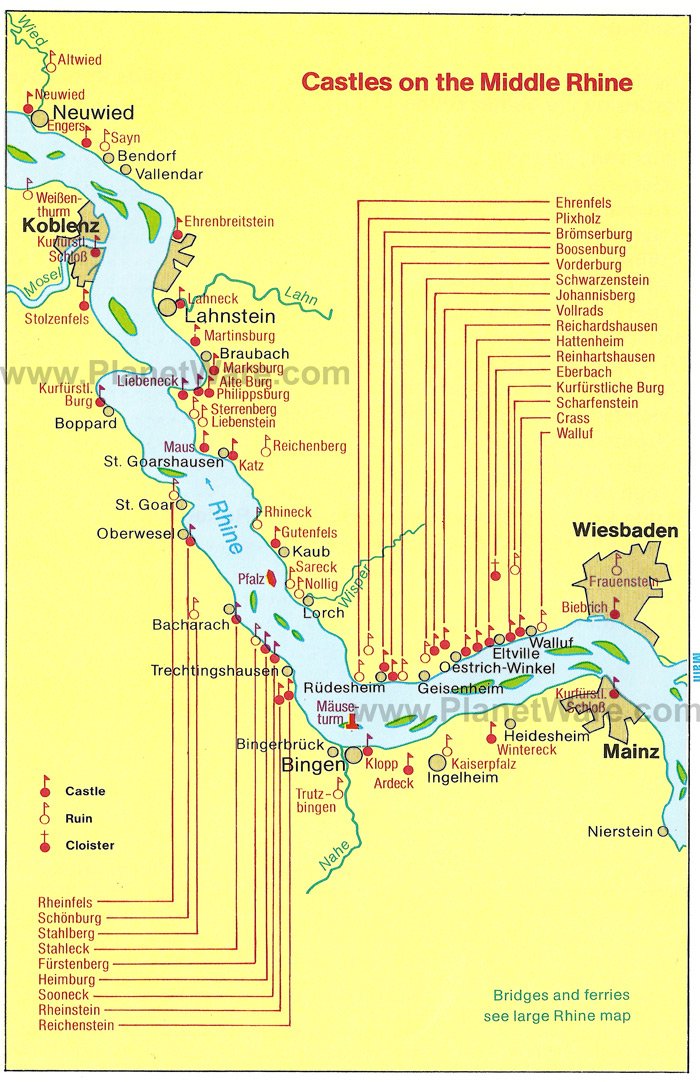
This weekend, I want to direct you to Schloss Vollrads, a winery in the German region Rheingau. Within Germany, the Rhine flows rather straightforwardly north, with a slight northwestern bent. But at one point in its course, for about 50 kilometers, the Rhine takes a southwestern bend, from Mainz (I grew up just south of it) to Bingen. This is the only time in Germany, that vineyards on the Rhine in Germany get full southern exposure facing the Rhine. This map is focused on all the castles along the Rhine, which is just one of the reasons why it is so beautiful there…but it also shows you how the Rhine flows and how the northern bank is fully exposed to the south.

The Rhine Valley between Mainz and Bingen (Photo Credit: www.planetware.com)

Why is that important? Germany is one of the most northern wine countries. Historically, our grapes need as much sun as they get, because it does not get warm enough for them to fully ripen. That is one of the reasons why most prime vineyards are fully south exposed, to get as much sunlight as possible, and even better, get the sun reflected from the river.

But back to Schloss Vollrads. The winery celebrates its 800th consecutive wine harvest this year, and that makes it the oldest running winery on the planet. Just mind-boggling.

Chris Kassel over at Intoxicology Report, wrote a piece in his inimitable style to celebrate their birthday! I had tremendous fun reading it, and I hope you will enjoy it, too!

Happy Sunday!

A Bit of Gloss for The Schloss Sauce: 800 Vintages and Going Strong!

Tagged , , , ,