Monthly Archives: August 2013

Some random thoughts on alcohol in Thailand, Laos and Cambodia


Check out these cheap wines in clearance.

Disclaimer: I entered into a tentative agreement with the online wine retailer Wine Chateau under which they sponsor two of my posts per month. Wine Chateau has no influence on the topic I select for the post or its content. Opinions expressed are all mine.

Nina and I have been traveling in Thailand, Laos, and Cambodia for about 6 weeks now. We are currently on one of the islands of Ko Samui, Ko Phangang or Ko Tao in the Gulf of Thailand. We are feeling the exhaustion of 6 weeks on the road, thousands of kilometers travelled on poor roads in sleeper busses (with beds!), normal day busses of all ages and makes, minivans and trains as well as on foot. Being in a totally different place every three to four days is very taxing. We have made many experiences, but I want to focus on wine for a bit, in line with my blog…this post will actually not be about wine very much, simply because of the circumstances in these three countries.

In all three countries, beer seems to reign supreme: most of you probably know the Thai megabrands of Chang and Singha. In Laos, Lao Beer dominates the market, with a Leo here and there and Nongkham, which I enjoyed most. In Cambodia, the national champion is Angkor, but there is also Cambodia  Beer and Kingdom…the latest newcomer is apparently “Ganz Berg”, a beer that advertises as “German Premium Beer”, yet I have no clue what it is, and its advertised website is not active.

Finding wine can be difficult, and if you find it it is clearly a luxury product that is heavily taxed. In the wine market, Chile, Australia and France seem to dominate. That is a bit odd, if you try to pair them with local foods, which should be rather difficult. But on second thought, wine is usually consumed with Western foods, not local foods, thus further making it difficult for wine to be embraced and incorporated into local culture. The only wine “product” we have tried so far was “Spy”, a wine cooler produced by a Thai company. They come in the craziest colors and flavors, the best having been the shiny blue “Kamikaze” which tasted like lemonade. Still kind of depressing…

There are developments and changes, but it is happening slowly. In Chiang Mai, in northern Thailand, wine buffets are apparently all the rage. We saw several places offering pretty much an all you can drink buffet which, however, was limited to their housewine only, lasting for two to three hours each night and costing around $10. Which tempted us, but somehow it never happened due to other plans. As I mentioned a while ago, there are also wineries in Thailand now, and I will have the good fortune of visiting the well renown GranMonte estate before we leave Thailand. I will definitely write about that visit in the future…

Globalization is taking hold more and more. Besides the different global wine countries present, we have been able to find German Franziskaner Weissbier (a German wheat beer Nina likes) and our beloved Savanna Dry (a South African cide), just to name a few.

This is my last post from our trip and I want to close with some random impressions:

  • The soft drink Fanta comes in all sorts of flavors and colors. We saw: red (strawberry), pink (lychee), green (tastes like chewing gum), purple (grape), blue (no clue).

  • Easily the best and most affordable food of the three countries is available in Thailand.

  • Chiang Mai rightly lays claim to a great coffee culture, Pakse in southern Laos tries but doesn’t deliver.

  • Lao kids are the best.

  • After traveling in Laos, Cambodia seems like a rich country. After entering Thailand, Cambodia seems like a poor country.
  • We had the best French baguette of our whole trip on Koh Samui, in a bakery run by a young Frenchman from Marseille. Divine.

  • You will find most French tourists in Laos and on the southern Thai islands. Most Dutch tourists by far are concentrated in Cambodia.

  • Upon return to the US we will have to buy a wok, so Nina can make use of the Thai cooking school skills she acquired. Also, we will need a professional blender, so she can make her beloved banana shakes.

  • There are more 7/11s in Thailand than in Canada.

  • Lay’s produces an insane variety of potato chips, from Nori Seaweed flavor to lobster or “American cheesy paprika” or shrimp ginger curry flavor to Sweet Basil Chili (our favorite).

  • Visit Laos sooner rather than later. It is rapidly developing and I fear might lose some of its charm in the near future.

  • After a few weeks, haggling becomes exhausting.

  • Pyjamas are an acceptable piece of clothing for women in Cambodia.
  • Showers are often just attached to the bathroom wall without seperating structures, so your toilet seat is frequently wet.

  • Quail eggs are an everyday staple in Thailand. You can buy 10 fried quail eggs as a snack at street vendors for $1.

  • McDonalds, Burger King and KFC in Thailand offer delivery services.
Tagged , , , , , , , , ,

The Wine Raconteur: Torbreck “The Factor” 2001

Somewhere, beyond the Sea...on Zanzibar.

Somewhere, beyond the Sea…on Zanzibar. 

This is the eleventh installment of my summer 2013 guest blogging series with the theme “Somewhere, Beyond the Sea”. Let me briefly introduce today’s blogger, who was most generous in sharing an earlier post with us. John “The Wine Raconteur” was new to blogging, like me, when I stumbled on his writing. We both had started our blogs in May 2012. His was actually one of the first blogs I came across and followed. We have since interacted on numerous occasions and met in person. I consider him a friend. In his blog, The Wine Raconteur, he explores restaurants, foods and wines. For John, wine and food is about moments and memories, not scientific analyses or tasting notes. With this approach, he covers an under-appreciated side of wine and food writing. His undying curiosity and vast knowledge in wine as well as the combination of fresh and old memories keeps me coming back to his blog again and again. Thank you, John!

Torbreck “The Factor” 2001

“Somewhere, Beyond the Sea”

Torbreck "The Factor" 2001

Torbreck “The Factor” 2001

It is my honor and privilege to make another appearance on the pages of this popular wine blog.  My name is John and I write about wines as “The Wine Raconteur” and I am guest writing another article for my good friend Oliver at his request, while he and his wife are on holidays.  The word “raconteur” is an old way of saying a story teller, and most of my articles are woven around a memory and a wine, as I do believe that wine should be enjoyed and there should be a great memory of the occasion.   As I stated in my other guest article, Oliver gave me the theme of “Beyond, The Sea” and I have presumed that he meant that I write about a non-domestic (American) wine.   Since my last article was across the pond about a French wine Chateau Latour 1961 a famed wine from the Commune of Pauillac of the Medoc, I thought I would traverse the other body of water and discuss a wine from the Barossa Valley in South Australia, Australia.

I was managing a clothing store, that was popular at the time, and we had plenty of customers that not only enjoyed quality clothing, but also quality wines.  This was a major “pro” for the store, but unfortunately there were a few more “cons” to this establishment, but that is not germane to my story.  There were always some beverages on hand for the customers, and there were times when the customers brought in their selection to share as well.  One memorable day a customer brought in two different vintages of Opus One wine from Napa Valley, suffice it to say that it was a great day, but not business wise per se.  Let me just add, that one of my unlisted duties when I was hired was the ability to wash and maintain a collection of crystal wine glasses, as we had both stemmed and stem-less wine goblets for the customers.   Thankfully most of the customers that drank beer did not require a glass.  Sometimes there were discussions about wine and other subjects, with the least interest in adding to one’s wardrobe at the moment, but that was a rare time.  I have found that the subject of wine is a great “ice-breaker” when meeting new people and it is popular discussion point and that some people have very strong opinions of certain wines and areas.

As I sit here looking at a wooden box which is my temporary muse, that at one time held a magnum of wine this is another story.  The marketing of magnums especially in individual wooden wine boxes, I think is a great plus, while it may add a small cost to the total package, I do believe it proclaims to the customer that yes, this wine should be taken seriously.  The wine was a Torbreck “The Factor” 2001 from the Barossa Valley in South Australia.  Torbreck Vintners, the winery was founded by David Powell in 1994 and he signed the back label of the magnum near the numbering of number 195 out of a count of 240 magnums that were bottled of this wine.  Mr. Powell named his winery after the Torbreck forest in Scotland.  The wine “The Factor” was his homage to the great old Shiraz vines of the Barossa Valley and one of the mainstays of most of the wineries of this area.  The manager on a Highland estate is referred to as “The Factor,” hence the proprietary name.  This particular varietal grows well in several parts of the world, but I must say that Australia has been a big promoter of this type of wine, and now other areas have also had great results with it as well.  One of the reasons that this wine is so full and rich in flavor is that it spent twenty-four months in French Oak barrels with thirty percent of them being new.  This is not a wine that was made for quick consumption, as the nuances and traits of these old vines were allowed to mature in the barrels properly.  Torbreck Vintners also produces several other varietals as well as some other “named” wines.

As my regular readers know, I tend to soak off labels and store them in scrapbooks as an easy way to remember wines that I have enjoyed.  Also many other labels have become the “wallpaper” on a couple of walls in my cellar as well.  This particular set, alas though empty now, has been kept intact as a curio in my cellar and a great talking point.  I guess my collecting interest goes beyond just cellaring and drinking wines with good friends.

“We’ll meet, I know we’ll meet.  Beyond the shore.”

 
Tagged , , , , , ,

Talk-a-vino: Surrounded by the Ocean – Truro Vineyards

Somewhere, beyond the Sea

Somewhere, beyond the Sea

I am happy to present you with a second article by Anatoli Levine of Talk-a-Vino for my summer guest blogging series “Somewhere, Beyond the Sea”. Anatoli, as most of you might have noticed, has been a source of knowledge and has been very generous over the last year by sharing and encouraging me. It has been a special pleasure when he volunteered a second article which literally takes place between the seas. Thank you, Anatoli!

Surrounded By the Ocean – Truro Vineyards

Ocean to the left, and ocean to the right. Vines in the middle.  Almost precisely half a mile in each direction. Ocean is Atlantic, to be precise. And the vines? Truro Vineyards.

Picture 1

Truro Vineyards is one of the only two vineyards and wineries which are located on Cape Cod. While Truro Vineyard came into existence only in 1992, the same land was successfully farmed for almost 200 years, producing grains and feeding cows. Sandy soils and maritime climate came in handy when the time came to produce grapes.

As many other wineries on the East Coast (both New York and New England), Truro winery takes an interesting approach to the  wine making. Well, I don’t mean here specifically how the wine is made, but rather how the grapes are sourced. The grapes which are growing well locally of course are sourced locally. Truro vineyards include 5 acres of Chardonnay, Cabernet Franc and Merlot. The grapes which are not doing well locally, are brought from the other regions, where they are actually doing well – like Zinfandel and Pinot Grigio from California, or Vignoles from Finger Lakes. The rest is in winemaker hands…

Picture 3

The winery is definitely fun to visit, starting from the little signs telling you in which direction and how you need to go to reach Napa (3,100 miles) and Loire (3,561miles) – the last number makes me curious – with such a precision of 1 mile, where exactly in Loire are we supposed to be? Well, no matter, as guess what – it will be hard to prove them wrong…

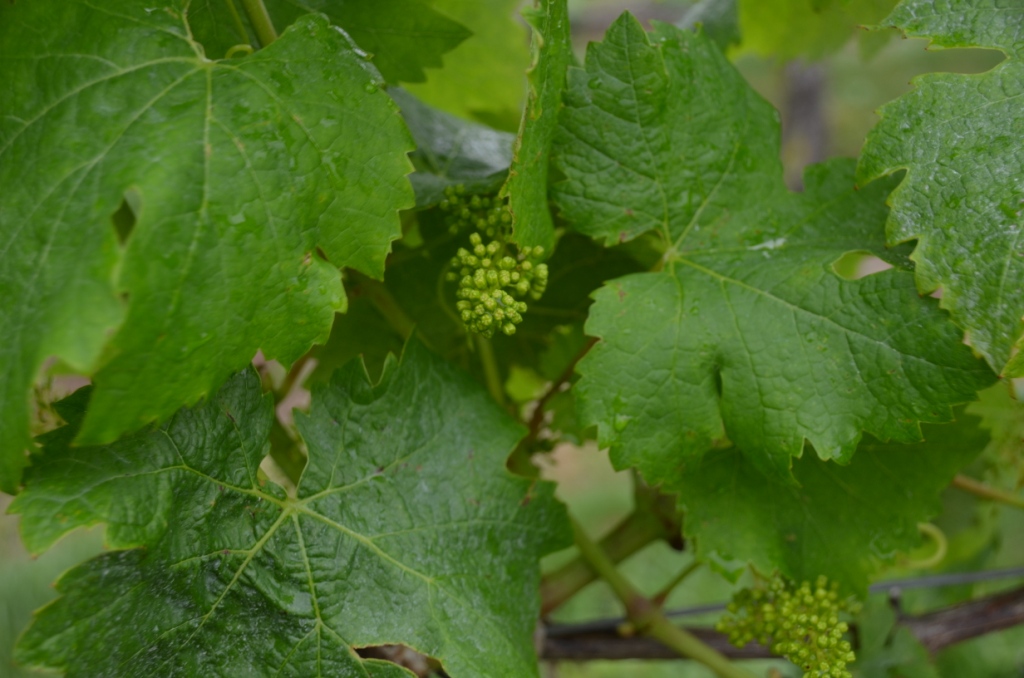
There will be grapes...

There will be grapes…

I love seeing the vines in all different stages – last year I took my first pictures of the vineyards in the Fall, with the beautiful range of colors. This year – it is vineyards in the Spring, when you know that the grapes are coming… it will just take a bit of TLC and time… (yep, going fancy here – Tender Love and Care, in case you are wondering).

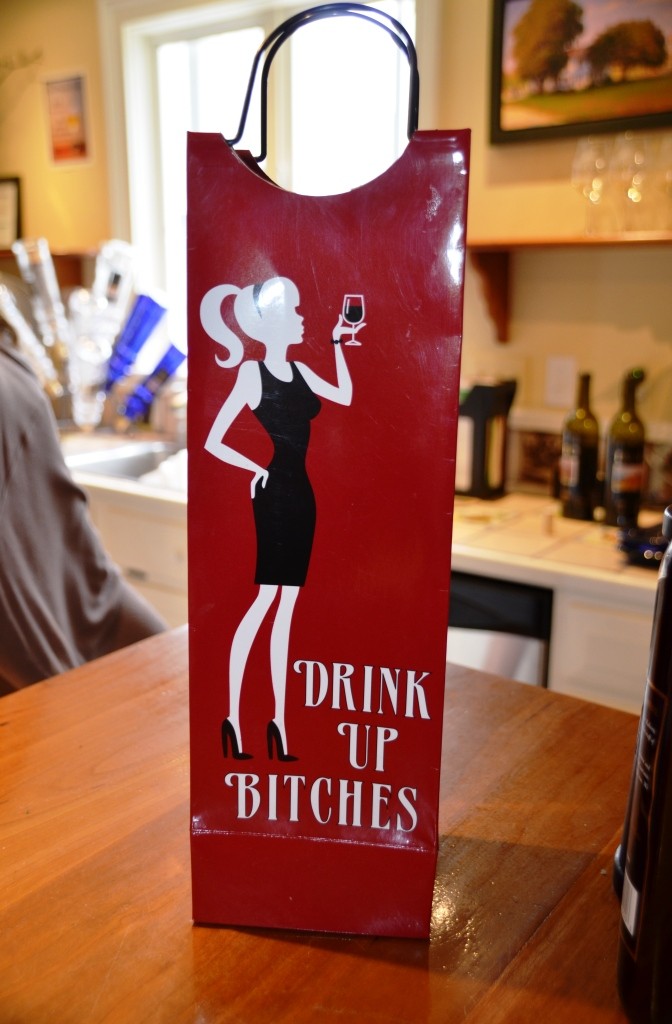
Fun outside continues with the fun inside – there are so many little things, like printed napkins, which help you not to take the wine too seriously:

Picture 12

And of course, there were wines, some of which we tasted, and some of them we did not (there was no open bottle of Sparkling wine, so I only have a picture, but no taste).

Picture 9

The tasting was organized and run every 30 minutes (there were a few of the winery tours throughout the day, but for the most of the cases I’m skipping those). The tasting consists of 5 different wines for $10, so it is good to spilt the tastes with the companion, as the whole tasting flight consists of 10 wines. This is what we did, so I managed to taste all 10 wines. Without further ado, here are my notes.

2012 Pinot Grigio (California fruit) – kind of okay, some green notes, but if I don’t have to be politically correct – meh. NR

2010 Estate Chardonnay – 100% local grapes, barrel fermented and aged  for 9 month – well, yeah, it was Chardonnay, I presume – some butter notes, but all over the place, very disorganized, lots of acidity and no fruit support. NR

2012 Vignoles (Finger Lakes fruit) – very nice, refreshing, sweet start, hint of tropical fruit and peaches. Drinkability: 7+

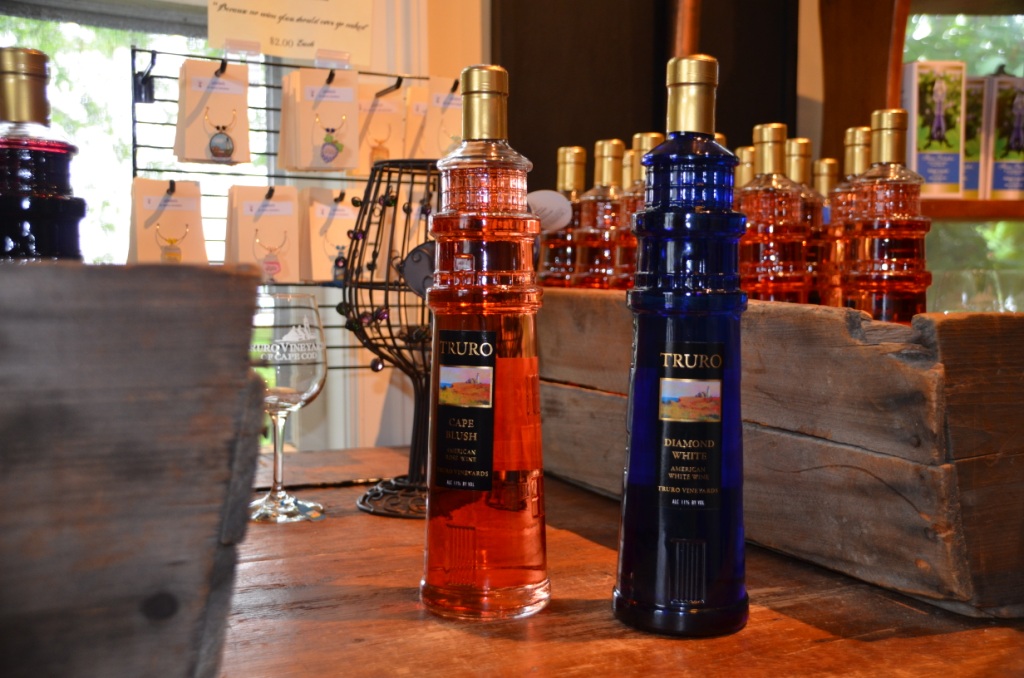
Cape Blush Lighthouse – a blend of Cayuga (Finger Lakes region) and Cabernet Franc – too sweet, needs acidity. Good strawberries, a bit flat overall. But the shape and form of the bottle easily compensates for all the shortcomings. NR

Yep, we are on Cape Cod

Yep, we are on Cape Cod

2011 Cabernet Franc – 100% local fruit. Outstanding. Classic Cabernet Franc nose, same on the palate – green bell peppers, red fruit, very clean and balanced. Drinkability: 8

2011 Zinfandel – California fruit (typically arrives in mid-September). Excellent wine. Very un-Californian, clean raspberries profile, pretty light for the typical Zinfandel , easy to drink. Drinkability: 8-

2011 Merlot – local fruit. Nice structure, good red and black fruit on the palate, good balance. Drinkability: 7.

2011 Triumph – Bordeaux-style blend of Cabernet Sauvignon, Cabernet Franc and Merlot. Again, very classic Bordeaux in style, with red fruit on the palate, some dry herbs and touch of dark chocolate, medium body. Drinkability: 7.

Cranberry Red – another lighthouse-shaped bottle. Blend of Rougeon and Syrah grapes with infused cranberries. I had high expectations based on the appearance, and it didn’t work for me at all. Not good. NR.

Diamond White – one more bottle in the lighthouse series. 100% Moore’s Diamond grape.  Excellent overall – lychees, tropical fruit, pineapple and honeydew are clearly distinguishable, but all well balanced with underlying acidity. This can be considered a light dessert wine – it doesn’t come through as heavy.

Well, friends, your virtual visit is over. If you are visiting Cape Cod, Truro Vineyards definitely worth your time, an oasis of vines and wines almost in a middle of the ocean.

Picture 17

Until the next time – cheers!

Tagged , , , ,