About a week ago, I was asked for ideas for blind tastings. As in what motto could work. I had a couple of ideas, and I figured why not share them, and some more general thoughts on tasting wine at home with friends.
I have great memories of tasting wines with friends at our or their home. There is something inherently communicative in wine. First of all, wine is a sensory experience: We look at the wine, then we smell it, and then we taste it. If the bottle has a cork, we even get to hear the “plopp” when it comes out. Second, wine is also an emotional experience. We taste a wine that we picked out, that we have some sort of connection with. That is even true for supermarket wines, because there was some reason in the first place why we bought that bottle. Maybe we have tried the wine before and are curious about how it will taste like now. Maybe it is a first, and we are not quite sure. Maybe it is a vintage that has some importance to us, and maybe we have been at the winery…there are so many emotions connected with opening a bottle. Wine brings all these emotions back to us.
So, we have a sensory experience and we have an emotional experience. I don’t know about you, but moments are usually enhanced by having a friend and loved ones around me because I need to share them. Sometimes it might be nice to have a bottle alone, but I definitely prefer sharing the experience under most circumstances. Besides, I also am curious what my friends think, how they see the experience while at the same time it is also a great way to find out what your friends drink and like.
In order for the tasting to work, I want to make sure that the people sharing the experience care about wine. In my view that is a crucial point. You can have a great evening with friends drinking wine when the wine is not supposed to be the star. But when you are tasting wines, when this is what you want to do with your friends that particular evening, then the ones joining you should be at least interested in wine.
So, apart from that, what am I suggesting?
First I’d narrow the field down a bit by picking a theme for the tasting: It can be grape varietal; or just the color of the grape; it can be a certain vintage; or a region; or even just wines from one specific vineyard that everyone cares about; your favorite summer wine or everyone brings a bottle of a wine they have never heard before….the topics really are endless and depend on your group. If my friends care as passionately as me about Mosel riesling, then we can do just a Mosel riesling tasting. If you don’t quite know, pick a broader topic.

I fell in love with this wine Yutaka brought for a white tasting at our place in July 2011: a 2000 Van Volxem Scharzhofberger…incredible.
My rule of thumb is to have around 6-7 people tasting, and every person is supposed to provide one wine each (you can up that number, too). With that number of people you need about one bottle per wine tasted and have some marginal leftovers. Also, I think 6-7 wines is a good number to start with…
After that, you have to make a decision on whether you want to do a blind tasting or an open tasting. In a blind tasting, everyone brings the bottle without disclosing what it is. Someone (usually the host or someone with some wine experience) should be designated to bring the wines in a tasting order (dry to sweet, light to heavy). That takes some experience, so don’t shy away from stepping up if you are the one with the most experience or relinquishing that position if you don’t feel up for it. The wine is then served covered (in a brown bag for example) and sampled without knowing what it is.
In my experience, a blind tasting is fun if people are willing and ready to share their thoughts on the wines without being afraid or hesitant, without fearing they might say something wrong (which is usually the case once everybody knows each other, feels comfortable with everyone). We did a lot of these blind tastings with my friends ManSoo and Yutaka, and what I learned from them is this: Nothing is wrong in the description of wine. If it tastes like soapy water or sweaty socks to you, then it does. So don’t be afraid to say it as you taste it. Nothing is wrong. But the exchange of ideas on what we smell or taste can help all of us identify traits in the wine that we otherwise might not have noticed.
For starters, especially if the group has not done a tasting together before, I suggest doing an open tasting. Everyone brings a bottle, as I said, and then you group them in the same way as for the blind tasting (light to heavy, dry to sweet). I suggest having everyone introduce the wines they brought before you try them. Let us know the story behind the wine, why did you bring it, what made you choose it, are there memories or anecdotes connected to it? I always want to know these stories…
Between wines, it is good to clean your palate with bread or water. I find bread the better cleaner, but that might just be me. If you’re not going for drunk, you might also hydrate once in a while…
One thing that we have begun to incorporate, is to provide everyone with tasting sheets by De Long Wine Discoveries, which are a great way to get you focused on what you have in the glass. It is by no means necessary, but definitely has helped me quite a bit.
As the evening progresses, the talk leads from wine to other subjects, and as the wines keep flowing the conversation flows, too. Don’t focus too much on the wines, but let them have their place at your table, like friends or acquaintances that came to the party. I suggest taking some notes, it always helps me to remember afterwards. But it is just as fine to free-float. The main thing is enjoying the company and the moment. As pretty much always.
I also suggest starting with some food before the tasting, a pasta dish or just a cheese platter or something. It is better to have something in your stomach before you start.
We’re having a tasting with a group of friends tonight. I’ll let you know how it went…
PS: As the host, you want to make sure to have some back up bottles ready (something sparkling or desserty), to serve before the tasting or after, in case there is some need…which there often is.

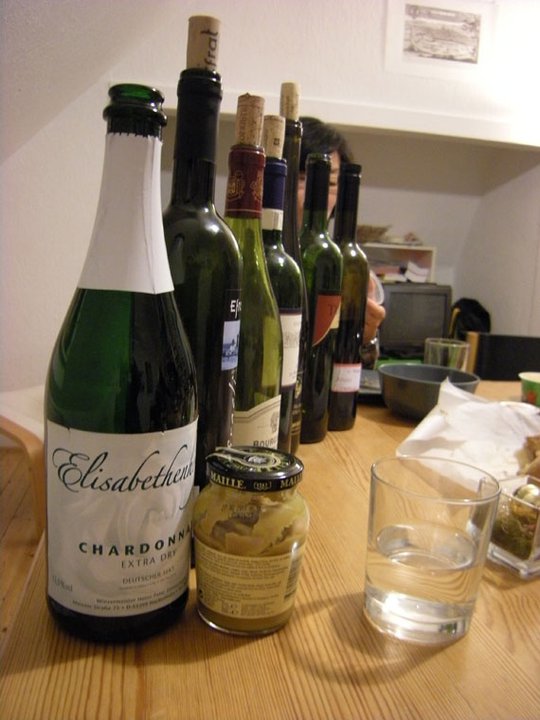
The line up at a red wine tasting in January 2011 (started with a sparkling wine, finished with a port)



 the winegetter