
Somewhere, beyond the Sea
For this instalment of my guest blogging series “Somewhere Beyond the Sea” I am happy to present you with the writing of fellow wine blogger Mariusz Rybak, who writes the excellent blog Kawa & Vino . Mariusz is a young man that travels the unbeaten wine paths. While his writing on Italian wines is great, I find his pieces on wines, wine making and wine culture in the Balkans the most compelling thing about his blog. He has opened my eyes for this region that I know next to nothing about. His style is educational and entertaining. He has really made me want to visit the area now. I am very happy that he readily agreed to write a post for this series. Thank you, Mariusz!
Trebinje – The Wine Capital of Republika Srpska
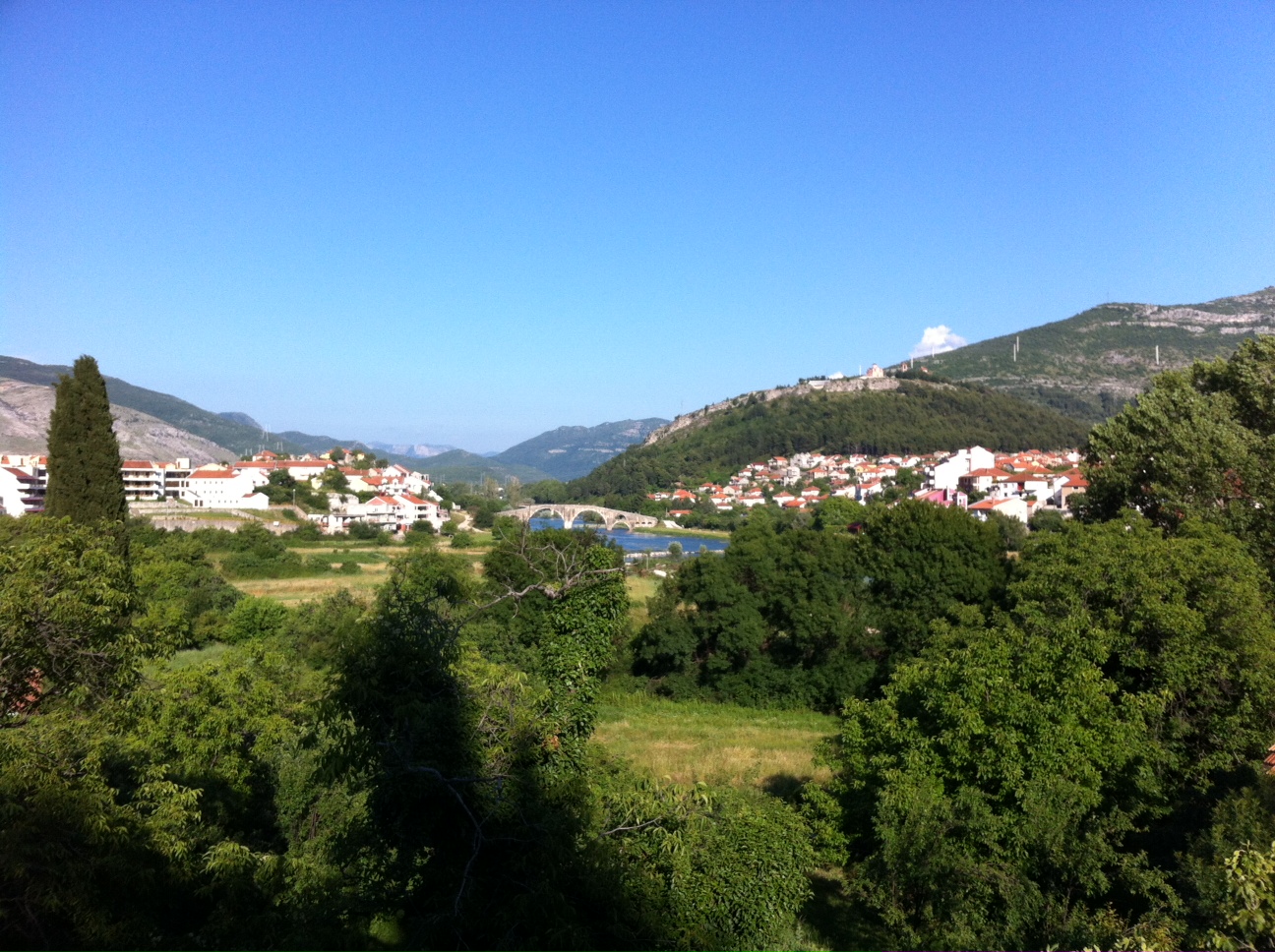
Trebinje is a small town, lost in the dry mountains of the southern edge of Herzegovina. Hidden in a deep valley, it may resemble end of the world, when entering it. But I knew that there are some experienced producers of quality wine there and my trip to this town did not disappoint me at all. More: I could not stop marveling over the assets Trebinje enjoys.

Trebinje
As lost as it may appear, it is not difficult to reach – situated in the corner between Croatia and Montenegro. It is all about a short drive from Dubrovnik or Herceg Novi, both highly touristic spots of the eastern Adriatic coast. The town is located in Republika Srpska, which should not be confused with Republic of Serbia. The former one is a part of Bosnia and Herzegovina, within its patchwork-like postwar political and administrative system.
Staying in the centrally situated hotel “Platani,” I had the small historical center around me, and the old famous plane trees above, after which the hotel was named. Tired, I went to the first nicely looking restaurant: “Tarana”. Over there I ordered 0,5 liter of their house wine and a plate with Herzegovinian prosciutto ham (pršuta) and hard cheese marinated in olive oil (sir iz ulja). This is one of the places where “vino de casa” is not worse than any other one sold by bottle – their white is Žilavka from Anđelić. This was divine food and, as I discovered later, only a modest beginning. The aforementioned Žilavka got a medal from the Decanter: a dry but fruity wine, of a golden-green color, elegant in its structure and so different from many rich, strong whites of the Mediterranean climate.
The next day I took a cab to the Monastery of Tvrdoš, which is – I guess – not more than 5 km from the town center. The typically small Orthodox church is from the very beginning of the 16th century, constructed on the ruins of older temples, the earliest one from the 4th century. But the big part of the winery is rather new. The monastery has a long wine making traditions, which suffered from the Turkish, and later from the two World Wars, the communism, and the war in Yugoslavia. As a matter of fact, they started their quality wine production only in the early 2000s. In the cellars, I was warmly received and the long talk, I enjoyed with one of the cellar workers, was only shortly disturbed by groups of tourists coming to visit the church and have a tasting of wines and spirits.

Tvrdos Monastery Winery
The monastery has seven wine and three spirit labels, the spirits produced from grapes too. As every respectful producer of the region, they have their Žilavka, an autochthonous variety, appreciated much by the Austrian-Hungarian emperors, who sourced it from a Hungarian producer in Lastva, a village to the south of Trebinje. Tvrdoš’ Žilavka was a beautifully balanced white, mineralic and with refreshing acidity. The strong sun, additionally reflected by limestone, makes the wines strong though, this one containing 13,7% of alcohol. The vines grow on stony, dry and poor soil with their roots reaching deep into the rock. It is not unlikely that the name could be traced from the word “žilavost,” meaning tenacity and strength. I’ve heard once that genetically Žilavka is not that far from Riesling and indeed whoever loves German and Austrian Rieslings most probably will appreciate tenacious whites from Herzegovina too. But also the Chardonnay “Oros” (Greek for “mount”) proved to be an elegant wine – with its fruity and honey notes and spiciness. My first red was Merlot, blended from two vintages: 2008 and 2009. It’s called “Izba” – an old Slavic word for cellar or pit-dwelling. In medieval times, monks kept their wines in such an izba. This light plumy wine was beautifully rounded by oak, its exciting herbal notes underlined. Good start before the 2007 Cabernet “Hum.” There are few Cabs that I don’t find tasting like all others, myself being only a moderate fan of this variety. In this one, I love its fresh acidity, forest berries – first of all, European blueberries, and bitter herbal accents. But Tvrdoš’ champion is Vranac, my bottle being from 2010. The harshness and fruitiness are mixed in a lovely tradition of this part of the world. Vranac gives wild and strong wines, acidic and heavy, particularly in its most prominent terroirs around Lake Skadar in Montenegro. In Serbia and Herzegovina, producers try to make it rather modern, tame it and reach this way more elegant creations. This one is even sweetish in aftertaste, revealing caramel-like, cherry and dried cranberry notes.

Wines of Tvordos Monastery
For a late lunch, I went to a restaurant that was recommended by everyone I asked for a good place to eat. I won’t keep its name secret, although I maybe should. Still, I’m aware that the mountains of Herzegovina will stay a barrier high enough to quick and exaggerated commercialization, and thus tradition destruction (see: Dubrovnik). In the “Konoba Studenac,” I had fresh trout, the restaurant being situated at the Trebišnjica river. I took also grilled red bell peppers, which are marinated with garlic and herbs – an all-Balkan tradition. The wine I had was again Žilavka from Anđelić’s cellars. The river simmered, the wine simmered – I felt like a dessert, and it had to be happiness, because otherwise I was full after all that fish they served me. I had a huge portion of tulumbe pastries.
On Monday, I started my week in the Vukoje winery, which is considered one of the best wineries in the whole Southeastern Europe, their tasting room wallpapered with medals and prizes. The producer has even more labels than Tvrdoš, so this time I tried only some wines, selected by my host. We started with the 2007 “Zlatna Vukoje Selekcija Bijela” – a product from selection of best Chardonnay (60%) and Žilavka (40%) grapes. They call this cuvee a golden selection and indeed there is sun and aromatic herbs inside, so typical for the local whites. The wine is oaked for 12 months, and enchants drinker with notes of almond, dry figs and quince. The second glass was filled with 2007 Cabernet “Tribunia.” Tribunia is an ancient name of Trebinje and designates a varietal wine series from international grapes. This elegant Cab seduced me by its forest fruit and tobacco (?) notes. Its sweet and tart notes as well as tannins were well balanced. Oak was used only to its advantage. Also, it has a potential for aging to satisfy with increased complexity of its fruity bouquet. Further, we compared Vranac “Rezerva” from 2006 and 2008. The former one is not available in the market anymore – what a pity! Its smell – alluring honey, sour cherry, chocolate and tobacco notes, becomes richer every time your nose is diving into the glass… pepper, cinnamon… there is the original wildness of Vranac visible, reemerging with age. The younger Vranac was less acidic, with notes underlined by oak more assertive. Its original wildness was tamed and hasn’t reappeared yet. There is something like honey acidity – kind of modern character but with traditions! Personally, I preferred the older one, but I strongly believe in the potential of the young.

The cellars at Vukoje
In the afternoon, I went to Vukoje’s restaurant, kept much in the Slow Food spirit. They source the majority of their ingredients from the local organic producers. I begun with a „Herzegovinian plate” being a mix of several delicious starters, for example, hard goat cheese aged in olive oil, two or three kinds of pršuta, cheese and herb pita (more like burek than pita bread from the Middle East). All this was served with freshly baked bread. My aperitivo was a glass of travarica – grape rakija with several herbs, rosemary being the most important one. The main dish – chicken breast fillet, stuffed with collard leaves (Serbian: raštan, Croatian: raštika), with slices of ham and in creamy mushroom sauce – was served with wine: Vukoje’s Žilavka. This was an awesome combination, although afterwards I came to the conclusion that a glass of Pinot Noir would be even a better pick.

Vukoje Wine Bottle
From the restaurant I took a taxi to the Anđelić’s cellars. I was lucky since I arrived in the moment when they were closing. Here, like in other two wineries, they are expanding their production and facilities for visitors – an impressive growth in this hardly known part of Europe!
Since I knew their Žilavka, I started with Chardonnay “Žirado,” and this was a shock. This aromatic, buttery but fresh wine, with a scent of ripe apple, was dry and tasted like semi-sweet, but what’s more, it tasted like “Jagoda” from the winery of Botunjac, in Serbia. However, Jagoda is a unique variety in the Župa region, so how comes that Chardonnay gives a wine with impressively similar aroma and character? Funnily, the producer said that it perfectly goes with štrudla cake. So does the “Jagoda!” Confused, I grabbed the glass of Rosé from Merlot, called “Lira.” It has an interesting copper color, like diluted port wine. The smell was intense, kind of cooked strawberry. Astonishingly, this is the strongest wine of the cellar: 14,5% of alcohol. The first red was a cuvee of Vranac, Cabernet Sauvignon and Merlot called “Tribun” – a very subtle and balanced wine of beautiful color. Pure Vranac, also from 2009, had of course more temperament; yet, it had a delicate aroma of bilberry and something earthy. Afterwards I got a drive to the center and my wine trip to Trebinje was basically finished, my bag full of notes, my head full of memories.
Trebinje seems to be an exception al piece of earth, hot and dry, but giving balanced and elegant wines, although usually quite heavy and rich. Beautiful as a town, close to such touristic attractions like Dubrovnik, Mostar and Kotor, it surely deserves more attention… especially from wine lovers.

The heart of Republika Srpska’s wine country

 Check out these cheap wines in clearance.



 the winegetter