Tag Archives: wine

MWWC #3: Possession

wine-stain1-2

Monthly Wine Writing Challenge #3

This post is part of the Monthly Wine Writing Challenge, which is now in its third round. Sally of My Custard Pie wrote the best piece last month around the theme trouble (this is what I could muster) and threw out the next challenge: Possession. Find the full info on the contest here.

I am a lawyer by training. And sometimes, this training, and the way of thinking it teaches you, can be a curse. So, when I read the theme for this month’s wine writing challenge, possession, my head got stuck on the legal meaning of possession. You see, the law distinguishes between ownership and possession. It is an important distinction, but in colloquial language and understanding, it often gets completely blurred. Now, ownership is a much better right to have, because it gives you exclusive rights over something. Possession, in contrast, only gives you a derived right. Derived, because the thing we are talking about belongs to someone else…

Why did my head get stuck on this distinction when we are talking about a wine writing challenge? Because possession, just like ownership, plays a huge part in the German wine growing world. I remembered a video I watched last year, posted by Denise Medrano, in which Ernst Loosen of the fabled Dr. Loosen winery takes a group through their vineyards in Ürzig, the Ürziger Würzgarten. It’s a long video, and rather boring at times, but what struck me was what he talks about from time mark 4:20 or so until minute 6. That part is not boring!

Ernie is talking about who “owns” which part of the vineyard, and as you can see, it is really tricky. In the most remarkable sentence he states that seven single vines (yes, single vines!) are bordered by four different wineries. What he does not mention is that some of those vines are not even owned by the wineries that work them, the wineries merely have legal possession: they leased the vines.

So much better than Hollywood

So much better than Hollywood…yet who owns these vines?

When you think of wine estates, many imagine the large, sprawling wine estates in the New World, where one winery owns hundreds and hundreds of acres of vines, all in neat rows, belonging to that one winery. The situation in a lot of Germany is different (and not just Germany, I think it is similar in other European wine growing countries): Wine has been grown for 2,000 years. Families have split, and with them ownership over land was split. The Catholic Church had huge holdings, which were later dismantled. But quite a bit of that land is actually still owned by the Church. But most bishoprics have given up making wine themselves.  Add to that the decline of active wineries in Germany because many cannot make a living, and there is a sizable amount of land under vine that is owned by persons that don’t even make wine.

What do you do with these tracts of land? Most of the land is in steep hills, or in areas that cannot be developed in another way for legal or geographical reasons. But the land might actually be quite valuable. And some people are not interested in a full payment to transfer ownership, they rather get a yearly rent (in money or even wine) and retain ownership. According to statistics by the German statistics office, over 60% of agricultural land under production is leased, not owned! In Rhineland-Palatinate, home to the large wine regions Rheinhessen, Palatinate (Pfalz) and the Mosel, 66% of all agricultural land is leased (I couldn’t find data just on wine).

This leads to a lot of possessive relationships in the vineyards. These are regulated by contracts which stipulate the exact duties (how does the possessor need to take care of the vines? Who is responsible for replanting when the vines grow old and tired? etc.) of lessee and land owner. A short research on Google revealed contract forms by two bishoprics leasing out land under vine. These contracts are many pages long. The contracts run for a set number of years, and it is common that after the end of the lease, the vines are rented to another wine maker…so the one who tended them for, let’s say, 20 years from one day to the other loses the right to use to these vines…
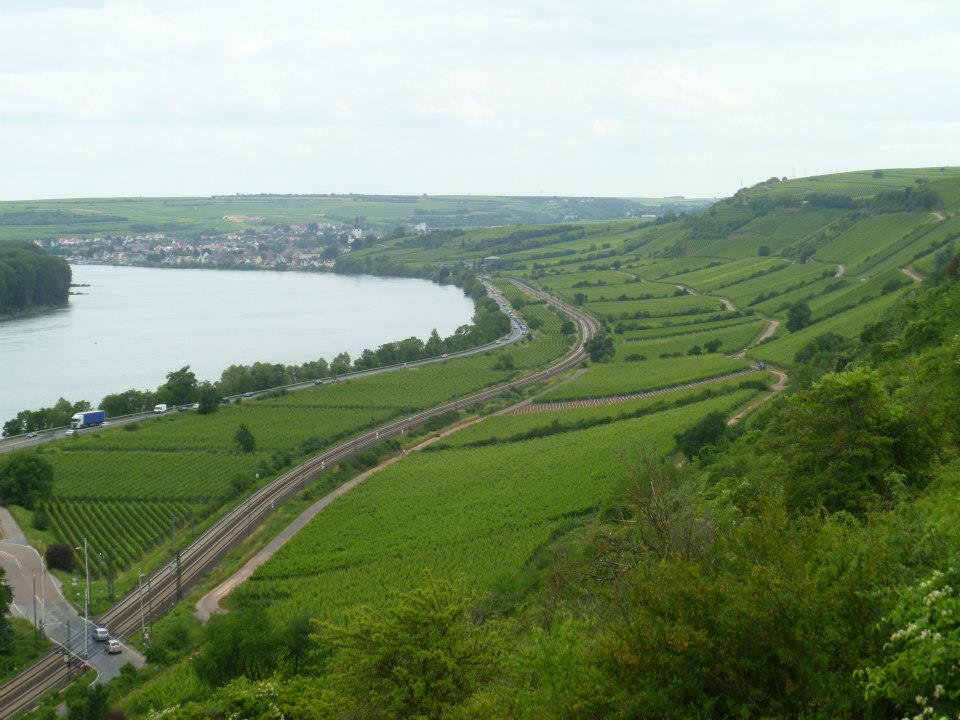
Roter Hang viewed from Nackenheim southwards to Nierstein

Roter Hang viewed from Nackenheim southwards to Nierstein

These relationships are beneficial for both parties, though. Take my friend Stefan Erbes of Karl Erbes. His family has been making wine in Ürzig since the 1960s, yet the most fabled of vineyards in the neighborhood was out of reach: Erdener Prälat. That tiny little parcel of land actually has seven or eight wineries tending to the vines in it, although ownership might be more obscure. Last year, Stefan was able to lease a teeny tiny bit of vines in the Prälat, and since the vines are already in place, he will be able to make wine from this top trophy vineyard for the first time this year already. On the other hand, the current owner does not lose his or her stake in this piece of land which, very likely, will continue to grow in value.

Well, this got us on quite the tangent, and is not necessarily the first thing that comes to mind when speaking of possession. But I just thought it was an important piece of information about German wineries. That the land they produce their wines from might never have actually been owned by them. Some of them are just possessors…
Tagged , , , , , , , , , , , ,

Sunday Read: Finger Lakes Region – Where Riesling Rules

I will be participating in the Finger Lakes Wine Alliance 2012 Riesling Launch virtual tasting on September 16. The tasting will be conducted from 8pm until 9pm EST via tweets on Twitter and a live stream on USTREAM, where a panel consisting of the participating wineries’ winemakers will answer questions. The hashtag is #FLXWineVT. Come join if you find the time! The participating wineries are: Knapp Winery, Lakewood Vineyards, Lamoreaux Landing Wine Cellars, Lucas Vineyards and Glenora Wine Cellars.

I have been doing some reading preparing for the tasting (and the wines have arrived at my house courtesy of the Finger Lakes Wine Alliance) and I found the article I want to share today one of the best reads. It gives a good introduction into what Finger Lakes wine country feels like and what current trends and ideas are. I have yet to visit the area, so I don’t know how true the impressions are, but they helped me in better understanding what is going on.

Lettie Teague seems to want the Finger Lakes wineries to focus more on the core message: Riesling, Riesling, Riesling. I am not sure whether that is the only way to go. I have tried some really good wines from other grape varieties, so I think it is legitimate to tout those credentials as well. In any case, it is time to visit the Finger Lakes in person…

Happy Sunday, and come join the tasting tomorrow!

Lettie Teague: Finger Lakes Region – Where Riesling Rules

Tagged , , , , , , , ,

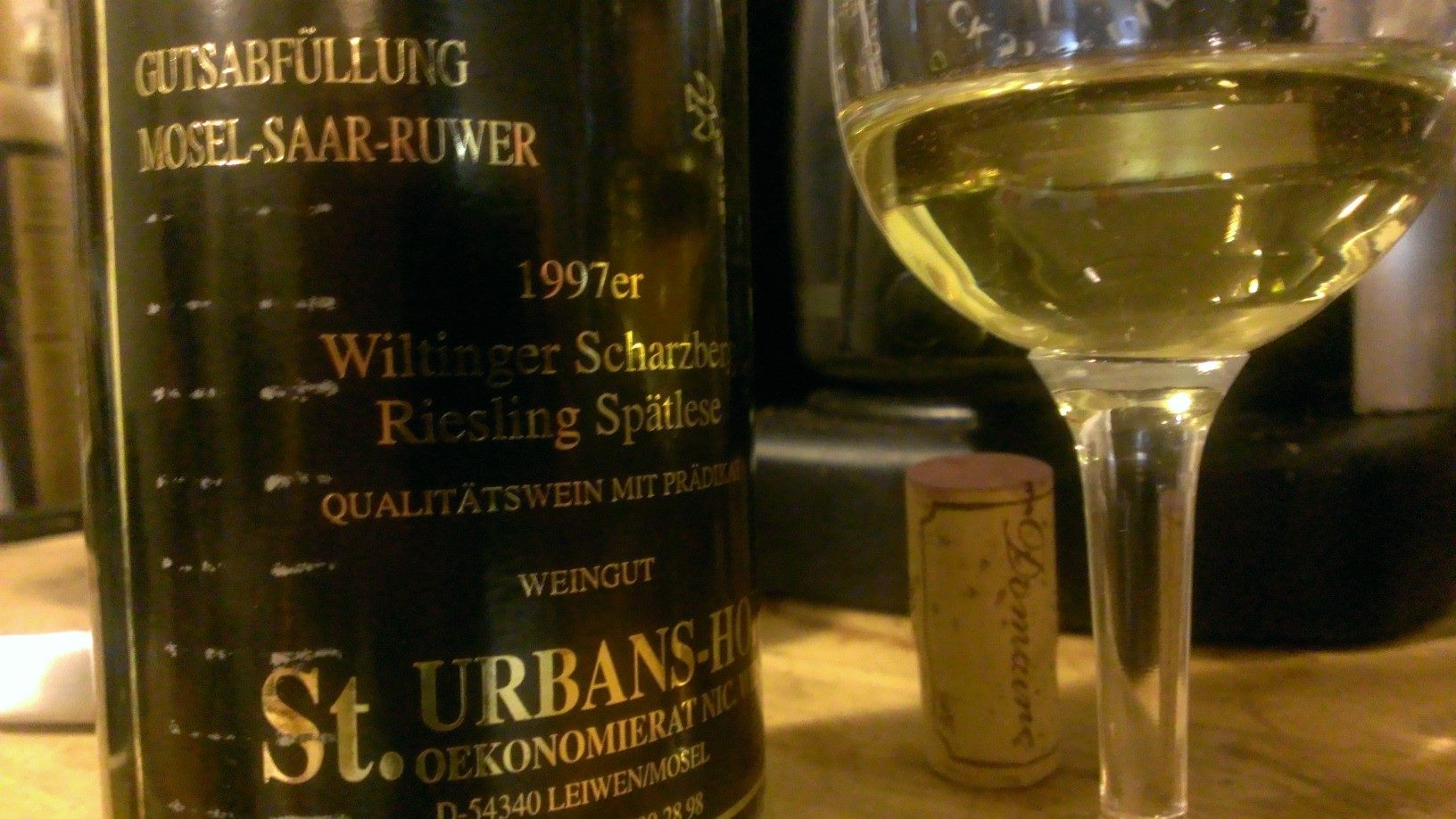
1997 St. Urbanshof Wiltinger Scharzberg Riesling Spätlese

1997 St. Urbanshof Wiltinger Scharzberg Riesling Spätlese

1997 St. Urbanshof Wiltinger Scharzberg Riesling Spätlese

Some of you may recognize the iconic black label of St. Urbanshof, because I have previously written about a wine from this winery, a wine I really like. This one however, a St. Urbanshof Wiltinger Scharzberg Spätlese, does take us back a couple of years (1997, the year in which I finished my alternative military service, the year in which I first moved to Trier to take up my studies, and oh did I hate Trier and Mosel valley at the time for being forced to go to my fourth choice school despite very good grades…but I digress). I need to write a somewhat longer introduction on this one…bear with me.

When Nina and I visited Germany last year, we naturally spent time with our wonderful friend, my wine mentor and former Korean teacher ManSoo (you have heard that name often enough by now). During our long, delicious dinner, he was gracious and kind enough to open many bottles of Riesling, among which were a just degorged 1992 Riesling champagne and this bottle of wine, a 1997 Scharzberg from St. Urbanshof. The wine had, as all wines do, a history: ManSoo had laid hands on some of these bottles through the president of Saar-Mosel-Winzer Genossenschaft, a cooperative that mostly makes Sekt, the German champagne, but also other wines. If I remember correctly, the president told ManSoo that he found several cases of this wine in the deep cellars of the cooperative. The wine label bears a special imprint that shows a bird and reads “Singapore Duty Not Paid – Not for Sale”. What the heck? Well, turns out that this particular wine was bought by Singapore Airlines to be served in first class service in the late 1990s, early 2000s and it was a special bottling. Apparently, Singapore Airlines had not taken all of the bottled wines, so some ended up, for whatever reason, in the cooperatives cellars….and now ManSoo got a couple of bottles.

We tried the wine back in June 2012 and really liked it. And I had firm plans to write about it, but to this day I have been unable to unearth the tasting notes from that evening….usually a sign that I had a tremendous time, but also quite unnerving!

Fast forward to May 2013. Friends of ours are heading to Denmark for a wedding and have the idea that maybe ManSoo could send them 12 bottles of Riesling for them to take home, because they love Riesling. So I contact ManSoo, tell him to send a package to Denmark, give him an idea of the price per bottle, and tell him “you know what we like”. Which was horribly unclear and naturally ManSoo assumed that the wines were for Nina and I. So he decided to ignore my pricing ideas and packed a box of very much more expensive wines than anticipated. When my friends posted photos of the contents, I almost screamed out at the screen! We were able to rectify the situation by them bringing the wines, and us exchanging them for wines more in their price range that we already had here….

This box, besides many treasures that I intend on sharing with you as we progress, contained a bottle of this wine, the 1997 St. Urbanshof Wiltinger Scharzberg Riesling Spätlese. Some of you might know that I am very fond of the vineyard Scharzhofberg. Notice the -hof- which differentiates that vineyard from the current bottle. It is confusing, and I believe it was designed to be confusing. The 1971 German wine act created 160 vast tracts of land under vine (so called Großlage) which received certain names which any winemaker who produced wines from that area could use. Some of them might sound familiar to you: Kurfürstlay, Michelsberg, Schwarze Katz, Domherr, Gutes Domtal and Rehbach, to name a few. Let me be clear: Winemakers were allowed to use these names for grapes that come from anywhere in that vast area. It is the opposite of terroir idea or single vineyard denominations, although it sounds like a single vineyard denomination…

The name Scharzberg is awfully close to Scharzhofberg, and one can only surmise that it was chosen to make sales easier because of that proximity in name. It is rare that one finds the name of the Großlage on a bottle from a renown producer. Usually, they put the single vineyard on there or, if they don’t, they do not even bother to put the Großlagen name on there and just sell it as a regional or even German table wine. Why did they do things differently on this one? I don’t know…but it is noteworthy.

After this long introduction, let me get to the wine which we shared with the carriers of the box it came in last week. The cork was dried out and very crumbly. I cursed myself for not having brought my two-prong bottle opener, which would have dealt with this situation. As it was, I had to crumble out what I could, and then push the last bit into the bottle. We then poured the wine through a very fine sieve into a decanter, where we let it sit for about 15 minutes.

It poured in a honey-tinged yellow with hints of green in the glass (it looked much more golden in the decanter). Great color. In the nose, the first thing I noticed was a vibrant acidity. There was also petrol, which I expect in a Riesling this age (not necessarily in a young Riesling, mind you!). There were also some honey aromas, but the most prominent for me was tangerine. The wine smelled quite citrussy, I noted down lemon rind and some butter aromas. One of our friends remarked that it smelled like kumquat to him, and I think that nails it: it was a tad more bitter than tangerine, so kumquat definitely made sense. The nose was just beautiful. There was so much going on, and it had this vibrant freshness to it, despite the cork disaster that made me cringe. On the palate, the wine was light bodied with great acidity, and I mean that, just  a backbone of great acidity. The residual sugar did its job of balancing the acidity beautifully. The wine tasted incredibly fresh, was very creamy (something I usually associate with Scharzhofberger). Fruit-wise I got gooseberry, petrol, white currants, tangerine and some slight vanilla. The wine’s finish was rather shortish.

It was a great wine. So fresh, so well held up. It brought some silence around the table, while everyone was pondering it and comprehending it. I was glad we got to share it with our friends, who are both Riesling nuts and are able to appreciate a good bottle of Riesling. But then again, I seriously believe this bottle would have impressed anyone, even the fiercest Riesling hater. It made me remember the dear friendship that brought the wine to me, and it brought memories of the night I first tried it. It made me feel damn lucky. This wine is not available anywhere for sale as far as I know, and yet I have been able to try it twice already. I’m a lucky bastard, I know…Oh, and thank you Singapore Airlines for never picking up all the bottles!

Tagged , , , , , , , , , , , , ,