Tag Archives: spätlese

Comparing Kabinett and Spätlese via 2011 wines by Weiser-Künstler

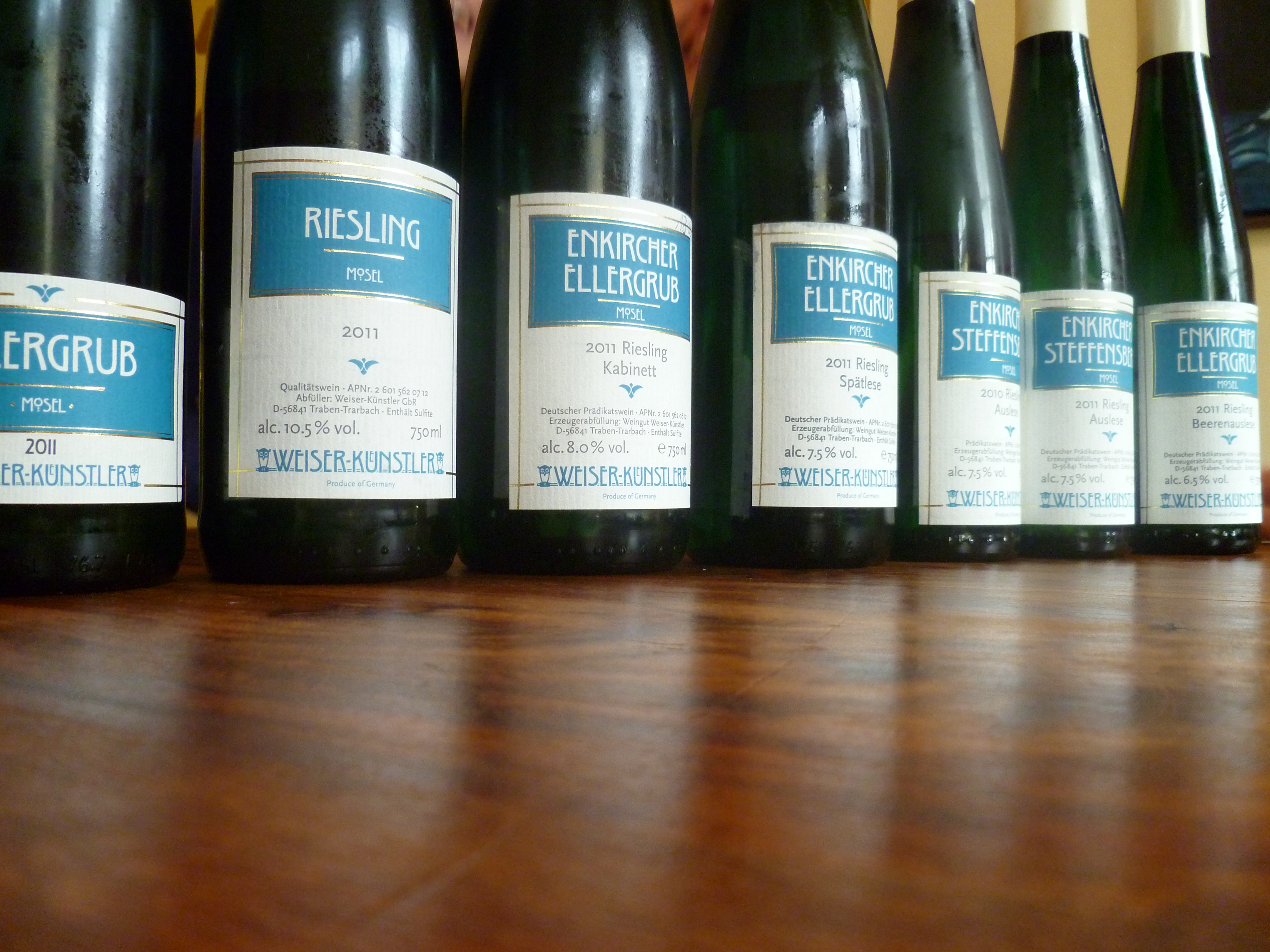
The row

Way back in August when I wrote about my winery visit at Weiser-Künstler in Traben-Trarbach (see here), I promised to write a comparison of the kabinett and spätlese styles from the same vineyard, the Enkircher Ellergrub, because I feel like they show the difference in the two styles very well and it gives me a chance to explain these two a bit more.

Kabinett and spätlese are two levels in the German wine classification system, kabinett being the entry level wine with distinction (Qualitätswein mit Prädikat), and spätlese the next level. Technically, they are defined by the German Wine Act of 1972, and this classification is only based on the residual sugar in the grapes at harvest time (defined by degrees on the Oechsle scale). The winemakers measure that with a so-called refractometer in the vineyard, measuring the density of the grape juice that is dripped onto the instrument. When the grapes reach the required sugar level (Kabinett: minimum 70 degrees Oechsle for the Mosel; Spätlese minimum 76 degrees Oechsle for the Mosel), the winemaker can harvest them. That is why the different levels of distinction can come from one and the same vineyard. The winemaker simply harvests batches as they ripen. Usually, the more sugar in the grape, the longer the grapes where on the vine and exposed to the sun. But if it rains a lot, the grapes can also soak in more water and therefore have lower sugar levels, so rains at harvest time can be detrimental for the classification.

You might have noticed that the levels of distinction only know minimum values: 70 degrees for kabinett, and 76 for spätlese (both at the Mosel). That means that a winemaker can designate a wine a kabinett that technically could be labelled spätlese or even auslese. It happens frequently and has led to much confusion among wine drinkers. Now, why would a winemaker do that? With the temperatures continuously rising in Germany over the last decades, we have seen Oechsle measurements rising as well. In the 1970s, when the Wine Act was passed, 76 degrees oechsle was a lot. Nowadays, it is standard, and would be considered a low measurement. That puts winemakers in a bind. If you harvest too early, when the sugar content in the grape is still low, the grape is also not ripe, which leads to aromas in the wine that you really don’t want. But if you only produce auslesen, consumers and restaurants will not buy your wines,  because an auslese does not sell very well in a restaurant, being a typical dessert wine. So, a lot of winemakers have begun down-labelling their wines.

On the one hand, that is great for consumers, because you get wines that would normally be more expensive at the price of a kabinett. But on the other hand, it also produces heavy weight kabinetts, that have nothing in common with the lighter, fresher image that kabinett has. And that can be frustrating if you open a bottle with a certain expectation, and then find a spät- or even auslese in there. If you know what you get, that is fine, but if you have not had the wine before, it can ruin your plans with that bottle.

True kabinetts are remarkable wines, and it is harder and harder to find them. One of my favorite Mosel wine review teams (Moselfinewines, more on them in a separate post) lately admonished wine makers to produce these beauties again. They argued that it is easy these days to make spätlesen and auslesen, but that the true challenge is producing classical kabinett wines and that winemakers that want to shine, should focus on these, because there is definitely demand for them.

How much nicer is it, when you actually find two distinct wines in a winery portfolio that highlight the difference in the two wine styles in amazing precision. And that is where Konstantin Weiser of Weiser-Künstler comes in. He produced a very clean kabinett from the Enkircher Ellergrub and you can compare it with the spätlese from the same hill.

The 2011 Weiser-Künstler Enkircher Ellergrub Riesling Kabinett had a nose of spontaneous fermentation, something I will write about in another post in more depth. Suffice it to say that the wines initially are more smelly/stinky when poured than you expect, which levels out after a bit. On the palate, the wine was lean, with yellow fruits and enough acidity to carry it. The wine held a perfect balance of acidity and sugar and was just great to drink. It was refreshing and easy to drink.

The 2011 Weiser-Künstler Enkircher Ellergrub Riesling Spätlese, which just like the Kabinett was harvested from exclusively fully ripe grapes without any noble rot, in contrast already showed a higher viscosity in the glass with peach notes dominating. Upon reaching my palate, it became broad, filling out my whole mouth. It had a wonderfully silky texture, with strong aromas of peach and a nice level of acidity (impressive in the 2011s!). It had a long finish, and just showed wonderful elegance, beauty and depth.

What a difference a couple of degrees Oechsle can make…give both of them a try, if you get a chance.

PS: After writing this, I checked the Moselfinewine review, and apparently they are of the opinion that the Kabinett has a spätlese feel to it and the Spätlese an auslese feel…hmmm. I am not sure I agree, the tasting was back in June and my notes do not read that way. That said, they both got raving reviews: 93 points for the Kabinett and 92 for the Spätlese.

See the vineyard here: www.weinlagen-info.de

Tagged , , , , , , ,

2011 Meierer Kestener Riesling Kabinett and 2011 Meierer Kestener Paulinsberg Riesling Spätlese

I promised to write a bit more in detail about some of the wines we tried on our trip to Germany. I want to start with the 2011 Meierer Kestener Riesling Kabinett and the 2011 Meierer Kestener Paulinsberg Riesling Spätlese. I wrote about the tasting experience at the winery in general here.

Bottle (photo courtesy of http://www.weingut-meierer.de)

The 2011 Kabinett was harvested from several lots in Kesten and the crushed together. The grapes used are those that are fully ripe but still low on sugar with a maximum of noble rot of 10%. The wine has 9% ABV with 7.5 grams of acidity/liter and 47 grams of residual sugar/liter. You can tell from these numbers that this is a typical German riesling on the sweet side. The key indicator for a sweeter wine is the lower alcohol content. As sugar is turned into alcohol by the yeast, a lower alcohol content necessarily means more residual sugar in the wine. It was vinified in stainless steel.

In the nose, I got sugary notes, with licorice and gummibear aroma. It smelled like fun! The palate was fruity with a healthy acidity. Unfortunately the finish was rather short. At $6.50 at the winery, this wine is a steal and a perfect summer treat.

Th 2011 Spätlese was harvested when the grapes were fully ripe and had some noble rot on them. The winery website says 10-20%. The wine has 8% ABV with 7.5 grams of acidity/liter and 74 grams of residual sugar/liter of wine.

On the nose, this wine had licorice (again!) and strawberry notes. The palate was really awesome. The wine initially tasted of herbs and peaches but a bit into the tasting more and more tropical fruit aromas showed up. I can only describe those as one of the ubiquitous multivitamin juices. I love that. The finish was nicely long. Another very solid wine.

European readers can order the wines directly from the winery here.

Tagged , , , , , , ,

The Vereinigte Hospitien tasting in June 2012

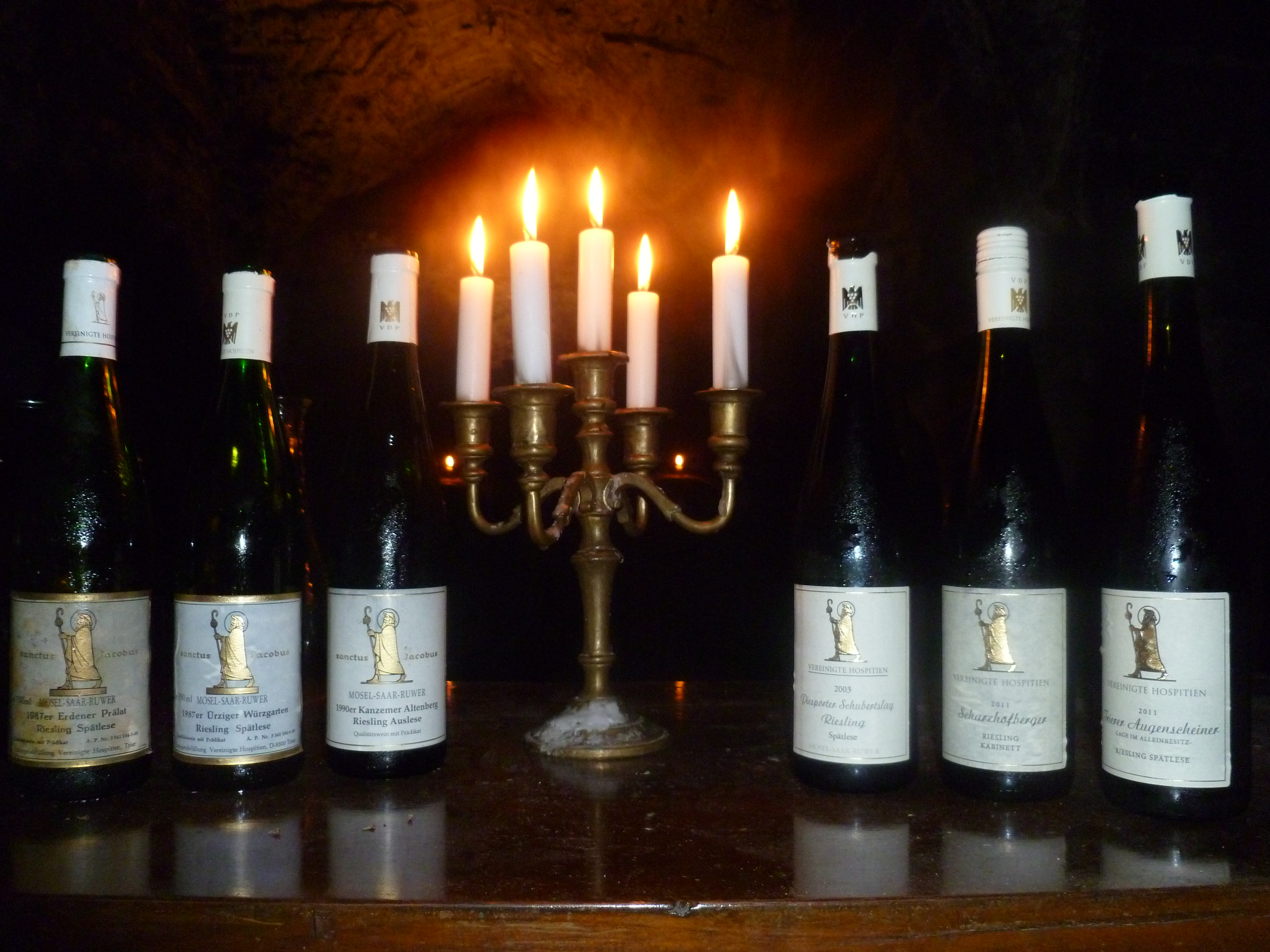
The line up

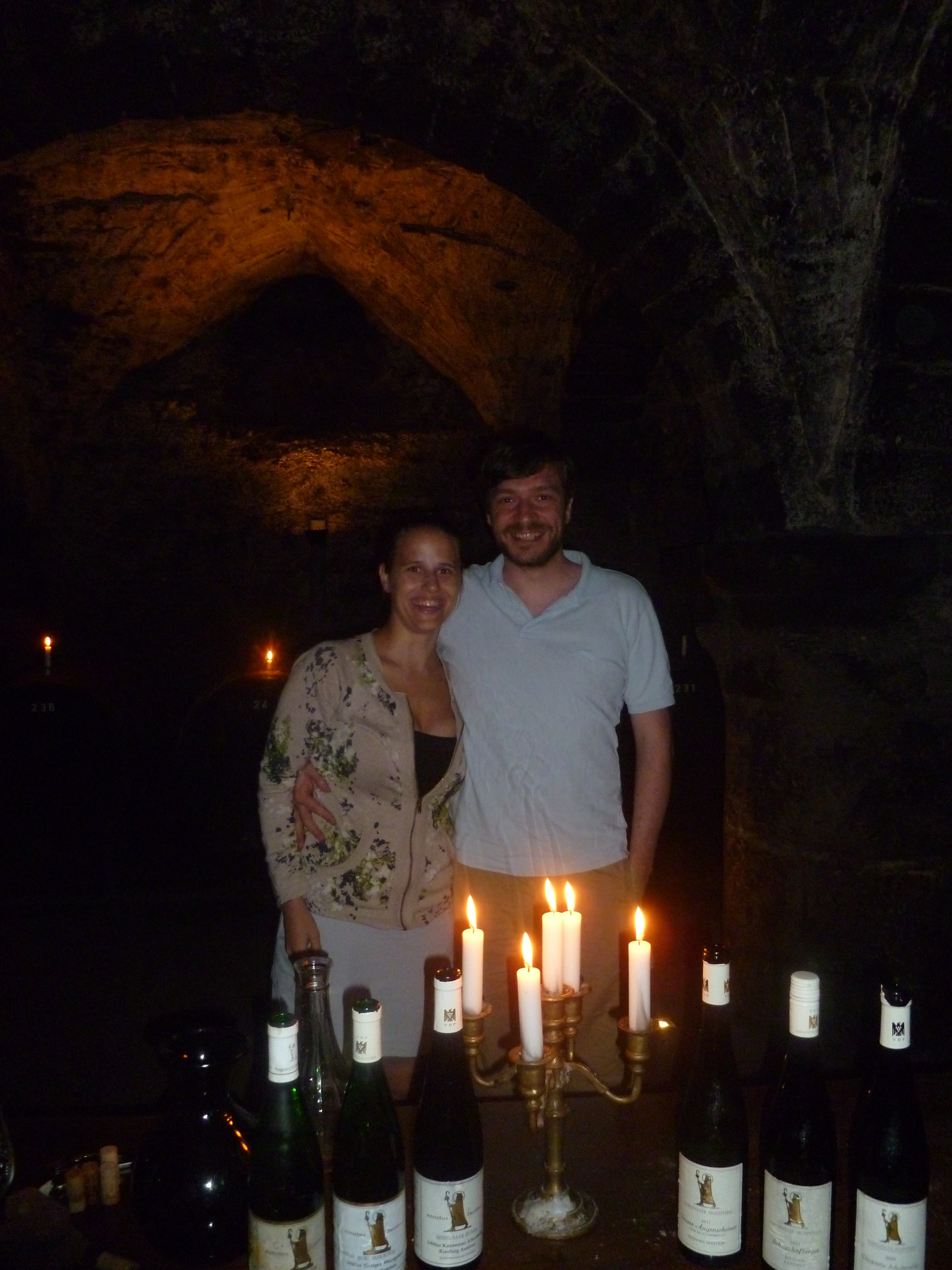
Finally, here are the tasting notes for our awesome tasting at Vereinigte Hospitien in June. As you might remember (if not, here is the initial report), we were sitting in Germany’s oldest wine cellar (the walls dating back to the 300s A.D.), soaking in the awesome atmosphere as our host Marc was picking up some bottles to try. And he did not let us down!

Here is the wine list:

1) 1987 Ürziger Würzgarten Riesling Spätlese

2) 1987 Erdener Prälat Riesling Spätlese

3) 1990 Kanzemer Altenberg Riesling Auslese

4) 2011 Scharzhofberger Riesling Kabinett

5) 2003 Piesporter Schubertslay Riesling Spätlese

6) 2011 Trierer Augenscheiner Riesling Spätlese

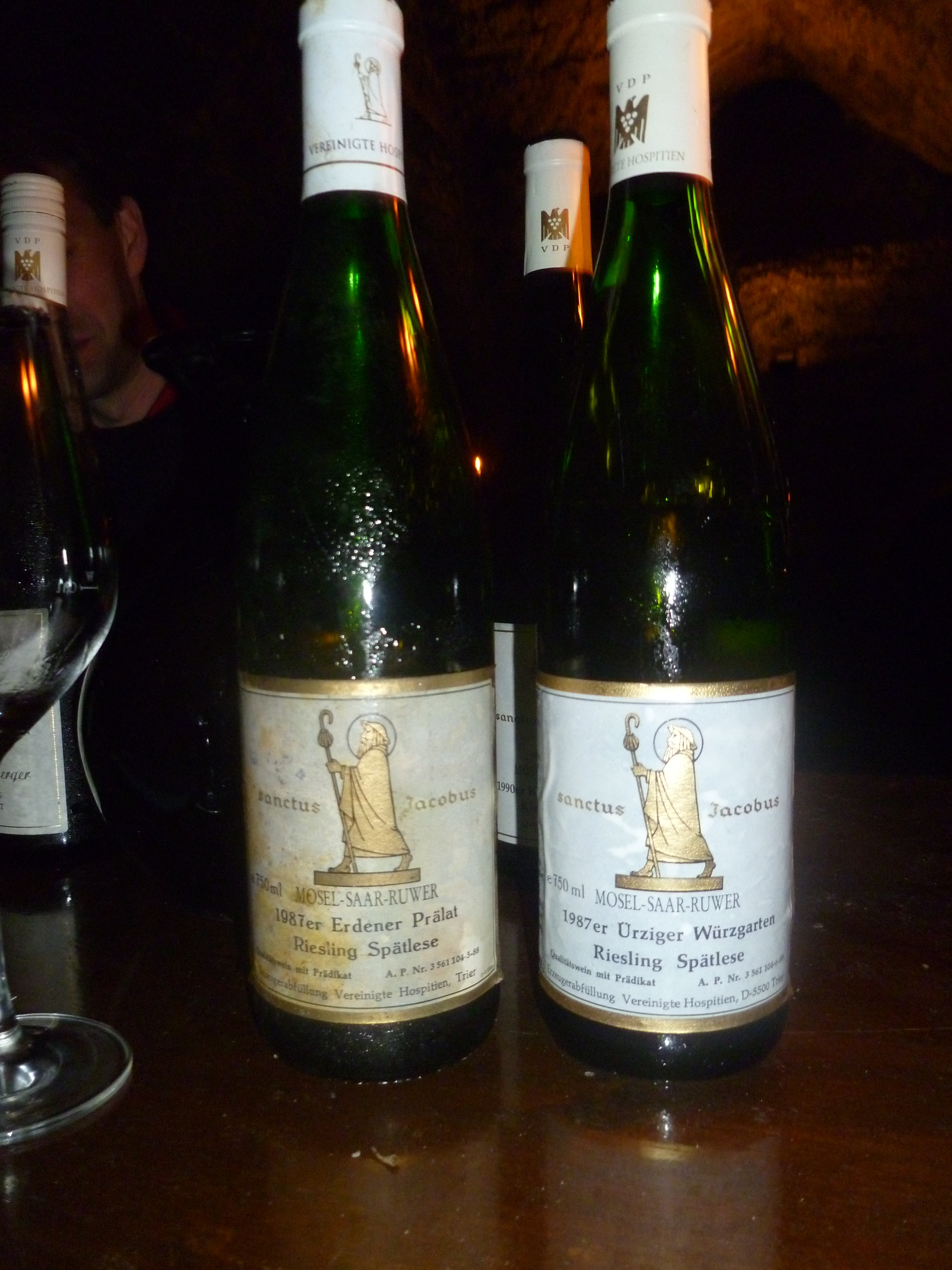
We began with a tasting of two 1987 wines from two of our favorite vineyards: Ürziger Würzgarten and Erdener Prälat. It is Nina’s birth year and Marc had learned that from the blog. We had tried the Erdener Treppchen Spätlese before, so now we were able to compliment this tasting experience that I described here.  Just think about that: we were able to try three similar quality wines from three connected vineyards of a 25 year old vintage. Maybe it is just me, but I get pretty excited about that!!

Both wines were spätlesen and they had remarkably similar profiles. The Ürziger Würzgarten had 10.4 grams of acidity per liter, with 41 grams of residual sugar; the Erdener Prälat was slightly higher in acidity at 10.5 grams and sweeter with 45 grams of residual sugar. At 84 degree Oechsle (a scale to measure the sugar in the harvested grape), it had the highest Oechsle for any of their spätlese in that year.

The Ürziger Würzgarten’s nose was flowery and fresh, one could say a typical nose for this vineyard. On the tongue, it had a sizeable amount of acidity, which gave it an incredibly fresh taste. The acidity persisted throughout the tasting. It was hard for me to discern what fruits I tasted.

The Erdener Prälat was remarkably well preserved. The nose was full of peach and once the wine reached our mouths, it broadened out, fully taking command of our taste buds with peach and apricot. The acidity only appeared more towards the end. It had a long finish.

It was interesting to see how different these two wines tasted. You could definitely tell the terroir in them, but the higher residual sugar in the Prälat probably helps explain why the acidity was less pronounced in it.

Two beauties

Another interesting thing we learned was that Vereinigte Hospitien did a chemical analysis of the Würzgarten and it produced a fascinating result. One thing that you hear over and over again when tasting older rieslings is that they tend to be more balanced, because the sweetness goes down and the acidity stays, so the wines become less fruit-pronounced. However, the chemical analysis showed that the amount of sugar in the wine had not gone down – at all. There was still the same amount of sugar in the wine! We just do not taste it anymore. Apparently, there is no real explanation for that. One guess is that the sugar transforms into longer-chained molecules that our taste buds cannot taste…crazy, right?

We then went for a 1990 Kanzemer Altenberg Auslese. Kanzem is at the river Saar, a small contribuary that meets the Mosel just south of Trier. Saar wines are usually more mineralic and have higher acidity levels than the Mosel, which makes for very interesting wines. Kanzemer Altenberg is one of the top vineyards along that river. The bottle had been recorked. The wine has 52 grams of residual sugar, harvested from fully ripe grapes.

Upon opening and pouring, we saw a dark orange wine, with a salty and sherry like nose. On the tongue it was weirdly metallic, some hints of passion fruit. It then fell flat fast. We decided the bottle was flawed (actually, Marc, who knew how it should taste decided…but it did taste odd). The second bottle we opened was very different: lighter in color, the nose full of gooseberry. On the tongue, it had a fabulous acidity, lively fruit notes and just gave us a great mouth-full of wine. The texture was wonderful. A great wine!

We then tried a 2011 Scharzhofberger Riesling Kabinett. The Scharzhofberg is the Saar’s most famous vineyard and its wines rank among my favorite. It has a hard to describe terroir note to it that I just find incredibly endearing and comforting. This one did not let us down. At 88 degree Oechsle, this Kabinett is actually a wine that could have been labelled as an Auslese, two spots higher. It has 9.8% ABV. The nose was fruity and flowery. On the tongue I tasted banana and apricot, with a looooong finish. Just a very decent, yummy wine.

Nina’s highlight, and I was pretty impressed, too, was the 2003 Piesporter Schubertslay Riesling Spätlese. Initially a single-owned vineyard by Vereinigte Hospitien, they are now leasing some out to other winemakers. The color was light and fresh. The nose full of strawberry and cream, with vanilla thrown in. On the tongue, the same tastes prevail. The sweetness is wonderfully balanced by a fresh acidity. Later on, we tasted caramel notes creeping in. Long finish, too. It was such a fun wine. We have had another bottle since, and that was just as good. A great wine at a great price ($15).

We finished the tasting with a 2011 Trierer Augenscheiner Riesling Spätlese, a vineyard completely owned by Vereinigte Hospitien. At 72 grams of residual sugar and 92 degree Oechsle, the first thing we noticed was sweet peach in the nose, complimented by perfumy and flowery notes. The taste was floral as well (I am bad with discerning different floral notes), the texture silky. The wine seemed incredibly concentrated, and definitely not yet ready for consumption. I bought a couple of bottles to see where this one is headed to…

As you can see, it was quite the outstanding tasting: old and new, Saar and Mosel. The full variety, even of just the sweeter rieslings, came out beautifully. I am looking forward to many more tastings there…

Bliss…

Tagged , , , , , , , , , , ,