Tag Archives: riesling

Sunday Read: German Riesling’s Turn in the Spotlight

Some of you might have heard of it: In February, New York City witnessed the first “Rieslingfeier”, an event to celebrate the beauty that is Riesling. It was the first such event, privately organized by Crush and Spirits and some other wine stores in NYC. One cannot say that Riesling isn’t being pushed these days in the US, with events like “Summer of Riesling” and others, and the German wine promotion agency is very much on its toes promoting it more. Still, this event seemed like something very special: With tastings in three wine stores, with winemakers present, and a collector’s dinner to finish the day. I would have loved to join, but this is one of those moments were it sucks to be in the middle of nowhere Ann Arbor: NYC quite far away, Chicago 5 hours away…there’s just not much going on here…

Eric Asimov wrote a thoughtful, yet somewhat restrained (is that the right word?) piece about the event. The article shows what this event is surrounded by, and the attention that all sorts of regions and wines are trying to garner for themselves. And in that light, Riesling is still a smaller light. So I decided to share it, because Riesling needs all the attention it can get.

Happy Sunday!

New York Times: German Riesling’s Turn in the Spotlight

Tagged , , , , ,

2003 von Hövel Oberemmeler Hütte Riesling Spätlese

2003 von Hövel Oberemmeler Hütte Riesling Spätlese

2003 von Hövel Oberemmeler Hütte Riesling Spätlese

From one of his frequent trips to Germany, a friend of ours brought back a mixed case of German wines that my friend ManSoo had put together for us. It contained some Kurt Hain wines, a sparkler, some 1989 Auslese and three wines by von Hövel, a VDP winery at the river Saar, one of them this 2003 von Hövel Oberemmeler Hütte Riesling Spätlese.

Now, for those not familiar with the Mosel region, the Mosel has two tributary rivers, the Saar and the Ruwer that are part of that wine growing area. The Saar, as I have explained before, meets the Mosel just south of Trier, in the town of Konz. It commences in France and then flows into Germany. It is a mere 246 km (152 miles) long, but only its final stretch in the state of Rhineland-Palatinate is used for growing wine, mostly Riesling. It is known to produce more mineralic, somewhat tarter Rieslings than the middle Mosel. The microclimate is cooler than at the Mosel, so the grapes tend to ripen later and can reach acidity levels without the higher sugar levels you can find on the Mosel, which gives them a distinct character. Most of the vineyards used to belong to the Catholic church, but in the course of secularization in the 19th century, many private investors bought plots and began wine making. Rich families began to settle later in the 19th century which led to the term “Saarbarone” (baronets of the Saar, a term derived from “Ruhrbarone” which was used for the industrialists in the Ruhr area that made a fortune when the industrial revolution took off). A lot of the estates on the Saar are very grandiose, unlike most Mosel estates.

Weingut von Hövel has been owned by the von Hövel family since 1803 (just in time for secularization) and is one such rather big mansion. It is a member of the prestigious German association of quality winemakers, VDP, and owns 11 hectares (27 acres) in the Saar valley which are planted with Riesling only. Its annual production is around 60,000 bottles. Since 2010 Max von Kunow has been the owner of the estate. Besides holdings in the legendary Scharzhofberg, the winery exclusively owns the vineyards Kanzember Hörecker and Oberemmeler Hütte, the vineyard this wine was from. Oberemmeler Hütte is a South-west facing tiny plot of land. Unlike most vineyards in the area, it is quite far removed from the river, on a higher lying plateau. In the 1868 Prussian taxation map, which marked vineyards according to their property value and therefore -indirectly- quality, Oberemmeler Hütte is in the same category as the Scharzhofberg, i.e. very highly ranked.

I was excited to try this wine, because while we lived in Trier, we were only about a 7 minutes drive away from where the Saar meets the Mosel and Oberemmel is pretty close to where that happens. We actually had our wedding celebration in a BBQ hut only a couple of miles away from this particular vineyard. So this is as neighborhood as it gets for Saar wines for us.

The wine poured in a very clear pale, almost white color. Absolutely no ageing was noticeable when looking at it. The nose was delicate, with fresh aromas of citrus, white peach, cream and hints of vanilla. There were some traces of age in the nose, but not prominent at all. On the palate, the wine was light bodied and surprisingly thin in texture. It had a somewhat ethereal feel to it in its lightness in general. The taste was still clean and fresh. There were no citrus aromas, but apple and pear had come in. There was hardly any minerality noticeable which was a bit surprising. The finish was medium long.

The wine was very interesting to me, because it was a combination of still quite fresh, but also seemingly contracted from age, which were the two poles that this wine was tied to. At times, I wanted it to be a bit firmer, and at other times I enjoyed its lightness. It was a type of aged Riesling I don’t think I have experienced in the past. Good to very good, I would say.

Check out the vineyard’s location here.

Tagged , , , , , , ,

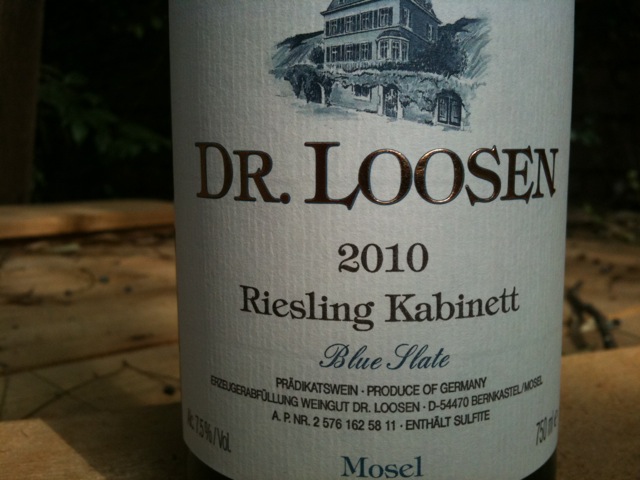
2010 Dr. Loosen Riesling Kabinett Blue Slate

2010 Dr. Loosen Riesling Kabinett Blue Slate

2010 Dr. Loosen Riesling Kabinett Blue Slate

You have read about me drinking Dr. Loosen wines before. I also indicated before that I never drank much of their wines while in Germany, for whatever reasons. But given Dr. Loosen’s prominence in the U.S. and Ernst Loosen’s tireless promotion of Riesling over here, I am finding more and more Loosen wines and try them here. When we went to a wine store and I saw this bottle, we decided to grab it. I am very fond of the crazy 2010 vintage, and I had heard about this particular wine before.

Let me give you some background on the winery: Dr. Loosen is currently owned by Ernst (or Ernie) Loosen. The estate has been family owned for over 200 years. The winery has been a member of the elite winemaker association VDP since 1992 and it owns plots in most of the Mosel’s prestigious vineyards. It is one of the larger estates along the Mosel.

This particular wine is a non-single vineyard Kabinett wine, in the German system the lowest level of quality wine with distinction (if you are not familiar with these denominations, please check out my quick guide here). The winery describes its aim for this wine as producing a light, typical Kabinett style wine. The grapes were sourced from blue slate vineyard sites in Bernkastel, Graach and Wehlen and the wine has 7.5% ABV. You can check out the winery’s description of the wine here.

A greenish yellow in the glass. On the nose subdued aromas of citrus and yellow fruit. On the palate, I got less acidity than I expected (it’s a 2010 after all!), with citrus aromas (grapefruit and tangerine mostly), some melon and early signs of ageing. The noticeable residual sugar gave the wine a medium long finish. The wine seemed a bit thin, though (for lack of other words). All in all, this was a refreshing summer wine, but it was also a bit disappointing: I had definitely expected more minerality and hoped for a stronger expression of flavors. It did pair alright with the Asian food we were having.

Given that we bought it on sale for $15 (it seems to retail for $20 and up) I am not sure the quality to price ratio is right for this wine. Also, keep in mind that for that money you can usually get at least a single vineyard bottle of Kabinett from other established wineries. And, I hate to say it, but their entry level Dr. L Riesling, which can be had for $9 and up, would be my preferred choice, not just for QPR reasons.

The Wine Spectator apparently awarded it 90 points and called it a “smart buy” (noting apple and citrus aromas, with kumquat in the the finish). It also received a Gold Medal at the Los Angeles Wine & Spirits Competition 2012.

Tagged , , , , , ,