Tag Archives: riesling

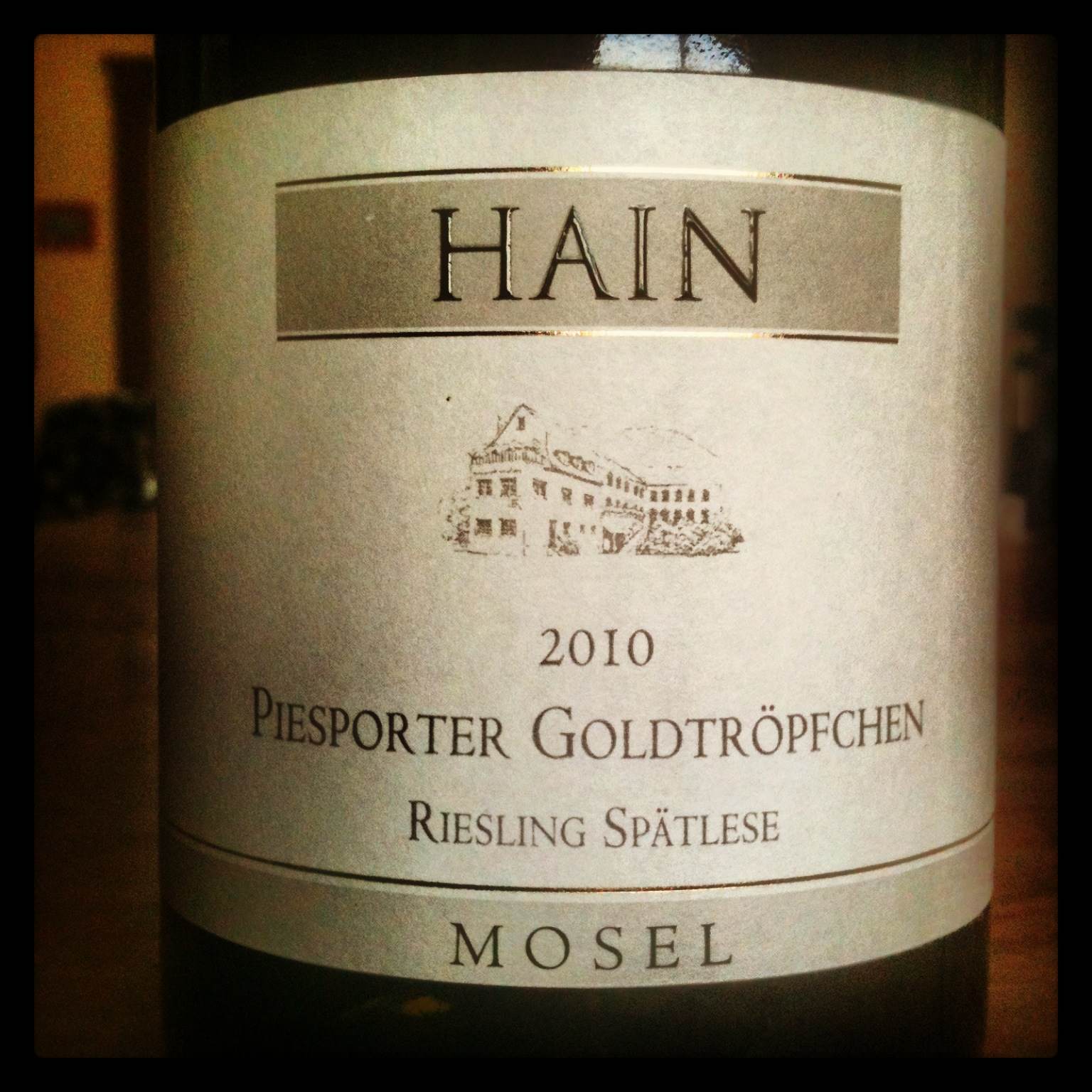
2010 Kurt Hain Piesporter Goldtröpfchen Riesling Spätlese Grauschiefer

2010 Kurt Hain Piesporter Goldtröpfchen Spätlese Grauschiefer

2010 Kurt Hain Piesporter Goldtröpfchen Spätlese Grauschiefer

The second and final German wine we tried after our Finger Lakes Tasting was this Spätlese by Kurt Hain. Regular readers should by now be familiar with this winery, despite the fact that the wines are practically impossible to find in the US. At one point, Gernot Hain, the winemaker and current owner, told me that he saw no need to export because he was able to sell all his wines in Germany…

Let me give you some background (cobbled together from earlier posts):

The winery is located in Piesport, home of the Goldtröpfchen (literally “Gold droplets”). People in the United States mostly know the ubiquitous Piesporter Michelsberg, a cheap and sweet wine. That, unfortunately, is the least appealing vineyard in Piesport. Unlike the other Piesport vineyards Goldtröpfchen, Domherr and Falkenberg, it is not located on the Northern side of the Mosel, where it would get full sun exposure all day, but on the South bank of the river, in flat terrain that used to be farmland and was not used for growing wines until a couple of decades ago. The Goldtröpfchen, in contrast, features steep vineyards and some of the best wineries all have holdings there. Another thing one should know is that the Goldtröpfchen used to be much smaller and was extended significantly under the German Wine Act of 1971 (as happened to most well known vineyard sites in Germany).
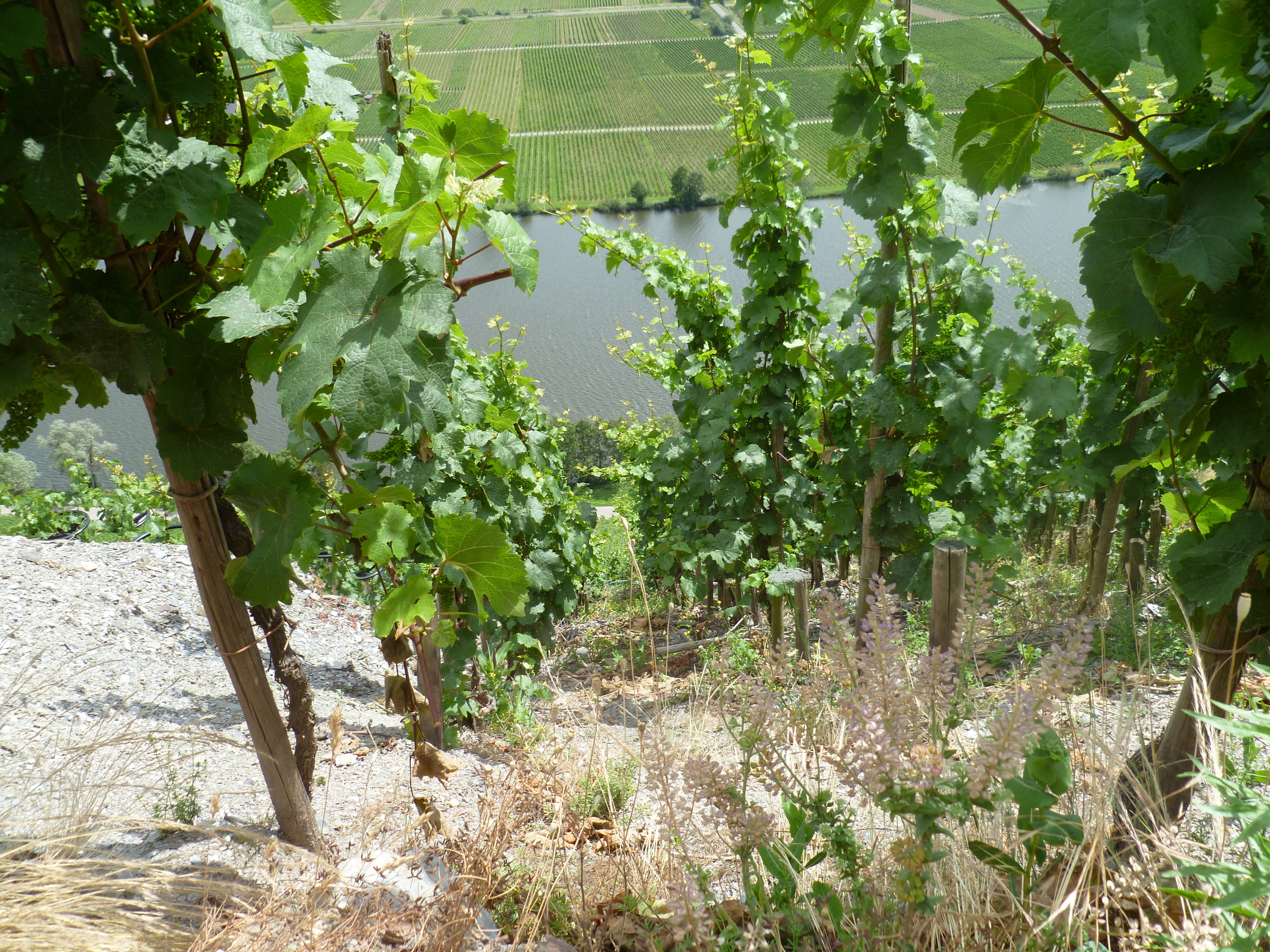
Steep vineyards in the Goldtröpfchen

Steep vineyards in the Goldtröpfchen

The winery Kurt Hain has been one of my favorite wineries in the Mosel village of Piesport. Gernot Hain, the winemaker (follow the link for a photo and his philosophy), has been making high quality wines for quite a bit now, and they rarely fail to impress me. They have a balance and sophistication about them that just draws you in. There is someone who knows exactly what he is doing…and he is doing it remarkably well. Whenever I want to really impress friends that are not very familiar with German wines, I pull out one of his bottles. They hardly ever fail to make their point.

Hanging out with Gernot Hain

Hanging out with Gernot Hain

2010 was what many people called the crazy vintage along the Mosel: Lots of acidity and lots of sugar led to levels of each that were puzzling to many winemakers. It wasn’t easy to make great wines in that vintage but those who succeeded made wines that are to die for. They have all the beauty of ripe grapes, but then take you away with their rather racy acidity. It is unclear how they will age, but they are still drinking phenomenally right now!

But to the wine, one of two of Kurt Hain Spätlesen from the Goldtröpfchen. Gernot selects the grapes from different holdings in the vineyard that have different soil types, namely grey and red slate (Grauschiefer and Rotschiefer). He used to give them numbers to distinguish but as of late has started just putting Grauschiefer or Rotschiefer on the label which helps a lot (I am numerically illiterate). This wine was a Grauschiefer, so grey slate soils. In the glass, it had a great, light yellow color. In the nose, there was a combination of citrus and honey, with underlying white peach aroma. Just as gorgeous as a Mosel Riesling can be. On the palate, it was a classic, exciting 2010: light to medium-bodied, sweet. But boy was the sweetness carried by wonderful acidity that kept it fresh and enticing. The acidity never dominated the wine, just gave it structure. Stunning in its balance and fruit. Very long, lingering finish. Just an excellent piece of work.

I tried a 2007 vintage of this wine last year, the review is here.

The best thing, though, was the reaction by The Drunken Cyclist, whose Twitter post I am sharing here:

You’re welcome! :)

Tagged , , , , , ,

2011 von Hövel Scharzhofberg Riesling Kabinett

2011 von Hoevel Scharzhofberg Riesling Kabinett

2011 von Hövel Scharzhofberg Riesling Kabinett

After the Finger Lakes Virtual Tasting last Saturday, we opened another bottle from my beloved Scharzhofberg. For those unfamiliar with the vineyard, let me use the explanation I gave in my review of the Bischöfliche Weingüter Scharzhofberger:

The Scharzhofberg is a vineyard along the Saar, a tributary to the Mosel. The Saar meets the Mosel just south of Trier, in the town of Konz. It springs in France and then flows into Germany. It is a mere 246 km (152 miles) long, but only the final parts in the state of Rhineland-Palatinate are used for growing wine, mostly Riesling. The Saar is known to produce more mineralic, somewhat tarter Rieslings than the middle Mosel. The micro climate tends to be cooler than at the Mosel, so the grapes usually ripen later and can reach acidity levels without the higher sugar levels you can find on the Mosel, which gives them a distinct character. Most of the vineyards belonged to the church, but in the course of the secularization in the 19th century, many private investors bought plots and began wine making. Rich families began to settle later in the 19th century which led to the term “Saarbarone” (baronets of the Saar, a term derived from “Ruhrbarone” which was used for the industrialists in the Ruhr area that made a fortune when the industrial revolution took off). A lot of the estates on the Saar are very grandiose, unlike most Mosel estates.

The Saar boasts many prime vineyards that you might have heard of: Kanzemer Altenberg, Ockfener Bockstein, Ayler Kupp and also, the most prominent among them, the Scharzhofberg. Technically belonging to the village of Wiltingen, the vineyard is so prominent that the wineries do not have to list the village name on their labels. They proudly just use “Scharzhofberger”. The vineyard stretches over 28 hectares (around 70 acres) in steep slopes (30 to 60 degrees) facing south, the soil consisting of slate and rocky soil with high amounts of iron and clay. Only Riesling is grown here by a few producers that read like the who is who: Egon Müller-Scharzhof, van Volxem, Reichsgraf von Kesselstatt, Bischöfliche Weingüter, Vereinigte Hospitien, Johannes Peters, Weingut Resch and also the winery that produced this wine: von Hövel. The wines from this vineyard are prized and it is easily the most famous vineyard of the Saar.

Weingut von Hövel has been owned by the von Hövel family since 1803 (just in time for secularization). It is a member of the prestigious German association of quality winemakers, VDP, and owns a total of 11 hectares (27 acres) in the Saar valley which are planted with Riesling only. Its annual production is around 60,000 bottles. Since 2010 Max von Kunow has been the owner of the estate. Besides holdings in the legendary Scharzhofberg, the winery exclusively owns the vineyards Kanzember Hörecker and Oberemmeler Hütte.

But on to the wine: In the glass, we found a very pale, light yellow color. The nose showed floral and herbal aromas, with some overlying fruit (apple maybe?). But all in all it was a rather restrained nose, clean and focused. On the palate, the wine was light-bodied and luckily a typical Kabinett style sweet wine. When I say Kabinett style I mostly refer to its lightness and how refreshing and clear it was, despite it being a sweet wine. I just really like that combination of lightness and sweetness. However, I always struggle with describing these wines from vineyards that are especially dear to me. There was something that made me think it reflected the terroir quite well. I believe I would recognize a Scharzhofberger in a blind tasting (don’t dare me, though). I do believe the wine could have used a bit more acidity, but then again it was a 2011 where a lot of the grapes suffered from low acidity levels. The finish was very nice, with decent length.

In my view, this is a very good wine for someone interested in trying a Scharzhofberger without breaking the bank and at the same time finding out what all the fuss is about the Kabinett wines. This von Hövel also showcased the 2011 vintage nicely, which is already where drinkable and accessible for the wine drinker.

Tagged , , , , , , , , ,

Finger Lakes Virtual Tasting on May 25, 2013

Finger Lakes Wine Month Tasting Line Up

Finger Lakes Wine Month Tasting Line Up

All Finger Lakes wines were provided as media samples by Finger Lakes Wine Alliance.

As I mentioned in my introductory post to the Finger Lakes region last week, I received a box with five samples to try during the Finger Lakes Wine Month’s final virtual tasting held on Twitter and Facebook last Saturday. There were two Gewürztraminers, one Riesling, one Cabernet Sauvignon/Merlot blend and one Cabernet Franc in the box. Given that five bottles are a lot, and that I like company, I invited my friend John, The Food and Wine Hedonist, to come with his wife and share the fun. Then I found out that Jeff, The Drunken Cyclist, was also going to be in town, so I strong-armed him into joining us as well. Add in two friends who are also quite into wine and we had a party. We got some cheeses and different, thinly sliced bacon (including a lamb bacon) to go with the wines and naturally some baguette. It’s what we used to do all the time in Germany where wine, cheese, bacon and bread all were way cheaper than here…oh, the good old days.

The “virtual” in this tasting was achieved by us wine bloggers taking photos of the bottles and tweeting our first impressions out to the world. Some of the winemakers were also active on Twitter, so it was a nice back and forth at times. I do have to say that I did struggle a bit in the beginning, because it is an awful lot to handle: trying a wine, taking a photo, finding a half witty 140 letter post, posting it, reading what others post…it does become exhausting. Jeff was much more of a pro, but he’s also done it before. It was a lot of fun, though, all in all!

Ruinart Brut Rose

Ruinart Brut Rose

Jeff, in his capacity as #ChampagneSlut (a handle I like to add to his name on Twitter because he is very much into the bubbles) brought a bottle of Rose Champagne from Ruinart to begin with. By that, he saved me since somehow I had totally spaced what to start the tasting with…Now I am not much of a bubbles drinker, and am usually at a loss describing them. I think the bubbles occupy me too much to focus on flavors. But I can tell you that this Ruinart champagne was very good, nicely spicy. I thought the bubbles were a bit too aggressive, but what do I know? Everyone seemed to really like it and I enjoyed it quite a bit as well.

John had brought some Asian pork lettuce wraps, which we decided to pair with the two Gewürztraminers. And off we went into the tasting:

Glenora Wine Cellars 2012 Gewürztraminer

Glenora Wine Cellars 2012 Gewürztraminer

First up was the Glenora Wine Cellars 2012 Gewürztraminer. The winery is located at Seneca Lake and has been around since 1977. The wine had 13% ABV. It showed a surprisingly light color in the glass. The nose was beautiful: floral and perfumy, with some sweetness. A very typical Gewürztraminer nose in my book. On the palate, there were again floral aromas, and the wine was a tad heavier than I wanted it to be, but luckily it tasted less dry than advertised. I really believe the, still low, residual sugar helped this wine tremendously. Nice, lingering finish. It also paired exceptionally well with the lettuce wraps. This was definitely a crowd favorite of the evening!

Sheldrake Point Vineyard 2012 Gewürztraminer

Sheldrake Point Vineyard 2012 Gewürztraminer

Next up: The Sheldrake Point Vineyard 2012 Gewürztraminer. Sheldrake Point Vineyard was founded in 1997 and is located at Cayuga Lake. This wine had 13.4% ABV. First off, let me say that I really liked the label. Most of the wineries’ labels this evening could benefit from less clutter and more modern appeal. Sheldrake Point definitely stood out positively! In the glass, we got a light colored wine. The nose was in stark contrast to Glenora’s wine: much more focused and clean, with just hints of Gewürztraminer aromas. This continued on the palate, which all in all was too subdued for me. There were pear aromas which I liked. But most of all, the wine had too much heat which made it seem unbalanced. You could really taste the 13.4% ABV, which were too much for me.

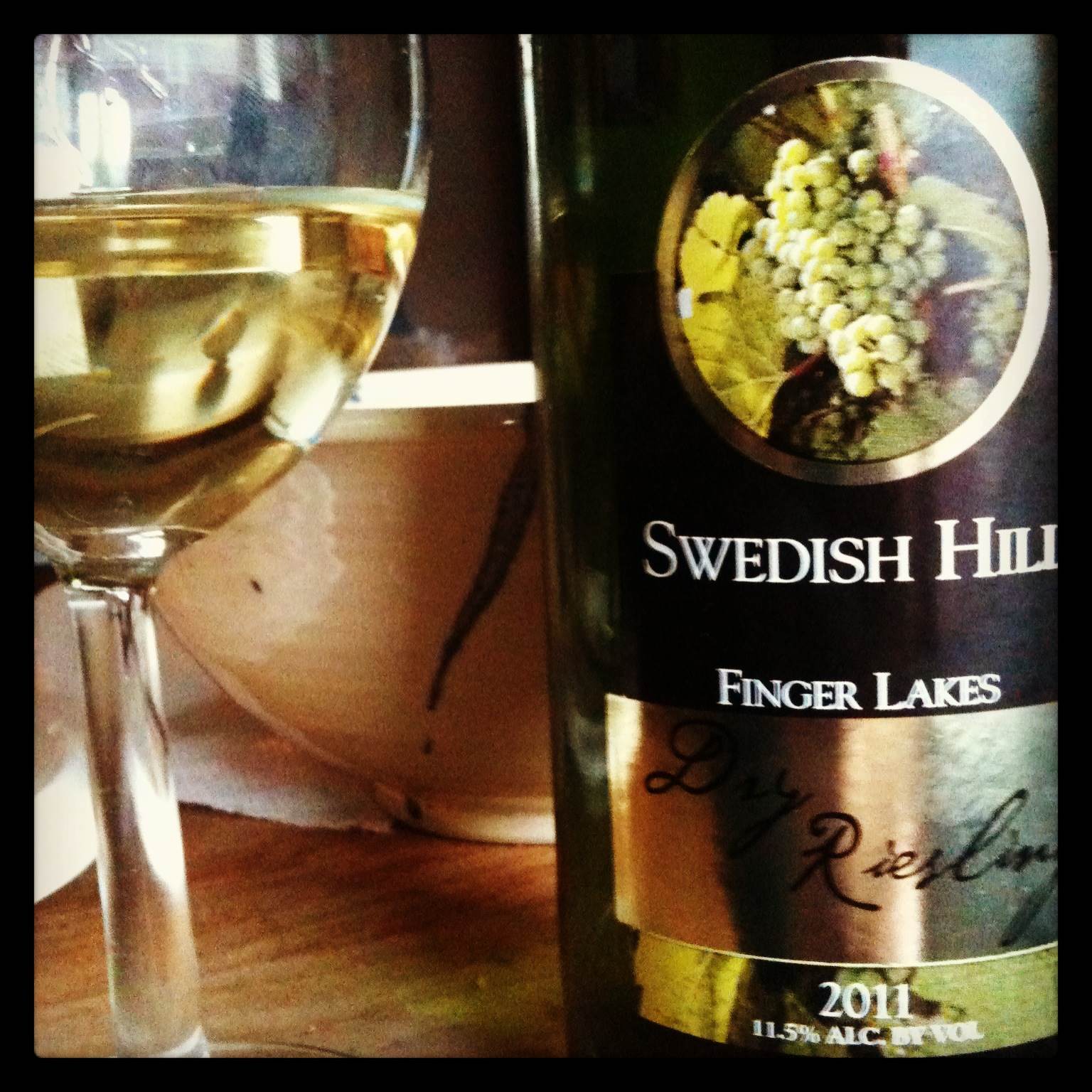
Swedish Hill Winery 2011 Dry Riesling

Swedish Hill Winery 2011 Dry Riesling

Up next, and now tasted with cheeses and bacon only, was the Swedish Hill Winery 2011 Dry Riesling. Swedish Hill is one of the larger producers in the Finger Lakes region and has been around since 1969. The wine had 11.5% ABV. It poured in a quite golden color, which I found rather exceptional in a dry Riesling, very pretty. The nose was a bit weird: It showed signs of petrol, which I usually don’t expect to find in young Rieslings, but not much else. I am not sure I would even have recognized the nose as Riesling. On the palate, the wine showed good acidity and very, very intense citrus aromas. I don’t think I ever came across a Riesling that was so decidedly citrussy. It was very refreshing, but maybe a bit one dimensional. There was agreement around the table that there might have been something wrong with the bottle, because there was what I can only describe as some funkiness going on…so, not entirely sure. But definitely an interesting tasting wine.

Stony Lonsesome Estate Cabernet Sauvignon Merlot

Stony Lonsesome Estate Cabernet Sauvignon Merlot

We then moved on to the reds: First up, the Stony Lonsesome Estates NV Cabernet Sauvignon/Merlot blend. On paper, this was an interesting experiment: It was blended from 54% Merlot and 46% Cabernet Sauvignon, with the Merlot coming from the 2010 vintage and the Cabernet from the 2011 vintage. The grapes were harvested from some of the oldest vines for their varieties in the Finger Lakes (both planted in 1982). Stony Lonesome Estates is one of three wineries (and a brewery) run by Three Brothers Wineries. The wine had 11% ABV. I was intrigued by the idea to blend two vintages for this wine, and I really wanted to like it. But when I tried it, I struggled: It poured in a surprisingly light color, which one would not expect from a Cab Sav and Merlot blend. It looked much more like a Pinot noir. The nose showed some nice fruit, but on the palate the wine just didn’t work for me. It tasted too sweet (despite the winery information stating it contains 0% of residual sugar), and I am not sure the varieties came through for me. It felt a bit all over the place and unfocused. I can see this as a summer afternoon wine, out on the patio, maybe slightly chilled. But I just could not see it achieving what the winemaker had hoped for, especially at the suggested retail price point. That was a bit sad.

Dr. Konstantin Frank Cabernet Franc 2010

Dr. Konstantin Frank Cabernet Franc 2010

Last up came the Dr. Konstantin Frank Cabernet Sauvignon 2010. The wine clocked in at 12.8% ABV. As I explained in my introductory post, Dr. Frank is one of the leading wineries in the region. And boy did this wine shine! Great color, and a great herbal nose, branchy, earthy, just fabulous. Very old world style. Initially, it had a very earthy feel to it. It was greatly balanced and had a lingering, long finish. A bit later, the wine became much more fruity and that was a very pleasant surprise. This was a uniquely interesting and well made wine and seemed like a great fit for the region. Everyone at the table was very impressed. What a great finish to a fascinating tasting experience. I really want to go and explore the Finger Lakes more now that I have tasted some. Definitely worth investigating more.

To finish off the evening, we cracked open another bottle of Champagne provided by John, and two German Rieslings which I intend to write about in separate posts…it was a wonderful evening all around.

Tagged , , , , , , , , , , , , , ,