Tag Archives: review

A Tale of France and Argentina: A Malbec Tasting

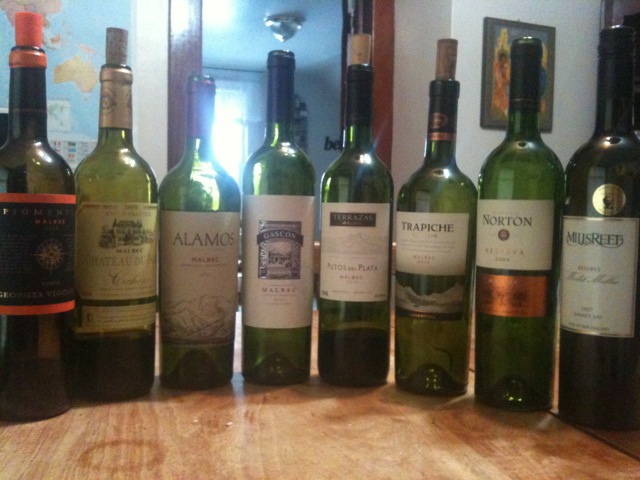
The line up for the Malbec tasting with wines from France and Argentina...and a New Zealander

The line up for the Malbec tasting with wines from France and Argentina…and a New Zealander

Two weeks ago, Nina organized a Malbec tasting with friends of ours. Malbecs are some of Nina’s favorite red wines, with their strong and edgy character. It is just what she is looking for in red wines. The tasting had been a long time in the making. Given our usual shoestring budget, she had acquired different, everyday Malbecs that you can find all over the place. To make things interesting, she decided not only to try Argentina Malbecs but also two from France. And in the end, she decided to throw in a Merlot/Malbec blend from New Zealand for the fun of it.

Now, as some of you may know, I am usually not a big fan of “bold” (aka strong) reds. I prefer old world style Pinot Noirs and a more balanced approach to grapes. I also am struggling with understanding red wines in the way I feel I intuitively understand white wines. But I was curious about this tasting, too. Nina’s hope in this endeavor was to figure out what exactly draws her to Malbecs. And, let’s not forget, it’s also tons of fun to have friends over and do a tasting together (for my thoughts on tastings at home, go here). This was the first time we used the tasting sheets provided by De Long Wine Discoveries which I found super helpful (check them out here). With these caveats ahead, please take my reviews with a grain of salt from the perspective of someone who generally prefers milder wines. Also, as I indicated, the wines tasted are on the lower level of of prices and retail between $8 and $17. Each wine was decanted for roughly 30-45 minutes.

We started with the two French Malbecs. I had read prior that Malbecs from the core French Malbec region Cahors tend to be quite tannic so we decided to get them out of the way before we moved to the Argentina Malbecs, which are said to be more fruity.
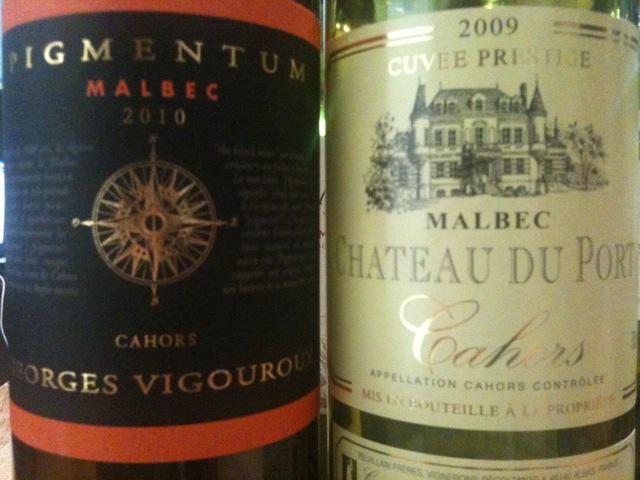
2010 Vigouroux Pigmentum and 2009 Chateau de Port Cuvée Prestige

2010 Vigouroux Pigmentum and 2009 Chateau de Port Cuvée Prestige

First up was the 2010 Georges Vigouroux Pigmentum. The wine has 13.5% ABV. It was of dark, clear ruby color. In the nose it was moderately aromatic with alcohol, plum, herbs and hints of tobacco. It was dry, medium bodied, with crisp acidity and quite flavorful. I tasted strong tannins, some red berries and a mineralic note. It was fruitier than I would have expected with a long finish. I thought this was a pretty good start. The wine was less tannic than I thought and fruitier. It also paired well with the soft cheeses we tried. (When retasted two days later, it was still good: more cherry aromas in the nose, with almonds, and great raspberry and blackberry on the palate).

Next up was 2009 Chateau du Port Cuvée Prestige, also from Cahors. This wine has 14% ABV. Of deep, purplish red color, it was aromatic in the nose and showed some age. I got cherries, strawberries, mint and violets and thought the nose was awesome. On the palate, I got a dry, medium bodied and smooth wine with medium tannins. The flavor profile was a bit of a let down, though: I got vegetal notes, but mostly bitter aromas and alcohol notes. It almost tasted a bit green. The nose just promised more than I got in my mouth, which disappointed me. (After two days, this was virtually dead. Bitter aromas had increased, and it smelled musty.)

We then moved on to the Argentina Malbecs. All were from Mendoza.

2011 Catena Alamos and 2011 Gascón Malbec

2011 Catena Alamos and 2011 Gascón Malbec

First up was the ubiquitous 2011 Catena Alamos Malbec with 13.7% ABV. Of medium ruby red color, the wine showed moderate aromas of vanilla, branches and almonds on the nose. I hardly got any fruit (which I found surprising) – others at the table disagreed and got a lot of fruit (stone fruit and red fruit). On the palate, it was dry, medium-bodied and quite smooth acidity-wise. But the tannins were strong and hard and I felt the wine was quite unbalanced. It was very peppery and tasted a bit green. The finish was short and disappointing. It felt quite closed at that point. (When I retried it two days later it was quite the revelation: the nose showed raspberry and currants and was very appealing. On the palate it also showed freshness and black currant aromas that I liked a lot! So, let this one breathe for quite a bit!)

Next up was the 2011 Don Miguel Gascón Malbec with 13.9% ABV. Dark and purplish in the glass, its aroma profile was good and youthful, with raspberries and other red fruit. I wrote down “pleasant nose”. On the palate, it was dry and medium bodied with a crisp acidity. The tannins seemed low and it was fairly balanced to me. Initially, I thought the taste was pleasant but then it got a bitter. It definitely showed more fruit than the two previous wines, but also had some pepper notes. What disturbed me most was its heat. There was just something about it that was too alcoholic for me. (Two days later, this wine showed a great nose of gooseberry, tart raspberries and jasmine. Very pleasant. On the palate, it had lost its bitterness and showed jasmine and green tea aromas and was very herbal. Again, I enjoyed this much more two days later, so: decant or aerate a lot!)

2010 Terrazas de los Andes Altos del Plata and 2010 Trapiche Oak Cask

2010 Terrazas de los Andes Altos del Plata and 2010 Trapiche Oak Cask

Next came the 2010 Terrazas de los Andes Altos del Plata Malbec with 14% ABV. Again, deep ruby colors with moderate aromas of oak, mountain flowers and almonds. I found the wine surprisingly sweet with smooth acidity and medium tannins. It showed aromas of pepper, red fruit, mint and some slight bitter notes. It was nicely spicy, but also showed too much heat for me. With a rather short finish. I wrote down “best of Argentinians so far”. (Two days later, this wine was dead.)

We then tried the 2010 Trapiche Oak Cask Malbec with 14% ABV. Deep ruby red color and a quite unpleasant nose of greenness, acidity, crude oil and butter. Not pleasant at all for me. On the dry side, with a light to medium body and crisp acidity, it showed high tannins and felt quite unbalanced regarding alcohol and tannins. It had a lot of heat, was watery and showed no signs of oak. Some red fruit and pepper. I did not like this wine at all. (Two days later, it showed strawberry and blackberry in the nose. It tasted sour with some spice and felt a tad better than initially assessed. Still would not buy this again.)

2009 Norton Reserva and 2007 Mills Reef Reserve

2009 Norton Reserva and 2007 Mills Reef Reserve

The final single variety Malbec was the 2009 Norton Malbec Reserva with 14.5% ABV. Deep and ruby colored, it showed powerful aromas in the nose. I got toffee, salt, soda, coffee and some cabbage notes. It was dry and medium to full bodied with medium to high tannins. It was nicely balanced, I thought, and flavorful: I got sour cherries, raspberry, lemon curd. Some said they got pie crust as an aroma. The finish was medium to long. All in all, I thought this was an alright wine. Maybe too citric and not as smooth as others felt, but still enjoyable. (Two days later it still tasted fine. The flavor profile showed some vanilla that I did not get initially)

We finished the red tasting with the 2007 Mills Reef Hawkes Bay Merlot Malbec Reserve from New Zealand. A 51% Merlot, 49% Malbec blend that has 14% ABV. Of medium red to garnet color, it was aromatic with some age and showed raspberry, herbal aromas, mint and strawberry. It was dry and medium bodied with fresh acidity, low tannins and was decently balanced. I thought it was quite enjoyable with some wood and slight vanilla aromas. It was a tad sweeter than the previous wines and not very fruity. Again, I thought this was an alright wine but it did not impress me. (Two days later, it had contracted to a thin, sweet wine that reminded me of bad port wine.)

So, who was the winner? I guess from the initial tasting I would go with the first one (Pigmentum from France) and the last wine (the New Zealans blend). However, after enough air got to them, the Alamos and the Gascón were actually quite enjoyable and pretty good value at around $10.

What I preferred: 2010 Kurt Hain Piesporter Goldtröpfchen Riesling Kabinett

What I preferred: 2010 Kurt Hain Piesporter Goldtröpfchen Riesling Kabinett

We finished the evening with a German Riesling, what else? We had planned for an aged Riesling (a 1991) but when I saw the cork and how wet it was, I decided against opening it. I want to talk to the seller first. So, I threw a 2010 Kurt Hain Piesporter Goldtröpfchen Riesling Kabinett in the freezer. Opened it, and loved it. Notes will follow when I actually am taking notes. It was a wonderful refreshing Riesling from a producer I like a lot. And a great way to end an awesome night with friends, wine and cheese.

Tagged , , , , , , , , , , , , ,

2011 Karl Erbes Ürziger Würzgarten Kranklay Riesling Spätlese

2011 Karl Erbes Ürziger Würzgarten Kranklay Riesling Spätlese

2011 Karl Erbes Ürziger Würzgarten Kranklay Riesling Spätlese

Last weekend, we met with friends for an afternoon of playing Super Mario Kart, wine, cakes, cheeses and minestrone (talk about an eclectic mixture). We had a Pinot Noir that I was not very fond of so I am not writing about that one (Nina liked it quite a bit, which is always a mystery to me…but she likes red wines with sharp edges, I don’t). But, with the cheeses, we did share this bottle of wine, the 2011 Karl Erbes Ürziger Würzgarten Kranklay Riesling Spätlese. Regular readers of this blog are probably familiar with the winery, if you aren’t, I wrote about it in detail here. The winemaker Stefan Erbes has become a good friend of mine.

Some of you should also be familiar with the Ürziger Würzgarten by now, one of my preferred vineyards along the Middle Mosel. But you might wonder what that word “Kranklay” behind it means. Let me explain briefly: The German Wine Act, passed in the early ’70s, did many things that I can just look at in amazement these days. One of them was merging single denomination vineyards into bigger single denomination vineyards by expanding particular plots and getting rid of the old names. So, what used to be a rather small vineyard, the Ürziger Würzgarten, is now a pretty big stretch of land. The incorporated vineyards lost their single vineyard denomination and vanished. Among these merged plots were some pretty good ones: in Erden for example the “Herzlay”, or in Ürzig the “Kranklay”. The German Wine Act prohibits wineries from putting the names of these now defunct vineyards on the label, even if the vineyards are in these old plots.

A younger generation of winemakers has realized that terroir actually matters (it really does not in any way to the German Wine Act). So, some of them have started putting the names of the deleted vineyards back on the labels because they believe they are unique and should be identifiable. While this is not allowed by the Wine Act, it depends on the wine commissioner to assess whether to exact penalties or not. The Middle Mosel is quite lucky in that regard as the current commissioner does not seem to care too much. So you will find the denominations Kranklay or Herzlay on bottles of Karl Erbes or Dr. Hermann.

Other areas fare worse: Weingut Peter Lauer, on the Saar river, has to come up with creative names for their wines that resemble the old vineyard names in order to be able to print something akin to the vineyard name on the label. It is complete bureaucratic idiocy at its “best” and everyone seems to agree that the Wine Act is in desperate need of an overhaul…but legislatures move slowly (as Americans know all too well)…so for now, we are stuck with a system that is generally considered bad, which is arbitrarily applied. Talk about the rule of law…

The Kranklay then is part of the Ürziger Würzgarten. It is located in the higher, Eastern parts of the South facing Würzgarten, close to where the Erdener Treppchen begins. It is a perfect amphitheater and has a pretty good micro climate. Stefan decided it is worth pointing that out and putting the name back on the label. The wines tend to taste a bit riper in my experience than the rest of the Würzgarten.

But let’s move on to the wine: it has 7% ABV and was from the super ripe 2011 vintage, so we knew we were in for a sweet treat…In a short exchange, Stefan told me that the 2011s are now beginning to shine.

In the glass the 2011 Karl Erbes Ürziger Würzgarten Kranklay Riesling Spätlese was strikingly bright yellow. To me, the nose was a bit subdued, with floral aromas. On the palate the wine was quite sweet, showed honey and peach aromas. It still retained a decent amount of acidity but the sugar level definitely gave me one of those very welcome sugar burns in the throat (I have no clue if you understand what I mean: it is this mixture of acidity and sugar that can create a warm, fuzzy feeling in the upper throat region. I quite enjoy that in a good Riesling). The wine had a long finish. After a while I began tasting red apples and some orange rinds. It was a perfect match with the goat cheeses we had (goat gouda, goat manchego, two other hard goat cheeses and a soft, Greek goat cheese). We like to eat those cheeses with some kind of fruit mustard, but who needs that when you have a wine like this in your glass?

It is still in the early stages of its development. To a certain degree, it seemed more like an Auslese than a Spätlese in its intensity and I am rather certain that the must reached Auslese levels in degrees Oechsle. If you like sweet German Rieslings, this is a great bottle of wine for you.

I just checked the guys over at Mosel Fine Wines (if you have not signed up for their free newsletter, I encourage you to do it: great wine reviews for pretty much all wineries that matter at the Mosel and it is free), and they noted yellow fruits and passion fruit. They remark that it is clearly botrytized (I thought the opposite last night, but what do I know?) and also got the honey notes. Their suggested drinking window is 2016 to 2026. So you might want to give this wine some time…

Tagged , , , , , , ,

2006 Vecchia Cantina di Montepulciano Vino Nobile di Montepulciano Redi Argo et Non Briareo Riserva

2006 Vecchia Cantina Vino Nobile Redi Argo et Non Briareo Riserva

2006 Vecchia Cantina Vino Nobile Redi Argo et Non Briareo Riserva

Phew, this is probably the longest wine name I ever wrote down…who complains about German wine labels when they see this? I like to call the wine simply Briareo.

This wine review is right in line with my recent praises of this wonderful community I have found through blogging (see here). Some of you know my constant complaining (and might actually be sick of it by now) about the absurdity that is the U.S. wine pricing system. I still cannot get over how expensive “better” wines are in this country. Blame the stupid three tier system, blame the high prices of French and Italian wines that the market somehow adopted for pretty much anything else, blame whatever you want. I still don’t think it is just the shipping that makes wines so expensive, because containers are not that expensive anymore…but, end of rant.

Several months ago, I realized that my wine friend Anatoli over at Talk-a-vino kept mentioning this wine site Wines Till Sold Out (or short WTSO). It is a site that sells one wine at a time, usually at a steep discount. Shipping is free if you buy a couple of bottles (usually between 2-4, depending on the wine). I started eyeing that website and realized that besides the usual suspects of California Cabernet Sauvignons and Burgundy whites, they also sell a lot of Italian reds. And the prices are actually quite good. Given that, including shipping, you usually end up with a price tag of somewhere above 70 bucks for between 2-4 bottles, it is still a considerable amount of money for this Germany spoiled imbiber. So I never bought anything.

Then, shortly before Christmas, WTSO was offering this wine, the 2006 Briareo and I simply had to buy it, as in HAD to buy it. I visited that winery (actually it is a cooperative) when I was in Montepulciano in 2005 and I LOVED, LOVED, LOVED their standard Vino Nobile (we took a case back to Germany). Back then, the Briareo didn’t seem to offer much better quality than the standard, and the standard was considerably lower priced (I think 12 euros per bottle instead of the 19 per bottle they wanted to the Briareo). But now, that did not matter: This was a winery I had visited and whose wines I remembered fondly, and that wine was selling for $18!! Incredible. So, I ordered four bottles to fulfill the minimum requirement for shipping.

The wines arrived after we returned from our Alaska trip in mid January. And have been sitting in the wine rack since. I have to say, I was actually hesitant to open a bottle. I remembered their wines so fondly, but this was a different vintage etc. etc. etc. What if I was going to be totally disappointed? (I can be a worrier…) Sunday night we decided to open a bottle. The heck, we still have three left after that one! Plus, I left Ann Arbor for a couple of weeks to help out a good friend of mine with some stuff in San Antonio, Texas, so why not make this a good last evening before I left?

The wine, as a proper Vino Nobile, is made from a mix of Sangiovese grapes (in Montepulciano that grape is called Prugnolo Gentile and a Vino Nobile needs to have a minimum of 70% of that grape in it) and Canaiolo. While a standard Vino Nobile gets to age two years in oak, a Riserva spends a minimum of three years in oak.

The crazy name “Argo et Non Briareo” is actually a reference to a medieval Latin inscription that is in one of the winery’s walls. It translates to “Argus and not Briareus”. Now that is not very helpful, right? Let me help you a bit with Roman and Greek mythology: Argus is a giant with a hundred eyes. (In German, a saying translates to “You have eyes like Argus.”) Briareus, in contrast, is a giant with just one eye. The inscription means it is better to be Argus with a hundred eyes than Briareus with one eye. According to the winery, they picked that inscription for the wine’s name because the wine is also better enjoyed with a hundred eyes because of its depth and sophistication than just one eye. Kind of cute that story. I have actually seen that inscription on the outside of their cellar walls.

Vecchia Cantina, the cooperative, was founded in 1937 by fourteen winemakers. You can find their website here.

But enough, enough of the gibberish. Let’s dive into this wine. I decanted it and oh boy, did this wine need decanting! We followed the wine over the course of 2 1/2 hours and its development was fascinating. It poured in a pale red to garnet color, very light. The initial nose was dominated by cherries, tobacco (lots of it) and floral aromas. After 30 minutes of decanting, the flavor was dominated by acidity and quite an amount of peppery heat which was really weird and disconcerting. I got violets, tobacco, leather and some plums. It was a thin, not very interesting wine.

So we decided to let it stand for a bit. And after 90 minutes in the decanter it finally began opening up: The cherry notes became more prominent in the nose, the heat was virtually gone from the wine. It was deep and interesting while at the same time retaining that refreshing lightness.

After two hours, the nose got super fruity, with a lingering tobacco aroma and some dark chocolate. It even seemed like the color had changed to a darker red, almost ruby. Now I finally enjoyed the wine. Its finish was long and enticing. I still think it should have had a little more heft to it given that it is a Riserva, but it was really yummy. And the best thing was how much Nina enjoyed it. She LOVED the Briareo and couldn’t get enough of it.

Just for those curious: The Wine Spectator rated this wine with 93 points and states its ageing potential as 2012-2025. According to their notes, there is dried cherry and berries, floral aromas, licorice, spices and leather aromas in the nose as well as on the palate. Long finish with ripe fruit and flowers.

Now I wish I had bought more bottles, because the price tag ($18) was great and if I want to taste it once a year within the suggested drinking window, I need to get a couple more to make it to 2025…:) Thank you, Anatoli!

Tagged , , , , , , , , , , ,