Tag Archives: mosel

Michigan vs. Mosel Riesling Tasting with friends

The Michigan vs. Mosel tasting line up

Last Friday (a week ago, I know…) we had our first just-tasting with friends at our place. I have written about my thoughts on doing tastings with friends here. The idea for this tasting was born a while back. Me being the Mosel riesling snob that I am, I have only made small progress into the Michigan riesling scene. Some of them I liked or was intrigued by (see for example here or here or here), some of them, well…Now, two friends of ours got married recently and they decided to spend their honeymoon in and around Traverse City, Michigan’s riesling mecca. While we were talking about that trip, we decided to do a comparison tasting. They had brought some stuff back, and we had some Mosel rieslings to share. We also invited another riesling nut to the tasting, who falls in love with virtually every riesling we serve her, which makes me feel good. And another friend, who was crashing with us, participated as well. To lessen the suspense: We had a blast. We had so much fun, and the comparison went quite well. If we had done that tasting blind, I don’t know whether I would have been able to pick which ones are from there.
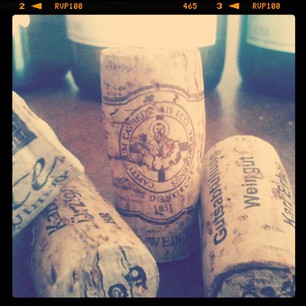
Some cork art. It does not get much fancier…

Here is our line up:

1) 2010 Chateau Grand Traverse Riesling Dry (Michigan)

2) 2011 Brys Estate Dry Riesling (Michigan)

3) 2009 Karl Erbes Erdener Treppchen Spätlese halbtrocken (semi-sweet) (Mosel)

4) 2006 St. Julian Riesling (Michigan)

5) 2011 Left Foot Charley Missing Spire Riesling (Michigan)

6) 2011 Karl Erbes Ürziger Würzgarten Kabinett (Mosel)

7) 2009 Hohe Domkirche Trier Scharzhofberger Spätlese (Saar)

8) 2009 Macquariedale Hunter Valley Late Picked Semillon (Australia)

In blind tastings, it is fun to throw a wine in that not necessarily fits the restrictions on the wines that you imposed prior to tasting. It is something outside the box, to throw you off, and to make the blind tasting even more fun. We usually referred to these as black pirates. The black pirate in this tasting was the Australian dessert wine, which was brought by the friend crashing with us.

But to my thoughts on the wines:

The Michigan line

First up, the 2010 Chateau Grand Traverse Riesling Dry. I do like their semisweet standard wine and their Late Harvest Riesling, so I was excited about trying the dry. Upon opening and pouring, a dark yellow wine showed itself which was bit confusing. Did not expect that from a young dry wine. The nose showed ripe fruit, but not much of it. On the palate, the first noticeable taste was bitterness. There was some slight peach, but hardly discernible. The wine felt quite alcoholic (which was confirmed when we checked the label: 12.5% ABV). The short finish was topped by a burnt taste. In short, it was quite the disappointment. I could never have guessed this was a riesling if tasted blindly, and it seemed way past its prime already.

(Addendum: I received word from the winery in the comments section that the discoloration in the 2010 CGT Riesling Dry indicates that the wine was actually flawed, either by a bad cork or bad storage…I guess I could have guessed that given that I got all the clues: wrong color, bitter notes and burnt taste; I just did not make the connection when tasting.)

Next in line, the 2011 Brys Estate Dry Riesling. The color was lighter straw, with a nose of ripe fruit, peaches and sugar, slightly confusing in a dry wine. The texture was lovely, it gave you a silky mouthful of wine. It had a nice amount of acidity, and first fruit notes I discovered were grapes, yellow apples, pineapple and then citrus. While holding on to my glass and continuing to try, I thought I discerned some vegetable notes in the beginning (maybe squash, maybe zucchini). The wine had a nicely long finish. The 11% ABV were hardly noticeable. In short: This was delicious. It was fresh, and reminded me of German rieslings, albeit not a German dry riesling, it would have been an off-dry in Germany. Very nice wine!!

Up next, the 2009 Karl Erbes Erdener Treppchen Spätlese halbtrocken (semi-sweet). A tad higher in alcohol content than the Brys wine at 11.5% ABV, I was curious how these two would match up. The color was a light yellow with a nose of sweetness and yellow fruit, with ripe aromas. On the palate, the wine had a quite condensed feel to it. It tasted very ripe, older than a 2009 should taste. It had some apricots and vegetal notes, but I could not get over the fact that it might have been flawed. I did not detect a cork flaw, and if so, it was mild. But the wine tasted off. So I really do not feel like I can rate it.
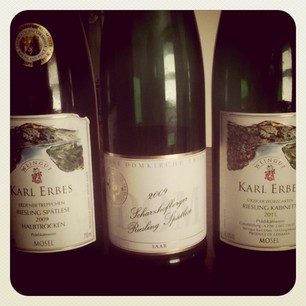
The Mosel line

The next wine was the 2006 St. Julian Riesling. Our friend had been excited when she found the single bottle of this wine in a wine shop and bought it for us to try. She has been fond of older rieslings, and so we wanted to experience this together. Open opening the screw cap and pouring the wine, we saw a lighter, saturated yellow in our glasses. The nose was …mmmmh…. interesting? To me, it smelled of band aids. Others said glue. It also smelled quite musty. It was very unappealing. On the palate, that continued. The wine was clearly way past its prime, probably had been stored in horrible conditions…this one had been dead for a while.
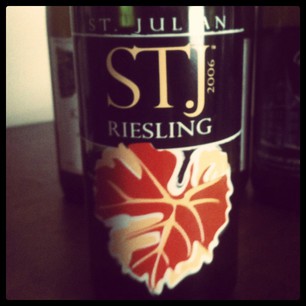
St Julian 2006 – Stay away!

It was on the 2011 Left Foot Charley Missing Spire Riesling to redeem Michigan. And boy, it did!! Of very light and almost water color, it had a beautiful, beautiful nose of grapes and green grass. The taste was floral and herbal (I also wrote down perfumy, but I know that these descriptions do not really help…), with a wonderful creaminess to it. There were some hints of bitterness towards the end. The finish was rather short, though. I found this wine wonderfully refreshing. Its 43 grams of residual sugar and 9% ABV made it a great sipping wine. In its beauty, it did remind me of Prälat wines, but I might have gotten carried away, especially after the two disappointments we tried before. Nina disagreed with me on that assessment, and I suppose she is right.

By that time, we had brought out the cheeses, and that definitely enhanced the tasting as well. Nothing like sweeter rieslings and cheese…

Up next was the 2011 Karl Erbes Ürziger Würzgarten Kabinett. At 8% ABV it had the typical alcohol content of a sweeter Mosel riesling, and I remembered it fondly from our tasting at the winery in June. The color was light straw and the nose had honey and a rather distinct grape note, very fresh. My tasting notes focused on my emotional response rather than the tastes. They read: “refreshing, sweet, honey, warm, nice acidity, deep, not very long, great with cheese”. I admit it, I had already had my fair share of wine, and my tasting capabilities went downhill. The wine just made me smile. It was just so pleasant.

This was followed by my highlight, the 2009 Hohe Domkirche Scharzhofberger Spätlese. You can find the review here (I needed more space for that).

We finished off with the 2009 Macquariedale Hunter Valley Late Picked Semillon from Australia, which is described here.
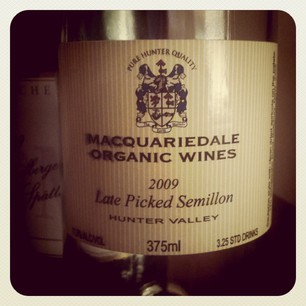
The black pirate

Like I said, it was a great experience. My cousin asked me who won. I really don’t feel like I can declare a winner here. The Brys and the Left Foot Charley were both pretty awesome wines, and so were the Erbes Kabinett and the Scharzhofberger. I think the biggest surprise for me was the quality of the Brys and the Left Foot Charley. They definitely convinced me that there is great riesling in Michigan and I am determined more than ever to go and find them.

Has anyone tried these wines or others from those wineries? Please share!!

Tagged , , , , , , , , , , ,

2011 Reuscher-Haart Gutsriesling trocken and 2011 Reuscher-Haart Piesporter Riesling

I have said it before (here and here) but I think one of the best bargains you can make along the Mosel are the Reuscher-Haart QbA wines, their basic rieslings. The wine is filled in a one liter bottle, so you get 25% 33% (oops, thanks for the pointer, Michael!) more than your usual bottle. Both wines are sold for around $5.50 at the winery, which makes them also quite affordable in the United States with the starting price $12.59 at one merchant.

It was interesting to taste the 2011 dry and sweet version of this wine against each other. They proved nicely the difference in a dry and sweet Mosel riesling, and why I like the sweeter rieslings better. Both wines are exceptional quality, and I highly recommend them. If a winemaker puts this much love in their simple estate wine, it speaks volumes about their work ethics.

The classic label (Photo credit: wine-searcher.com)

The 2011 Gutsriesling Trocken (trocken is the word for dry in German) was harvested from Piesporter Falkenberg. The grapes had a sugar level that would have qualified this wine for a spätlese, but Mario decided to make the dry gutsriesling out of them. The wine has 12% ABV and residual sugar of 6.7 grams/liter. It is light in color, with apple notes dominating the nose, exuding a freshness that was very welcome. On the palate, apple persisted strongly. The acidity in the wine was never overbearing and nicely tied to the apple notes. It was a very refreshing wine.

The 2011 Piesporter Riesling was not harvested in a specific vineyard, the grapes come from several lots in Piesport. The wine has 9% ABV, the residual sugar was not listed. The wine looked similar to its dry brother, but the nose showed more fruit aromas: there was gooseberry and kiwi, beside the apple notes that I find often in Mario’s wines. On the palate, the sweetness strengthened these aromas, and made the wine a great mouthful of fruit. The wine’s acidity ensures it is not too sweet on the palate. It is one of the most refreshing, easy drinking wines I know.

What does that comparison show? In my experience, more residual sugar in a wine (up to a certain extent!) brings out more fruit aromas, which is one of the greatest beauties of riesling for me. When I try a dry riesling I often find myself appreciating the wine but thinking: “If there was a bit more sugar here, it would be even better.” But, alas, that is my relationship with riesling…

You can order the wines at the winery here.

Tagged , , , , ,

The Vereinigte Hospitien tasting in June 2012

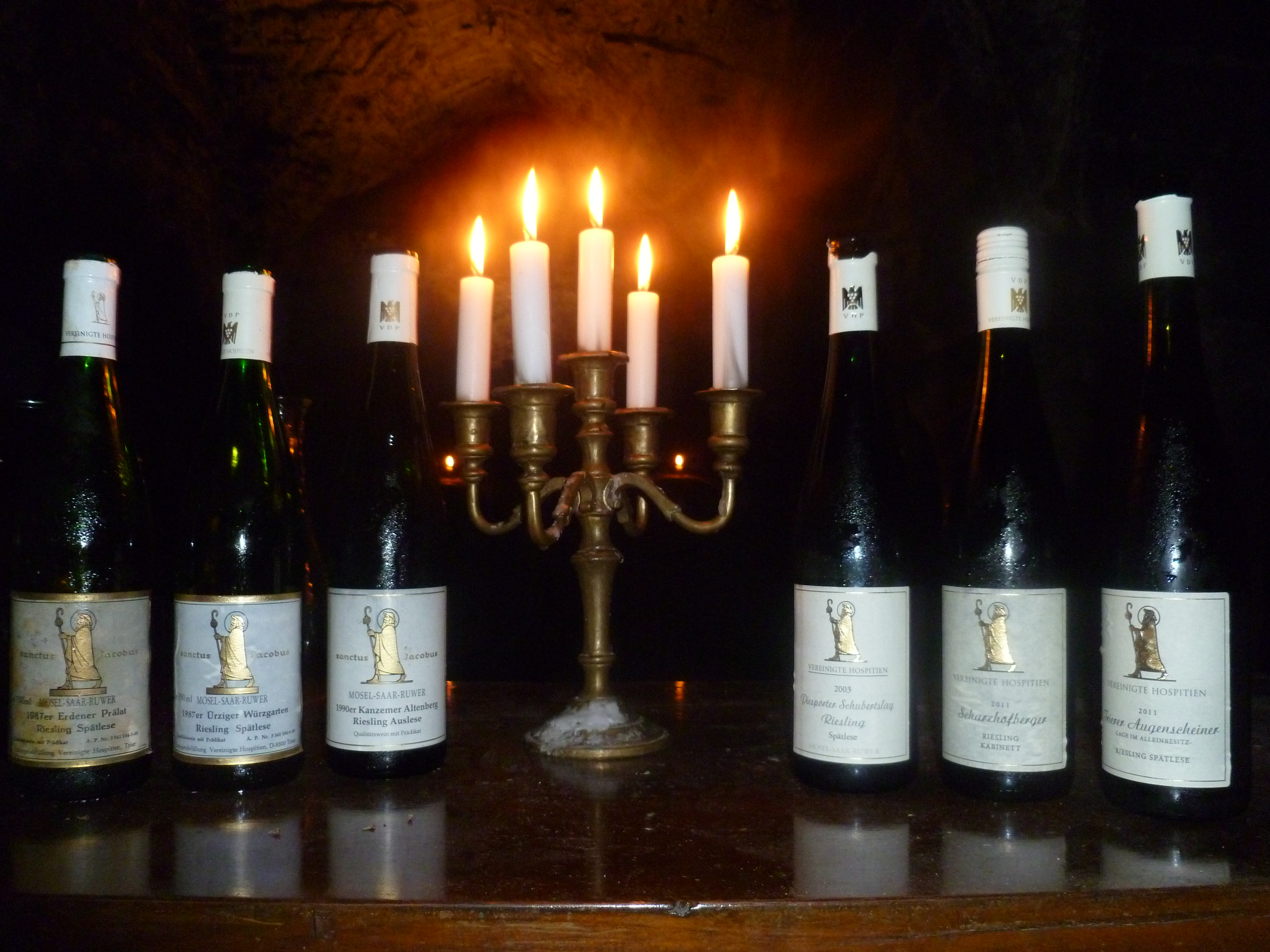
The line up

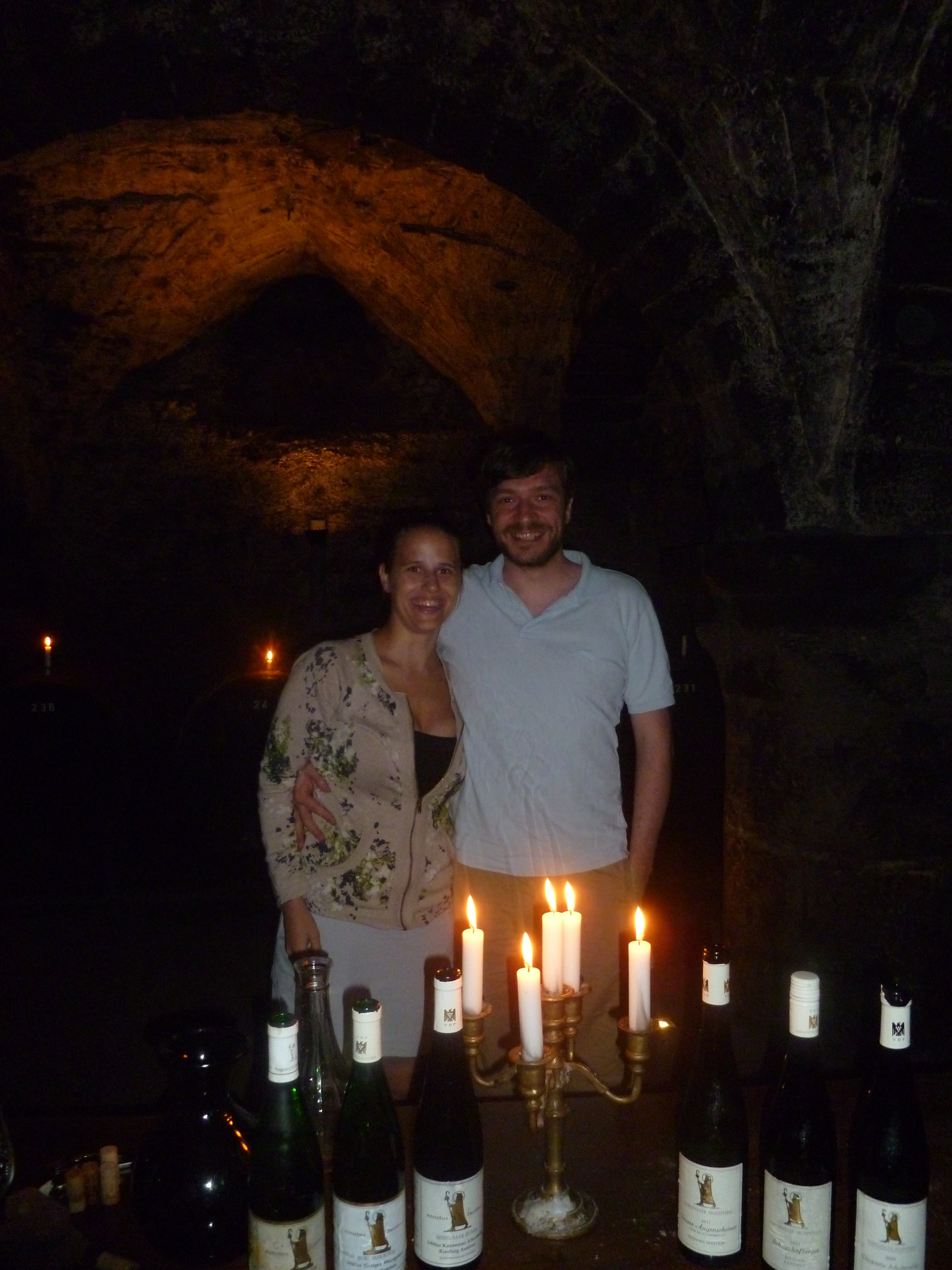
Finally, here are the tasting notes for our awesome tasting at Vereinigte Hospitien in June. As you might remember (if not, here is the initial report), we were sitting in Germany’s oldest wine cellar (the walls dating back to the 300s A.D.), soaking in the awesome atmosphere as our host Marc was picking up some bottles to try. And he did not let us down!

Here is the wine list:

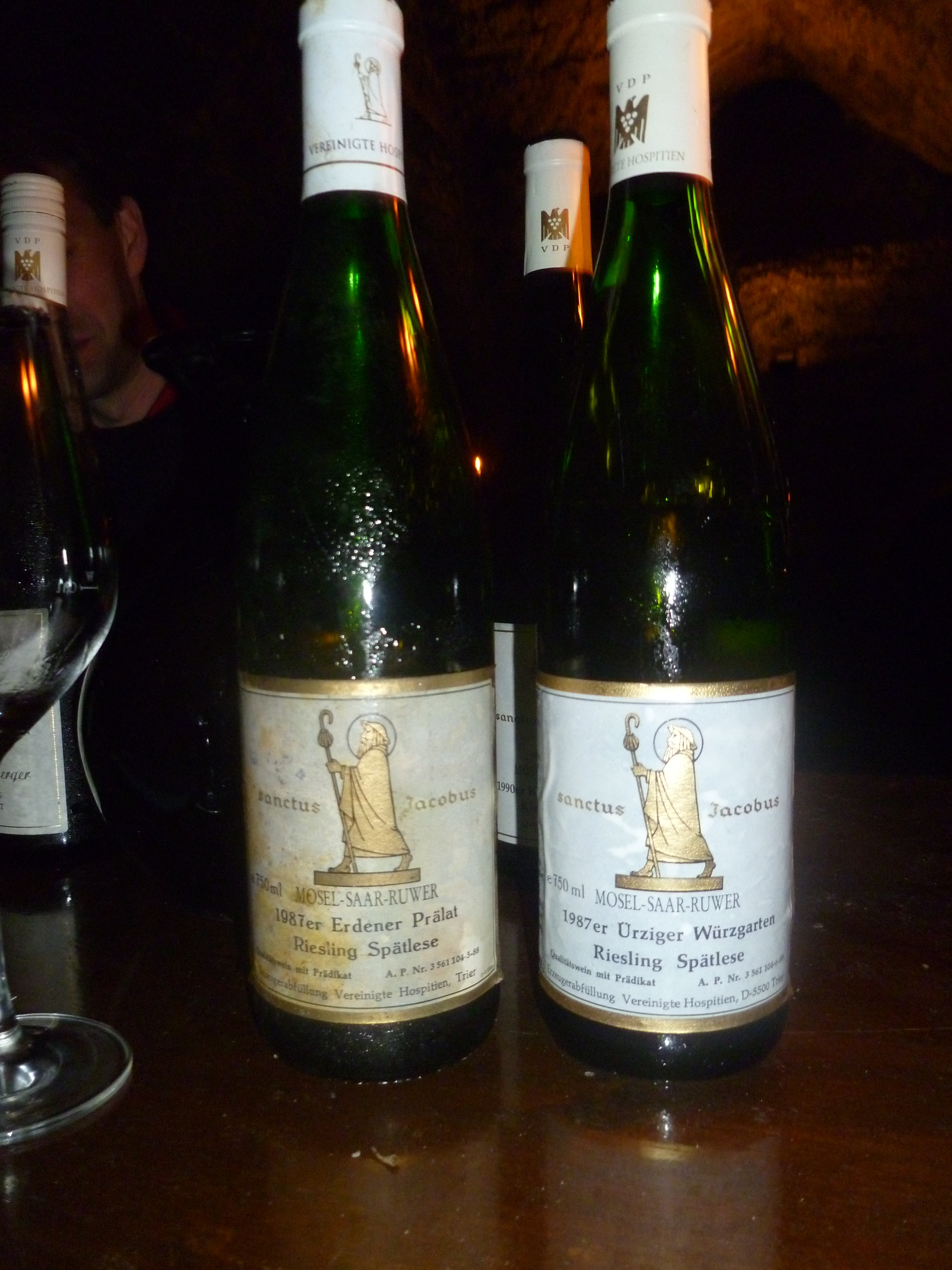
1) 1987 Ürziger Würzgarten Riesling Spätlese

2) 1987 Erdener Prälat Riesling Spätlese

3) 1990 Kanzemer Altenberg Riesling Auslese

4) 2011 Scharzhofberger Riesling Kabinett

5) 2003 Piesporter Schubertslay Riesling Spätlese

6) 2011 Trierer Augenscheiner Riesling Spätlese

We began with a tasting of two 1987 wines from two of our favorite vineyards: Ürziger Würzgarten and Erdener Prälat. It is Nina’s birth year and Marc had learned that from the blog. We had tried the Erdener Treppchen Spätlese before, so now we were able to compliment this tasting experience that I described here.  Just think about that: we were able to try three similar quality wines from three connected vineyards of a 25 year old vintage. Maybe it is just me, but I get pretty excited about that!!

Both wines were spätlesen and they had remarkably similar profiles. The Ürziger Würzgarten had 10.4 grams of acidity per liter, with 41 grams of residual sugar; the Erdener Prälat was slightly higher in acidity at 10.5 grams and sweeter with 45 grams of residual sugar. At 84 degree Oechsle (a scale to measure the sugar in the harvested grape), it had the highest Oechsle for any of their spätlese in that year.

The Ürziger Würzgarten’s nose was flowery and fresh, one could say a typical nose for this vineyard. On the tongue, it had a sizeable amount of acidity, which gave it an incredibly fresh taste. The acidity persisted throughout the tasting. It was hard for me to discern what fruits I tasted.

The Erdener Prälat was remarkably well preserved. The nose was full of peach and once the wine reached our mouths, it broadened out, fully taking command of our taste buds with peach and apricot. The acidity only appeared more towards the end. It had a long finish.

It was interesting to see how different these two wines tasted. You could definitely tell the terroir in them, but the higher residual sugar in the Prälat probably helps explain why the acidity was less pronounced in it.

Two beauties

Another interesting thing we learned was that Vereinigte Hospitien did a chemical analysis of the Würzgarten and it produced a fascinating result. One thing that you hear over and over again when tasting older rieslings is that they tend to be more balanced, because the sweetness goes down and the acidity stays, so the wines become less fruit-pronounced. However, the chemical analysis showed that the amount of sugar in the wine had not gone down – at all. There was still the same amount of sugar in the wine! We just do not taste it anymore. Apparently, there is no real explanation for that. One guess is that the sugar transforms into longer-chained molecules that our taste buds cannot taste…crazy, right?

We then went for a 1990 Kanzemer Altenberg Auslese. Kanzem is at the river Saar, a small contribuary that meets the Mosel just south of Trier. Saar wines are usually more mineralic and have higher acidity levels than the Mosel, which makes for very interesting wines. Kanzemer Altenberg is one of the top vineyards along that river. The bottle had been recorked. The wine has 52 grams of residual sugar, harvested from fully ripe grapes.

Upon opening and pouring, we saw a dark orange wine, with a salty and sherry like nose. On the tongue it was weirdly metallic, some hints of passion fruit. It then fell flat fast. We decided the bottle was flawed (actually, Marc, who knew how it should taste decided…but it did taste odd). The second bottle we opened was very different: lighter in color, the nose full of gooseberry. On the tongue, it had a fabulous acidity, lively fruit notes and just gave us a great mouth-full of wine. The texture was wonderful. A great wine!

We then tried a 2011 Scharzhofberger Riesling Kabinett. The Scharzhofberg is the Saar’s most famous vineyard and its wines rank among my favorite. It has a hard to describe terroir note to it that I just find incredibly endearing and comforting. This one did not let us down. At 88 degree Oechsle, this Kabinett is actually a wine that could have been labelled as an Auslese, two spots higher. It has 9.8% ABV. The nose was fruity and flowery. On the tongue I tasted banana and apricot, with a looooong finish. Just a very decent, yummy wine.

Nina’s highlight, and I was pretty impressed, too, was the 2003 Piesporter Schubertslay Riesling Spätlese. Initially a single-owned vineyard by Vereinigte Hospitien, they are now leasing some out to other winemakers. The color was light and fresh. The nose full of strawberry and cream, with vanilla thrown in. On the tongue, the same tastes prevail. The sweetness is wonderfully balanced by a fresh acidity. Later on, we tasted caramel notes creeping in. Long finish, too. It was such a fun wine. We have had another bottle since, and that was just as good. A great wine at a great price ($15).

We finished the tasting with a 2011 Trierer Augenscheiner Riesling Spätlese, a vineyard completely owned by Vereinigte Hospitien. At 72 grams of residual sugar and 92 degree Oechsle, the first thing we noticed was sweet peach in the nose, complimented by perfumy and flowery notes. The taste was floral as well (I am bad with discerning different floral notes), the texture silky. The wine seemed incredibly concentrated, and definitely not yet ready for consumption. I bought a couple of bottles to see where this one is headed to…

As you can see, it was quite the outstanding tasting: old and new, Saar and Mosel. The full variety, even of just the sweeter rieslings, came out beautifully. I am looking forward to many more tastings there…

Bliss…

Tagged , , , , , , , , , , ,