Tag Archives: 2012

Minor Thoughts on the 2012 Mosel Riesling vintage

Somewhere along the Mosel, November 2013

Somewhere along the Mosel, November 2013

I’ve spent the last five days at the Mosel, where I was lucky to taste 2012 Rieslings with some of my favorite producers, and new contacts. Most of these tastings were dedicated to the 2012 vintage, but it was hard not to talk about the 2013 harvest, which was just finished a few days or weeks ago, depending on the winery, so let me start with that.

2013 seems to have been a very difficult year: It started with low temperatures which led to late bud break and flowering, followed by a very dry summer. Some areas saw early summer hails that led to some areas remaining without any yield. Once harvest time came around, the weather started turning wet and rainy, which meant vintners and their staff had to time picking grapes quite well in order not to get grapes that were either too soaked with water or brought in a bunch of water.

All in all, 2013 seems to have reinforced the need for a lot of work in the vineyards throughout the year (e.g. cutting down grape clusters very early once it was clear that the ripening period was shorter). What I tasted from the barrel showed quite some acidity (as was to be expected from a very mixed weather year), but aromas seemed to be alright. Most winemakers lamented how low their yield was, but that they were fine with the result in the barrels. This is the third in the last four years that brought significantly lower yields than on average, and it could mean financial difficulties for some….for now, a lot of the wines are still bubbling, and it is wait and see.

Barrel tasting 2013s at Immich-Batterieberg

Barrel tasting 2013s at Immich-Batterieberg

But now to the 2012 vintage. Let me recap the growing conditions, with the help of Mosel Fine Wines (if you haven’t signed up for their free newsletters, go and do that now!):

March 2012 was unusually warm at the Mosel, which led to an early bud break. Through uneven weather conditions in June, the yields fell quite a bit and there was early rot due to a rainy July. Other than that, conditions were normal. And a standard September weather brought a quick rise in sugar levels, maintaining higher acidity levels as well. The October had cool nights which made the acidity remain rather high and grapes remained mostly clean with low levels of botrytis.

All in all a rather good year, with the problems of low yields arising from June and July.

I had not read much about other people’s assessments of this vintage, so I was excited to go and try for myself. As you may recall, 2011 along the Mosel was, for my taste, a bit too low in acidity. Back in June 2012 I wrote: “2011 (…) was a year with high yields and very, very healthy grapes. (…) Nina called (what we tried of the 2011s) subtle, I would add sophistication. They also showed great mellowness. Think of 2010 as a crazy, modern art painting and of 2011 as a well composed and pleasing piece of art.”

In retrospect, and having tried more 2011s, I think I am really struggling more than I realized back then with their low acidity. Which was good for the dry Rieslings, but made the fruity and sweeter styles more difficult.

Reinhold Haart Piesporter Goldtröpfchen Auslese 2002 and 2012

Reinhold Haart Piesporter Goldtröpfchen Auslese 2002 and 2012

The 2012, in contrast, cannot complain about too little acidity. The wines all showed a nice balance of healthy acidity and enough sweetness. They were light and elegant, and refreshing. I probably benefited from trying them longer after their bottling than the 2011s, but it seemed to me that these wines were more to my liking. The interplay between sweetness, fruitiness and acidity is such an important part in a Riesling. And it seemed to work in most.

I also tried a bunch of 2012 dry Rieslings. I do think I still prefer the subtler style of 2011 over the stronger acidity-determined 2012s, but I found many of them surprisingly good. My range of assessing vintages is still very limited, so I cannot really compare or give advice on where this vintage lies (and, I also realize more and more that there are no good or bad vintages, it is more easier or harder vintages for the winemakers….or as a winemaker put it: There are no bad years, just bad winemakers.).

The guys at Mosel Fine Wines, whom I have come to trust quite a bit, think 2012 will be one of the great vintages when we look back in several years, especially for clean and juicy, i.e. fruity Kabinett and Spätlese (they see potential to play in the same league as the great vintages of the 1970s)…

Tagged , , , , , , , , , ,

2012 Josh Cellars Cabernet Sauvignon

Josh Cellars Cabernet Sauvignon

Disclaimer: The wine was received as a media sample. Opinions expressed are my own.

A few weeks ago I was approached whether I wanted to review a wine for a good cause. Apparently, the California negociant Joseph Carr has developed a line of five varietals under the name Josh Cellars, to honor his father. With the holidays coming up, the company is going to donate $1 for every bottle bought until December 31 to the military family support organization Operation Homefront (up to $50,000). While many like to talk about honoring the troops and with Veterans’ Day, I thought that’s a neat idea and why not combine pleasure and giving.

The wines in the line include a Cabernet Sauvignon, Pinot Noir, Chardonnay, Sauvignon Blanc and Merlot. Grapes come from California and are made in the French wine making tradition, whatever that really means (sometimes, I do find marketing talk interesting). The wines should be available nationwide.

A few days after the initial contact, I received a bottle of the Cabernet Sauvignon in the mail….and cursed myself for not telling them that usually I am not that fond of Cabernet Sauvignon. My preferred choice would have been the Pinot Noir or even the Sauvignon Blanc. Ah well. I knew I could count on Nina to help me assess the wine (she’s in love with all things Cabernet Sauvignon).

I checked the technical stuff on the wine, so let me share that with you. It contains 75% Cabernet Sauvignon, 15% Merlot and 10% Cabernet Franc, which was actually exciting news because I tend to like Cabernet Sauvignon blended much better. For those unfamiliar with negociants, they are wine merchants that cooperate with growers to produce a crop from which the negociant makes and markets wines, think of Louis Jadot or Georges Duboeuf of the American Kermit Lynch.

When we poured the wine, shortly before I took off to Germany, it poured in a surprisingly light color, much less saturated than I had anticipated. The nose showed some heat, prunes, ash, blackberry and strawberry after a while of opening up. When tasted initially, it just had a great mouth feel with a good chewiness and freshness. I got green peppers, some sweet raspberry aromas, cooked strawberries and there were hardly any tannins noticeable. The wine had retained some hints of sweetness, and was all in all quite pleasing. After an hour, I noticed aromas of licorice and tobacco complementing the palette.

What the Josh Cellars Cabernet Sauvignon might lack in depth, it easily made up for its drinkability and how accessible it is. I can see this as a great wine for people that might be interested in wine, but don’t have much experience, and frankly, we all have a ton of such friends. They want to explore wine more, but they also see the entry barrier as too high. I can see the Josh Cellars Cabernet Sauvignon come in handily for those. And when seen from that angle, it makes for a great gift for a family member or something to take along to a party in the neighborhood. It’s an easy to enjoy wine for sure, and the price tag at $14.99 SRP seems quite alright.

Their website is currently under construction, but you can look up their partnership with Operation Homefront on Josh Cellars Facebook page.

Tagged , , , , , , , , , , , ,

Finger Lakes Riesling Launch – 2012 Vintage

Finger Lakes Riesling Launch 2012 - The line up.

Finger Lakes Riesling Launch 2012 – The line up.

Disclaimer: The wines were received as media samples from the Finger Lakes Wine Alliance. Opinions are all my own.

Last week, I participated in the Finger Lakes Riesling Launch virtual tasting. For a couple of years now, the Finger Lakes Wine Alliance has been presenting the new vintage of the region’s Rieslings in several events called Riesling Launch. Part of it are several Twitter tastings, in which wine writers and consumers can engage with wine makers. For this tasting, the Alliance was live streaming the wine makers of the particular wines that we were tasting. Writers had submitted questions beforehand, and there were to be answers to these questions…

So much for the theory. I have participated in a Twitter tasting with the Finger Lakes Wine Alliance in the past (see here), and I had a great time. The possibility to engage with winemakers directly, to get answers from them, to exchange ideas, to connect, was awesome. It was overwhelming at times, trying, tasting, typing, reading, engaging, but it was fun. To me, I think the live stream was one dimension too much. It was impossible for me to taste, listen, type, watch, read, engage, and listen again…add to that that the stream just worked for the first half, and I can state that I would have been fine without the live stream. I think it’s an interesting idea, I just think the connection with Twitter and tasting wines is too much…

But to the wines. I have written about the region previously, so feel free to check out this post that I wrote for the Finger Lakes Wine Month back in May.

We had a couple of friends over, I made my Korean spicy-braised potatoes and later we moved on to cheese that our friends had brought. We tasted the wines in order from driest to sweetest, as suggested by the Alliance. The 2012 growing season is generally described as warm and pretty dry, which led to a lot of sugar in the grapes. Ultimately, this can lead to higher levels of alcohol in the wine. All wines were made with 100% Riesling grapes.

Finger Lakes Riesling Launch 2012 - The dry wines

Finger Lakes Riesling Launch 2012 – The dry wines

We started off with the 2012 Knapp Dry Riesling Estate KV. The winery was founded in 1984 and is located at Cayuga Lake tending to 40 acres under vine. The grapes for this wine came from one 1.5 acre plot (single vineyard, yay!!) called Block 11. The wine has 12.5% ABV, only 182 cases were produced, $18.95. It is a collaboration between the vineyard manager Christ King and the winemaker Steve DiFrancesco. The wine poured in a light yellow color with a sweetish nose of peach, white grape and lemon aromas. The nose prepared me for a semi-sweet wine (it just smelled so sweet), but fortunately the wine definitely tasted dry. It was citrussy and tasted quite nice. Very clean tasting, refreshing. This wine definitely reminded me of a German Riesling. There were slight, slight bitter aromas at the end which were no problem though. Nina thought it was more a feinherb-tasting wine (meaning a drier semi-sweet), but I disagree. To me, it was dry. Definitely an impressive start.

Next up was the 2012 Lakewood Vineyards Dry Riesling.  Lakewood Vineyards Winery was founded in 1989, but grapes have been grown on this family-owned farm since the 1950s. It has 80 acres under vine, ten of them Riesling. The four different blocks of Riesling that were used for this wine were fermented separately and then blended in January. Bottling begins in April. The wine has 11.7% ABV, 810 cases were produced, $12.99. The winemaker is Chris Stamp, grandson of the farm’s founder. This wine’s color was lighter than the Knapp, very light yellow. Its nose was floral, with nectarine aromas being very prominent. It was a beautiful nose. On the palate, the wine seemed a bit heavier than the Knapp giving it a great mouth-feel. There was a nice amount of acidity with pear and sweet apple aromas. The middle part was the best in this wine for me. It just opened up and became wide with a hint of creaminess. The finish then surprised with citrus aromas coming in. This wine really worked for me. Front and middle section were very lovely, the finish was decent. Add in the price tag and you have a stunner!

The last dry-labelled of the evening was the 2012 Lamoreaux Landing Red Oak Vineyard Riesling, another single vineyard wine. Lamoreaux Landing is run in the third generation, with holdings on Seneca Lake. The wine has 12.5% ABV, 400 cases produced, $19.99. In the glass, this Riesling was extremely light in color, almost looked as clear as water (I was surprised by how light the color of the first wine was, but we kept going lighter and lighter). The nose was screaming peaches at me. Peaches, peaches, peaches. Great nose, very fresh, too. I was excited. On the palate, though, this light-bodied wine was somewhat less impressive. The flavors were subdued, just some slight pear and strawberries. There was a tad too much heat for my palate. After half an hour it got a bit milder. I was somewhat disappointed by this wine. Maybe it came in the wrong spot after the very flavorful Lakewood, but it just did not seem very aromatic to me, which is something I want in a Riesling…tweets from other writers suggest that they really liked this wine. Don’t get me wrong, I didn’t think it was bad. It was just not aromatic enough for me.

Finger Lakes Riesling Launch 2012 - The semi dry and semi sweet

Finger Lakes Riesling Launch 2012 – The semi dry and semi sweet

We then entered the semi-sweet zone, one of my favorite zones in Riesling. I just think that some amount of residual sugar really helps bring out the aromatics. So I was excited to try the next two.

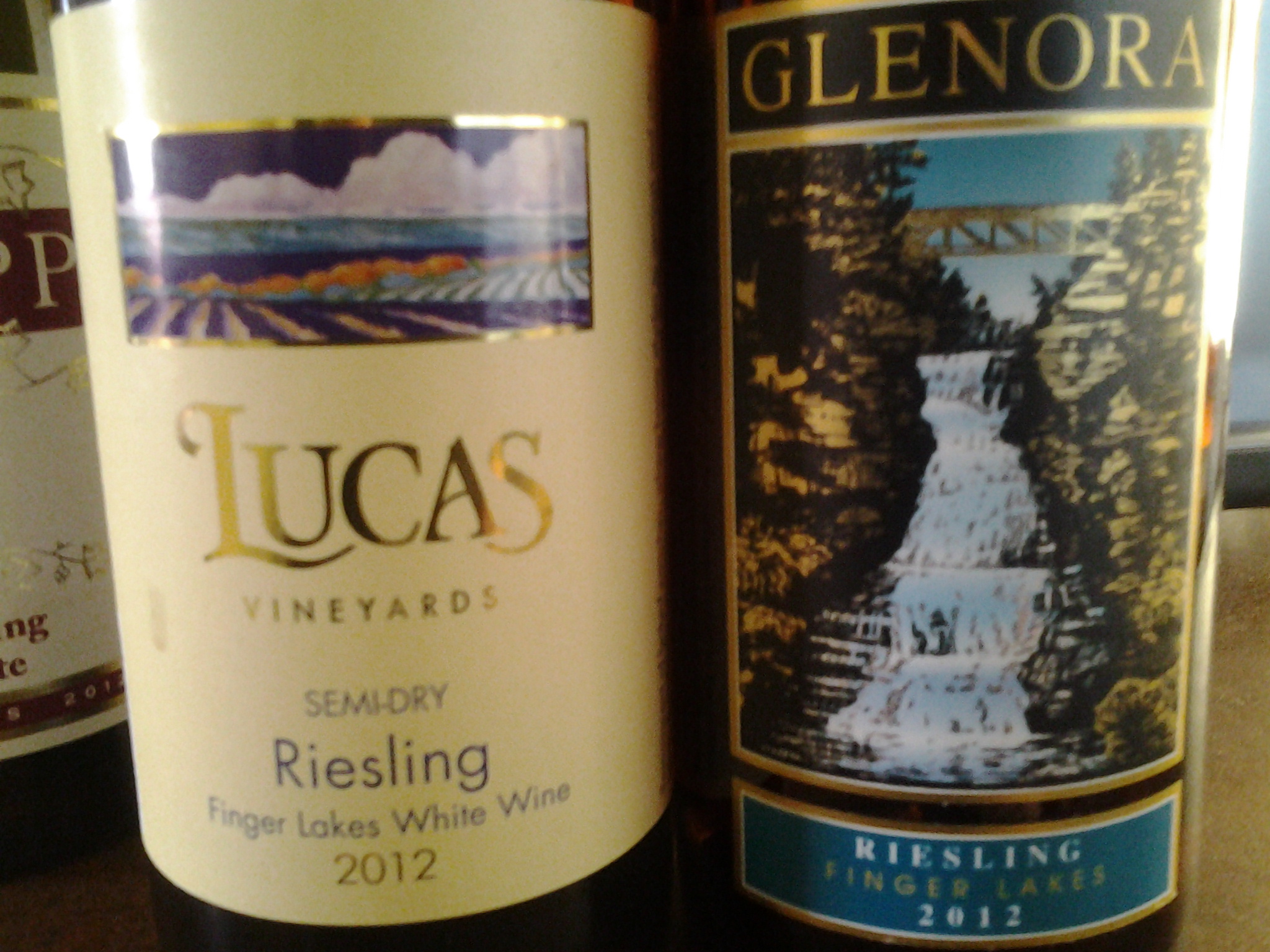
First up was the 2012 Lucas Vineyards Semi-Dry Riesling. The winery is located at Cayuga Lake and has been around since 1980 tending to 32 acres of vines, only 5 acres being Riesling. The winemaker is Jeff Houck, the wine has 11.4% ABV, $13.99. I am not sure whether my bottle was flawed, but this wine did not work for me at all. The nose was weirdly devoid of fruit and same goes for the taste. Just nothing seemed to be coming together. I will therefore not comment on this wine.

The final wine was the 2012 Glenora Wine Cellars Riesling. The winery was the first on Seneca Lake, and the wine was also made by Steve DiFrancesco, the winemaker of the first wine. The grapes came from three different farms around Seneca Lake. 2,600 cases were produced and the wine has 12% ABV, $13.99. During the tasting in May, we had the chance to try a Glenora Gewürztraminer which I found pretty flavorful. The wine poured in a lighter yellow color. The nose was pretty, with honey, sweet apple and tropical fruit aromas. I liked it. Maybe a bit too much honey for a wine that is supposed to be medium-sweet, but pretty. On the palate, the medium-bodied wine first showed its 12% ABV. That was a bummer. Aroma-wise, it was great with papaya and pineapple. There was some acidity, but I wished there was more of it. The finish felt a bit flat, with bitter aromas and petrol. This wine started out nicely, the aromas were there, the weight was there. But then I feel like the alcohol took over. I wish it had clocked in at maybe 10.5% or so, with the added sugar, ok, but that might have brought a bit more balance. I can see that the lack of acidity was another problem, so at 10.5 it might have ended up tasting too sweet. A conundrum, for sure…this wine is still very young, so maybe it will need some more time to get the flavors together and for the alcohol to integrate better.

All in all, I was most impressed by the dry wines with the Lakewood being the standout wine here. That just worked for me. Light and flavorful, just like a dry Riesling should be. The Knapp was also a strong showing. The Lamoreux I will have to retry on its own one of these days. I really feel like it might have been harmed by the depth of flavors in and direct comparison with the Lakewood Riesling. This outcome was a surprise for me, given how much I prefer the medium sweet Rieslings in general. But that, to me, is also testament to the quality of these Rieslings…Finger Lakes Rieslings are definitely worth trying out.

Tagged , , , , , , , , , , , , , , , ,