Tag Archives: 2009

2009 Kermit Lynch Côtes du Rhône

It was our anniversary this weekend, so we decided to try a restaurant in Ann Arbor that is focused on using local ingredients. It was our first time there, so we tried their five course tasting menu to see what the chef was capable of. The restaurant offered an accompanying wine pairing for half of what dinner cost. While I sometimes have had good experiences with these restaurant offered pairings, this is usually only the case if the restaurant has a sommelier and is as devoted to its wine menu as it is to its cuisine. Somehow, this place (and their wine menu) did not give off that impression, so I was reluctant to take it.

Given that the tasting menu was a surprise menu, it was not the easiest thing to decide what wine to go for then. Given that there was no riesling on the menu (shame on them), we decided to go with a lighter red wine that could complement most of what was possibly going to come, and sit out on the wine when it did not match at all. I find Côtes du Rhône wines to usually be a good companion when it comes to this. They are not as heavy bodied as other French reds, and at the same time offer an interesting mix of spices and earthiness. The only Côtes du Rhône the restaurant had was this one, so we decided to go for it.

Today I found out that Kermit Lynch is a major wine merchant in the tradition of French négociants from California. They offer a whole variety of wines from France and Italy with a gazillion of producers working for them. This particular Côtes du Rhône blend is vinified by Jean-François Pasturel from Grenache, Syrah, Cinsault and Carignan grapes from 40 year old vines on 36 hectares around Avignon.

The wine had a medium ruby color. Its nose was nicely perfumy with wooden and earthy notes, Nina detected some blueberries that were definitely there. On the palate, the wine was on the lower end of medium bodied, and it showed a nice fruitiness of red berries and herbal, foresty aromas. The finish was of medium length, with a nice peppery note to it. It was pretty yummy to guzzle at dinner, and was just the right weight.

It also paired nicely with our – quite disappointing – dinner. The first course was a duck liver paté, to which the earthy notes paired well. The second course was a very nice salad with pan-seared (over-peppered) local trout, where it sort of worked. This was followed by uninspired “gnocchi” (which had nothing in common with gnocchi any Italian would serve) in a tomato sauce – the wine worked again. The next course was pork loin with potatoes (talk about uninspired again), where the wine complemented the roast aromas on the pork and went nicely with the onions. The dessert was an abomination of a panna cotta, made with buttermilk which destroyed its texture and taste (hardly any vanilla, and not even a reminder of the creaminess a panna cotta should have) and topped with a horrible concord grape syrup that tasted as bad as a Welch grape juice (which I completely detest)…luckily, I had the wine to clean my palate from the few spoons I ate before I abandoned the dish.

It was kind of a sad thing, this dinner. While I want to support locally sourced restaurants and like the idea, using these ingredients does not absolve you from making dishes that taste good. It is like organic wines. There is no inherent goodness in making wines in an organic fashion. They have to taste good first and foremost. If the two go together, the better. If not, I will relinquish ingredients over taste at any moment.

The wine was nice, so I recommend it.
Tagged , , , , , , ,

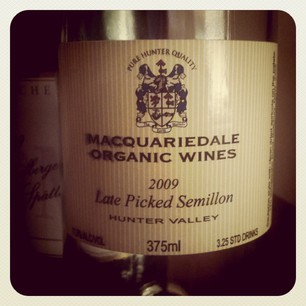
2009 Macquariedale Hunter Valley Late Picked Semillon

The black pirate

The final wine and black pirate at our Michigan vs. Mosel Riesling Tasting came from Australia, and was brought by a friend who had just arrived from Australia. She knows Nina’s and my love for wine, and she pretty much nailed it earlier this year when she brought this wine for us…

It was only after the tasting that I dove a bit further into the winery. On its website, the owners state that Ross and Derice McDonald started planting some vines in 1993 as an escape out of Sydney’s corporate world…interesting. In 1998 they went in all the way by moving to their Hunter River property from Sydney. They now own 15 hectares of vineyards and claim to make biodynamic/organic wines. I know organic wine making is quite the rage for a lot of consumers these days. I am fine with drinking organic wines, but it would never be my main criterion in buying a wine. A wine has to taste good first and foremost. If that can be combined with less intrusive methods of growing, that is fine with me. What I do not like is that equation of organic = good. To their credit, Mcquariedale does not seem to push that point too hard.

They grow shiraz (it is an Australian winery after all!), cab sav, merlot, semillon, chardonnay and verdelho grapes.

The wine description on their homepage reads as follows: “Our late picked Semillon is produced in a light style with hints of citrus peel and marmalade on the palate.  The semillon grapes are left to ripen on the vine and then fermented briefly to retain all the natural acidity and sweetness.  The wine will age gracefully and deepen in colour and flavour with extended cellaring.”

Here are my tasting notes. The wine poured in a deep orange color, and was highly viscose, as was to be expected by a fortified dessert wine. The nose had prominent pumpkin and clove aromas, then dried apricots and overripe cantaloupe. On the palate, the first and slightly overwhelming note was honey. As the earlier detected pumpkin and clove came in, so did some hints of sweet potato. I hardly noticed any acidity at all. The finish had an interesting touch with slight salty notes in the end.

I have to say, this wine did not grow on me. It was just too sweet without redeeming acidity. The pumpkin and cloves aroma did not help, because I am not fond of pumpkin pie at all (hey, I am not American, I do not have to like pumpkin pie!). I think the craftsmanship is there, and I bet there are many that like this type of dessert wine, some of the vin santo I tried in Italy was of similar style. I am just spoiled by my riesling BA, TBA and ice wines…

Tagged , , , , ,

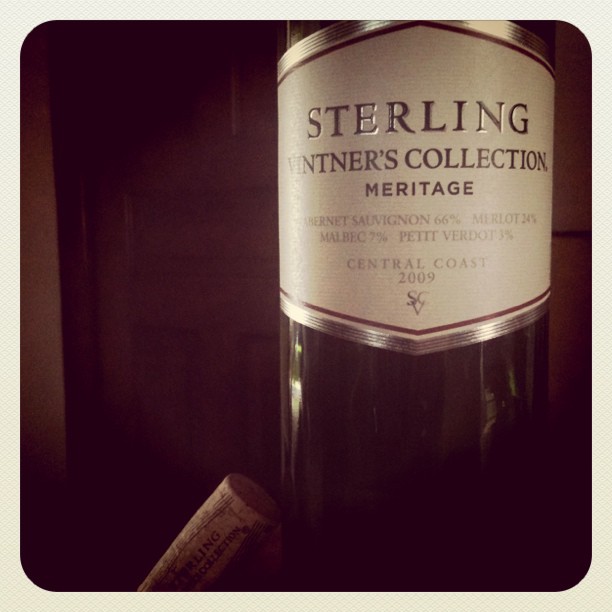
2009 Sterling Vintner’s Collection Meritage

I am just realizing this is my first blog entry on red wine…see, I am not as one dimensional as you thought!

Prior to buying this, I had never seen the name Meritage before, so I checked it out and found this on it: It is a term coined by American winemakers, that stands for Bordeaux-style wines. This means not one or two grape varietals but rather a blend of several varietals to create a complex and harmonious product. Some California winemakers decided to found the Meritage Association (now: Meritage Alliance) in 1988 and you have to be a member to label wines “Meritage”. A clever guy came up with a combination of “merit” and “heritage”, so it is to be pronounced like heritage, just with an “m”…

While modern times have become more and more obsessed with single variety wines (you know what I’m talking about when you look at your supermarket’s or winestore’s wine displays), it is not at all uncommon to blend several grapes into one wine. Bordeaux is the prime example, but also Chianti classico is made of several varietals (until a couple of years ago, they could even include white grapes!) same as a lot of wines from Portugal’s Douro region. It gives winemakers the unique chance of blending different tastes together into one. I personally like blended wines, the rough edges of a cabernet sauvignon can be mellowed by merlot for example. When I once talked to a Douro winemaker friend of mine and mentioned that I had tried and hated a single varietal “tinta barocca” in South Africa, he looked at me in shock. How could anyone make single variety tinta barocca, he asked? It is a classic filler grape for bigger reds…

Now on to this one. Sterling is a huge winery in Napa Valley. You can check out their site here (with elevator music…). The Vintner’s Collection is their “cheap”, really mass label. We paid about $10, I think. This Meritage (thankfully they put that on the label) has 66% Cabernet Sauvignon, 24% Merlot, 7% Malbec, and 3% Petit Verdot in it. Upon pouring, it showed its not overly dark color, which I found surprising. I had expected a way darker red. The nose was strong and full of different smells: initially strawberry hit me, then vanilla and cherry. Somewhere in the middle, herbal and floral notes crept in and I think I smelled some very light tobacco as well. It was awesome. I have not had a bold red in a while, and this reminded me of all things good. The taste was chewy and powerful. Initially smoky, leathery, some black pepper. Then red fruits came in. There was a distinct note of acidity that gave the impression of some unripe grapes in the wine. This acidity also made the wine taste more like plums, which I found appealing. The finish is ok.

I did like this wine. It was bold and not ashamed of it. Especially given that it was mass-produced I did like it. Some imbalances, the acidity, but all in all a very decent wine. Oh, and it went well with the pizza we had, too.

Tagged , , , , , , ,