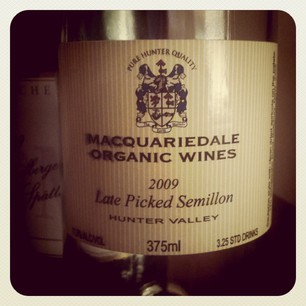
2009 Macquariedale Hunter Valley Late Picked Semillon

The black pirate

The final wine and black pirate at our Michigan vs. Mosel Riesling Tasting came from Australia, and was brought by a friend who had just arrived from Australia. She knows Nina’s and my love for wine, and she pretty much nailed it earlier this year when she brought this wine for us…

It was only after the tasting that I dove a bit further into the winery. On its website, the owners state that Ross and Derice McDonald started planting some vines in 1993 as an escape out of Sydney’s corporate world…interesting. In 1998 they went in all the way by moving to their Hunter River property from Sydney. They now own 15 hectares of vineyards and claim to make biodynamic/organic wines. I know organic wine making is quite the rage for a lot of consumers these days. I am fine with drinking organic wines, but it would never be my main criterion in buying a wine. A wine has to taste good first and foremost. If that can be combined with less intrusive methods of growing, that is fine with me. What I do not like is that equation of organic = good. To their credit, Mcquariedale does not seem to push that point too hard.

They grow shiraz (it is an Australian winery after all!), cab sav, merlot, semillon, chardonnay and verdelho grapes.

The wine description on their homepage reads as follows: “Our late picked Semillon is produced in a light style with hints of citrus peel and marmalade on the palate.  The semillon grapes are left to ripen on the vine and then fermented briefly to retain all the natural acidity and sweetness.  The wine will age gracefully and deepen in colour and flavour with extended cellaring.”

Here are my tasting notes. The wine poured in a deep orange color, and was highly viscose, as was to be expected by a fortified dessert wine. The nose had prominent pumpkin and clove aromas, then dried apricots and overripe cantaloupe. On the palate, the first and slightly overwhelming note was honey. As the earlier detected pumpkin and clove came in, so did some hints of sweet potato. I hardly noticed any acidity at all. The finish had an interesting touch with slight salty notes in the end.

I have to say, this wine did not grow on me. It was just too sweet without redeeming acidity. The pumpkin and cloves aroma did not help, because I am not fond of pumpkin pie at all (hey, I am not American, I do not have to like pumpkin pie!). I think the craftsmanship is there, and I bet there are many that like this type of dessert wine, some of the vin santo I tried in Italy was of similar style. I am just spoiled by my riesling BA, TBA and ice wines…

Tagged , , , , ,

Sunday read: Why write about wine?

I bet this is a question that a lot of wine bloggers ask themselves or are being asked by others. Why do you write about wine? Is it just to show off? Is it because you have no friends to talk about wine with?

We all have our own answers. I have explained a bit in my About section. Thinking about it more, this blog has also become my wine diary. It is a nice aide memoire. But there is more to it. I feel like I want to share more about my favorite white grape, riesling (you guessed it!), because I was fortunate enough to live in an area that produced the most stunning examples. So I am trying to share my impressions, my experience with wineries and wines. A lot of us don’t have the money to go after the top tier producers, but there are a ton of winemakers out there in Germany that make affordable, fantastic rieslings.

But that still is not all…and this is where Evan Dawson of New York Cork Report comes in. In May, he published a piece titled “Why Do I Write About Wine?”. I stumbled across it when I checked the wine blog awards 2012. It received the Best Blog Post of the Year award. The title caught me, and Evan’s writing drew me in deeper and deeper. I think it expresses a lot of my sentiments well, and therefore I am sharing it today.

I hope this is posting correctly this week, and as always, I hope that you have the appropriate drink in your glass for the time of day…for me, it will be coffee.

http://newyorkcorkreport.com/why-do-i-write-about-wine/

Tagged , , , ,

Federweisser Time

Yesterday morning, it felt like fall for the first time this year. It made me think of late summer in Germany, and how this time of year is also an interesting time wine wise:

The summer is usually filled with wine festivals in the villages along Mosel and Rhine. They initially began as a chance for wine makers to empty their cellars of the previous vintage and make room for their new harvest. There might still be some truth in this, but by now the festivals really are a highlight of local wines, good company and food. Along the Rhine in Rheinhessen for example, every weekend, another village will have its wine festival, so you can pretty much spend the whole summer drinking wine straight from the vintners. These festivals are coming to a close around this time of year, as the wine makers prepare for their harvest.

However, that is not universally true. The world’s largest wine festival, for example, takes place in Bad Dürkheim (Palatinate) this weekend. It is called “Wurstmarkt” (Sausage Market) and this year’s is – believe it or not – the 596th time they are holding it. You can find more information here. The sheer size makes it different from the village festivals.

Anyway, in many parts, the harvest does not start until October, so it is a time of anticipation, checking the weather in the hope of a golden fall with lots of sunshine (for the grapes to fully ripen) and little rain (so that the grapes do not rot). And when October finally comes around, and the grapes are harvested and transported back to the cellars to be crushed and fermented, all those villages along the wine rivers will have a distinct smell hovering above them, a smell of grapes and yeast, and fermentation…to me, it is bliss.

The highlight of this part of the season, late August until end of September, is “federweisser” (literally “feather white”). It has many different regional names, but this is the most common. This specialty is grape juice that is still fermenting. The color is a milky yellow to light brown (hence the name), it is bubbling, and it is delicious. Once the grapes have been crushed, the juice (or must) will rapidly start fermenting when combined with yeast. The sugar in the grapes will be turned into alcohol by the yeast until there is no sugar left. This happens in a matter of days. Winemakers are allowed to sell federweisser once the alcohol content reaches 4% ABV. Not all winemakers will produce it, and the grapes are not from top notch vineyards, because that would be a waste as you can only drink it for a few days and nothing sophisticated is coming from it…

Federweisser is filled in bottles or plastic containers, but you must not close it off with a cork because of the fermentation. Usually the producer just puts a plastic cap over the bottle head and you need to transport it carefully and not lay the bottle down in the fridge.

Federweisser at its best (Photo credit: http://www.ekneipe.de)

The supermarkets will carry stuff originating from Italy and other places. Fermentation in these federweisse has usually been stopped which makes them boring and tasting slightly off. You want that bubbling still going on from fermentation. That is why it is imperative to buy it from a winemaker. A bottle will cost you between $3 and $6, depending on winery and region, and that is a pretty good price for the winemaker because it brings in money fast (they do not have to wait for the release of their wine next year) and is less work than cellaring and storing the wines.

What does it taste like? I would describe it as a grape based soda. It is sweet, it is refreshing, and very fruity. Despite the low alcohol content, these drinks can get to you fast. I am usually wasted after three or four glasses. Nina lasts a bit longer.

We pair it with “Zwiebelkuchen” (onion pie), a bit like a pizza or a quiche with tons of onions, some cream and bacon bits on it (there are a million recipes for onion pie out there, some with meat, some with cumin…every family has their own recipe). It seems like an odd mixture, but the saltiness of the pie with the sweetness of federweisser is great. It is hard on your digestive system, let me tell you, but it is as much a tradition in German households in wine regions as asparagus season in June all over Germany or Christmas markets in December.

If you ever get the chance to be in Germany around this of year, give federweisser a try. It is a tradition worth experiencing. And it smoothes us over into harvest season. I will make onion pie for friends of ours soon, and I am cursing my fate that does not allow me to have federweisser with it…

Tagged , , , , ,