Sunday read: Black Forest Chateau

This Sunday, let’s broaden our horizon about German wines a bit further. While I am focused on rieslings mostly, there is another revolution going on in Germany and that is Spätburgunder, aka pinot noir. John Stimpfig wrote a great piece for the Financial Times.

Germany has been growing more and more of this grape variety, many of them clones from Burgundy. This article does a good job at explaining the wonder that these pinots can be. The article starts out fun:

“Should you ever need to accurately calibrate an oenophile’s knowledge of wine, here’s a handy question that will immediately expose them as buff or bluffer. Simply ask them what they think about German Spätburgunder, aka Pinot Noir. The bluffer will either stare at you blankly or snort with derision at such a preposterous idea. In marked contrast, the buff’s eyes will immediately light up before he or she enthusiastically acknowledges that Germany’s top Pinots are unquestionably giving the best of Burgundy a real run for its money.”

But he also dampens expectations with this:

“But as Monego diplomatically points out: “Compared to burgundy, we’ve only just reached Everest base camp, so there’s still a long way to go. German Pinot is a work in progress and there are many different routes to the summit.” What everyone can agree on is that there’s now a much greater recognition of German Spätburgunder beyond its home territory. But before you rush out to stock up on the latest must-have vintages, there are a couple of things you need to know. The first is that some are even harder to find and buy than burgundy. The other is that they’re often just as expensive.”

I for one, am just excited that there are exciting red wines in Germany, too…more choice, more to drink.

Have a great Sunday!
Black Forest Chateau

Tagged , , ,

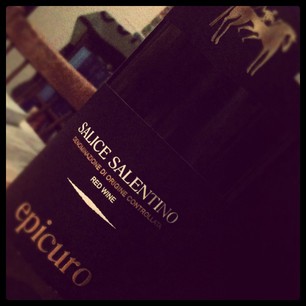
2009 Epicuro Salice Salentino Riserva

2009 Epicuro Salice Salentine Riserva

Some of you might remember that I wrote a quite fond review for this wine’s 2007 Riserva, if you don’t you can find it here. It is available at Trader Joe’s for $5.99. Let me just repost some of the information on Salice Salentino from my previous post:

“Salice Salentino is a red wine from Southern Italy and has had DOC (denominanzione di origine controllata) status since 1976. The village it is named after is in the heel of the Italian boot. The main grape in a salice salentino is negroamaro, which is generally described as a rustic and earthy grape.

This red has 80% negroamaro and 20% malvasia nera in it. It has 13% ABV.”

The wine poured in a dark, blackberry red into the glass. On the nose, I initially got some floral notes, possibly violets, then some mint. The wine smelled very”fresh”, not sure how else to describe it, with hints of acidity. On the palate the first impression was very spicy and floral. It had a medium bodied mouth-feel to it and the fruit I noticed was strawberry. There was a nice acidity in this wine that kept it fresh. The finish was herbal and tangy with some leather notes, and of medium length. It was a tad too acidic for my taste, but all in all a pretty decent and interesting red.

This 2009 vintage tasted significantly different from the 2007 vintage. It lacked the depth that I seem to remember (probably because I don’t get much leather and tobacco in this one), but it was still an enjoyable wine. I also am never quite sure whether I remember wines that I liked in the past more fondly than they actually were…but that is another story.The acidity is definitely more prominent and the wine seems lighter and fresher in total. I am pretty certain I will buy this one again.

Tagged , , , , , ,

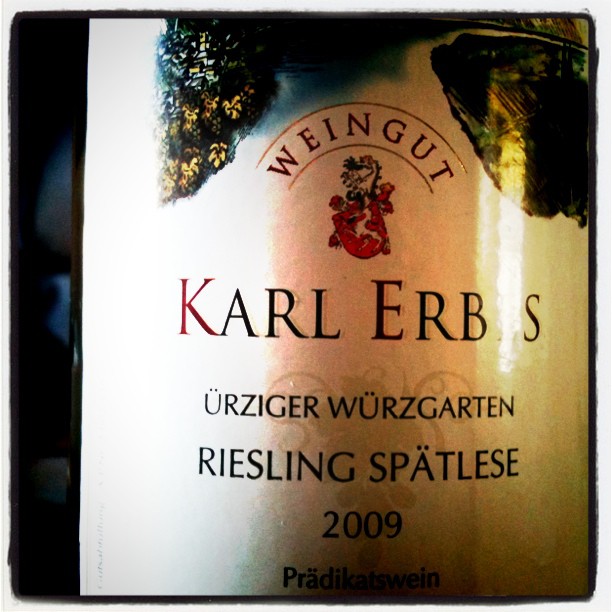
2009 Karl Erbes Ürziger Würzgarten Riesling Spätlese

2009 Karl Erbes Ürziger Würzgarten Spätlese

Just a short tasting note today. We had this beauty to finish up our Thanksgiving Dinner last Thursday. You can read more about the winery, of which I am very fond, here, and I have waxed on lyrically about the Würzgarten before here.

The 2009 Karl Erbes Ürziger Würzgarten Spätlese poured in a lemony, yellow color. The nose was a bit subdued, but had the typical floral and herbal aromas, with a notable freshness to it (I don’t know how else to describe it). On the palate, it was on the heavier side of light-bodied, with a healthy dose of sugar and yellow fruit. What made me love this wine was  a great lemon-flavored acidity that lingered on my tongue long after I had swallowed it. It was a great companion to chill after overindulging on turkey, mashed potatoes, red cabbage and creamy onions or gruyere-baked butternut squash. Finally something light and refreshing…

Tagged , , , , , , ,