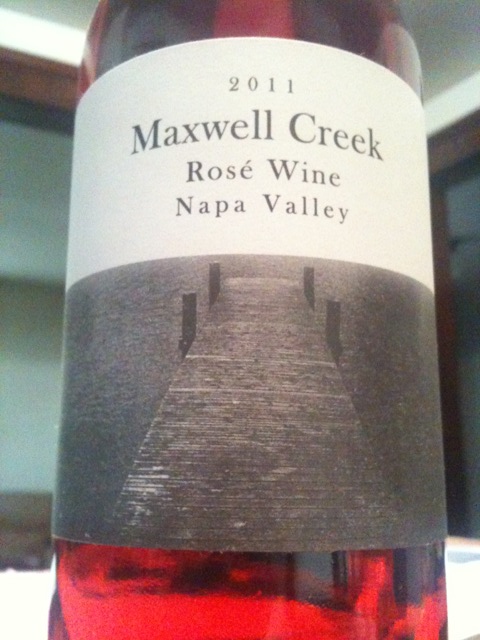
2011 Maxwell Creek Rosé Wine Napa Valley

2011 Maxwell Creek Rosé Wine Napa Valley

2011 Maxwell Creek Rosé Wine Napa Valley

I don’t know how things are going weather wise for you all, but Ann Arbor has finally had a few sunnier days and temperatures have begun to rise. All this lured me into craving a rosé (or blush) wine. I have a weak spot for Rosés. Always had. While growing up, one of my favorite wines was a Portugieser Weißherbst made by my winemaker friend Pitt Zimmermann in my hometown. Portugieser is the grape, and Weißherbst is a German denomination for a rosé wine that is made from just one grape variety and from one single vineyard. I loved that wine: It was always served very cold, was quite sweet and always hit you with strawberries all over the place.

Over the years, it has become a bit too sweet for my taste buds, but when home I still enjoy a glass or two of this wine. Let’s call it one of the gateway drugs…

For those not familiar with Rosé, it is a wine made from red grapes. Unlike red wine, the pressed must does not sit on the skins and stems for long (or at all). Since the color in red wine comes from the skin, and the juice is white just like in a white grape, this leads to just slight discoloration in the wine, hence the name rosé (or blush). Many regions produce these wines, and there are some general rules: Rosés from Southern France tend to be the most dry of all Rosés. Very dry are usually also the Spanish wines of that kind. American and German Rosés tend to be sweeter, with more residual sugar. To me, there is a place for both. While the Southern European versions are great food companions, I actually enjoy a bit of residual sugar in terrace or garden slurpers, when I have the wine on its own.

I bought four of these bottles of Maxwell Creek during a flash sale on Wines Till Soldout and this was the first of the four I opened. I paid $9 per bottle, I believe. “Maxwell Creek Cellars” is located in Rutherford, California. A bit of research showed that it is not a “proper” winery, but rather a filler of wines apparently serving as a second label to sell off overcapacity. The great news about that is that it is usually produce from good wineries just sold under a generic name which comes with a steep cut in price. I was unable to unearth much more about this wine or label, so if you know more please let me know in the comments section!

The wine had 13.7% ABV. Winehoarder declares that the grape varieties used in the wine are Cabernet Sauvignon, Cabernet Franc, Petit Verdot, Malbec and Merlot.

First off, I have to say I LOVED the color of the 2011 Maxwell Creek Rosé. It was a darker red that I associate with strawberries. I so love that color and prefer it over the more salmony or orange looking rosés. The nose was very fruity, just what I wanted and had hoped for: strawberries, gooseberry and peach, some water melon. Really draws you in if you like fruit-forward aromas. On the palate, the wine was quite light-bodied, with good acidity and some tannin giving it body. To me, peach and cream flavors dominated, later gooseberry coming in. It also reminded me of one of the ubiquitous blends in Germany of sparkling wine and vineyard peach liqueur (just without the bubbles). There was some slight bitterness in the finish, which I think might come from the pretty high alcohol level, which overall led to an unbalanced wine. Nina remarked that for her, the wine was too sweet in the middle section and then not good enough at the end. I thought that was a pretty good explanation of what is going on. There is definitely some sweetness to this wine which many will probably not appreciate. The finish overall is disappointing.

But what can I say? The wine was not impressive or anything special (except for the nose). However, I think this is another example of a wine I only want to drink on a summer afternoon, sitting in the sun. And then it will hit all the right notes and all the right points. It was definitely not the right day to open this bottle with the 45-50 F we are having right now. But I am happy that I have three more bottles to open this summer.
Tagged , , , , , ,

Sunday Read: Why Decant?

A while back, my blogger friend Jean, the Red Wine Diva, pointed out in a comment that I was decanting quite a lot of my wines. That got me thinking, and doing a bit more research. The classic reason why one decants wine, especially red wine, is to get rid of the sediment that might form in older bottles of wine. Now, because I don’t own any really expensive or fancy or very aged red wines, there seems to be no obvious reason for me to decant.

And yet I do. Especially younger red wines. For me, it makes sense: these wines are often still very closed and tight, with strong tannins that had not time to settle. In my experience, airing them gives them room to expand and show more of their underlying flavors. It is a bit like ageing the wine fast. I know many people use aerators for that, but I have none in my house. I am fine with decanting and waiting. There is also a magic to that.

I also tend to decant older Rieslings (eight years plus) in order to give them some exposure to air so that it can open up after the time in the bottle. It is a delicate balance, just like with older reds, because too much air can kill them, too. So I make a habit of trying the wine first and then deciding whether it needs air or not.

During my research, I found this article by Sandra Jordan (it is an excerpt from her book on decanting) on Epicurean. I thought it summarized the pros and cons quite well. I hope you will find it helpful.

Have a great Sunday, as always!

Sandra Jordan: Why Decant? The Risks and Rewards of a Ritual

Tagged , ,

2007 Treana Red Paso Robles

2007 Treana Red Paso Robles

2007 Treana Red Paso Robles

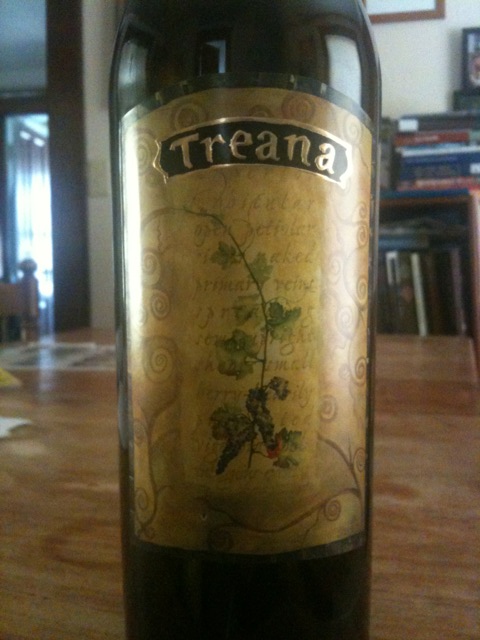
Some of you may remember the dinner I had with my fellow blogger and wine friend John, The Wine Raconteur, earlier this year. John, being the wonderfully generous man that he is brought us a bottle of wine as a gift, which caught us off guard because we clearly did not anticipate this, and had nothing to reciprocate. Well, we promised to make up for it and we will. The wine John gave us was the 2007 Treana Red, a wine from Paso Robles on California’s central coast.

I am not very familiar with California wines: I find most to be overpriced and the chief reliance on Cabernet Sauvignon, a grape variety I am not overly fond of, doesn’t help. I explained earlier that a good friend of ours has made me drink more California reds and I have found ways and makers that I enjoy, but I am still a complete ignoramus when it comes to these wines. I might have heard Paso Robles before, but I would not be able to locate it on a map at all. So, I am afraid a drew a blank when John gave me the wine and looked at me expectantly…I still feel guilty for that.

In an order to redeem myself, I did some research: Treana is part of the family owned Hope Family Wines company which maintains five different brands, of which Treana is one. The family arrived in the late 1970s and planted apple trees and vines. They planted the classic varieties Cabernet Sauvignon, Merlot, Syrah, Mourvèdre and Grenache. In 1996, they produced their first Treana white and red. The current owner and winemaker, Austin Hope, is the son of the founders who was eight when the family moved to Paso Robles.

Treana Red is what the winery deems its flagship wine (I was SHOCKED to see the retail price! John, thank you so much!!). The wine is made with 70% Cabernet Sauvignon and 30% Syrah. It is sourced from their up to eight different best vineyards in Paso Robles. It is fermented with cultivated yeasts and matures for ten to 14 months in French oak (50% new oak). The grapes ripen separately, and in the summer the best barrels are combined in barrels. Before filling, the wine is moved to a tank. The winery describes it as somewhere between a Napa and a Bordeaux wine (now if I only knew what that could possibly mean). According to the label, the 2007 had 15.5% ABV.

The wine poured in an inviting ruby red. The nose was full of cassis, as in full of it. Gorgeous. Add in some perfumy and herbal notes (branches). It was deep and inviting. On the palate, the medium-bodied Treana initially hit us with a quite strong acidity that made it feel unbalanced. There were peppery notes, the perfume continued. But we couldn’t get over how acidic it was. The texture however was great, a really nice silky mouth feel. The finish was of medium length with some bitterness.

We waited a bit, and lo and behold, some beautiful crushed coffee bean aromas started showing up in the finish. I loved that. After an hour, the wine was more herbal and felt much more concentrated than we initially thought, but the acidity persisted. Only after two hours was the acidity finally balanced and gave the wine a good structure.

Nina really liked the wine, and I thought it was pretty good, too. We have different tastes in red wine, and she likes the bigger reds more than me, so that makes sense. Thank you, John and your lovely bride, for providing a great evening for us!


Tagged , , , , , , ,