Category Archives: Year

2003 von Hövel Oberemmeler Hütte Riesling Spätlese

2003 von Hövel Oberemmeler Hütte Riesling Spätlese

2003 von Hövel Oberemmeler Hütte Riesling Spätlese

From one of his frequent trips to Germany, a friend of ours brought back a mixed case of German wines that my friend ManSoo had put together for us. It contained some Kurt Hain wines, a sparkler, some 1989 Auslese and three wines by von Hövel, a VDP winery at the river Saar, one of them this 2003 von Hövel Oberemmeler Hütte Riesling Spätlese.

Now, for those not familiar with the Mosel region, the Mosel has two tributary rivers, the Saar and the Ruwer that are part of that wine growing area. The Saar, as I have explained before, meets the Mosel just south of Trier, in the town of Konz. It commences in France and then flows into Germany. It is a mere 246 km (152 miles) long, but only its final stretch in the state of Rhineland-Palatinate is used for growing wine, mostly Riesling. It is known to produce more mineralic, somewhat tarter Rieslings than the middle Mosel. The microclimate is cooler than at the Mosel, so the grapes tend to ripen later and can reach acidity levels without the higher sugar levels you can find on the Mosel, which gives them a distinct character. Most of the vineyards used to belong to the Catholic church, but in the course of secularization in the 19th century, many private investors bought plots and began wine making. Rich families began to settle later in the 19th century which led to the term “Saarbarone” (baronets of the Saar, a term derived from “Ruhrbarone” which was used for the industrialists in the Ruhr area that made a fortune when the industrial revolution took off). A lot of the estates on the Saar are very grandiose, unlike most Mosel estates.

Weingut von Hövel has been owned by the von Hövel family since 1803 (just in time for secularization) and is one such rather big mansion. It is a member of the prestigious German association of quality winemakers, VDP, and owns 11 hectares (27 acres) in the Saar valley which are planted with Riesling only. Its annual production is around 60,000 bottles. Since 2010 Max von Kunow has been the owner of the estate. Besides holdings in the legendary Scharzhofberg, the winery exclusively owns the vineyards Kanzember Hörecker and Oberemmeler Hütte, the vineyard this wine was from. Oberemmeler Hütte is a South-west facing tiny plot of land. Unlike most vineyards in the area, it is quite far removed from the river, on a higher lying plateau. In the 1868 Prussian taxation map, which marked vineyards according to their property value and therefore -indirectly- quality, Oberemmeler Hütte is in the same category as the Scharzhofberg, i.e. very highly ranked.

I was excited to try this wine, because while we lived in Trier, we were only about a 7 minutes drive away from where the Saar meets the Mosel and Oberemmel is pretty close to where that happens. We actually had our wedding celebration in a BBQ hut only a couple of miles away from this particular vineyard. So this is as neighborhood as it gets for Saar wines for us.

The wine poured in a very clear pale, almost white color. Absolutely no ageing was noticeable when looking at it. The nose was delicate, with fresh aromas of citrus, white peach, cream and hints of vanilla. There were some traces of age in the nose, but not prominent at all. On the palate, the wine was light bodied and surprisingly thin in texture. It had a somewhat ethereal feel to it in its lightness in general. The taste was still clean and fresh. There were no citrus aromas, but apple and pear had come in. There was hardly any minerality noticeable which was a bit surprising. The finish was medium long.

The wine was very interesting to me, because it was a combination of still quite fresh, but also seemingly contracted from age, which were the two poles that this wine was tied to. At times, I wanted it to be a bit firmer, and at other times I enjoyed its lightness. It was a type of aged Riesling I don’t think I have experienced in the past. Good to very good, I would say.

Check out the vineyard’s location here.

Tagged , , , , , , ,

2005 Melini Vigneti La Selvanella Chianti Classico Riserva

2005 Melini La Selvanella Chianti Classico Riserva

2005 Melini La Selvanella Chianti Classico Riserva

Sometimes, you luck out in liquor stores. And sometimes you don’t. But I have learned that it is worth trying it out. And with this find, the 2005 Melini Vigneti La Selvanella Chianti Classico Riserva, I definitely lucked out. According to Wine Searcher, the wine retails for $25 and up. I found this lone bottle on the sales shelf for $12. There is always a good chance that an older vintage wine sold in a liquor store (instead of a professional wine store) has gone bad because of poor storage conditions etc. But it is sometimes worth a try, and it all depends on what discount the store is giving you.

Some of you know that I have made Melini’s 2010 Chianti Borghi d’Elsa my go to, everyday Chianti. It is nicely affordable and delivers refreshing, light wines. When bought in the magnum bottle, which are available at Costco, it is hard to beat price wise for a good dinner companion.

Cantine Melini is a big Italian wine producer. The winery was established in 1705 and today covers over 550 hectares of land in Chianti and Chianti Classico. The vineyards reportedly cover 136 hectares divided in 5 farms. While the Borghi d’Elsa is an everyday wine, La Selvanella is on the other end of Melini’s spectrum: It is their top notch wine which has garnered attention by Italy’s leading wine guide, the Gambero Rosso (the 2006 La Selvanella got the coveted 3 glass rating). This vintage received 2 glasses in Gambero Rosso and 4 grapes in the Duemilavini guide. The 2005 vintage was rather difficult as far as the weather was concerned (lots of rain and low temperatures from June to August), but the grapes are said to have ripened enough. The wine is made with 100% Sangiovese grosso grapes which come from 49 hectares around Radda in Chianti, one of the top villages in Chianti. The grapes were harvested in October and after 20 days of maceration it ripened 30 months in French oak. It has 13.2% ABV and the winery gives it 10 to 12 years of ageing potential. (All this information can be found on the winery’s website)

We decanted the wine for about an hour. It poured as a darker red wine with very slight browning on the edges. In the nose, I got raisins, lots of plum and some sweetness as well as herbal aromas. The medium bodied wine showed mostly plums and prunes on the palate, with good acidity and medium tannins which were nicely round. There was some spice going on and it had a medium length finish. The wine was still very, very fresh, which surprised me. It is by far not nearing its end yet.

I really enjoyed this wine. At the price I bought it, it was a steal. It also paired great with the Pecorino Toscano (a young Pecorino with delicate flavors that has none of the ripened Pecorino’s saltiness which I don’t enjoy much) I was able to secure in San Antonio and awesome different, thinly sliced bacons from my favorite sausage maker in town, Biercamp (which is right around the corner). It transported me right back into Tuscany, on a warm fall day afternoon, sitting outside, munching on Pecorino Toscano, prosciutto and panini and having a glass of wine…there is no better compliment I can make a wine.

Tagged , , , , , , , ,

Wines from Texas, Seriously? Seriously.

I’ve been spending some time in San Antonio visiting good friends of ours over the last weeks. While seeing the friends and their dogs was the main reason, the sunny weather was definitely also very welcome. Sitting on the porch in a T-shirt definitely beats Michigan at the moment…but today, I am heading back to snowy Michigan so it was time to publish this piece.

As you may know, I have been quite intrigued by the fact that every single state in the US now produces wine (they count fruit wines as wines, that is why!). So I was naturally curious to try some Texan wines. And I did. And I did have some good experiences that I want to share.

According to the Texas Wine And Grape Growers Association, Texas was the site of the first winery in North America. Yes. Franciscan priests established it in 1662. Today, it has 4,400 acres (1,780 hectares) of land under vine. 273 wineries and over 400 growers produce 1.4 million cases of wine, which makes it the fifth largest wine producer in the US. I was quite impressed when I read those numbers: The area under vine is more than half the area that forms the Rheingau region in Germany. Apparently, the climatic conditions are compared to Portugal, with sunny and dry weather. The harvest time is usually at the end of July, two months earlier than in California!

I tasted a couple of wines, but want to talk about three in particular. I naturally opted for reds because white wines grown in hot climates often have a hard stand with me. Plus, let’s face it, I am a Riesling nut…

2011 Becker Vineyards Iconoclast Fascination

2011 Becker Vineyards Iconoclast Fascination

The first wine I picked up at Trader Joe’s: the 2011 Becker Vineyards Iconoclast Fascination Red. The wine has 13.2% ABV. Weirdly, the wine is not featured on the company’s website. The label just states it is a blend of their red varietals. The wine poured dark red and the initial nose was dominated by oak, and the first taste rather harsh. We dumped the wine in a decanter for a good 45 minutes, and then retried. It had worked. The smokiness was now nicely integrated with dark fruits. The wine had some interesting spice aromas which reminded me of a forest. This herbal spiciness was a distinguishing factor for that wine and helped it a lot. I thought for 10 bucks this was a great value. The winery told me later via Twitter that this is their bestselling “not so bold” red. I told them that the “not so boldness” was what I liked about it.

2010 Becker Vineyards Iconoclast Merlot

2010 Becker Vineyards Iconoclast Merlot

During my next visit to Trader Joe’s, we picked up another of Becker Vineyards wines, the 2010 Becker Vineyards Iconoclast Merlot. The wine has 13.92% ABV. Again, this wine is not featured on the winery’s website. The wine poured in a lighter red. On the nose, it is quite jammy, with sugar and cherry aromas, maybe some red berries. On the palate, this medium bodied wine proved itself quite aromatic, with intense flavors of wood (quite smoky, but not unpleasant), tobacco, pepper, and some residual sugar which nicely balanced the smokiness. With a healthy acidic touch, it was different from your usual mellow Merlot. The finish was medium long. In a way, this wine reminded me of how I imagine the rougher countryside of Texas: some edges, some smoke, but sturdy and holding its ground. I don’t know whether that is just my imagined Texas, but to me it made sense. Would not be my go to red, but definitely a good experience. My friend, who likes smoky wines, enjoyed this quite a bit.

Becker Vineyards website is here.

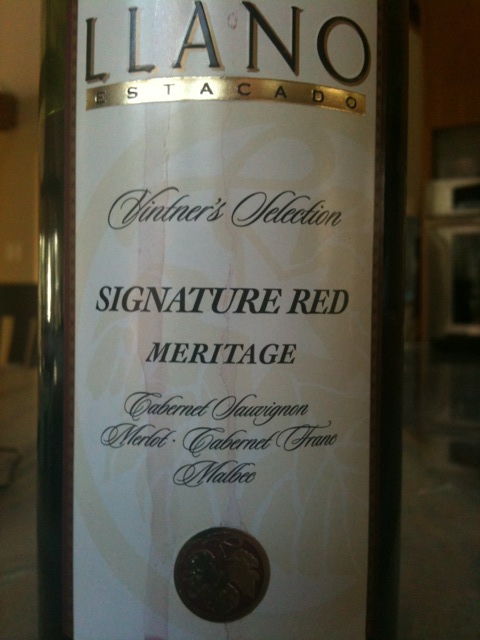
NV Llano Estacado Vintner's Selection Signature Red Meritage

NV Llano Estacado Vintner’s Selection Signature Red Meritage

The third bottle comes from Llano Estacado Winery, their NV Llano Estacado Winery Vintner’s Selection Signature Red Meritage. The wine has 12.9% ABV and is composed of the classic combination for a Meritage: 52% Cabernet Sauvignon, 31% Merlot, 10.5 Cabernet Franc, and 6.5% Malbec. In the glass, a surprisingly light colored red wine presented itself. In the nose there were sweet cherries, some light smoke and hints of liver sausage (don’t laugh!). Initially, the wine showed rather strong bitter aromas, which were actually not a turn off (even for me, who normally does not appreciate that!). These were filled up with cherries and some acidity. The finish was very short, leaving just aromas of bitterness (in that case unpleasant). All in all it was pretty disappointing. I would not even have guessed that this wine was a blend of Bordeaux grapes. It seemed flat and not very inspired. From a quick glance around the net, other reviewers seem to have mixed feelings about this wine, too.

Llano Estacado Winery’s website is here.

We also had the chance to attend the San Antonio Stock Show and Rodeo which was most of all fun! Imagine me surrounded by Stetsons, belt buckles and leather boots. It was quite hilarious! One of the cool things was that they also had a wine garden where organizers were showcasing wines that participated in their annual competition. Staff there was very attentive and enthusiastic, but I wish the organizers would take a couple of things into consideration for next year:
First, even if you have to charge money for even a sampling under Texas liquor laws (which seem the insanest that I have yet come across, but the I am certain there are even crazier ones out there) you simply cannot offer a thimble for $2. That’s just not gonna work…and charging $8 for a glass is also pretty steep.

Second, I wish they had a larger selection of Texas wines on offer. When we asked for Texan wines specifically, it turned out that of the 20+ wines on tab there were only two bottles from Texas, both from the same winery Messina Hof (which, frankly, I found quite disappointing). Their reasoning was that they only served gold medal winners in the wine garden, which seems like a good idea until you realize that most of the wines there were standard wines from California and other places a lot of which are easily available in any random supermarket: from Cupcake to Kendall-Jackson…If these won gold, I probably don’t want to try the Texas wines. However, I feel like more regional pride should prevail here (also, isn’t Texas one of the proudest states??). So, even if Texas wines don’t make the “gold medal” cut, why not still have a selection of maybe a third of the wines on offer reserved for Texas wines, even if they are only silver or bronze medal winners. There has to be some local interest into local wineries…

And third, I wish the organizers would stick to their published schedules. It happened to us twice in one day that we showed up for a tasting only to be told that it was going to start an hour later…that is kind of annoying during a fair when you walk around and plan your activities accordingly.

I realize all this is just a tiny glimpse into a big wine producing state. It was definitely exciting, and there were some nice surprises. Is there any more fun in the wine world than trying stuff from regions or areas you have never had wine from and be positively surprised? Well, yeah, for me probably a bottle of German Riesling. But that other thing comes in a very close second…

Tagged , , , , , , , , ,