Category Archives: 2013

Meeting the Vintners: Warwick Estate, Stellenbosch, South Africa

Warwick's logo is a wedding cup from which two persons can drink at the same time

Warwick’s logo is a wedding cup from which two persons can drink at the same time

One of the first wines I picked up when I lived in Botswana six years ago was Warwick’s Three Cape Ladies, mainly because of the fabulous label, but also because it is a Cape Blend, which by law has to include 30% of Pinotage, that is usually blended with Cabernet Sauvignon and then Shiraz or any other of the French usual suspects. I like Pinotage, and I wanted to try something unique. I liked the wine a lot back then, so when it was time to go to Stellenbosch, I put it high on my list.

Warwick Estate is a family-owned winery that was bought in 1964 by Stan Ratcliff, but the winery dates back to the 1700s. His wife Norma decided to learn how to make wines from other winemakers in the region, and initially produced only wines for friends and family. Norma became one of the first female winemakers in South Africa. Since 1981, winemaking has become more commercial and today the estate maintains about 60 ha under vine and about 110 ha in total, and produces a wide range of wines from whites to Pinotage to a flagship Bordeaux blend. The current managing director is the third generation of the Ratcliff family managing the estate. The grounds boast wide lawns around a water basin, and you can have picnics there while you taste their wines. One curio as you enter the gardens is a larger than life Nelson Mandela statue made completely from beads…

Paying our respects to Nelson Mandela

Paying our respects to Nelson Mandela

We met Warwick’s winemaker Nic van Aarde over lunch in the winery’s garden. We were about two hours late because we had had such a grand time with Dirk Coetzee at L’Avenir. Luckily, the chef had prepared tapas food, with most of the ingredients coming from the region. There was chicken liver pate that was to die for, and the pulled pork sandwiches were delicious as well. Even local olives were served.

Very tasty tapas

Very tasty tapas

Nic is an easy going, very likable guy. He’s quick, full of stories, loves to laugh and keeps any taster on his toes with what seemed like constant questions about how I would describe the wines. He has consulted for a while with a Mumbai-region based winery in India…I didn’t know there was winemaking in India, and his tales were amusing but also horrifying at times. Talk about an interesting fellow.

Nic’s winemaking “philosophy”, if you want to call it that, is to try to avoid overly herbaceous wines, a flavor characteristic that one can find in many South African reds. He doesn’t like softening his wines, and prefers to present them the way they come, with some edges and character. The wine he considers most in line with that philosophy is his Cabernet Franc which comes in a small batch and is only available at the winery.
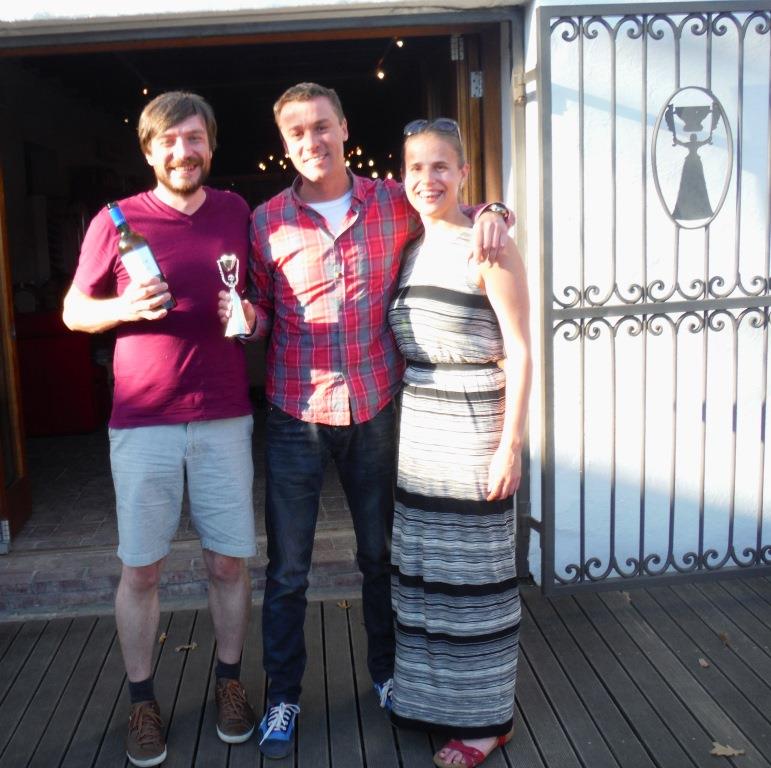
Us with Nic

Us with Nic

We tried a host of Warwick’s wines and started with the 2013 Prof. Black Sauvignon blanc. The wine is named after Prof. Black, who planted a peach orchard on the premises in the 20th century, but that didn’t work out so well. Now, the area that used to be the orchard hosts Warwick’s Sauvignon blanc vines. They are among the oldest vines on the property. For this vintage, 14% Semillon joined the Sauvignon blanc, and it worked out well. The wine showed a very light yellow color, with a restrained nose of grass and citrus aromas. The palate was surprisingly expressive given the nose, with minerality, low acidity and great citrus fruits. I was very partial to this wine!

Next up were the 2013 First Lady Unoaked Chardonnay and the 2013 White Lady Chardonnay (which is oaked). The first one is made in the Chablis-style with partial spontaneous fermentation. The color was slightly golden, and the nose showed grapefruit, lees and grass aromas. The mouthfeel was as full as one would expect from an oaked Chardonnay, but it had very clean and light flavors. The oaked Chardonnay is fully spontaneously fermented and after fermentation, the barrels are being rolled to stir the wine. Nic called it great exercise. The vines for this wine are 32 years old, and combined with the wood they clearly produced a more intense nose which also was dominated by citrus aromas. The mouthfeel was fuller than the unoaked (surprise, surprise), and while the wood was noticeable, it still showed good freshness, mainly driven by good acidity. I still preferred the unoaked version though.

We then tried the 2012 First Lady Cabernet Sauvignon, which sometimes gets blended with Shiraz, but not in 2012. The grapes come from younger vineyards and the wine spends 18 months in older barrels. The wine poured in a purplish red color and smelled of ripe red fruit, tobacco and leather. It was an interesting mix of very expressive fruit and tartness, which reminded more of a Cabernet Franc rather than a Cabernet Sauvignon. It confused me a bit too much, I am afraid to say.
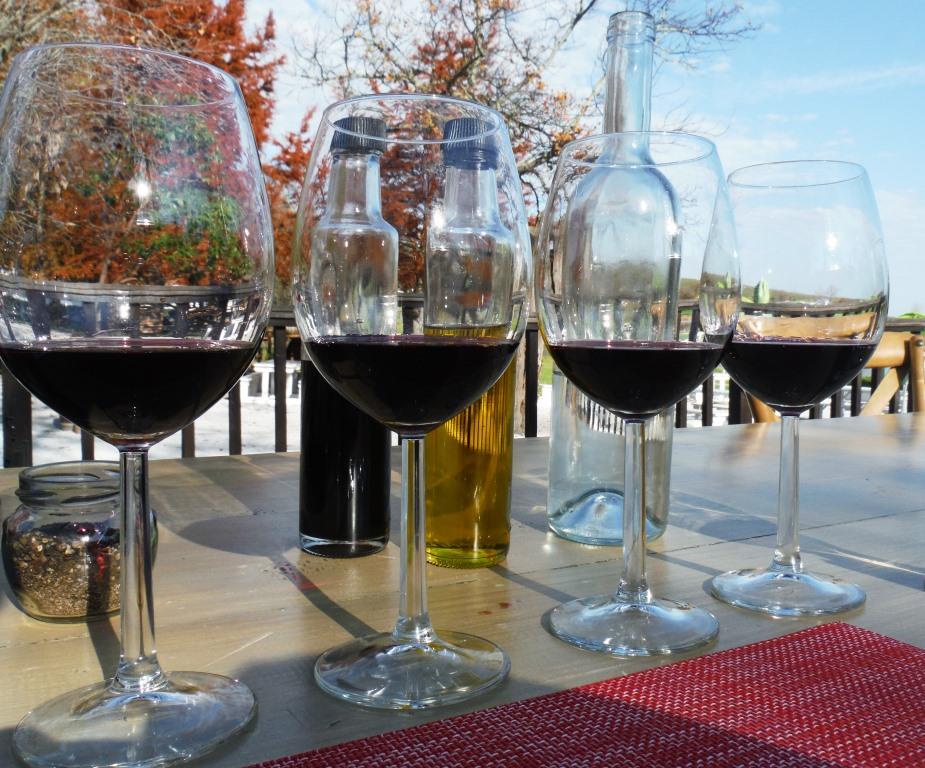
The reds lined up

The reds lined up

Up next was the 2012 Pinotage, which hails from old bush vines (vines that are not tied to posts and wire). It is produced in old barrels with a soft approach that does not try to extract too much from the grapes (in order to not get too many tannins). It poured in a dark purple, and the nose was very expressive with cassis, sandalwood and cake batter. We loved it! On the palate, it was light and refined in texture, with cassis being the dominant aroma in this fruit driven version of a Pinotage. Great to drink, very easily accessible. Would recommend this to fall in love with the fruitier side of Pinotage.

After that, it was time for the 2011 Three Cape Ladies, which is a third each of Cabernet Sauvignon, Shiraz, and Pinotage. The wine smelled of red berries, sour cherry and tobacco leaves, a combo I like a lot. In the mouth, it felt silky and had good tannins. The most wonderful thing though was the combination of raspberries and dark chocolate with a whiff of sweetness, and then a bitter chocolate finish. Love, love, love it!

The final wine was the 2010 Trilogy, Warwick’s flagship Bordeaux blend, which sells as Barrique Estate in the U.S. due to copyright problems. The grapes come from two Cabernet Sauvignon vineyards (60%), two Cabernet Franc vineyards (30%) and one Merlot vineyard (10%) and spend 24 months in 60% new oak barrels. The color is dark and brooding, and the nose very complex: There is ripe cherry, definite coffee aromas, and hints of cooked meat. The texture is wonderfully silky, and the flavors are carried by just enough acidity. I found the wine to be very balanced in its play between red fruit and leather aromas. It leans towards the Cabernet Franc side in taste more than in the nose. Very good length on the finish. I was quite impressed with this wine.

All in all we were quite happy with the line-up, which is marked by wines that are ready for consumption, but should also do well in the longer run. The food was great and just what we needed and dealt with Nina’s food allergies very well. Nic is a great guy, and I hope for anyone that they can run into him either at the estate or at an event!
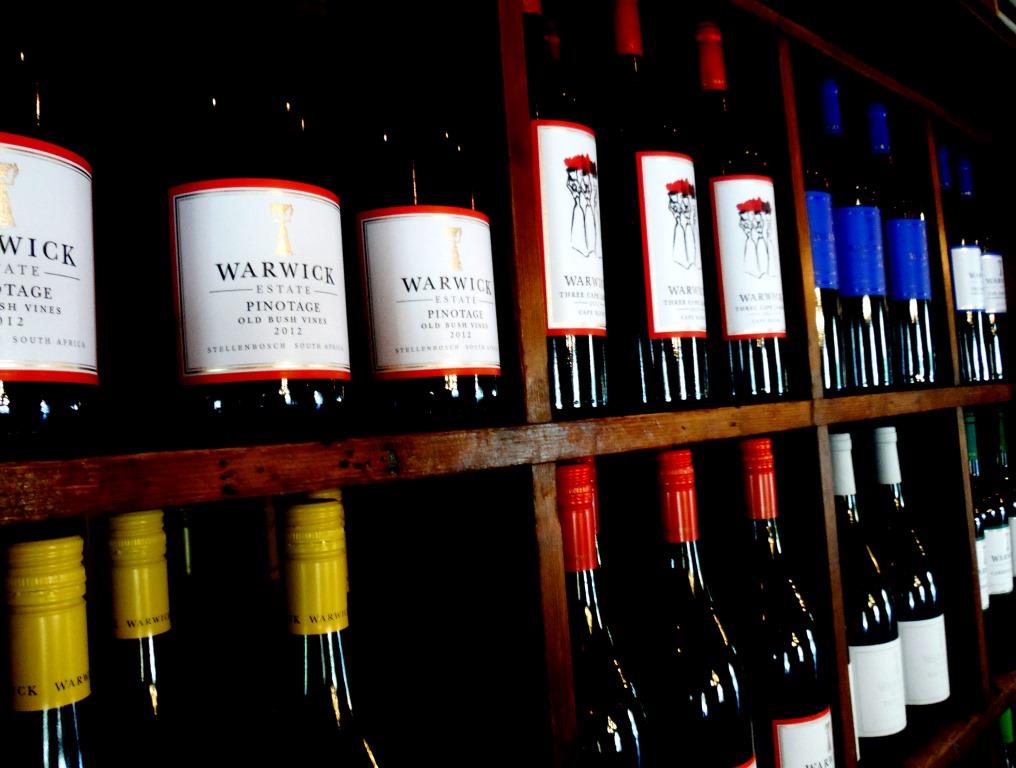
Warwick's iconic and easy to recognize labels, Three Cape Ladies in the center

Warwick’s iconic and easy to recognize labels, Three Cape Ladies in the center


Tagged , , , , , , , , , , , , , , , , , , ,

Because of the gorgeous summer weather: Two Rosés I liked…and a bonus wine

The wines were received as samples from the winery or a marketing association.

We’ve been spending the whole week in London and Oxford, and the weather has been startlingly gorgeous: temperatures in the high 20s Celsius, barely any rain. I don’t think I have ever seen the UK like this…with temperatures like this, I find myself reaching for Rosés, fulfilling every Rosé stereotype: that they are only really good when it’s warm and you can drink them very well chilled. In fact there are a lot more uses for these types of wine, and I acknowledge them, but to me a Rosé still tastes best in the summer…

Over the last months, I received a couple of samples and I was particularly impressed by these two:


Piattelli Premium Malbec Rosé

Piattelli Premium Malbec Rosé

2013 Piattelli Vineyards Premium Reserve Rosé of Malbec

Piattelli Vineyards is an Argentinian winery with holdings on the Eastern side of the Andes in Mendoza and Salta whose head oenologist is Valeria Antolin. This particular wine was made with 91% Malbec and 9% Torrontés (a white grape) grapes and has 14% ABV. I tried it as part of #BevChat, a Twitter tasting, in May. The wine poured (as you can see) in a bright red that I would describe as watermelon color.  The nose offered roses and melon aromas, and was enticing. On the palate, this presented itself as a serious wine, pretty heavy with not much acidity. It felt much more like a light red than a heavy white, if you know what I mean. It had pretty good balance and not much fruit.  The main reason I like this particular wine is that it pairs great with a BBQ, THE summer food. It has the heft to stand up to these charred aromas, and is still fresh. Someone else tried it with a sausage and mushroom pizza and was also seriously impressed. This is not your easy-peasy Rosé you can grab for a few bucks at the liquor store, but it shows what Rosé can be capable of. Retails for between $8 and $14.

Cline Cellars Rosé

Cline Cellars Rosé

Cline Cellars 2013 Mourvèdre Rosé Contra Costa County

I tried this wine as part of a #WineChat hosted by Protocol Wine Studios and received the wine as a sample from Cline Cellars. Cline Cellars has a reputation for producing Rhone-style wines in California, and as it happens, Mourvèdre is a standard Rhone grape but is rare to find in California. The wine has 13.5% ABV and 8.1 grams of residual sugar per liter. The special thing about this Rosé is that the grapes come from vines that are a century old, which is not normally material for a Rosé. It shows that Cline Cellars takes this wine seriously. The way the wine is made is as a blanc de noir, basically a white wine made from red grapes. Let me just say that I loved this wine. It was wonderfully full of raspberry aromas with some floral elements, and it was just super fresh and great. Nice acidity keeps it lively, and the hint of sweetness makes for great drinkability. Retails for between $10 and $14.

And while we’re talking Cline Cellars, let me add a non-Rosé to the mix:

Cline Cool Climate Pinot Noir (Photo credit: www.wine-searcher.com)

Cline Cool Climate Pinot Noir (Photo credit: http://www.wine-searcher.com)

Cline Cellars 2012 Cool Climate Pinot Noir Sonoma Coast

This wine was part of the Cline Cellars tasting, and if you know me, you might have picked up on my weariness when it comes to California Pinot Noir, which I often find too strong, too intense, too fruity. Well, not this one, let me tell you. At 14.5% ABV it is definitely a tad higher than I would wish for in a Pinot Noir, but the wine’s aromas totally made up for it: In the glass, this Pinot Noir was prune colored. The nose gave away raspberry, cherry, white cake batter, and was slightly perfumy. An intriguing mix of aromas. On the palate, the wine was a bit smoky, showed aromas of cocoa and cherry and just great acidity! Someone wasn’t shying away from it in a very good way. There was also enough forest aromas in the wine to make it recognizable as a Pinot Noir, but it wore its New World colors proudly. A great mix, in my book. This should work really well with a BBQ and was a great surprise! Retails for between $15 and $20 and is a great value!


Tagged , , , , , , , , , , , ,

Impressions of VinItaly NYC 2014

VinItaly Logo

I apologize in advance that this post is text-heavy, but I don’t like taking a camera to these kind of events. I want to focus on the experience, the wines I try, the personal connections I make. I find taking photos distracts me from that. For another impression check out Anatoli’s excellent post he just published.

More often than not I have these moments where I am asking myself: How did I get here? And how do I deserve this? This year’s VinItaly and Slow Food tasting in New York was definitely one of those moments that made me appreciate my blogging and all that it has brought to my life. Before we get to the tasting, I need to give credit where credit is due:

I would never have gone had it not been for my formidable partner in crime and friend Stefano, of Clicks and Corks, who sent me an email in November telling me to see whether I could make it to New York for VinItaly. This put the idea in my head, and when I found decently priced tickets Nina and I decided to go. We stayed in Connecticut with Stefano and Francesca (of the wonderful food blog Flora’s Table), who were the most hospitable hosts you can imagine. We flew in Saturday, and Sunday we had a big dinner with fellow bloggers Anatoli (the inimitable Talk-a-vino) and his wife, Suzanne (of the great food blog A Pug in the Kitchen) and Azita (of the Persian, mouthwatering food blog Fig and Quince). As you can tell, Francesca was on a suicide mission, inviting all these fellow food bloggers to her house and cooking dinner for them….just as us wine bloggers were trying to outdo each other with our wines (Nina and I had checked a bag to be able to bring some wines). It was a competition of sorts, but tampered by the mutual respect for each other and the fun we had with the meal, wines, and company. What a night it was! Francesca truly outdid herself with her apple and speck risotto, which will become a staple for me, and her veal roast which was so so so tender. Incredible! It was wonderful meeting Stefano and Francesca again, and then meeting these online friends that I now am able to count as real world friends! Thank you all, for a spectacular evening!!

Monday morning, we braved the snow and headed to downtown Manhattan for the VinItaly NYC tasting. Let me give you a tiny bit of background: VinItaly is the largest tasting of Italian wines in the world, held every year in Verona, Italy. Not long ago, the organization decided to branch out and hold tastings in New York, Moscow, Chengdu, and Hong Kong as VinItaly International. VinItaly teamed up with Slow Wine who also brought wineries to New York for what turned out to be a great tasting experience. The tasting lasted from 1pm until 5.30pm, but there were all sorts of classes in the morning as well. While I did not manage to get into any, Nina was able to snatch a place in a tasting class on Franciacorta (Italy’s Champagne, as they dub themselves) and one on Amarone (lucky her!).

If you have never been to a tasting like this, it is hard to imagine what goes on there, so let me give you an idea: You enter a hall that has rows and rows of tables, behind which winery representatives stand, three bottles of wine in front of them. If I say row upon row, I mean row upon row: Slow Wine alone had brought 70 wineries, and VinItaly another 50. You can do the math, but that is a lot of wine. And naturally, I wasn’t able to taste them all. But I tasted a fair share: I have, just to give you one example, never had that much Barolo in my life (combined), and it was a marvelous experience. The best part to me, though, is talking to the winemakers, hearing their stories (not their sales pitches necessarily)…these tastings are a great opportunity to meet these folks, while the tasting itself is completely overwhelming. You don’t have much time to fully experience the wine, and the whole spitting is also not necessarily conducive to a full wine experience….given that notes are cryptic and hardly worth sharing, let me just share a few stories with you:

Treasure trove for Wine Century Club aspirants
VinItaly is a feast for Wine Century Club aspirants. Italy, along with Portugal and Greece, is a cornucopia of indigenous grapes that only grow in minuscule quantities and still survive. Case in point: The white grape Timorasso that I tried. The winemaker told me that total production by 23 producers is 300,000 bottles. Worldwide. That’s it. How incredible is that? I am not saying there aren’t reasons why this grape is not more popular (the wine was rather bland), but the odds of ever being able to try this grape are so low, how can I not be excited about this? We added about 30 grapes to our list with this tasting alone and are halfway to Double Membership!

Re-trying rare grapes you only tried once
In that same vein, it’s also really exciting to find several wines of a particular grape that one has only tried once in the past. Case in point: Remember my post on a wine called Lacrima di Morro d’Alba? I really, really liked that wine. And there we were, towards the end, standing at a table, glancing over, and I see the words Lacrima di Morro d’Alba and almost jump!! Massimo and Pascale, the owners of Tenuta San Marcello in the Marche region, were surprised I was aware of the grape, and my ecstatic behavior paired with their gentle humor and friendly demeanor made for quite the match. Unsurprisingly, their wines were very good and since it was towards the end of VinItaly they were my last impression there…couldn’t have asked for more!

200 year old vines?
A winemaker from Mount Etna had an eye opening revelation for me: He told me that his vines are over 200 years old. 200 years, I am not kidding you! I looked at him in disbelief and then asked how low the yield was. Because in Germany, these 120 year old vines have way lower yields. Now was his turn to look at me in disbelief: NOOOOO, the yields were super high! I just stared at him. He then pulled out his phone and started showing me pictures: His vines looked like trees, seriously. The trunks were massive, like trees. And then he smiled and explained: Yes, yields go down, but it is a curve, and after 180 years or so, yields go up again….go figure. Reason to hold on to the old vines for my German winemaker friends!

Can your face muscles be sore?
After tasting dozens and dozens of wines, mostly red, mostly young, mostly quite tannic and acidic, swishing them around in my mouth, my facial muscles got so tired that it became harder and harder to muster the force to spit the wine out in style….towards the end, I had to grab the spit bucket, hold it under my mouth, and just let it run. That was embarrassing and I will need to train my muscles more!

Tagged , , , , , , , , , , ,