Category Archives: USA

Tasting with Friends: Unexpected Pinot Noirs

It had been way too long since we conducted one of our fairly regular wine tastings with friends. The rules are always the same: The host sets a topic (we did “European Reds“, “Strange Fruit“, “French and Argentinian Malbecs“, “Michigan vs. Mosel” and others in the past; you can find links to all of them here), and then guests bring a wine bottle each. The wines are usually accompanied by cheeses and meats, and as of late we try to taste them blindly.

Two of our friends had to move out of town for work, so we had been missing them dearly. When one of them came to town for a visit, we made sure to have a tasting. Since I was hosting, I had the honor of setting the rules. I called the tasting “Unexpected Pinot Noirs” and explained that I would like to try Pinot not from France or the U.S. usual suspects Oregon and California (but guests were free to ignore that rule). I am a huge fan of Pinot Noir and was looking for a chance to expand my palate.

We paired the wines with cheeses and meats from my local go to sausage maker Biercamp. These guys just know what they are doing: I got several bacons thinly sliced, including duck and lamb bacon, a wonderful garlic and herbs de Provence sausage with a nice kick, as well as smoke sticks from them. Delicious pairing options for sure.

Blind tasting has its own trappings, and I am always a bit weary of it because it is the most humbling experience you can imagine. You try to whittle down where the wine is from, and while doing that more often than not I convince myself that it is a particular style or region or vintage and then look for arguments to support that, thus closing off my mind. Nina tends to be way better than me at picking up nuances and determining characteristics about wine. She definitely owns me in blind tastings, and so it was with this one:
A Pinot from the Ruwer valley

A Pinot from the Ruwer valley

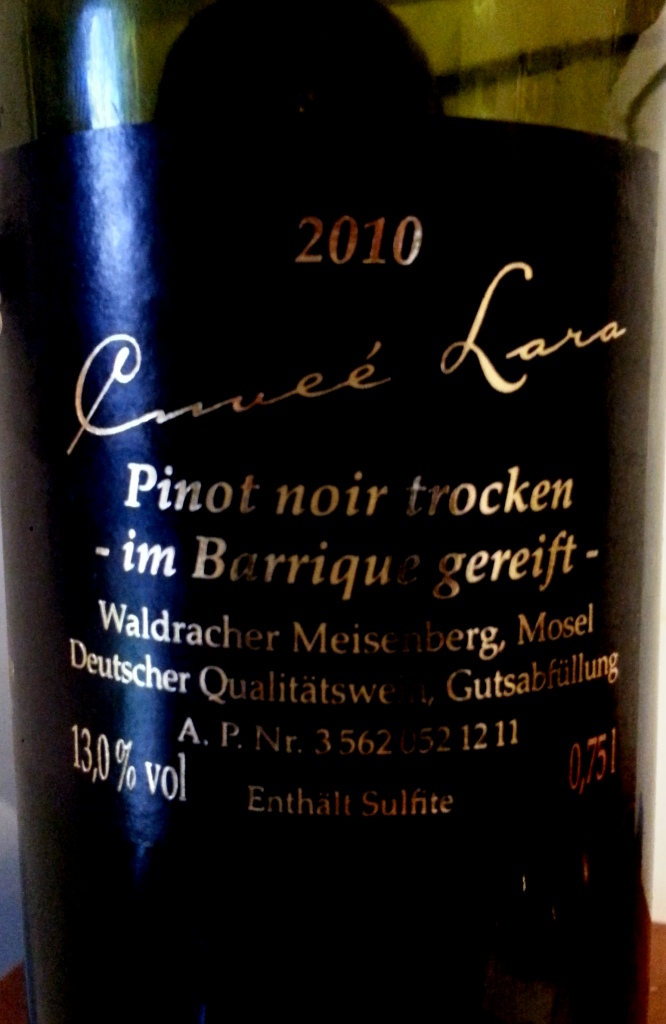
The first wine we tried was a German Pinot Noir (called Spätburgunder, literally “late Burgundy”), a 2010 Heinrich Mertes Waldracher Meisenberg Cuveé Lara. My friend Mansoo had sent me this bottle a while back (as well as the other bottle we entered into the race), and I was eager to try it. Heinrich Mertes winery is located in the Ruwer valley, a small tributary to the Mosel river. The wine showed a medium-light red color. The nose was perfumy with currants and some heat. It wasn’t exciting at all. The heat was actually quite disturbing. On the palate, though, this wine shone: raspberry, red currant and tobacco aromas, and an awesome kick of acidity. The puzzling and intriguing thing about this wine was that the fruit tasted very ripe, yet the acidity kept it wonderfully fresh. This was a strong beginning. The nose not so much, but the flavor profile was awesome. For me, the acidity gave it away: Because I knew there was a 2010 from Germany in the race, a year with quite high acidity in general, I took my chances and guessed right (so did Nina).

Quite the label, huh?

Quite the label, huh?

Next up, a 2007 Arno Kruft Veldenzer Grafschafter Sonnenberg from the Mosel (our second entry). The color was in stark contrast to the first wine: dark, purplish red. The nose showed wet dirt, some rotting branches and what others described as compost aromas. Not very pleasant. I think the compost descriptor came from hyper-ripe fruit aromas, but I couldn’t nail down which fruit. On the palate, the first noticeable thing was that it was way chewier than the first wine. It also was somewhat smoky, with cherries and cranberry aromas as well as a bit of vanilla. In my mind, this was totally a new world Pinot with a lot of the characteristics I have encountered in some California Pinot Noir: too potent, too strong, no restraint. But I want my Pinot Noir less potent, less strong and with more restraint. I did not like this wine. I guessed it was from somewhere pretty warm, and definitely new world. Boy was I wrong.
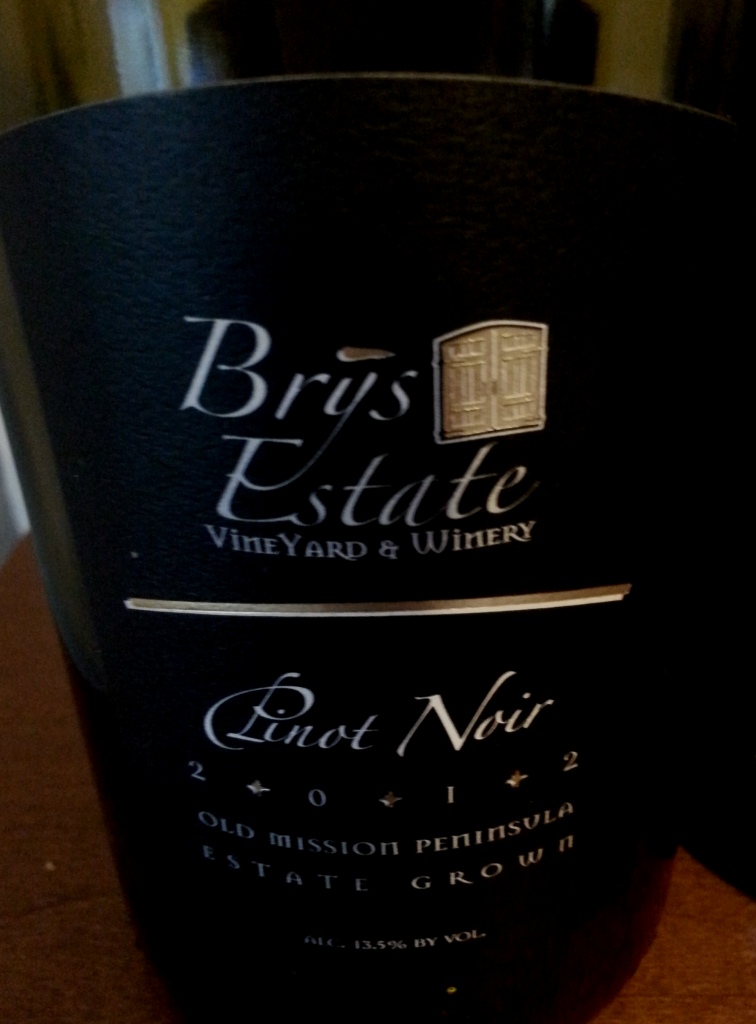
Michigan high end winery with South African winemaker

Michigan high end winery with South African winemaker

The third wine of the evening was a 2012 Brys Estate Old Mission Peninsula Pinot Noir from Michigan. Apparently, Michigan winemakers consider 2012 one of the best Pinot Noir vintages yet, so this should be exciting. The color on this one was gorgeous: a red currant red, darker than wine 1, much lighter than wine 2. The nose was flowery, with some strawberry, rather intense smoke, but seemed quite closed at this point. On the palate, the wine felt creamy and heavy, which gave it a wonderful mouthfeel. But it is a mouthfeel I don’t expect or particularly cherish in a Pinot Noir, which I want more light footed and delicate. Still a solid showing. Nina guessed Michigan correctly, I had no clue.

Another established Michigan winery

Another established Michigan winery

Up next, a 2011 Black Star Farms Arcturos  Pinot Noir, also from Michigan. Again, the color was spectacular, a bright and shiny red currant. The nose was full of roses, almonds and cedar wood, with hints of red berries. I thought the nose was gorgeous. The palate also started off nicely, with spice and pepper aromas, and a light footed feel to it. But then the palate turned out to be a bit harsh: There were bitter aromas kicking in that were rather striking. It also felt like the wine had a bit too much alcohol (which was not the case, we checked later and it clocked in at only 12% ABV, but felt more like 14), and that really turned me off. I couldn’t get over the harshness in the wine. My guess was, because of the perceived high alcohol, a warm climate wine, maybe Southern Italy.

A New Zealand surprise and an Oregon Pinot

A New Zealand surprise and an Oregon Pinot

Second to last came a 2011 Oya Pointe Pinot Noir from New Zealand’s Marlborough Valley. New Zealand has definitely gained some serious street cred for its Pinot production. The color was similar to the previous wine, and the nose was awesome: strawberry jam with rosemary and sage aromas. It was crazy, but good crazy! I loved it. The palate was very herbal as well, thyme, rosemary and sage aromas, with strong acidity with some iron aromas, great lightness to it and some red berries. This was very unique and therefore impressive wine. I hadn’t come across such an herbal Pinot before. This was an exciting wine. Because of the iron aroma that I had come across before in an Oregon Pinot Noir, I decided to guess Oregon…

The final wine was a 2012 Grochau Cellars Commuter Cuveé Pinot Noir from Oregon’s Willamette Valley. The color was more purplish, maybe black currant. The nose was chalky, intensely perfumy, with cocoa aromas. On the palate, the wine seemed rather bland: some cherries, some strawberries, plum, not very expressive though. Straight-out fruit forward style, but all a bit thin. I would not have recognized it as a Pinot Noir if I hadn’t know it had to be one, maybe more of a Grenache or so. I just didn’t find much that excited me about this wine. Not bad, but quite standard. My guess, because it was a bit heavy, was California.

So, recap: My guesses were mostly off. My ranking of the wines from best to least favorite, is 1 (2010 German), 5 (2011 New Zealand), 4 (2011 Michigan), 3 (2012 Michigan) and 2 (2007 Germany) and 6 (Oregon) – the last two share the spot, I couldn’t decide.

Combined with the others rankings (6 points for favorite down to 1 point for least favorite), this is the likability ranking:

First place: 2010 Heinrich Mertes Cuveé Lara – 23 points (ranked first by three people out of four)

Second place: 2011 Oya Pointe Pinot Noir (New Zealand) – 17 points (ranked second twice)

Third place: 2012 Brys Pinot Noir and 2011 Black Star Farms Arcturos Pinot Noir – 16 points each (with the Arcturos being ranked first once)

Fifth place: 2012 Grochau Cellars Commuter Cuveée Pinot Noir – 6 points

Sixth place: 2007 Arno Kruft Veldenzer Grafschafter Sonnenberg – 5 points (ranked last by three out of four)

The tasting was fun, and it was kind of interesting to have a German Pinot Noir ranked first and last. The Heinrich Mertes was just such a great expression of the grape, to me it was a rather easy winner. The New Zealand Pinot Noir was unique in a good way, expressing some aromas that were unfamiliar, yet seemed befitting to the grape.

The pretty clear winner

The pretty clear winner

Tagged , , , , , , , , , , , , , , , , , , , , , ,

An Eiswein (Ice wine) themed #winechat on Twitter

The three dessert wines participating

The three dessert wines participating

Disclaimer: The wines were provided by the winery or wine association as samples.

Last week, I participated in a #winechat on Twitter. The theme was Eiswein (and dessert wine). The wines were supplied by Knapp Winery and Boundary Breaks Vineyards of the New York Finger Lakes region, and by the Austrian Wine representatives in the US. At 9pm EST on Wednesday, a group of several bloggers who received samples met with the organizers Protocol Wine Studio, the suppliers, winemakers and others interested folks to discuss the wines as well as ice wine in general.

For those unfamiliar with Eiswein (the German word for Ice wine), I wrote a longer piece about it a while back so please feel free to check it out here. To recap: Eiswein is made from grapes that are frozen on the vine (that’s for purists, like me, some regions, like Quebec, allow freezing off the vine). The grapes freeze, so all the water in the grape becomes ice. When you press these grapes, all you get is minuscule quantities of pure concentrated flavors. Sugar and acidity are extremely present in these wines. They make for some of the rarest wines in the world, and age ridiculously well.

Meats from Biercamp in Ann Arbor

Meats from Biercamp in Ann Arbor

We had a few friends over for trying the wines, because of their intensity, I usually only want a small glass of each wine. It is the perfect wine to share. We paired the wines with mostly cured meats from the wonderful Ann Arbor sausage shop Biercamp (duck bacon, Canadian bacon, and a honey/cracked pepper bacon as well as Andouille sausage), cheese (a creamy Delice de Bourgogne, Manchego, goat Parmiggiano, and Roquefort), as well as homemade (by one of our insanely talented baker friends) sweet macarons. I will write a separate post on what to pair with sweet wines, but for now you should know I prefer salty over sweet pairings.

Macaron made by our friend

Macaron made by our friend

But on to the wines. Up first was the 2012 Boundary Break Late Harvest Riesling (not technically an Ice wine). The wine is made by a young winery whose other Rieslings have gathered quite some praise from The New York Times and others. This wine was made with Riesling grapes from one single clone that come from a single vineyard. The vines were planted in 2010, so they were very, very young when the grapes were harvested for this wine. In Germany, winemakers tend to hold off on producing wine from vines that are under 4 years old. The wine had 127 grams of residual sugar per liter, and 14.2% ABV. The first thing we noticed when pouring was how light in color the wine was. The nose offered aromas of ripe cantaloupe, cream, honey, some vanilla, and something the reminded of gummy bears. On the palate, it was very sweet without much acidity, which was what surprised me the most. Its mouthfeel was light, and there were some orange bitter rinds like in English orange jelly. I struggled with this a bit. There was definitely craft in this wine, but I couldn’t help wondering whether the winemakers should have held off on making a small quantity, high level wine from such young vines. It also didn’t feel like a Riesling to most of us. Trying it with the macarons made the wine a bit more acidic, which was welcome. So this could definitely be paired with sweets. Retail price: $30

Boundary Breaks Riesling Late Harvest

Boundary Breaks Riesling Late Harvest

Next up: Knapp Winery’s 2012 Vidal Blanc Ice Wine. Harvested on January 3, 2012 at 11 degrees Fahrenheit (which by my standards makes it a 2011, because the grapes grew in 2011, not 2012), the wine spent almost a year fermenting slowly until it was bottled on December 20, 2012. 24 cases were produced, the wine has 12% ABV and 140 grams of residual sugar per liter. The wine’s color was more saturated than the Boundary Break Vineyard Riesling. The nose was gorgeous, with ripe aromas of spiced orange, some clove, bergamotte. On the palate, this Vidal Blanc showed good acidity, some smoky aromas, with a wonderful viscose mouthfeel to it. I got citrus aromas, mandarin oranges, and raisins mostly. What I was struggling with was the alcohol. It left an almost cognac feel to the wine on the finish, which I was not looking for in an Eiswein. Others on the table had less of an issue with this, so it might just have been me. When I retried this wine 6 days later, the alcohol had stopped bothering me. All in all, a solid wine with good primary Eiswein aromas. However, texturally it reminded me more of an Auslese or Beerenauslese than an Eiswein. I would probably not have identified it as such in a blind tasting. As for pairings: It worked remarkably well with the creamy delice de Bourgogne, taking off the edge of the alcohol. With the goat parmiggiano, more almondy flavors became present, and the bacons worked as well. While I thought it was also good with the macarons, I got shouted down by the table that that was not the case….Retail price: $25

Knapp Vidal Blanc Ice Wine

Knapp Vidal Blanc Ice Wine

Finally, we tried the Austrian 2009 Höpler Pinot noir Eiswein, an Eiswein made from the red grape Pinot noir. The wine poured in a gorgeous amber color, lush and rich and syrupy in texture. The nose was beautiful, with dried apricots, honey, and rum and raisin aromas. When I tried it, my first note read “ICEWINE”, underlined twice. The richness and flavors worked, the wine felt special, just like an Eiswein should. There was a wonderful smokiness to the wines, with the aromas from the nose persisting. Its finish was great: It became smoky again, with lots of honey, and a wonderful acidity that tickled your throat. The wine was decidedly heavier than the first two, and much more intense in flavors. It also paired the best with salty foods. This was a wonderful expression of how interesting ice wine from a red grape can be. Retail price: $69

Höpler Pinot noir Eiswein

Höpler Pinot noir Eiswein

All in all it was a great experience, and I am grateful for the organizers and hosts for letting me participates. The wines were all interesting and showed the diversity there is. The conversation on Twitter was lively and engaged, and I got into some really interesting side discussions about pairings and occasions to drink these wines.

Tagged , , , , , , , , , , , , , , , ,

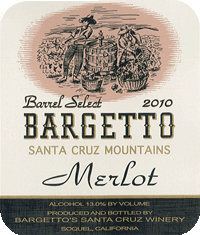
2010 Bargetto Santa Cruz Mountains Merlot

2010 Bargetto Santa Cruz Mountains Merlot

2010 Bargetto Santa Cruz Mountains Merlot

Last summer, we spent about 10 days with Nina’s grandmother who lives in Santa Cruz, California. During that visit, we had the good fortune to attend a tasting at Ridge (for the report and an awesome photo of me see here – at the bottom of the post). While I love visiting producers that are widely known and appreciated, I also get a kick out of visiting smaller, less well know, more local wineries. For one weekend, we decided to go and hit up Bargetto Winery, a winery I had never even heard of. It’s located in Santa Cruz and was established in 1933. It was founded by two brothers that migrated to the United States from the Piemonte region in Italy. From 1918-1933, due to prohibition, the winery was only making wine for family and friends, until in 1933 they cranked up production with the end of prohibition. It is the oldest continuously operating winery in the Santa Cruz Mountains appellation.

We went to the tasting room in Soquel on a Saturday afternoon, and had a great time. It was a rather quiet day, we paid the California obligatory tasting room fee, and then proceeded to try their Merlot, Pinot Noir, and other varietal wines. We got to talk to Michael Sones, the winemaker who is a great guy, and got a tour of the estate. The winery claims to try to follow the Northern Italian wine making tradition, which seems to entail trying to express colder climate flavors in their wines. For us, that approach seemed to work. Grandma signed up for the wine club, and we took home a couple of bottles of this Merlot, and one of their high end Pinot Noir, which I really enjoyed.

Another note to send ahead: I don’t understand why so many people have issues with Merlot. When done right, it is such an interesting grape, with awesome flavors. Its rather light feel is a much better fit for me than the seemingly heavier Cabernet Sauvignons. In my book, if you are looking for something between Cabernet and Pinot Noir, try a Merlot….but that might just be me.

The 2010 Santa Cruz Mountains Merlot is composed of 90.2% Merlot and 9.8% Petite Syrah grapes with the vast majority of grapes coming from Regan Estate vineyard. The wine has 13.5% ABV and was aged in 33% new oak barrels for 18 months before being bottled in September 2012. 381 cases were produced. Price: $25.

In the glass, the wine showed a bright darker red with hazy rims. The nose was extremely full of berries, mostly crushed raspberries, but also currants. There were floral aromas, and hints of smoke. I thought the nose was terrific. After a while, branch aromas started to show up and the nose got more earthy. On the palate, the first thing I noticed was a healthy acidity, and then what I can only describe as vanilla ice cream with raspberry sauce. It was such a cool tasting experience, and definitely not what I remembered from our tasting room tasting. The mouth-feel was silky and fresh, and some wood aromas shown through. The wine was of good length, with all in all well integrated flavors. If I had one issue, it would be that the acidity was maybe a bit too bright for it to be entirely balanced.

All in all, a cool tasting experience. I enjoyed the flavors, which became more spicy and herbal as the bottle progressed, and it brought back good memories from last year’s visit to the Bay area. Cannot wait to go back. Also, I tried some dark chocolate with this wine, and it was a great pairing. The red berries and chocolate just hit it off! If you get a chance, stop by at Bargetto Winery and give their wines a try.

Tagged , , , , , , , ,