Category Archives: Something about wine…

Sunday read: 800 years Schloss Vollrads in the Rheingau

This weekend, I want to direct you to Schloss Vollrads, a winery in the German region Rheingau. Within Germany, the Rhine flows rather straightforwardly north, with a slight northwestern bent. But at one point in its course, for about 50 kilometers, the Rhine takes a southwestern bend, from Mainz (I grew up just south of it) to Bingen. This is the only time in Germany, that vineyards on the Rhine in Germany get full southern exposure facing the Rhine. This map is focused on all the castles along the Rhine, which is just one of the reasons why it is so beautiful there…but it also shows you how the Rhine flows and how the northern bank is fully exposed to the south.
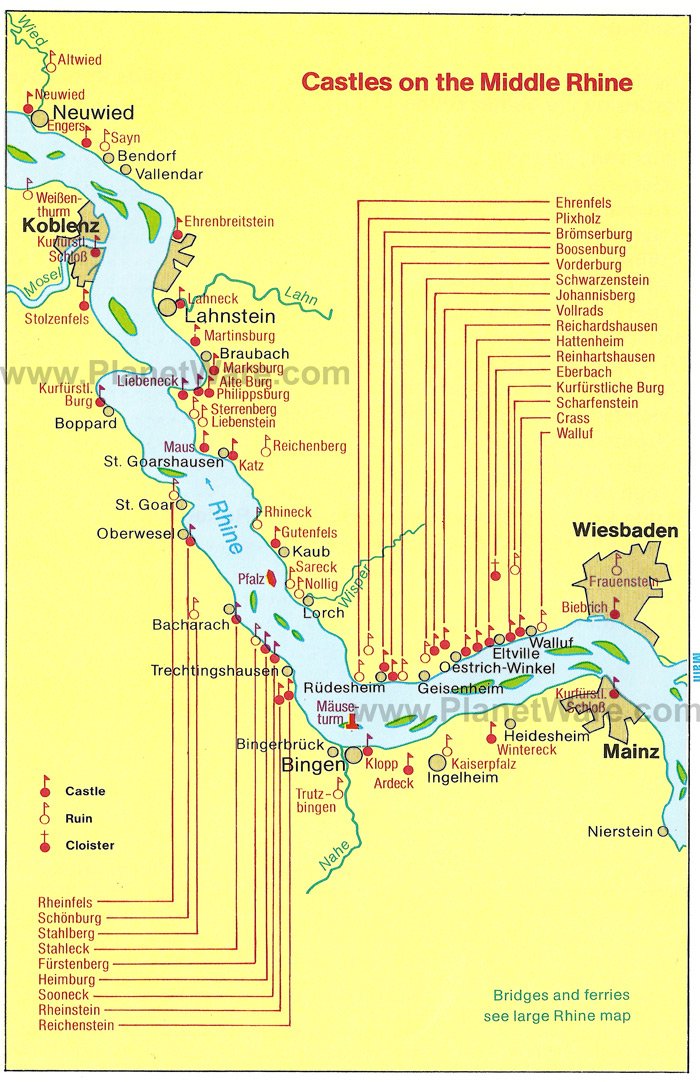
The Rhine Valley between Mainz and Bingen (Photo Credit: www.planetware.com)

Why is that important? Germany is one of the most northern wine countries. Historically, our grapes need as much sun as they get, because it does not get warm enough for them to fully ripen. That is one of the reasons why most prime vineyards are fully south exposed, to get as much sunlight as possible, and even better, get the sun reflected from the river.

But back to Schloss Vollrads. The winery celebrates its 800th consecutive wine harvest this year, and that makes it the oldest running winery on the planet. Just mind-boggling.

Chris Kassel over at Intoxicology Report, wrote a piece in his inimitable style to celebrate their birthday! I had tremendous fun reading it, and I hope you will enjoy it, too!

Happy Sunday!

A Bit of Gloss for The Schloss Sauce: 800 Vintages and Going Strong!

Tagged , , , ,

Sunday Read: The new Nahe

Some of you know that I have a (not so) secret crush on Jancis Robinson, master of wine and great friend of riesling from the early days when no one was talking up riesling. Her 1996 German edition of “Weinkurs” (published as “Wine Course” in 1995) was my go to book when I first began looking and reading into wine more. Her Oxford Companion to wine is seen as one of the great encyclopedias on wine (I don’t own it, so I don’t know how good it is).

Jancis Robinson with a riesling tattoo

What I have liked about her most though is her writing style. She has a wonderful effortlessness about her writing. She picks her readers up and transports us to the places and wines she tries. It is a great gift, I think.

I was reminded of how much I like her when I read this piece on Financial Times the other day. She is writing about a wine region in Germany that not many know: the Nahe. A tributary to the Rhine, it is one of the smaller wine growing regions and usually overshadowed by Mosel and Rheingau. Over the last 15 years however, some extraordinary vintners have given it new glory. Names like Dönnhoff, Emmrich-Schönleber and Kruger-Rumpf now have a place on the German wine map, and are pretty well known abroad, too. Taking Werner Schönleber’s birthday celebration as the occasion, she has produced a wonderfully intimate piece on this interesting and off the beaten track region in Germany. So much to explore!

Have a great Sunday!

Jancis Robinson, The new Nahe, Financial Times September 7, 2012

Tagged , , , , , ,

Checking vineyard sites online

I want to present you with a great tool that I have been using for a while now. It is called Weinlagen Info, and gives you a chance to see exactly where the grapes in the bottle that you are drinking come from. This is because a lot of wine labels tell you quite exactly where the grapes for the wine were grown and harvested.

Take for example a German wine label. As soon as you go for wines above table wine, the label will tell you the village and vineyard that the grapes were grown.

Dr. Hermann winery label “Erdener Prälat” (photo credit: http://www.domaineselect.com)

If you are not familiar with labels, that can be quite confusing. But once you figured out that the word that ends in “-er” stands for the village and the following word for the vineyard, things get easier. For example, “Erdener Prälat” comes from the village Erden, and the vineyard is the famous Prälat. The same is true for all other village denominations in German, like “Nackenheimer Rothenberg”, the vineyard Rothenberg in my hometown Nackenheim. So, please, when talking about the village, drop the “-er”.

Armed with this information, Karlheinz Gierling from Heidelberg has had an awesome idea. He dove into publicly available information on the exact locations of vineyards and marked them on Google Maps. He thus produced a database containing many of Germany’s and other European countries’ vineyards. For the lesser vineyards, the database is still patchy, but it contains pretty much every important vineyard in Germany. The website can be accessed here:

www.weinlagen-info.de

I superficially checked the content for Austria, France, Italy, Hungary, the US (!), and Spain, the other countries in the database, but the content is still very limited, so for now it is best as a German vineyard resource. Right now, it is only available in German, but it is pretty straightforward because of its drop down menus. It begins with Country, Area, District, Town, and that followed by vineyard. My Google Translate did a decent job of translating that into English…It also has a search function which makes things even easier!

So here it goes. Next time you have  a bottle of Mosel wine or other area contained in the database and you are curious how big it is, or what it looks like, you just use Gierling’s database to get a visual. It has helped me a lot, and gives me chance to virtually visit the birthplace of wines…

To give you a feel for it, here is the Erdener Prälat:

Erdener Prälat location on http://www.weinlagen-info.de

Tagged , , , ,