Category Archives: Something about wine…

Wine travelling in Germany

I have mentioned it in passing, but Nina and I will be in Germany for three weeks in June and early July. I cannot tell you how excited we are about this. Not only for seeing friends and family, but also for all the wine tasting opportunities. Wine tasting and travelling in Germany is incredibly pleasant. The wine culture is still very much based on local, small wineries with farm-like structures. Now, I am not saying that the winemakers are mere “peasants”, on the contrary. They are smart businessmen, and they know they produce for a world market. Yet, they have retained a lot of the wonderful ease of access that their fathers established and that is one of the best features of German wine culture. It also gives you super-easy access to winemakers and their knowledge and treasure trove of stories.

Tasting with Stefan Erbes and friends in May 2011

While Nina and I lived in Trier, we would make a habit of wine touring on weekends. We would drive down the Mosel and ring random doorbells at wineries and ask whether we could try their wines. We were never turned down. We had wine tastings in fancy tasting rooms, kitchens, wine cellars and wine storage rooms. The overwhelming majority of winemakers was friendly, and once they realized we cared about wine, they usually opened bottle after bottle to try for us, and we often ended up hours later, with many wines tried. American friends who have taken part in these are usually amazed by the generosity (there is nothing like that twinkle in a winemaker’s eye when he announces that he still has a BA or TBA open for us to try…) and the fun. The winemaker will sit down with us and enjoy his wines with us. For me, it has always been like this, so that is what I expect…As a caveat: That does not necessarily work at the big estates with stellar reputation. But it is true for a lot of the wineries just beneath those.

Also, the tastings are usually free. However, I firmly believe in the principle that since the winemaker opened his cellar and wines for us, courtesy requires that I buy at least a case. The cool thing is, in a tasting you will usually find a wine or two that you like. Rather low prices at German wineries also made this affordable for this usually cash-strapped blogger…

Tasting with Mario Schwang of Reuscher-Haart and friends in May 2011

The 2011 vintage is said to be phenomenal. Check out the German Wine Institute’s vintage report here. After very low yields in 2010, 2011 brought vast improvements in yield and quality. The president of the Wine Growers’ Association announced: “In terms of quality, the 2011 vintage leaves nothing to be desired. Thanks to the textbook autumn a large part of the harvest has reached predicate wine level. Wine lovers will get a lot of 2011 wine for their money and have a great choice in all quality levels.“

So, naturally, I am super-stoked to get to try this vintage at some of my favorite wineries (and then share with you). We currently have made plans with the following wineries (in alphabetical order):

Karl Erbes, Ürzig (Mosel)
Within one wine tasting in May 2011, we became great friends with Stefan Erbes, the maker of beautiful rieslings…

Gunderloch, Nackenheim (Rheinhessen)
THE winery in my hometown. I went to school with the oldest daughter, and now her brother is taking over more and more in this excellent winery.

Dr. Hermann, Ürzig (Mosel)
Christian Hermann is a genius with wine. They produce stellar collection after stellar collection each year.

Klaus Meierer, Kesten (Mosel)
This will be a first for us. Really excited about the opportunity!

Reuscher-Haart, Piesport (Mosel)
Mario Schwang, the winemaker, is one of the coolest wine guys I know and it is always great to get to hang out with him and his great wines.

Vereinigte Hospitien, Trier (Mosel and Saar)
Used to be my go-to winery in Trier, with wines from spectacular locations. This time around we will get a tour of the cellars and try some wines old and new (actually thanks to my post about their 1987 which made the person that sold me the wine invite me!!).

Weiser-Künstler, Traben-Trarbach (Mosel)
One of last year’s biggest discoveries for me. Konstantin and Alexandra’s wines have a depth and finesse that is mind-boggling. Their 2010 dry riesling ranks among the very best dry rieslings I’ve ever had.

We will probably add some more to that list along the way…

If ever you get to go on a wine trip to Germany, give the let’s go and ring a random doorbell approach a try. I have made some great discoveries that way. There are incredible winemakers out there waiting for you to discover their wines.

Tagged , , , , , , , , , ,

Wine friends and an exhibition in Seoul

The sloping Mosel at Bremm.
The photo was taken by Yutaka Kitajima from the Bremmer Calmont, the steepest vineyard on the Mosel.

Two of my closest wine friends are ManSoo Hwang from Korea and Yutaka Kitajima from Japan. ManSoo and Yutaka have a long friendship going that they forged during their studies as graduate students in Trier, Germany. Trier is in the heart of the Mosel valley, and Mosel as well as Saar and Ruwer (two smaller rivers) are easy to reach. Both of them fell in

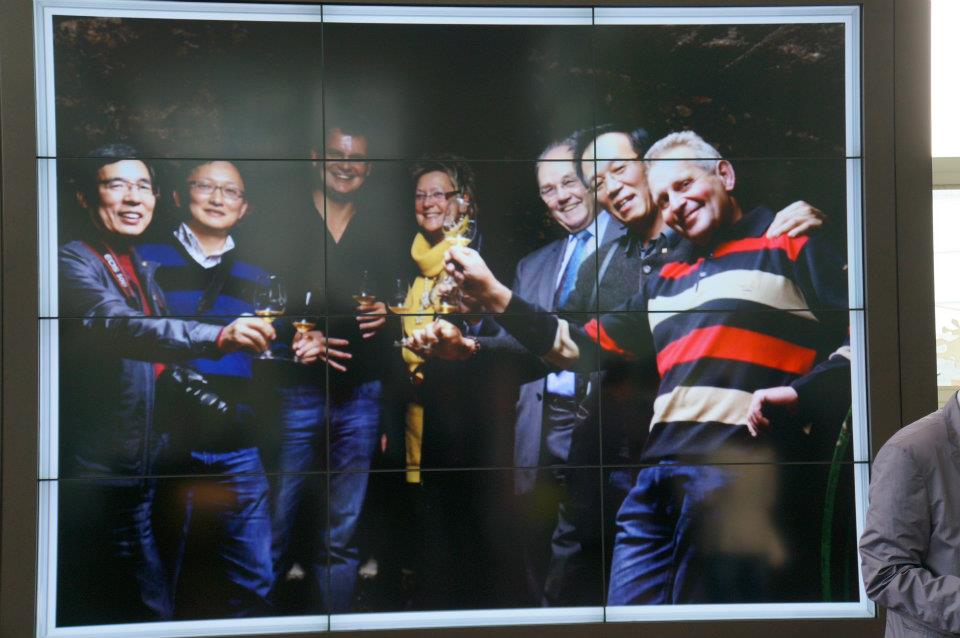
My friends ManSoo (right), Chunhwa (second from right) and Yutaka (second from left) with the Korean wine journalist Son Hyun Joo

love with Mosel rieslings and over the years became tremendous experts. Yutaka has been blogging on Mosel wines for several years and has been a contributor to the Japanese wine magazine Vinotheque since 2005. ManSoo is a certified wine advisor, graduated from the German Wine and Sommelier College in Koblenz and is also a wine journalist.

Both of them have played a huge role in my developing a better feel for and understanding of riesling. Usually at ManSoo’s home we would have long wine tastings, often with Korean food (a so good pairing that it goes beyond imagination…but that will be the subject of another entry). We would each bring some bottles, and then we would do blind tastings. We would discuss the wines, we would try to place them geographically as well as age-wise and varietal. All that mattered was why we made a particular argument. It was tremendous fun. While they both share immense knowledge and experience, they were always willing to indulge me and later Nina, too. I owe a lot to these two.

Wine maker’s hands

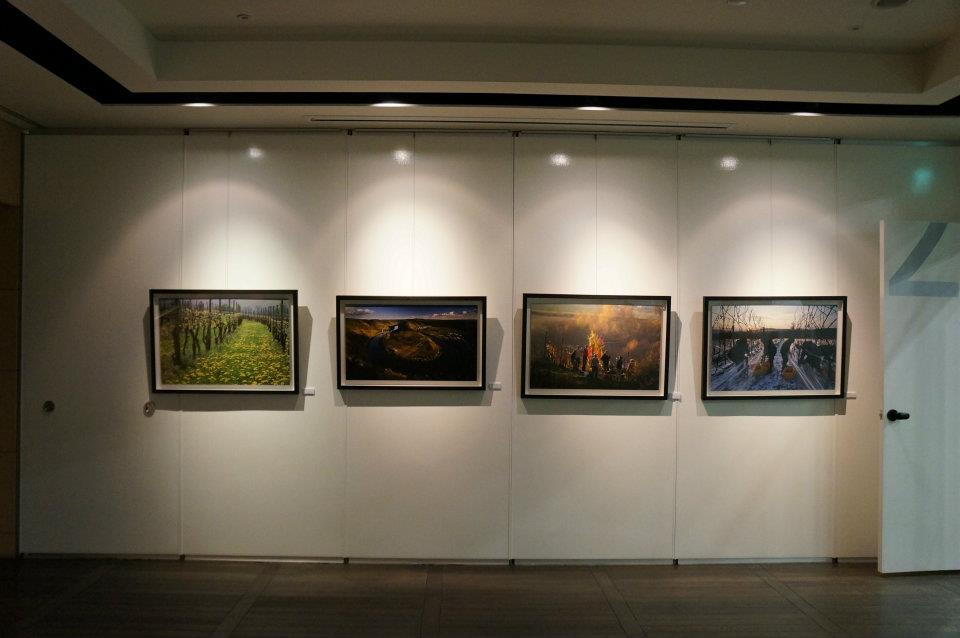
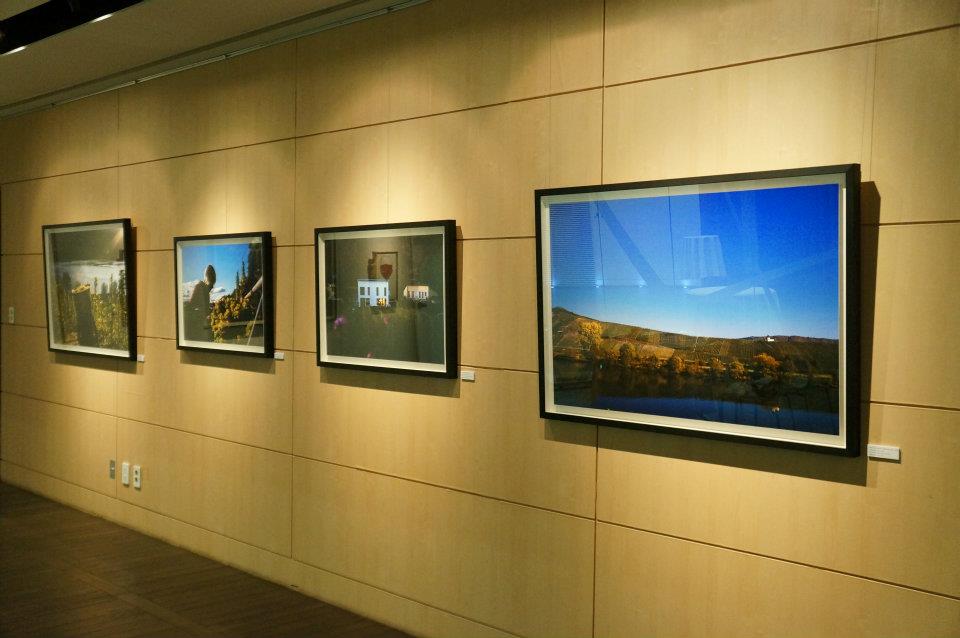
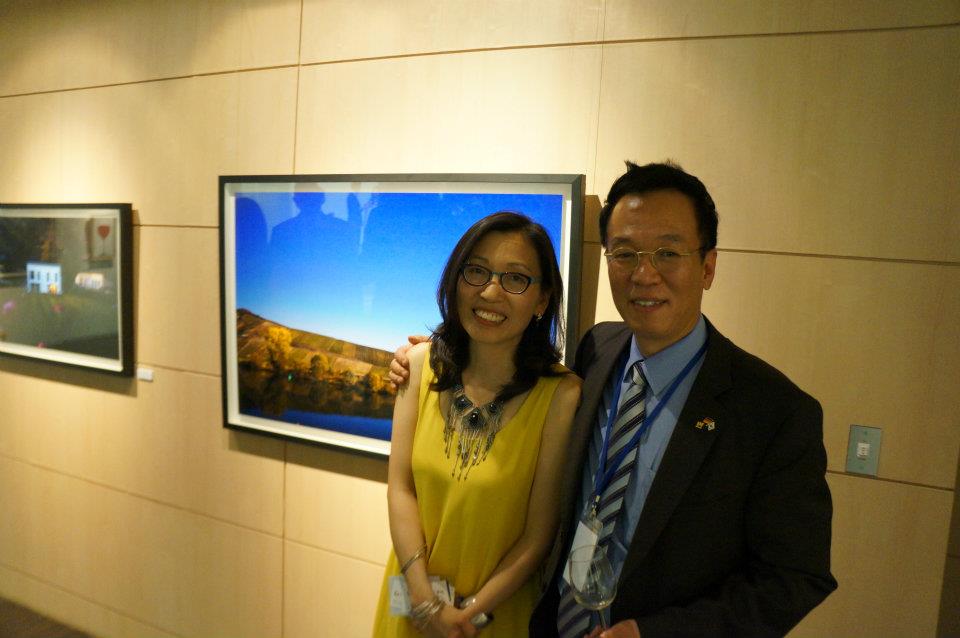
Besides being great friends and wine lovers, they also are both exceptionally good at taking artful photographs and that is where I am heading with this post. Several of their photographs and pictures by others have made it into a (seemingly) gorgeous photo exhibition in Seoul, Korea, organized by Chan Jun Park. The exhibition is called “Mosel! Nature, Terroir, People” and its opening reception was last night (naturally with tons of wine and great food). When I saw photos on a friend’s facebook page today, I wished even more I could have been there. I asked permission to share some with you, because they bring home why I care so much about German wine, riesling, and the Mosel. And my friends…I am not sure which pictures are by whom, and some of them are not even by ManSoo or Yutaka, but it will give you a feel. Also, I am not sharing the high-resolution photos, just shots that my friend Shinju Lim, who was at the exhibition, took. Seeing riesling and the Mosel celebrated in Korea warms my heart.

While I will see ManSoo in June in Germany, Yutaka is now living in Yokohama, so it might be a little while until we get together again. But we sure will.

You can see more of Yutaka’s stunning photos here.

Here is to you, ManSoo and Yutaka! Great work.

The exhibition is on display until 8 June 2012 (so hurry up, if you are in Seoul!) in the Hilstate Gallery in Seoul. Opening hours from 10am-6pm, free admission.


More photos can be found at this post.

Tagged , , , , ,

Demystifying German Riesling – WSJ 4 May, 2012

I know, another article, but this one is about German rieslings, and so I feel like I should share it with you.

Is it a trocken? Demystifying German Riesling

The author makes many valid points, among them the following four reasons why riesling is loved by sommeliers in the US:

1) Riesling is wonderfully capable of transmitting the character of a particular terroir of just about anywhere in the world, though arguably no more so than in its native Germany.

2) Ageability: A great German Riesling can age longer than just about any white wine in the world.

3) Affordability, especially relative to other great wines of the world.

4) The German wine-classification system can make the study of Burgundy seem like a proverbial walk in the park and that is why sommeliers seem to be necessary.

The author then goes on trying to explain that there are many German rieslings that are not as sweet as they tend to be perceived. She definitely has a point there. Another aspect she raises is that Americans talk dry, and like off-dry and semi-sweet. My experiences with American friends visiting us in Germany and going wine touring with us was usually the same: They would tell us prior that they wanted dry wines. The off-dryer and sweeter they got during the tasting, however, the more they fell in love. It is because of riesling’s natural acidity, that makes the sweetness play with it in a hugely pleasurable way.

Yet, the author also falls into the traps of German wine labeling that she tries to avoid: In the article she seems to equate kabinett (the lowest class of Praedikat wine, remember my post?) with off-dry or semisweet. That is not entirely true, though. There are many kabinetts that are dry. This problem, again, stems from the confusing German wine labelling. While Mosel riesling kabinetts are usually sweet, if the label does not denote anything you can assume that they will be on the sweeter side. The winemaker labels them “trocken” (dry) or halbtrocken or feinherb (off-dry) if they are not. In other regions, where tradition is different, a kabinett without any extra labelling can be dry…and if it was sweeter that would be put on the label. My point: Don’t assume a kabinett is off-dry or sweet just because it is a kabinett. If it is from the Mosel, you can safely assume it is on the sweeter end.

The article is still a good read.

Tagged , , ,