Category Archives: Mosel

Comparing Kabinett and Spätlese via 2011 wines by Weiser-Künstler

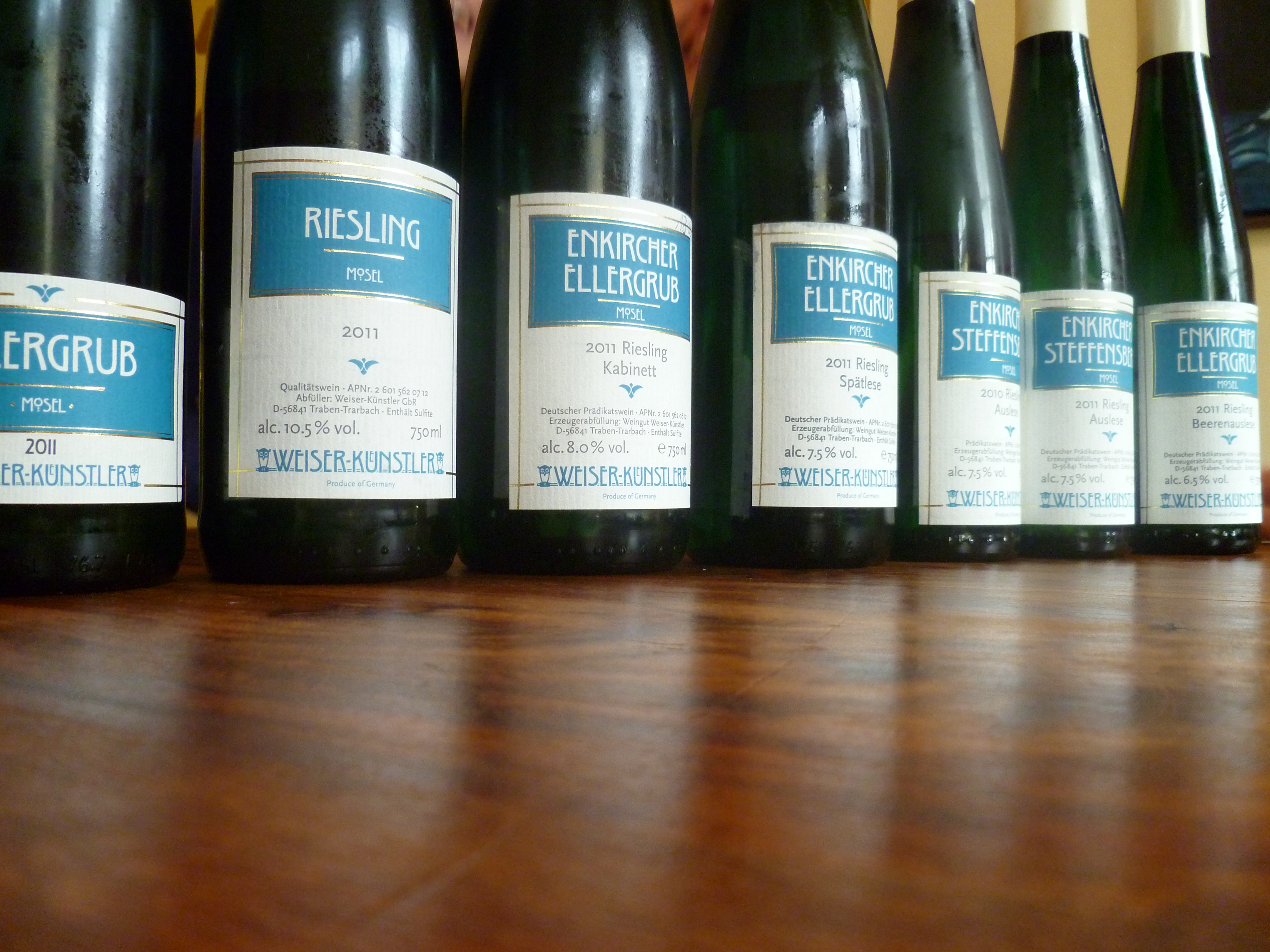
The row

Way back in August when I wrote about my winery visit at Weiser-Künstler in Traben-Trarbach (see here), I promised to write a comparison of the kabinett and spätlese styles from the same vineyard, the Enkircher Ellergrub, because I feel like they show the difference in the two styles very well and it gives me a chance to explain these two a bit more.

Kabinett and spätlese are two levels in the German wine classification system, kabinett being the entry level wine with distinction (Qualitätswein mit Prädikat), and spätlese the next level. Technically, they are defined by the German Wine Act of 1972, and this classification is only based on the residual sugar in the grapes at harvest time (defined by degrees on the Oechsle scale). The winemakers measure that with a so-called refractometer in the vineyard, measuring the density of the grape juice that is dripped onto the instrument. When the grapes reach the required sugar level (Kabinett: minimum 70 degrees Oechsle for the Mosel; Spätlese minimum 76 degrees Oechsle for the Mosel), the winemaker can harvest them. That is why the different levels of distinction can come from one and the same vineyard. The winemaker simply harvests batches as they ripen. Usually, the more sugar in the grape, the longer the grapes where on the vine and exposed to the sun. But if it rains a lot, the grapes can also soak in more water and therefore have lower sugar levels, so rains at harvest time can be detrimental for the classification.

You might have noticed that the levels of distinction only know minimum values: 70 degrees for kabinett, and 76 for spätlese (both at the Mosel). That means that a winemaker can designate a wine a kabinett that technically could be labelled spätlese or even auslese. It happens frequently and has led to much confusion among wine drinkers. Now, why would a winemaker do that? With the temperatures continuously rising in Germany over the last decades, we have seen Oechsle measurements rising as well. In the 1970s, when the Wine Act was passed, 76 degrees oechsle was a lot. Nowadays, it is standard, and would be considered a low measurement. That puts winemakers in a bind. If you harvest too early, when the sugar content in the grape is still low, the grape is also not ripe, which leads to aromas in the wine that you really don’t want. But if you only produce auslesen, consumers and restaurants will not buy your wines,  because an auslese does not sell very well in a restaurant, being a typical dessert wine. So, a lot of winemakers have begun down-labelling their wines.

On the one hand, that is great for consumers, because you get wines that would normally be more expensive at the price of a kabinett. But on the other hand, it also produces heavy weight kabinetts, that have nothing in common with the lighter, fresher image that kabinett has. And that can be frustrating if you open a bottle with a certain expectation, and then find a spät- or even auslese in there. If you know what you get, that is fine, but if you have not had the wine before, it can ruin your plans with that bottle.

True kabinetts are remarkable wines, and it is harder and harder to find them. One of my favorite Mosel wine review teams (Moselfinewines, more on them in a separate post) lately admonished wine makers to produce these beauties again. They argued that it is easy these days to make spätlesen and auslesen, but that the true challenge is producing classical kabinett wines and that winemakers that want to shine, should focus on these, because there is definitely demand for them.

How much nicer is it, when you actually find two distinct wines in a winery portfolio that highlight the difference in the two wine styles in amazing precision. And that is where Konstantin Weiser of Weiser-Künstler comes in. He produced a very clean kabinett from the Enkircher Ellergrub and you can compare it with the spätlese from the same hill.

The 2011 Weiser-Künstler Enkircher Ellergrub Riesling Kabinett had a nose of spontaneous fermentation, something I will write about in another post in more depth. Suffice it to say that the wines initially are more smelly/stinky when poured than you expect, which levels out after a bit. On the palate, the wine was lean, with yellow fruits and enough acidity to carry it. The wine held a perfect balance of acidity and sugar and was just great to drink. It was refreshing and easy to drink.

The 2011 Weiser-Künstler Enkircher Ellergrub Riesling Spätlese, which just like the Kabinett was harvested from exclusively fully ripe grapes without any noble rot, in contrast already showed a higher viscosity in the glass with peach notes dominating. Upon reaching my palate, it became broad, filling out my whole mouth. It had a wonderfully silky texture, with strong aromas of peach and a nice level of acidity (impressive in the 2011s!). It had a long finish, and just showed wonderful elegance, beauty and depth.

What a difference a couple of degrees Oechsle can make…give both of them a try, if you get a chance.

PS: After writing this, I checked the Moselfinewine review, and apparently they are of the opinion that the Kabinett has a spätlese feel to it and the Spätlese an auslese feel…hmmm. I am not sure I agree, the tasting was back in June and my notes do not read that way. That said, they both got raving reviews: 93 points for the Kabinett and 92 for the Spätlese.

See the vineyard here: www.weinlagen-info.de

Tagged , , , , , , ,

2010 Loosen Bros. Dr. L Riesling

America’s German go to riesling with Korean pancake

Finally, you might say, finally a riesling that you have tried and you can compare my notes with your impressions. I admit that I have not tried many rieslings that are easily available here in the US. I have seen the ubiquitous bottle of this wine at Trader Joe’s but was unwilling to pay the $10.99 they were asking for it. So when, on our latest Costco run, I spotted the Dr. L for $8.99 I decided to give it a try. It seems to be the go to riesling for so many people here, and there was no reason at that price point to not give it a try.

First things first. I am usually not very optimistic when it comes to huge productions of quality winemakers, because all too often I have found them to be wanting. In Germany, I have not had many Dr. Loosen wines, so I also was not very comfortable assessing this and putting it into perspective. Then seeing the $10+ price tag for a very simple wine, I was even more turned off. Add in that I also tend to shy away from things everyone likes, Dr. L was in a bad position to start with. If you call all this over-thinking things, I guess you are completely right. I am glad that the price tag made me overcome all my preconceived objections.

When I decided to make Korean squash pancakes (hobakjeon, 호박전) with mushrooms, I figured this was the night to try the wine. I have had many good experiences with the Korean food and riesling pairing (for example here), so it seemed like a no brainer.

For those not familiar with the wine, just a few quick facts. Ernst (or Ernie) Loosen, the owner of Dr. Loosen Estate, is one of the major producers along the middle Mosel with vineyards in many prime sites (Wehlener Sonnenuhr, Graacher Himmelreich, Ürziger Würzgarten, Erdener Prälat, Erdener Treppchen). He is a charismatic figure and has done loads for promoting German rieslings. The Loosen Bros. Dr. L is his entry wine produced for a global market. The riesling grapes come from all over the place and are blended for this wine. The wine has 8.5% ABV.

Upon opening the screw cap of the beautifully dark green bottle, we poured a light yellow wine. As soon as Nina put her nose into the glass, she sighed “Aaaah, real German riesling, I missed you”. She relished the nose of what she described as summer fruits, peach, pineapple. To me, the nose did not really open up much or impress me. I got the peach and some floral notes later, but not initially (and no, the wine had not been chilled too much). The palate, though, was very nice. Peach, apples and citrus notes dominated it, with some herbal notes in the background. It had a nicely present acidity (probably owing to the vintage, 2010 had loads of acidity; read more here) that played well with the sweetness of the wine. In my view, this acidity was what carried it through and made it interesting. It is definitely a tad on the sweeter side, but the acidity makes it quite refreshing. It went great with the pancake and its soy-sauce based dips.

At nine bucks, this is a good value for a wine. We will be stocking up for sure. I am a little worried about the 2011, because if there is less acidity this could end up just too sweet. We’ll see. I will be drinking the 2010s as long as I can and then make the switch. It was nice to see that none of my worries came true. I whole-heartedly recommend this affordable, everyday German riesling.

Tagged , , , , , , , , ,

1997 Karl Erbes Ürziger Würzgarten Auslese* and 1999 Bonnes et Guerre Pommard AOC

Two beauties, meant for each other

Some pairings seem to be made in the heavens: Think steak and malbec, think cheese and sweet riesling, think cooked beef and burgundy wines…the list is endless. But sometimes, we have the chance to reconsider our preconceived ideas, and be surprised, because a whole new horizon opens up as we do.

On one of these days, Nina and I were visiting Stefan Erbes of Karl Erbes. We were trying our way through his newer wines and on to older wines. I mentioned it before, but the cool thing with his winery is that his father has stashed away wines of virtually every vintage. We were trying the 1996 Ürziger Würzgarten Auslese against this 1997 Ürziger Würzgarten Auslese* (they make up to a *** Auslese to distinguish between them according to what Stefan and his father consider the most stellar ones). Both tasted beautifully, unfortunately I cannot find the tasting notes for that visit. Stefan started explaining that he had had the 1997 with a grilled steak the other day and that that was amazing. This is when I intervened and told him to stop pulling my leg. I was incredulous. A steak and a Riesling Auslese? I know Riesling is versatile (think Korean food and riesling), but that versatile? Stefan just laughed, handed me a bottle and challenged me to try it out.

The next day, we did. We threw coals on the grill and seared beef steaks with friends. And, oh man, did it work. The wine nor the steak were ruined by the pairing. Incredibly, the sweetness of the wine gave the steak a new feel and aroma, and the smokiness of the steak gave the wine a certain depth. I was stunned. We stocked up on the wine (because it is amazing, steak or not) and were looking forward to the next BBQ Riesling dinner.

The occasion arose when we made plans with two good friends for dinner. She is falling more and more in love with German Riesling, while he has remained a bit skeptical, but is definitely indulging in the older vintages we’ve brought along. We agreed on steak, a butternut squash with sage risotto and baby potatoes. This was to be followed by a cheese platter, our usual routine.

I knew I wanted to take another bottle of wine, too, and my eyes fell on a bottle of 1999 Bonnes & Guerre Pommard. It was a gift by my French exchange partner and great friend Fred (another match made in the heavens). Pommard is a very well renown village just south of Beaune on the Cote d’Or and my friend knew full well that it is also the sister city of my home village Nackenheim. He had brought two bottles of this wine. I have not been able to find out anything about Bonnes & Guerre, so if any of you know them, please let me know. The first of these bottles I shared with two friends in my last weeks in Germany before heading over to Ann Arbor. It was an utter disappointment: The wine had clearly been dead, whether of cork or another flaw or just bad wine making, I could not determine it. It was just sad. So, I had been worrying about the bottle sitting here in Ann Arbor for a while, and I decided it was time to take it and see…

The Pommard and the decanter

The white was opened and left to breathe for about 30 minutes prior to tasting, the red was decanted and stood for about 45 minutes. We had parts of the Würzgarten with our steaks, and then some of the Pommard as well. That led over to the cheese course, where we also had both wines.

My notes on the 1997 Ürziger Würzgarten Auslese* (the wine had 7.5% ABV): The color was surprisingly light, not as ambered as one would expect an Auslese to be when 15 years old. The nose initially was not very prominent, I could not distinguish any particular aromas. As the wine opened up, there was peach in the nose. On the palate, the wine was very fresh, no significant indications of ageing. The peach aromas came through very nicely, the acidity in the wine balancing the reduced sugar beautifully. I guess I was most endeared by how fresh the wine still tasted. About 2 hours into the evening, the wine opened up further and there were tropical fruits coming in. The wine paired nicely with our steaks, but we were also happy to have preserved some for the cheese, because it definitely shone more on the cheese course, when it opened up and was supported more by the goat cheese we were having. It is a marvelous piece of art that Karl Erbes created…

So light…

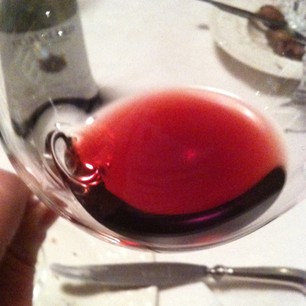
I knew this bottle of 1999 Bonnes & Guerre Pommard AOC was not flawed as soon as I uncorked it. The cork looked clean and intact, and when I poured the wine into the decanter, a full blown raspberry attack was going on. I don’t recall ever to have had such a prominent and distinct raspberry aroma in the nose. The wine was incredibly light in color, almost translucent. There was no darkening or browning on the edges when poured into the glass. It was remarkably fresh as well. In the nose, the raspberry aromas persisted, with some jam and tartness mixed in. I also smelled something like dough batter, but that might have been my brain playing tricks on me (I love raspberry tartes). There were also notes of chalk in the nose. On the palate, the wine was condensed, but very fruity. The alcohol of 13% ABV was noticeable, but at no instance was the wine heavy. Later in the evening, when we were having cheese, the wine showed cherry, plum and slight tomato notes. There was also a certain earthiness to it. The wine was such a surprise to me. I had expected it to be flawed or a heavier, darker pinot noir. The light color deceived that it was deep and subtle and strong. The finish was long, and it shone through.

Was this a pairing made in the heavens? I think it was. Trying old wines with friends, from two regions in the world that matter a lot to me, both fruity, both light, both deep. They expressed some great European wine making, and to have them side by side, was an experience I likely will not forget for quite some time…

Playing with filters to show how light it looked…

Tagged , , , , , , , , ,