Monthly Archives: July 2012

Meeting the vintners: Weingut Reuscher-Haart, Piesport (Mosel), Germany

I am slowly but surely getting there, catching up with my winery visit notes from the Germany trip. A couple more to go, and I promise I will also be posting more tasting notes and shorter pieces soon…

But back to the story: For June 16, I had made arrangements with Weingut Reuscher-Haart for around 4:30 to 5:00pm, right after the tasting at Weingut Dr. Hermann. We were about 2 1/2 hours into our tasting there when I realized that there was no way we could hold that time frame. I stepped outside and gave Mario Schwang, owner and winemaker at Reuscher-Haart, a call. He was more than relaxed: We should come whenever we were done. If he was not there, then his father Hugo would do the tasting. No problem at all. We are always welcome. This response gives you a really good impression of Mario. He is one of the nicest and coolest winemakers I know. Ever since our first tasting there in 2011 he has let us know that we are always welcome, whenever.

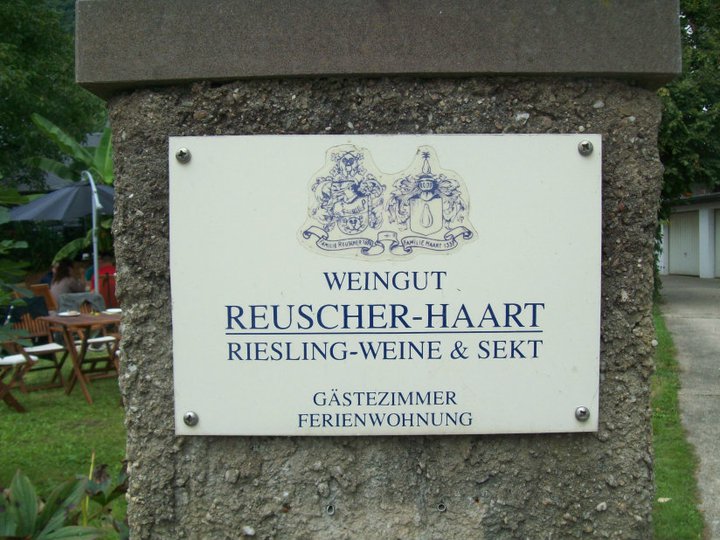
The Reuscher-Haart winery has a long history. The two families date back to 1624 (Reuscher) and 1337 (Haart) respectively, and the coat of arms on their labels bring that home. The winery is still located where the seat of the Haart family was, with a garden adjacent to the Mosel. The merging of the families happened in 1919 when Elisabeth Haart married Matthias Reuscher. Their portraits adorn the tasting room, too. Mario and his father Hugo have a very clear vision: They have cut back on their yields to increase quality in their grapes, and since 1987 they have been using integrated, natural methods of protecting their grapes without inescticides. The vinification also happens in gentle steps: Reuscher-Haart owns temperature controlled stainless steel barrels that lets Mario and Hugo use very low temperatures (5 to 8 C) in fermentation to preserve natural aromas. They clarify their wines without any clarifying agents.
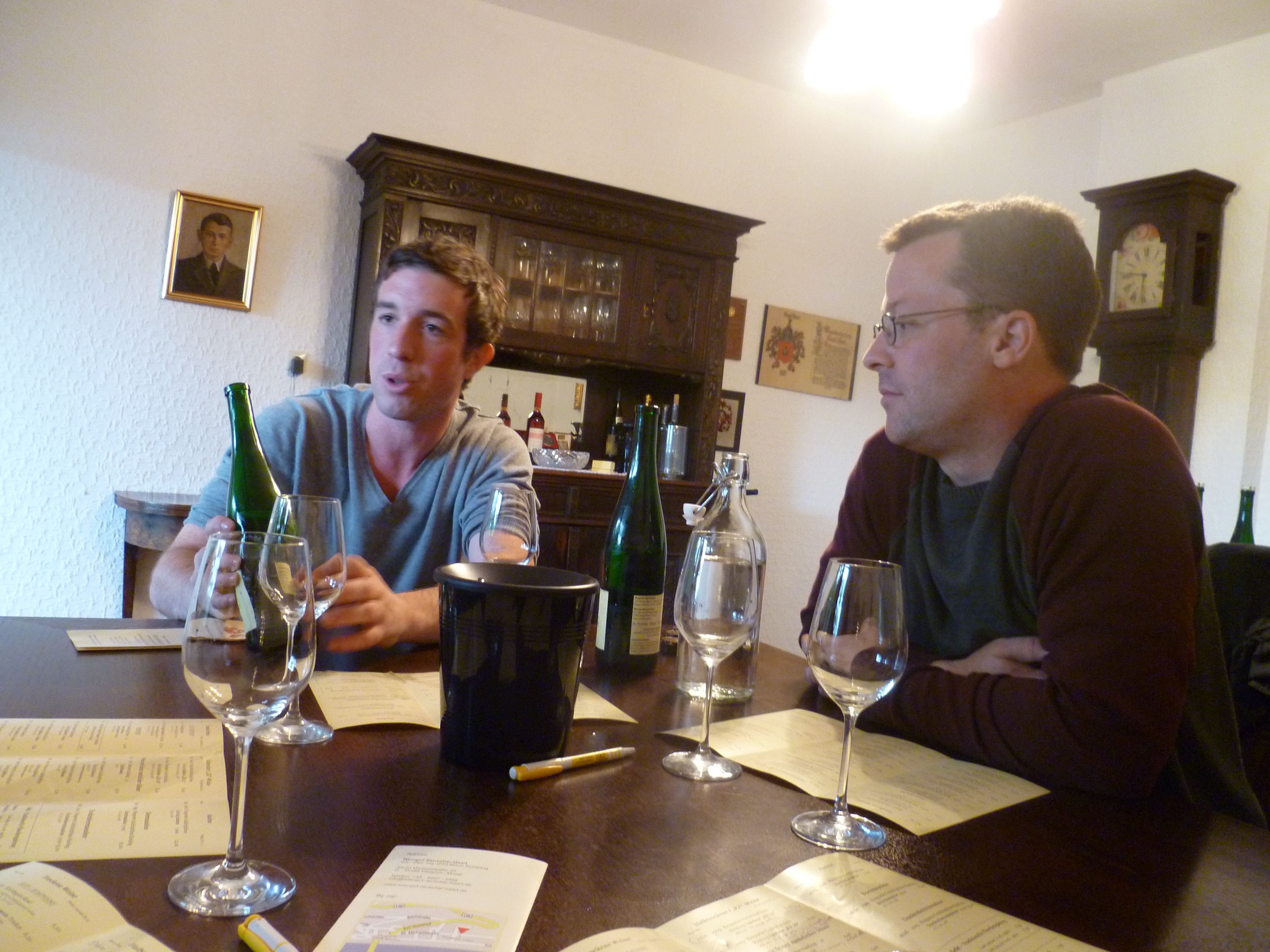
Mario (left) at our wine tasting in 2011

We first came in touch with this winery through my friend ManSoo (whom else?). He suggested stopping by there and our first wine tasting in June 2011 was awesome. First, Mario’s father Hugo took us on a Vineyard Safari in their old Land Rover. We drove through the Piesporter Goldtröpfchen, stopped occasionally and Hugo filled us in on their gentle approach to cultivating vines, and what the work in the vineyards means for the winemaker. After a good hour or so, we headed back to the estate and had a tasting with Mario. Not only did we have a lot of fun, we also liked their wines a lot. The basic Gutsriesling is probably the best price-value bargain you can get at the Mosel (I mentioned it previously here). We had been back for their wine presentation in August 2011, and Nina took some of her visiting friends there and had a great time, too.

The winery is located in Piesport, home of the Goldtröpfchen (Gold droplets). Reuscher-Haart owns vineyards in Goldtröpfchen, Domherr (Canon, as in a priest assigned to the cathedral), and Falkenberg (Mountain of Falcons) as well as the lesser known Günterslay and Grafenberg. Most international readers connect Piesport with “Michelsberg”. That, unfortunately, is the least appealing vineyard in Piesport. Unlike Goldtröpfchen, Domherr and Falkenberg, it is not located on the Northern side of the Mosel, where it would get full sun exposure all day, but on the South bank of the river, in flat terrain that used to be farmland and was not used for growing wines until a couple of decades ago. Another thing one should know is that the Goldtröpfchen used to be much smaller and was extended significantly under the German Wine Act of 1971. Old Piesport wineries were fighting this and got permission to label the core piece of Goldtröpfchen as “Piesporter Domherr”. So Domherr is the heart of Goldtröpfchen. Unfortunately, hardly anyone knows this and Domherr has therefore not been as succesful as the Goldtröpfchen…
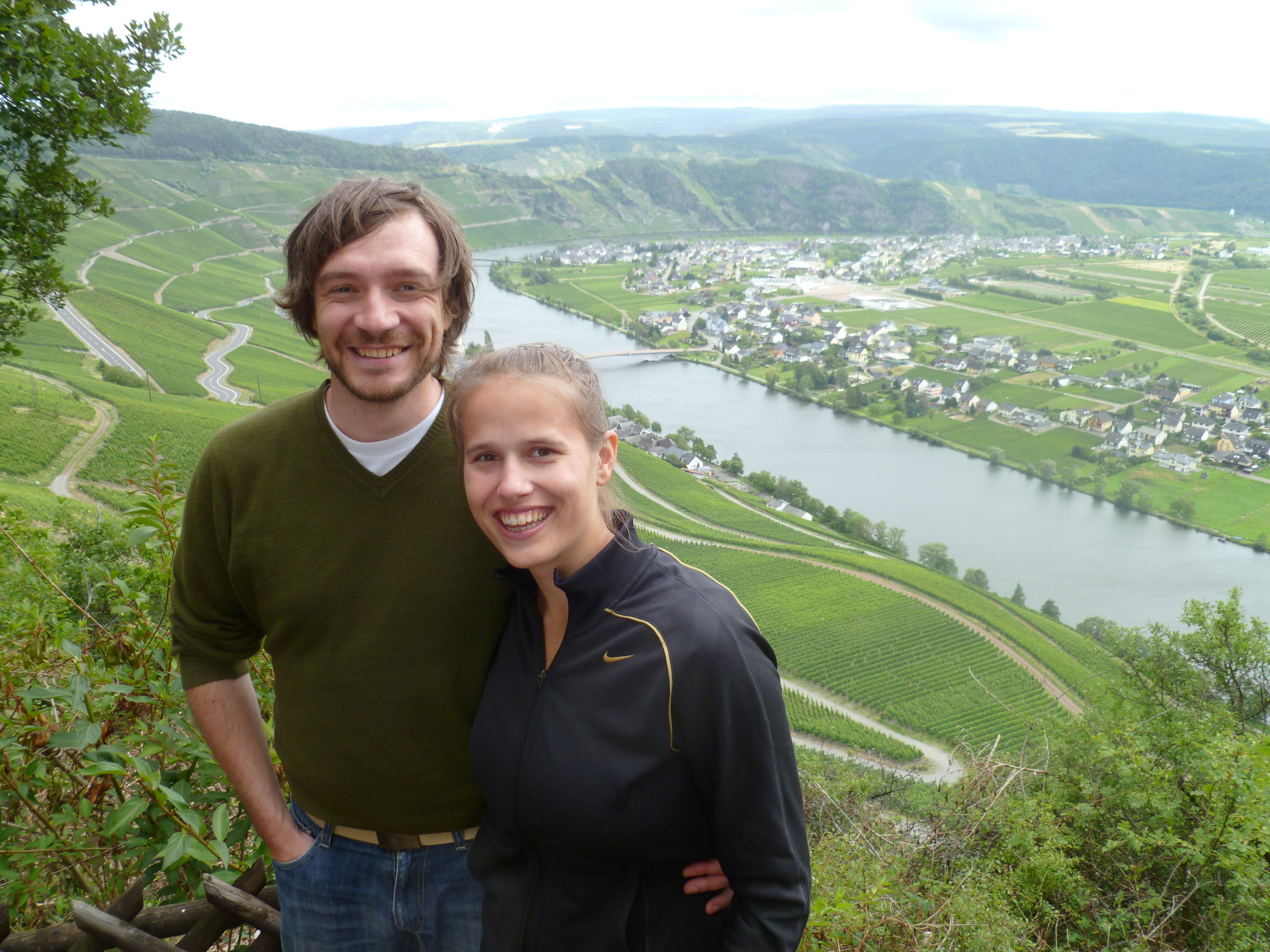
During our vineyard safari 2011: Piesport Goldtröpfchen behind us, Piesporter Michelsberg on the other side of the Mosel

By the time we finally made it to the winery, we were already two tastings in and it was approaching 7:00pm. We were also constrained by the European soccer championships, because we wanted to watch the match that night which started at 8:45pm. This did not right by Reuscher-Haart, but given that Mario is a member of the “Weinelf“, Germany’s national soccer team composed of winemakers, he understood. Also, we were just three weeks away from Mario’s wedding, so their level of relaxedness was even more impressive. Another thing that happened was that we completely forgot to take pictures which is why I am using photos of older tastings there…

Member of Germany’s wine soccer team!

Mario had to run some errands, so we tried the first wines with Hugo. It is always interesting to get a glimpse into the relationship in these family businesses. While Hugo is obviously very proud of Mario and his work, he is still very much involved in day to day decision processes. The latest contention they had was about labelling. Mario has tried out a new label design for one of their export bottles to the U.S. and Hugo was not fond of it. The cool thing was that we got to discuss the virtues of both approaches, and that there are no hard feelings involved. It is a dispute about how best to present their products.

Their newest project is the planting of a new grape called cabernet blanc. Hugo explained that it is a new crossing between cabernet sauvignon and resistant grapes. Its main advantage is that it is fungus resistant. The berries are small and leave room for air between the grapes. In taste, it is being compared to a mix of sauvignon blanc and riesling. I am already curious about the results.

We tried a total of nine wines that evening and were very happy with what we got to try. I will write about some in seperate posts. If you are unclear about what some of my designations mean, check out the at a glance sheet on German wine classifications.
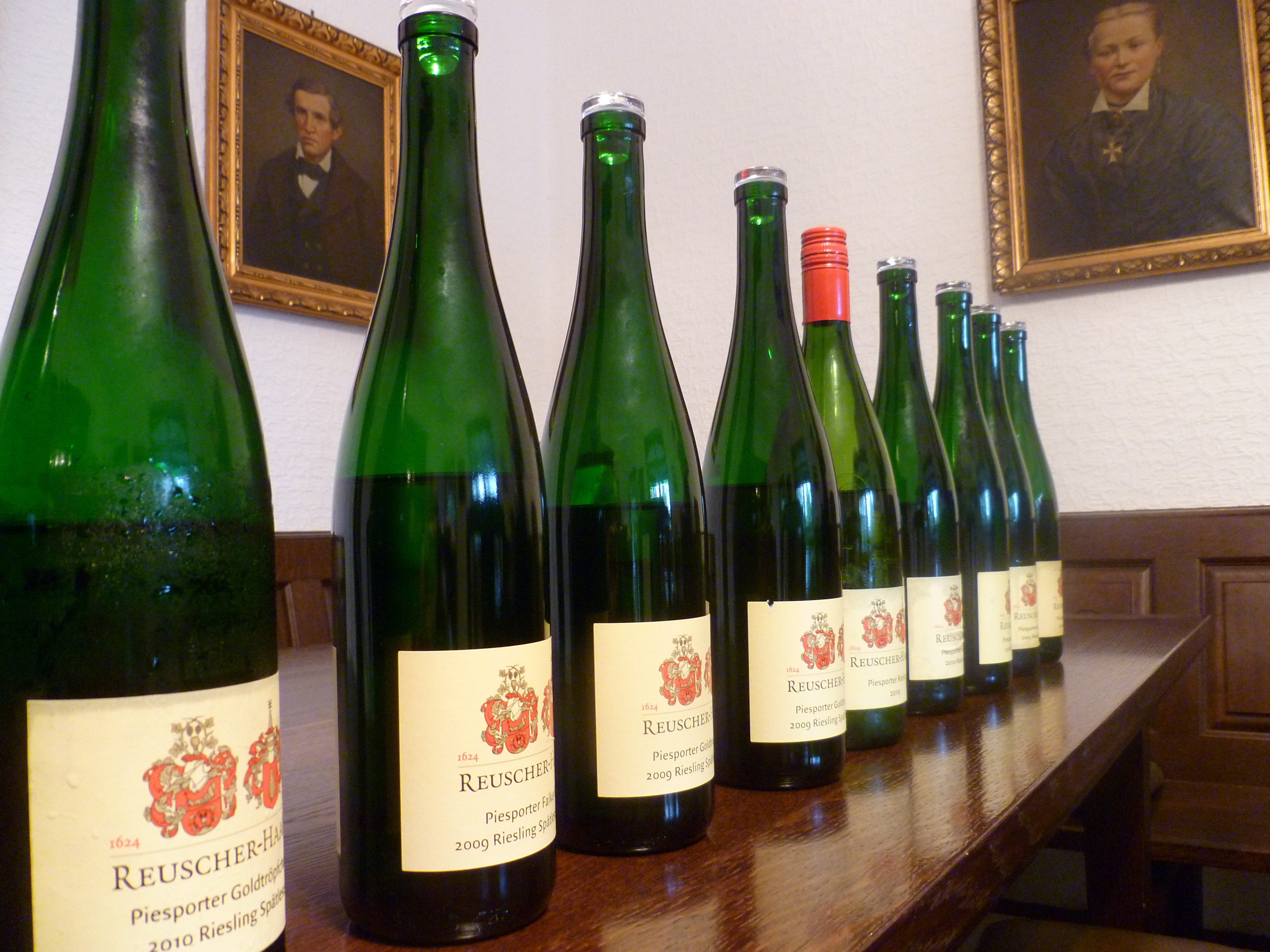
The line in 2011

We began with their dry wines. Most of them had not been bottled yet (Mario and his father believe in late bottling, given the wines as much time as they need to ripen), so we just went with the two 2010s they still have available. The 2010 Piesporter Falkenberg Riesling Kabinett had aged quite nicely: good fruit, very fresh still, nicely long in the finish. The acidity was pleasant. The 2010 – Urgestein – (a dry Spätlese from the Domherr) was awesome. Coconut in the nose it was a powerhouse on the tongue with a forceful acidity. Very impressive.

The two semi-sweets were both Spätlesen from the Goldtröpfchen. The 2010 Spätlese RZ 13 had nicely aged, but was not really my taste. I would have wished for some more sweetness in the wine. The 2011 “Überschwang” was a beautiful delivery of a classical Mosel riesling with a fruity nose with a not overbearing sweetness.

I compared their dry and sweet gutsriesling in a seperate post here.

Their sweet wines of 2011, though, were all very impressive. The Goldtröpfchen Kabinett had apple notes, was very fresh with an awesome amount of acidity and will probably be good for a while. There were two spätlesen from the Goldtröpfchen, one with 9% ABV and the other with 8.5%. The 9% ABV one was incredible: gooseberry and tons of tropical fruit on the nose and with the same notes on the tongue. It was fresh and is well worth storing. The 8.5% in contrast, had hints of sauerkraut on the nose (yes, that was weird!) and seemed a whole lot sweeter on the tongue. I think it needs a bit longer to settle and show its true colors.

We had to rush out to get to see the match, so we did not try their blush and red wine of 2011, but I remember the 2010s as pretty decent, too. It was great seeing Mario and Hugo again, and I wish we had had more time to spend with them. They are both visionaries and it is great to learn from them. I look very much forward to our next encounter and what they will come up with next. Mario speaks great English, so don’t hesitate to go visit! And make sure you ask for the vineyard safari. You can find Reuscher-Haart wines in the U.S. German and European readers can order their wines through the winery website. Pricing is quite reasonable, and the wines are well worth the money.
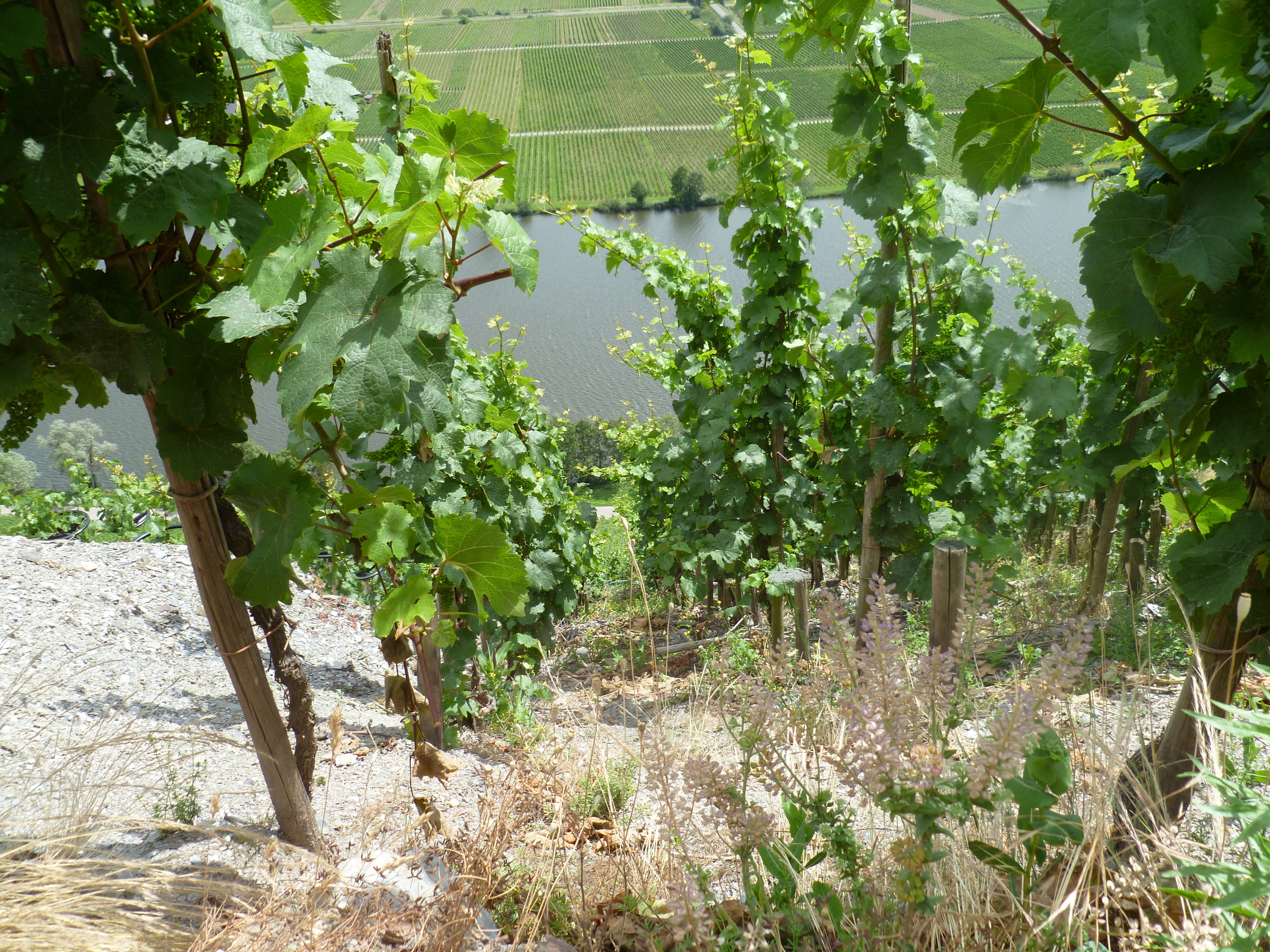
Steep vineyards in the Goldtröpfchen

Tagged , , , , , , ,

Meeting the vintners: Weingut Dr. Hermann, Ürzig (Mosel), Germany

Row upon row of TBA waiting to be shipped to Israel

Stop number two on our epic June 16, 2012 Mosel trip was Dr. Hermann winery in Ürzig. Avid readers of this blog know that I have a love affair with that particular village along the Mosel. I seriously think it is one of the most beautiful areas in the world (see also my post here). Almost more importantly, the vineyards Ürziger Würzgarten (Spice Garden), Erdener Treppchen (Little Steps), and Erdener Prälat (Prelate), which are right next to it, rank among my favorite hills. I am convinced (probably falsely) that I can always recognize a Würzgarten just from its nose.

Before we headed to our appointment with Rudi Hermann at 2.30pm, we took a break at the ancient Roman wine presses they found in the Erdener Treppchen. Hannah had baked amazing filo dough pockets and we dug in. Photos and an account of the wine presses will be shared in another blog post (gotta ration myself).

The Dr. Hermann winery will always have a very special place not only in my heart, but also Nina’s. I had my first encounter with Rudi and Christian Hermann, father and son, at a tasting with my friend ManSoo. They took us into their vineyards and their cellars, and let us taste their full collection. It was stunning. It is special for Nina, because we spent her first birthday in Germany there, trying amazing wines and actually getting to taste a sip of their 2009 Trockenbeerenauslese (TBA), the whole 20 litres of which Christian was filtering that day. Also, we went to spend an hour with Rudi Hermann before I brought her to the airport when she returned to the U.S. for good in summer 2011.

Magnum and double magnum of the Herzlay

Christian, who has been in charge of operations in the cellar and vineyards for a couple of years now, is producing highly praised, classically sweet rieslings typical for the area. The wine guide Gault-Millaut calls them “baroque”, and there is something to it: they are oppulent and succulent, full of sweet beauty and body. The contrast to the leaner Weiser-Künstler was tastable, although both go for sweeter wines.  Dr. Hermann has been on the up and coming for a while now. All wine guides praise the high level of skill, and the wines, from basic to rare, are sought after worldwide. 90% of their production is sold abroad: in Scandinavia and Hong Kong, in Japan, the United States and notably Ontario and Quebec. They win award after award. The great thing is that they are still as accessible and hospitable as they have always been. Whenever we go visit, Rudi or Christian take their time with us, and we get filled in on the latest developments.  If you want to know a bit more about their philosophy, there is a good interview on the Riesling Revolutionary.

In the cellar with Rudi Hermann

Dr. Hermann owns sections of all three vineyards I mentioned above. What makes this area so unique is that within 500 metres you have three different types of soil: the Würzgarten is made mostly of red sandstone and slate; the Treppchen, right next to the Würzgarten, has red and grey slate as well as clay slate; the Prälat, a mere 1.5 hectares (3.7 acres) nestled between the two, combines the red and grey slate in an ideal microclimate. The vast majority of Dr. Hermann’s vines are ungrafted and old, some of them over 100 years.

The challenge for this winery is how to grow further without losing their identity. Their basic riesling, the H, is so sought after that they could already sell double of what they produce! The reassuring thing about Rudi and Christian is their down-to-earthness. They know that the only thing that matters is the quality of their wines. So they will probably expand further by contracting with other winegrowers that they know, using those grapes for the H. But they will never compromise on quality.

The winery cat

We tried a total of 13 wines there (I think) over the course of about 4 hours. As with the other winery reviews, I will write about some of them seperately. If you need clarification about the classification of German wines, check my at a glance sheet.

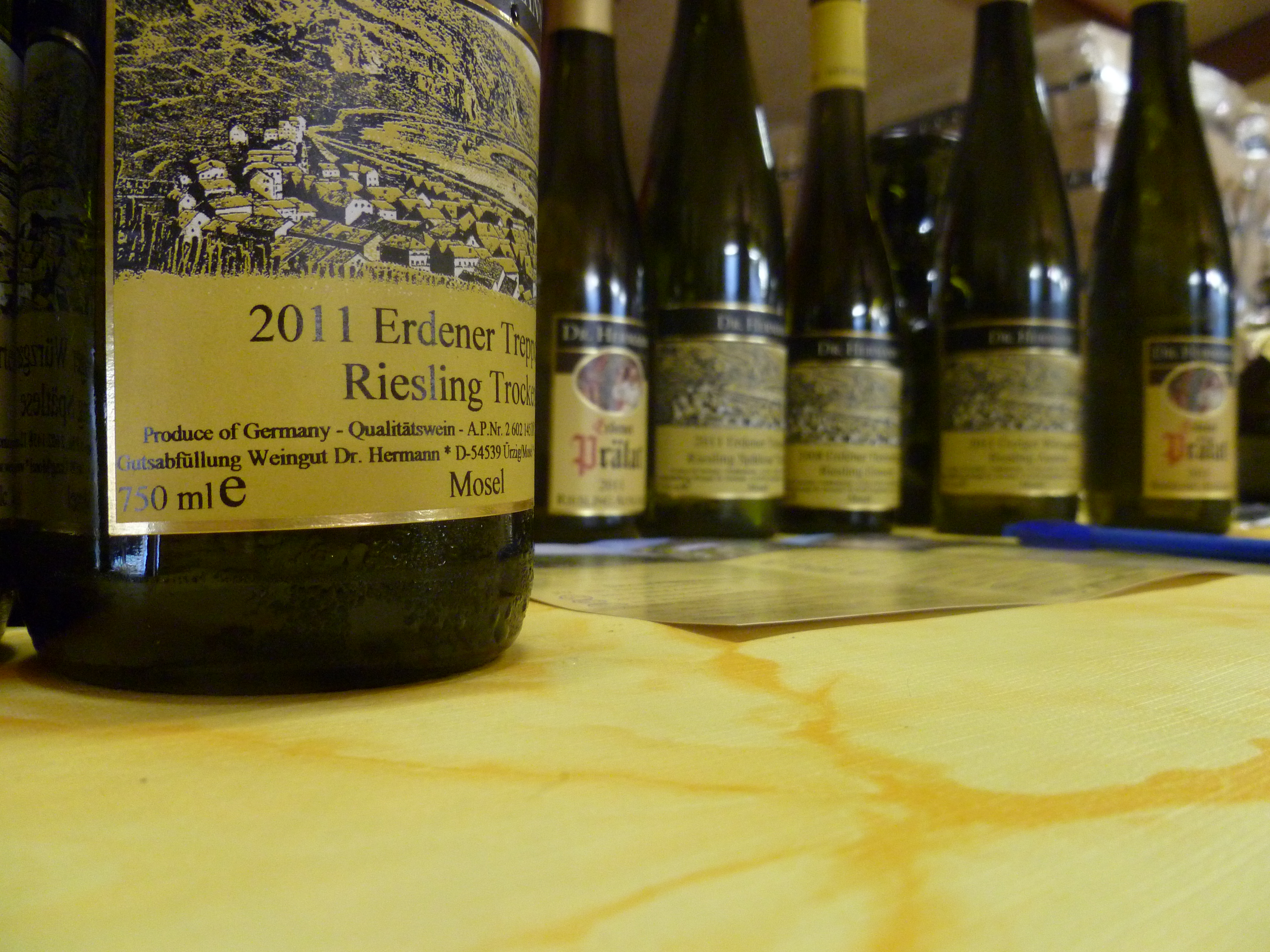
We began with two of their dry rieslings: the 2011 Riesling QbA dry and the 2011 Erdener Treppchen Riesling QbA dry. All dry wines ripen in wooden barrels. The grapes for the first wine come from vineyards in Kinheim and Lösnich, neighbouring villages. It had a great, fruity nose and confident acidity. The Erdener Treppchen is from 120 year old vines and has the typical creaminess of the Treppchen with lots of fruit.

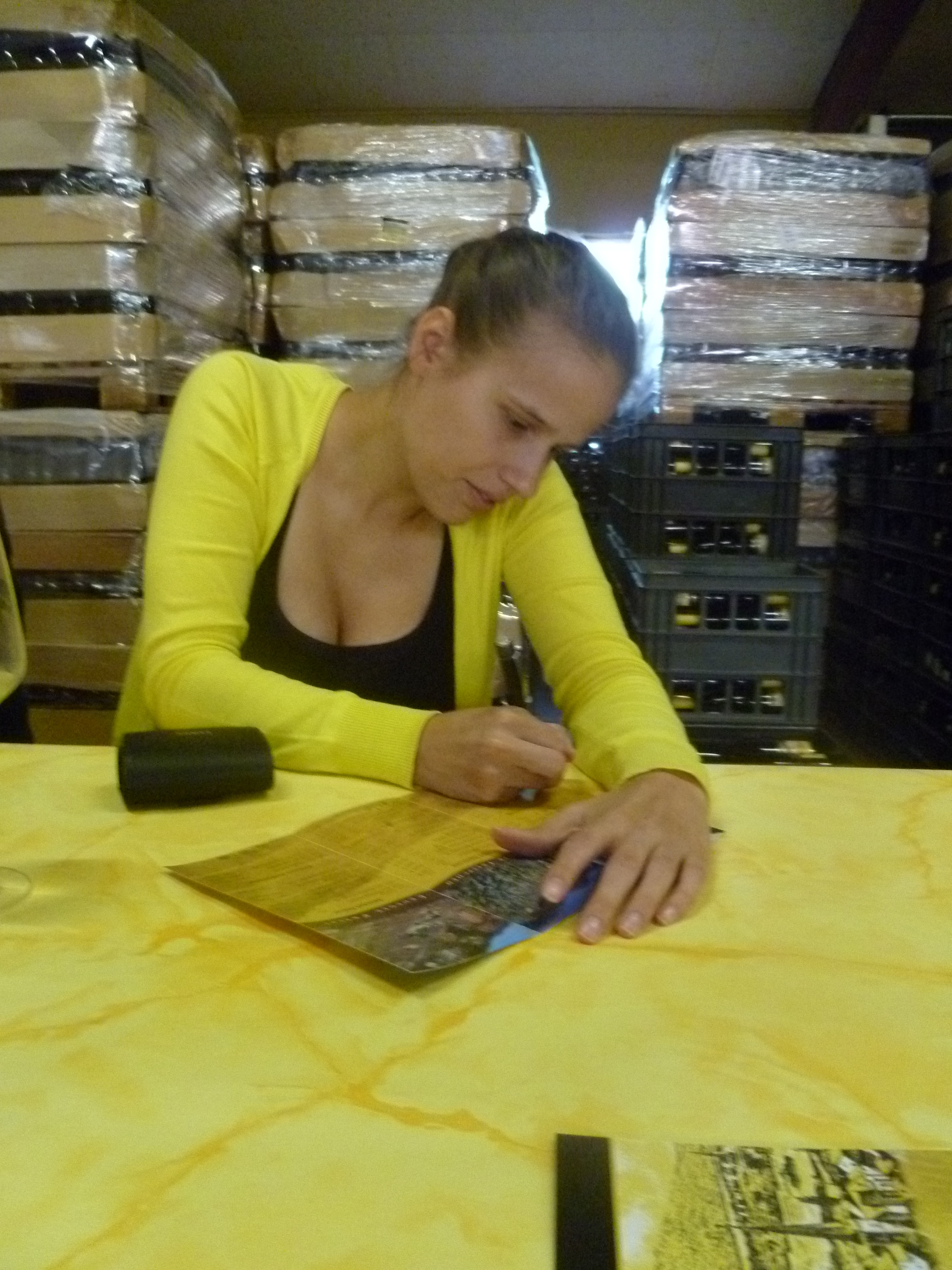
Nina taking copious notes

Next up were the off-dries and sweeter wines. I really liked their 2011 Erdener Treppchen Kabinett, which, again, was creamy with apple notes and good acidity. The corresponding Kabinett from the Ürziger Würzgarten was fresher, had more acidity while retaining the spice notes in the nose.

We then tried the Treppchen Spätlese against the Würzgarten Spätlese and here, too, the differences were striking. While I liked the Treppchen with its nose and taste of stonefruits, I really loved the length and depth in the Würzgarten. It was mild, had the typical floral, herbal nose. Usually, I tend to go with the Treppchen wines, but in the 2011 harvest, it seems like the Würzgarten produced the more interesting ones.

Impressions

We tried more exceptional Würzgarten and Treppchen and then moved on to the stars of the winery, the Prälat wines. I will also talk about those in a seperate post.

We finished the tasting with a 2008 Erdener Herrenberg Eiswein. The Herrenberg is located above the Erdener Treppchen, high up over the Mosel. This wine was harvested at -10 C. I thought it was just beautiful. It is still very young, and should lay low for quite a while. But given that that was the year that Nina and I met, we decided to get a bottle for us and took one for a friend of ours, who loves eiswein.

We had an awesome time with Rudi, who also took us to the cellar to explain the expansions they are currently planning. His generosity in sharing his wines and his thoughts and stories keep overwhelming me. The wines are exceptional, and the pricing is still quite reasonable. Their best wines are sweet, and I am aware that not everyone is fond of that. But if you want to experience why the Mosel is famous for its wines, one of their wines is probably a good way to find out. Don’t have them on their own, when you try something like them for the first time. Give them a salty companion like cheese and bread to soften that sweetness a bit. I love drinking these on their own, too.

The row

Their wines are among the most easily accessible in the U.S. of all the wineries we visited, so go and try them out. If you are in Germany, it is a bit harder to find them. The easiest is to order from their website directly. This is a winery where you need to make an appointment if you want to visit, because the cellars and tasting room are not connected to the winery. Both Christian and Rudi speak great English.

Tagged , , , , , , , ,

How I pack wine for plane travel

Recently I reported on US customs duties and that we carried 23 bottles with us on the plane.

In the comments section, bravawine asked how we got that packed.

Here is how we do it: We make sure to travel lightly on clothing when we travel to wine country. My wife’s favorite thing in the world are tank tops, and they are awesomely light and can be brought to good use when packing wine. We now know that we can get about 12 bottles into one suitcase and still hit the 50 lbs. mark for luggage on economy tickets.

The key for me is that the bottles stay in a wine box, and that they have no way to move in the box. To that end, we wrap up each bottle in a tank top or t-shirt or any other piece of clothing that fits. German wine cases are usually 6 bottle cases, but you can also get 12 bottle cases at the wineries. Each bottle wrapped up, we put them in the box, make sure they do not move, and then tape the box shut tightly. Then, it is pretty much impossible that the bottles can move and thereby hit each other in the box. The box goes into the suitcase and is secured the straps inside the suitcase, or you put bigger items around it to secure it.

I have also done that with less bottles (2 or 3) which I pack into cardboard wine gift boxes, the same principle applies: wrap the wine in a thin layer of clothing, make sure the wine cannot move, tape the box shut and put it in the suitcase.

A friend of mine has been bringing us wine lately when he travels to Germany. His baggage allowance gives him two free pieces of luggage. A case of 12 bottles weighs between 45 and 50 lbs, so it is the perfect size. He, again, wraps the bottles in clothing and then puts them in a shipping box which he checks as a piece of luggage. We have not had a bottle broken yet.

It is really easy to travel with 8-9 bottles, because that way you can still store clothing in the suitcase. I am convinced that the key is that the bottles cannot move. That is why I do not just wrap them up in clothing and store them in the suitcase. Any clothing that could not be used for wrapping goes in the small carry on suitcase.

Hope that helps!

How do you go about that when you travel? Curious to see whether there are simpler methods…

Tagged ,