Tag Archives: winery

Meeting the Vintners: GranMonte Asoke Valley, Khao Yai, Thailand

The vineyards of GranMonte Winery

The vineyards of GranMonte Winery

Disclosure: We visited GranMonte at the invitation of the owners who provided us with food, wine, lodging, and an awesome time. 

It’s been half a year now since Nina and I visited GranMonte Asoke Valley Winery in Thailand’s Khao Yai region. I published an article on Palate Press about our experience there (you can find that article here), but I wanted to expand a bit, because the word limit on Palate Press cut into my usual wordiness when it comes to winemakers…

As I indicated in the Palate Press article, I was initially skeptical of winery operations in Thailand and could not quite believe that a tropical climate was very suitable for the attempt. But my fellow blogger Rainer The Man from Mosel River, who at the time was living in Bangkok, convinced me to get in touch with the owners Visooth and Sakuna Lohitnavy, and see for myself. So, after our eight week whirlwind through Thailand, Laos, and Cambodia, and fresh from Railay Beach, we embarked on the two and a half hour bus ride to Khao Yai. Khao Yai is a natural reserve in Eastern Thailand. The landscape is gorgeously hilly and lushly green. When we arrived at the drop off city Muak Lek, a driver from GranMonte was waiting for us and took us to the winery, which is nestled between hills and sits on property that Visooth’s father owned in Asoke Valley and which was previously used for corn and cashew production. I wasn’t prepared for how excited I would get by seeing vineyards after several months…it’s little joys that make the journey worthwhile, I guess…:)

More vineyards

More vineyards

Let me give you some background on the winery: GranMonte was founded in 1999 by Visooth Lohitnavy and his wife Sakuna. It started on approximately 12 acres, and now has reached a size of about 36 acres. The family opened a state of the art wine making facility in 2009 which has a maximum capacity of 120,000 bottles, although currently it produces around 90,000 bottles a year. GranMonte currently makes wines from Cabernet Sauvignon, Chenin blanc, Syrah, Viognier, Semillon, Verdelho, and Durif grapes.

The winemaker is Nikki Lohitnavy, Sakuna and Visooth’s daughter, who grew up on the property and decided at a young age that she wanted to get into wine making. She studied at winemaking at the University of Adelaide, Australia, and is Thailand’s only female oenologist to date. For her young age, she has a ton of experience including harvesting and making wine in France, Brazil, and Portugal. She is full of energy and passion, entertaining and adventurous. We were glad to spend a considerable amount of time with her. It never ceases to amaze me how much passion these young winemakers bring to their job, and in that she reminded me a lot of some of the young winemakers I was fortunate to meet along the Mosel and in Rheinhessen. But Nikki seems even more impressive to me, because she was not born into a wine culture like most of the winemakers I know. So she does not have that background that many can rely on, and still is doing an outstanding job.

Hanging out with Nikki

Hanging out with Nikki

It is her and her father’s enthusiasm that is visible in the whole winery endeavor: They use top notch modern equipment like five weather monitoring stations that not just measure the weather but also the soil’s humidity, which has led to a marked reduced in their need (or perceived need) for watering. The vineyards are impeccably maintained. Being a young winery in a new wine region, they experiment with a ton of things, like harvesting grapes twice a year (turns out that’s not such a good idea since the vines just get very tired), or growing Riesling (also not a good idea, because the warm weather is not good for the cool climate grape). I really enjoyed seeing this adventurism at work, and it was great how open the family shared with us…

Touring the estate with owner Visooth

Touring the estate with owner Visooth

It’s impossible not to notice how much detail goes into everything: The staff at the winery’s tasting room is courteous and knowledgeable, the wait staff at the winery’s exquisite restaurant Vin Cotto just as attentive and hospitable. Every dish we tried was very well executed (I had an outstanding coq au vin, just to name one dish!).

What struck us the most during our dinner with our hosts was how food compatible the wines were. An example that stood out was the 2012 Heritage Syrah, one of their top line wines. We drank this wine with steaks that came with spicy oils: a more medium spicy Thai dip, and an insanely spicy tip with Brazilian chili peppers. My mouth BURNED! And yet, the Heritage Syrah was cutting through it like it was nothing. That was a stunning experience.

The wines we were able to try were good to very good, and impressed us quite a bit. There is a lot of craft and skill going into them, and I can only see them get better as Nikki keeps experimenting and learning. I will write up some of my tasting notes in an extra post.

The state of the art cellar

The state of the art cellar

All in all, we had a great experience at GranMonte. It is a perfect place to kick back and relax, enjoy some great Thai wine, and very good Western food. I assume it is not on many people’s bucket list, but the natural beauty of Khao Yai National Park can definitely be an attraction off the beaten path. Thailand, it turns out, is not just for beaches, but has joined the growing universe of wine production. And quite impressively so. I hope you can make a trip there and see, but more importantly, taste for yourself what they have to offer.

You can reach GranMonte, which is around 160 kilometers north east of Bangkok, via a taxi, bus, or mini-bus. I recommend getting in touch with the winery first, they can present you with good options on how to get there. We took the mini-bus and it was comfortable and cheap.  GranMonte also has a gorgeous guesthouse overlooking the vineyards. You can find GranMonte’s contact information here.

Tagged , , , , , , , , , , , ,

Off the Beaten Track: GranMonte Vineyard and Winery in Khao Yai, Thailand

GranMonte Vineyards

While I am working on more detailed posts about my visit to GranMonte winery in Thailand last August, why don’t you go and check out a small appetizer I just got published on Palate Press about it yesterday. There will be more about the winery on this blog, but this should give you a first idea.

The article starts like this:

When I first heard that wines were now being produced in Thailand I laughed it off as gimicky…

Continue Reading

Tagged , , , , , ,

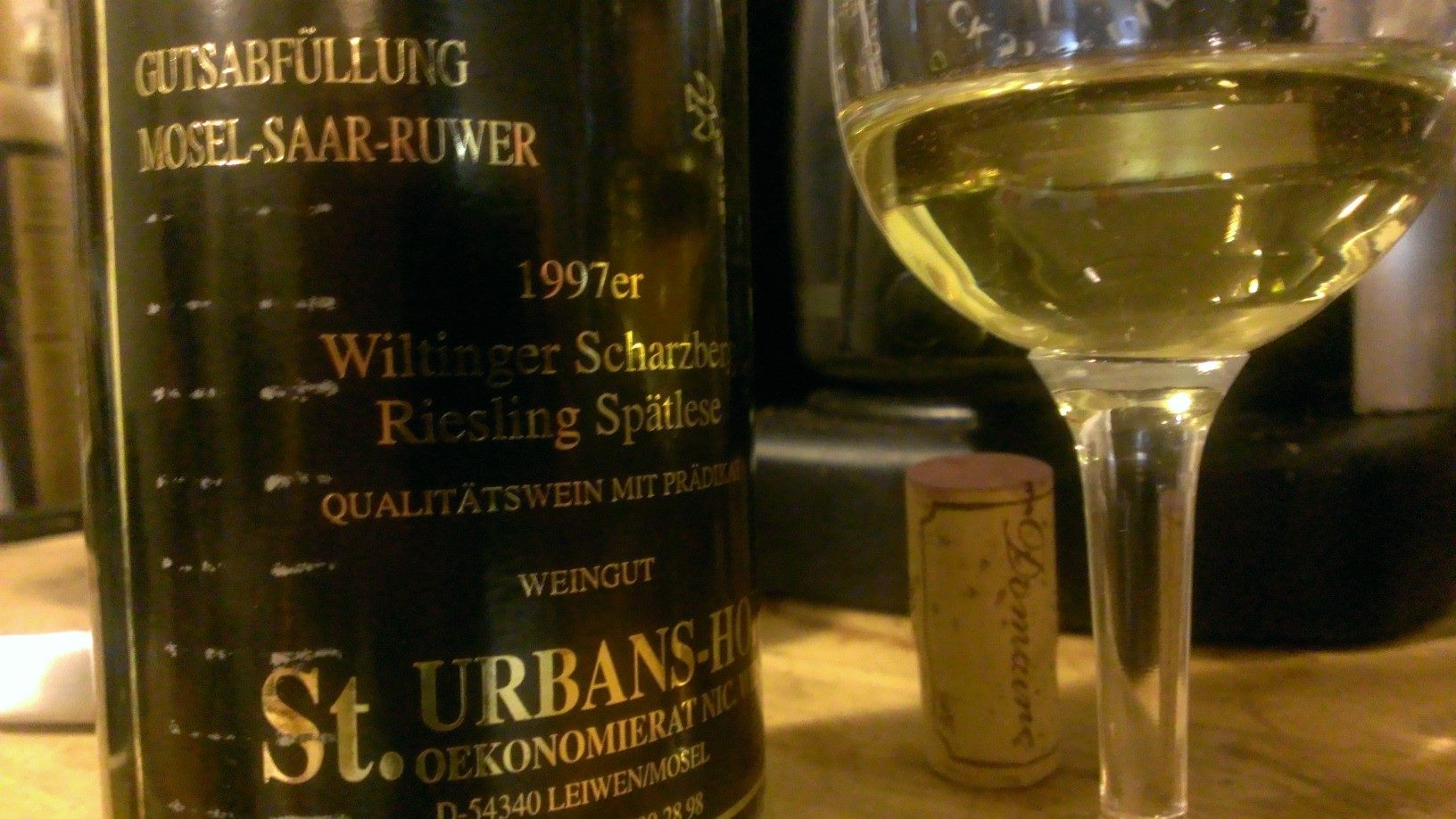
1997 St. Urbanshof Wiltinger Scharzberg Riesling Spätlese

1997 St. Urbanshof Wiltinger Scharzberg Riesling Spätlese

1997 St. Urbanshof Wiltinger Scharzberg Riesling Spätlese

Some of you may recognize the iconic black label of St. Urbanshof, because I have previously written about a wine from this winery, a wine I really like. This one however, a St. Urbanshof Wiltinger Scharzberg Spätlese, does take us back a couple of years (1997, the year in which I finished my alternative military service, the year in which I first moved to Trier to take up my studies, and oh did I hate Trier and Mosel valley at the time for being forced to go to my fourth choice school despite very good grades…but I digress). I need to write a somewhat longer introduction on this one…bear with me.

When Nina and I visited Germany last year, we naturally spent time with our wonderful friend, my wine mentor and former Korean teacher ManSoo (you have heard that name often enough by now). During our long, delicious dinner, he was gracious and kind enough to open many bottles of Riesling, among which were a just degorged 1992 Riesling champagne and this bottle of wine, a 1997 Scharzberg from St. Urbanshof. The wine had, as all wines do, a history: ManSoo had laid hands on some of these bottles through the president of Saar-Mosel-Winzer Genossenschaft, a cooperative that mostly makes Sekt, the German champagne, but also other wines. If I remember correctly, the president told ManSoo that he found several cases of this wine in the deep cellars of the cooperative. The wine label bears a special imprint that shows a bird and reads “Singapore Duty Not Paid – Not for Sale”. What the heck? Well, turns out that this particular wine was bought by Singapore Airlines to be served in first class service in the late 1990s, early 2000s and it was a special bottling. Apparently, Singapore Airlines had not taken all of the bottled wines, so some ended up, for whatever reason, in the cooperatives cellars….and now ManSoo got a couple of bottles.

We tried the wine back in June 2012 and really liked it. And I had firm plans to write about it, but to this day I have been unable to unearth the tasting notes from that evening….usually a sign that I had a tremendous time, but also quite unnerving!

Fast forward to May 2013. Friends of ours are heading to Denmark for a wedding and have the idea that maybe ManSoo could send them 12 bottles of Riesling for them to take home, because they love Riesling. So I contact ManSoo, tell him to send a package to Denmark, give him an idea of the price per bottle, and tell him “you know what we like”. Which was horribly unclear and naturally ManSoo assumed that the wines were for Nina and I. So he decided to ignore my pricing ideas and packed a box of very much more expensive wines than anticipated. When my friends posted photos of the contents, I almost screamed out at the screen! We were able to rectify the situation by them bringing the wines, and us exchanging them for wines more in their price range that we already had here….

This box, besides many treasures that I intend on sharing with you as we progress, contained a bottle of this wine, the 1997 St. Urbanshof Wiltinger Scharzberg Riesling Spätlese. Some of you might know that I am very fond of the vineyard Scharzhofberg. Notice the -hof- which differentiates that vineyard from the current bottle. It is confusing, and I believe it was designed to be confusing. The 1971 German wine act created 160 vast tracts of land under vine (so called Großlage) which received certain names which any winemaker who produced wines from that area could use. Some of them might sound familiar to you: Kurfürstlay, Michelsberg, Schwarze Katz, Domherr, Gutes Domtal and Rehbach, to name a few. Let me be clear: Winemakers were allowed to use these names for grapes that come from anywhere in that vast area. It is the opposite of terroir idea or single vineyard denominations, although it sounds like a single vineyard denomination…

The name Scharzberg is awfully close to Scharzhofberg, and one can only surmise that it was chosen to make sales easier because of that proximity in name. It is rare that one finds the name of the Großlage on a bottle from a renown producer. Usually, they put the single vineyard on there or, if they don’t, they do not even bother to put the Großlagen name on there and just sell it as a regional or even German table wine. Why did they do things differently on this one? I don’t know…but it is noteworthy.

After this long introduction, let me get to the wine which we shared with the carriers of the box it came in last week. The cork was dried out and very crumbly. I cursed myself for not having brought my two-prong bottle opener, which would have dealt with this situation. As it was, I had to crumble out what I could, and then push the last bit into the bottle. We then poured the wine through a very fine sieve into a decanter, where we let it sit for about 15 minutes.

It poured in a honey-tinged yellow with hints of green in the glass (it looked much more golden in the decanter). Great color. In the nose, the first thing I noticed was a vibrant acidity. There was also petrol, which I expect in a Riesling this age (not necessarily in a young Riesling, mind you!). There were also some honey aromas, but the most prominent for me was tangerine. The wine smelled quite citrussy, I noted down lemon rind and some butter aromas. One of our friends remarked that it smelled like kumquat to him, and I think that nails it: it was a tad more bitter than tangerine, so kumquat definitely made sense. The nose was just beautiful. There was so much going on, and it had this vibrant freshness to it, despite the cork disaster that made me cringe. On the palate, the wine was light bodied with great acidity, and I mean that, just  a backbone of great acidity. The residual sugar did its job of balancing the acidity beautifully. The wine tasted incredibly fresh, was very creamy (something I usually associate with Scharzhofberger). Fruit-wise I got gooseberry, petrol, white currants, tangerine and some slight vanilla. The wine’s finish was rather shortish.

It was a great wine. So fresh, so well held up. It brought some silence around the table, while everyone was pondering it and comprehending it. I was glad we got to share it with our friends, who are both Riesling nuts and are able to appreciate a good bottle of Riesling. But then again, I seriously believe this bottle would have impressed anyone, even the fiercest Riesling hater. It made me remember the dear friendship that brought the wine to me, and it brought memories of the night I first tried it. It made me feel damn lucky. This wine is not available anywhere for sale as far as I know, and yet I have been able to try it twice already. I’m a lucky bastard, I know…Oh, and thank you Singapore Airlines for never picking up all the bottles!

Tagged , , , , , , , , , , , , ,