Tag Archives: wine

Finger Lakes Wine Month

flwine_month_logo_finalI know I am a bit late to the party, but at least I made it. May has been designated Finger Lakes Wine Month and is promoted as such by the Finger Lakes Wine Alliance, a winemaker organization in the New York Finger Lakes region. The Alliance is hosting a lot of different events, from tastings in wineries and restaurants to video interviews with winemakers and virtual tastings held on Twitter.

I had my first Finger Lakes wine ever (sic!) in late April. I was not very familiar with the region, just had heard that as a Riesling drinker (some might say ‘nut’) I should look into this wine region. It can be tricky to find its wines in Michigan, though, where Rieslings from Traverse City and the Leelanau Peninsula dominate wine racks. So I took my chances when a friend from Buffalo, NY was visiting us for a weekend and asked whether he could bring some wines to try – and he did. I still have not opened these wines for various reasons, but we went out the first night of his visit to a local wine bar and when I checked the wine list, I saw a Dr. Konstantin Frank Riesling on it. I immediately ordered it because I had heard the winery name before. I liked the wine quite a bit, red apple flavors were dominating the palate. Nothing exceptional, but a good and tasty wine…it definitely made me want to try more Rieslings from the area.

But what is that area anyway? The Finger Lakes region became an officially recognized American Viticultural Area (AVA) in 1982 and consists of approximately 4,451 hectares (11,000 acres) that are operated by around 100 wineries. The main glacial lakes that make up the area are Canandaigua Lake, Keuka Lake, Seneca Lake and Cayuga Lake. These (and other lakes) stretch from North to South just South of Lake Ontario which explains their name: Finger Lakes. Apparently, the first vines were planted in 1829. The Finger Lakes really seem to have taken off when the above mentioned Dr. Konstantin Frank (a Ukrainian immigrant with a PhD in plant science) started experimenting with roots and grapes varieties there for Cornell University in the 1950s and 60s. His work proved to be the first that enabled wine makers in the North Eastern United States to grow European grape varieties, in a climate and area that had been deemed off limits for these grapes.

What is interesting about the region is that the lakes lie at different heights, with land surrounding Canandaigua Lake reaching up to 2,000′ in height, with the land between the lakes further to the East successively reaching lower heights of  1,500′, 1,300′ and 800′. So this should actually make for different micro climates and therefore perfectly situated for single vineyard wines.

The region’s dominating grape varieties by acres under vine are mostly North American usual suspects: Concord (1,814 acres), Catawba (811 acres) and Niagara (667 acres). However, the Finger Lakes region’s second most planted variety is Riesling with 828 acres under vine. The climate should be favorable to Riesling and other varieties grown in colder climates like Germany. Actually, if you look at data gathered by Cornell University in the summer of 2012 (which also provides the other numbers), there are many obscure German or Austrian varieties planted in the area: from Zweigelt to Siegerrebe to Geisenheim to Dornfelder.

The Finger Lakes have been pushing their Riesling credentials, and from what one can read, rightly so. Its slate soils and cooler temperatures seem to give their Riesling grapes all the ingredients a winemaker needs to make good Riesling: slow ripening conditions to develop sugar and acidity and mineralic soil…

I am looking forward to participating in the Finger Lakes Wine Month virtual tasting on May 25, 2013 which will be held on Twitter (#Flxwine) and Facebook between 6pm and 10pm. This will be my first virtual tasting and I am really excited to be a part of it. I’ll write up my experience in another post. Or better yet: Come join if you are on Twitter.

Tagged , , ,

A few random facts from behind the facade…

I don’t know about you, other bloggers out there, but there are a couple of things that I find make this whole endeavor so much fun beside the writing and interacting.  I have now been blogging for over a year (I am not much into anniversaries, so I just ignored the fact for a while) and there are just some things I want to share. I am curious what cracks you up. And for those readers that don’t blog, this might provide some interesting insight…

For example, when I look at my stats page which shows me my daily, weekly and monthly views, I do get a kick out of the map and list of countries that tells me where my visitors have come from. Over the last year, the vast majority have come from the US (about four times as many as from the next country), followed by Germany, Canada, the United Kingdom, Denmark, Australia and South Korea. What is the most fun, though, is spotting visitors from tiny countries, or countries that I care about: like my one visitor (ever) from Botswana, Fiji or the Virgin Islands, or the two visitors from Zimbabwe. The map that is shown is colored according to number of visits. And there is a white corridor that stretches from North Korea through China, through Central Asia, pretty much all of Northern, Central and Western Africa to the South American republics and territories North of Brazil and Colombia. Except for a number of hits from Nigeria and a few in Sierra Leone, Kenya and Cameroon, Africa is practically blank (except for Southern Africa)…which makes me sad.

My visitors Map May 2012 until May 2013

My visitors Map May 2012 until May 2013

It also shows me the most frequent recent commenters (in order of appearance: Stefano, Tracy, Megan, Anatoli, Jeff and Julian, in case you were wondering!) and the most commented on posts (again from most down: About, The Wine Century Club, Sunday Read: Almaroja Pirita 2007 ArribesSunday read: Why you should be drinking cheap wine and Trader Joe’s Espiral Vinho Verde).

Another cool feature of the support tools is that it tells me which blog post has been visited the most. This has to be taken with a grain of salt because by far the most hits are to my front page (five times the following page’s hits), which contains the latest three articles. The counter cannot distinguish which posts are visited on that page, so it just tells me “Homepage”. But behind that, this picture emerges (again, all time records):

  1. Trader Joe’s Espiral Vinho Verde – my idea of summer wine
  2. I’m back with a note on U.S. customs duties for wine
  3.  About
  4. 2009 Epicuro Salice Salentino Riserva
  5. 2009 Cantina Zaccagnini Montepulciano d’Abruzzo

The first single vineyard Riesling article comes in at spot 19 (sic!), the 2011 St. Urbanshof Ockfener Bockstein Riesling Kabinett. At least some of my winery profiles rank at 8, 13, 14 and 16. That is kind of a bummer, because I was really hoping to be pushing Rieslings more, but it is also a reflection of what people search for in search engines and what leads them to my site. And people do search for wines that are widely available…and these Rieslings are still filling a niche. And I blog about wineries in Germany that have not dominated the market or wine news.

And that brings me to the best (at least funniest) feature for me: I am also told what search terms lead people to my site. Over the last weeks, for example, I have seen the number of hits from search engines spike that contained the words “wine”, “us customs” and ” air travel”. When I searched some of these terms in Google, my blog came up in third position on page one, behind two much older posts. I guess this explains why that article made it to number two in my ranking of most popular post.

The most popular search terms, however, have been these (with variations of the terms):

  1. vinho verde trader joe’s
  2. cantina zaccagnini montepulciano d’abruzzo 2009
  3. the winegetter (YAY!!)
  4. salice salentino riserva 2009
  5. how many bottles of wine can i bring to the us

Now, those are not very funny. So what is the funniest about these? It is the singular search hits I get. In one case, a friend of mine played a trick on me and reached my blog via these search terms: “winegetter amazing german man riesling blog”. Naturally I was all excited and plastered these news all over my Facebook site until Nina confided in me it was one of our friends…and there are other hits I just cannot explain to myself: how do you get to my site with the search word “mllongo”, and what does that even mean? Or “where can i buy michigan mcintosh apples”, hell do I know? Or ‘why are cotes du rhone so earthy”. Great question, but I am definitely not the one who could explain that…

But sometimes, my posts also hit the nail on the head, like today, when someone searched for “martini bianco with lemon on ice images”. If you remember, my post on Martini Bianco contained a photo of exactly that drink that I had taken…dang, and now I want one really badly.

I still love the front end of my blog, and it is what keeps me writing. But I do enjoy those behind the scene facts I am given. Add in the growing number of visitors in general, and I feel like I am on a pretty good trajectory.

Tagged , , , ,

Tasting with Friends: Strange Fruit

Last Friday, we had the third of our group of friends’ wine tastings. The previous tastings were themed around old world and new world Malbecs and European reds (which we conducted blindly). Not only did this time’s hosts decide to cook us a spectacular meal, they also picked a really cool theme for the night: “Strange Fruit”. They had initially thought about restricting the allowed wines to unknown grape varieties or regions, but later settled for strange fruit, which proved to be an awesome theme.

My initial thoughts for what wines to bring were centered around grape varieties that were strange or not very common, but I then also thought about wines that tasted different than expected. I had a couple of ideas and we ended up bringing a bottle of German Riesling (what’s unexpected about this, you may ask, but bear with me!), a bottle of the Ruchè we had tried with Nina’s birthday burgers and a Cannonau di Sardegna, both Italian reds.

Meierer Logo

Meierer Logo

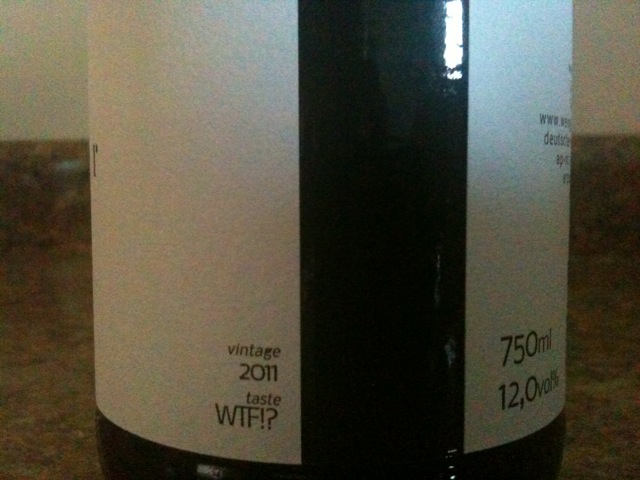
2011 Meierer Riesling WTF!?

2011 Meierer Riesling WTF!?

We started with the 2011 Meierer Riesling WTF!? (12% ABV, limited to 300 bottles made). When Nina and I first tried this wine at the winery in the summer of 2012, it was definitely one of the weirdest Rieslings we ever had, hence the name… Matthias, the winemaker, had decided to produce this wine in the way one would usually make a Pinot Noir: He let the must sit on the skins and stems for a couple of days. This really changed the nose and palate of this wine making it intense and I would never have guessed it was a Riesling if I had not known. I was eager to share this wine with the group, so we made it our apéritif. The wine showed itself in a slightly darker yellow, pretty much pee color. The nose showed acidity, some sour apple, I got hints of vanilla and coconut, but there seemed to be a decisive lack of fruit in the nose. The palate was herbal and what I would call branch-y, with healthy acidity and some apple aromas. Most in the group remarked on that it reminded them of a Chardonnay. The finish was long, with some bitterness. I like the experiment itself, I am not sure I would want to drink this wine all the time…but how could one, with only 300 bottles made? (I wrote in depth about the winery here). And it definitely fit the tasting’s motto.

2011 Agape

2011 Barafakas Winery Agape

The first course of the meal was an arugula salad with cranberries, walnuts and blue cheese. We paired it with a 2011 Barafakas Winery Agape, a Greek white wine blend from the Peloponnese peninsula. The wine is made with 50% Roditis grapes and 50% Savatiano grapes and had 12.5% ABV. The label promised strong acidity as well as citrus, banana and peach aromas. It poured in a light yellow color and had a very subdued nose. I really was not able to discern anything in the nose. The flavor profile on the palate showed a dry, slightly buttery wine with virtually no acidity or fruit aromas, some bitterness and a decent amount of heft to it. Nina said it seemed syrupy to her in texture (not sugar), I am not sure I got that. All in all, a bit boring. But then again, a lot of Southern European dry whites give me that impression. That said, it paired exceptionally well with the salad. The acidity in the dressing, the blue cheese and the nuttiness of the arugula made for good companions.

2010 Osél Ruchè di Castagnole Monferrato

2010 Osél Ruchè di Castagnole Monferrato

For the pasta course, a classical dish of orechiette pasta and tomato-based ragù sauce, we first opened the 2010 Osél Ruchè di Castagnole Monferato that we had brought. My notes resembled the notes I made when we initially tried it in March, which is why I just repost them here: “It poured in a lighter red with some hints of brick. The nose was floral and perfumy with cherry and jammy notes. Rather enticing. The flavor profile of this light to medium bodied wine was very intense, with again cherry and some earthy aromas. There was noticeable residual sugar, maybe a tad too sweet. It had a peppery and slightly bitter finish that was rather short.” All in all, it seemed fruitier this time around, which I did not mind at all. Still a solid wine.

NV Accattoli Lacrima di Morro d'Alba

NV Accattoli Lacrima di Morro d’Alba

We then opened a NV Accattoli Lacrima di Morro d’Alba DOC, an Italian red wine made from 100% Lacrima grapes, an ancient and rare grape variety. The wine had 12.5% ABV (notice a theme here?) and poured in a very dark ruby red. The nose was great, incredibly floral: violets and lavender and other floral aromas. It smelled a bit like an old grandma, but in a good way, if that makes any sense…On the palate, the wine was medium-bodied and soooo silky. That was the first thing I noticed: I really loved the texture of the wine. There was some cherry, and some smokiness to it, but the dominating factor was its black currant and blackberry aromas. Incredible. If you ever had black currant juice (I have, they sell it in Germany and it is AWESOME with sparkling water), you know what I am talking about. Just a wonderful currant, cassis bomb. There were hardly any tannins in this wine, and the finish was quite short. This was seriously yummy. And it paired well with the homemade dark chocolate ice cream. The fruitiness was great and the lack of tannins also helped when pairing it with the ice cream.

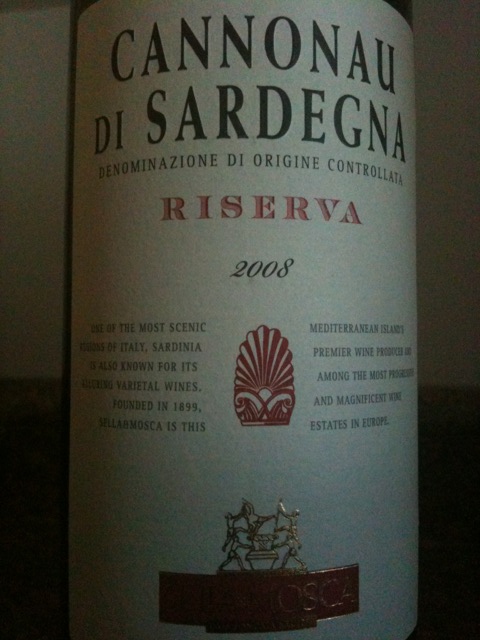
2008 Sella & Mosca Cannonau di Sardegna DOC

2008 Sella & Mosca Cannonau di Sardegna DOC

We then proceeded to open my back up bottle, the 2008 Sella & Mosca S.P.A. Cannonau di Sardegna  DOC Riserva. I had brought the wine in case we’d run short because given our hosts gracious and laborious meals, we guests were providing the wine, and two of our friends couldn’t make it, so we would potentially have been short of wine. I had initially bought this bottle because I liked the label and the word Cannonau…which I had hoped was another strange fruit, but it turns out that it is the Sardinian name for Mourvèdre. The wine poured in a brickish red. The nose showed wet tobacco, a serious level of ripeness and some age, sweet plums, and, honoring the tasting’s motto: horse sweat. Significant horse sweat. Well, that was weird. On the palate, it felt flat with serious acidity (others were less kind and said sour), had a short finish and was not very enjoyable. I guess the fruitiness of the Lacrima, the wine we had before, did not help this contender, but it still seemed like it had serious issues which was too bad…

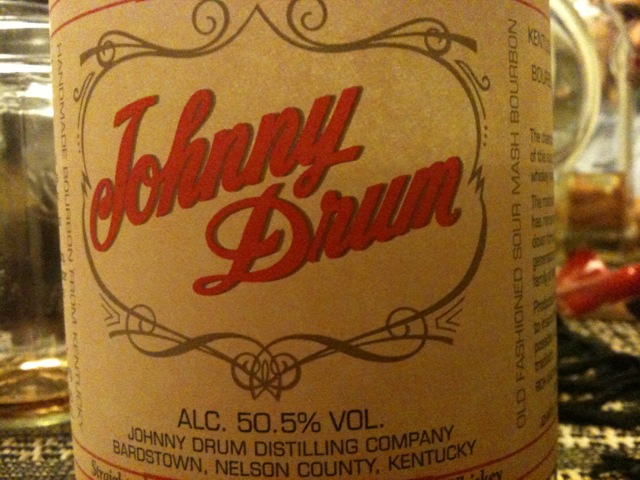
Johnny Drum Bourbon

Johnny Drum Bourbon

We finished the night with a glass of small batch Bourbon that our host, a total Bourbon aficionado, pulled from the kitchen closet. It was delicious and a great finish for another awesome tasting night. We’ll try to work another one into the time before we head out for our big trip this year, and I already cannot wait.

Tagged , , , , , , ,