Tag Archives: white wine

Tasting at Gunderloch Part 2: The sweeter wines

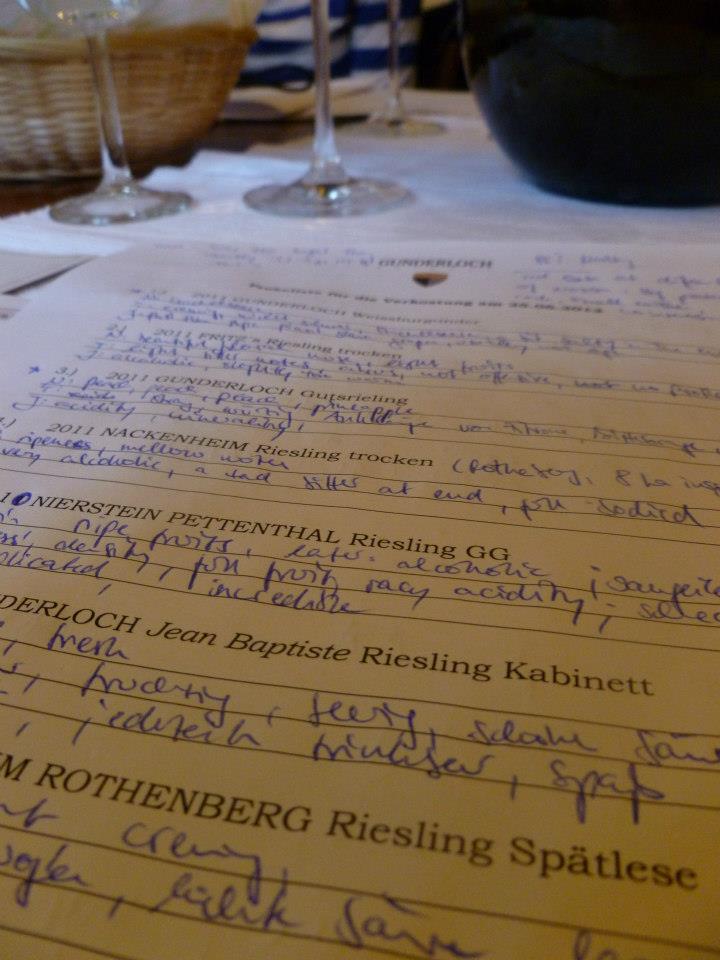
My tasting notes.

My tasting notes.

As promised in my piece about our wonderful tasting at Weingut Gunderloch that I published last week (if you missed it, check it out here), this installment brings you the tasting notes on the sweeter wines. Bear in mind that I am naturally a lot fonder of the sweeter versions in general.

From the flagship dry wines, the Grosses Gewächs (GG), we moved on to one of the most ubiquitous Gunderloch wines of all: the 2011 Gunderloch Jean Baptiste Riesling Kabinett. The wine is named after a character in Carl Zuckmayer’s “The Merry Vineyard”, a play from the 1920s. Zuckmayer was actually born in Nackenheim and the play was quite scandalous. The Jean Baptiste Gunderloch in the play is a winery owner with some twisted ideas about morality. Only in the 1950s and 1960s did Nackenheimers and Zuckmayer reconcile…but I digress. The wine is available all over the world: I have seen it in restaurants in Seoul, Korea in 2000 and I had it in Anchorage. It is the wine that made Gunderloch known to the more general public. I have tried pretty much every vintage since the early 2000s at our local wine festival. I started out really liking it but found the ones produced in the mid-2000s a bit wanting. But that’s enough of an introduction, let’s see how the 2011 fared: In the nose I got gooseberry and a nice freshness, probably carried by acidity. On the palate, it showed some moderate sweetness, was fruity with a nice acidity. I thought the vintage worked alright. There are definitely other Kabinetts out that offer more drinking fun, but at least this one is available widely.

We followed the Kabinett with the 2011 Nackenheim Rothenberg Riesling Spätlese (for those familiar with the German wine classification system we went in the right order, up a notch). According to Johannes, none of the grapes used for this wine were botrytized, which means they showed no signs of the noble rot that can get to grapes. In the nose, we got a great spontaneous fermentation nose that is initially a bit off-putting (because they smell a bit bad), but usually heralds great things for the glass. I got a lot of exotic fruits and the wine also smelled of cream. A very nice nose indeed. On the palate, it was really creamy and felt wonderfully balanced: some acidity, healthy sweetness, all in great symmetry. The best thing for me was its finish. My notes read: “loong, looooooong, very, very long”. It was just a beautiful rendition of a rich Spätlese. And unlike the GG from Rothenberg, this seemed quite accessible already.

In the classification scheme, what comes after a Spätlese? … Yes, an Auslese. So we followed that wine with the 2011 Nackenheim Rothenberg Riesling Auslese. Johannes told us that in contrast to the Spätlese, 100% of the grapes used for this wine had the noble rot on them. In the nose, I got mostly pineapple. The wine looked heavy in the glass. On the palate, there were minor signs of ripeness, thanks to to the botrytis. This Auslese distinguished itself by being nicely mild. There was a noticeable and welcome acidity (some winemakers struggled with the low amounts of acidity in that vintage). All in all the wine was warming and very expressive in a gentle way. Definitely different from a lot of Mosel Auslesen I know that can be overwhelming that young. This one was not out to be a rock star, rather it seemed to hold back a bit and just letting on that it is a great wine. It should be interesting to taste it in a couple of years.

The tanks holding Trockenbeerenausele at Gunderloch

The tanks holding Trockenbeerenauslese at Gunderloch

After that, we got lucky. As in seriously lucky: The photo above shows the three tanks that stood in the tasting room: two 190 liter tanks of Trockenbeerenauslese (TBA) and an 8 liter glass bulb full of single vineyard TBA from the Rothenberg. The unpronouncable Trockenbeerenauslese is the highest ranked and most rare of Germany’s wines (ice wine might be rarer, but I am not even sure it is). It literally translates to dry berry selection and that gives you an idea. The grapes are usually very shrivelled and picked individually. The juice you press from them is thick and syrupy, with concentrated sugars and low water to dilute it. The wines made from them are masterpieces, and take a long time to ferment. We had the tasting in late June, and the wines were still slowly fermenting. Johannes said they’d give them as much time as they need to finish the job. And he let us try some.

2011 Gunderloch Trockenbeerenauslese

2011 Gunderloch Trockenbeerenauslese

It is a rare occasion to try one of these, yet even rarer to try them at the winery while they are still fermenting. I remember, when we visited Dr. Hermann winery once in spring, Christian was just filtering the 20 liters of TBA he had made. And he proudly shared some of it with us. It makes you feel quite blessed when that happens. As you can see from the photo, the wine is of dark, dark amber color and highly viscous. In the nose, we got ripe plum and raisins. On the palate, it was still all over the place, which TBAs tend to be for quite a while after bottling, too, but there was definitely honey (which is a standard you taste in a TBA) and a nice spicy note to it. It was definitely exciting. Johannes said what every winemaker will tell you about their TBA: this one will be good in a hundred years. I am still looking for folks to either invite me to try a 100 year old TBA, or who are willing to wait it out with me. Should be fun. I already envy future generations!

Tagged , , , , , , , , , ,

2010 Bex Riesling Nahe

Bex Riesling

2010 Bex Riesling Nahe (Photo from the producer’s website)

So, the 2010 Bex Riesling Nahe marks Riesling’s return to this site! Regular readers may know by now that it is hard for me to walk past a bottle of Riesling on a display shelf without at least looking at it. There are some wines that I have not bought and am not considering buying (most of them come in blue bottles or play with German umlauts on the label in weird ways…), but when I saw this bottle I checked it out: A 2010 (a vintage I am very fond of for its acidity and because Nina and I got married that year), a German Riesling, a pretty cool looking bottle, grapes sourced from the Nahe region which I know hardly anything about, and the price tag of around $8 were the principal reasons.

I ended up buying it and opened the screwcapped wine the other night when we were in a Riesling kinda mood (when is that not the case you might rightly ask). The screwcap is by now no longer a sign of cheap(er) wines. A lot of German winemakers have switched to either screwcap or glass lids for their wines simply because the chance of a cork spoiling the wines is greater than with these closings. I miss the cork sound, but appreciate a winemaker’s decision to sell his wines in a way that better ensure I get to enjoy them.

I tried to find out more about the producer of this wine but it turned out to be tricky: The website shows clearly that it is meant for the party crowds without interest in who made it. It makes absolutely no mention of a producer, curiously labeling itself “Bex Winery”. The talk on the website is marketing gibberish deluxe (Sample: “A powerful departure from the norm, BEX Winery specializes in Riesling of unparalleled quality and flavor.”).  Luckily, German wines have to have the A.P. Nr. printed on their labels, a code making every filling unique and therefore one can discern who made the wine (I wrote more about that here). Unfortunately, this number is only meant for the wine authorities’ use so there is no online database to check it for consumers. However, a Google search showed that the “280” in this wine’s A.P. Nr. stands for Moselland eG, one of the largest German wine cooperatives.

Now, it could seem weird that Moselland, which is located at the Mosel (duh) would produce a wine with grapes from the Nahe region, but that is not necessarily a bad thing. Many big producers do that.  Moselland makes a ton of different wines of varying degrees of quality and owns other cooperatives in the Palatinate and Rheinhessen. When I found out they produced this wine, I actually had mixed feelings…

But to the wine: The website states it has 9.5% ABV, 8.5g of acidity per liter and 2.9% of residual sugar (whatever that means, I am used to g/liter). Apparently, the Tasting Panel Magazine gave it 90 points. A comparison with its 2011 brother shows that that wine has less acidity (7g) but the same amount of residual sugar which one could have assumed given 2011s lower acidity levels in general.

The 2010 Bex Riesling Nahe was quite light in color, slightly greenish. In the nose, I got grapefruit and other citrus aromas. It was quite refreshing. On the palate, the wine felt rather heavy actually with a viscous mouthfeel (not what I expected at all). It is dry with a healthy acidity and aromas of grapefruit and lychee. The finish was quite peachy and nice. I actually enjoyed this wine quite a bit. Not complicated, refreshing, the acidity doing a good job. Nina however, did not like the wine very much. She ventured out and grabbed a bottle of 2010 Dr. L Riesling. I couldn’t blame her. While this wine was decent, there definitely are better wines around from the same year and around the same price point. Still, if you are looking for an affordable German Riesling that delivers rather typical flavors, this is a good starting point.

Tagged , , , ,

2010 Caiu a Noite Vinho Verde and 2011 King Estate Acrobat Pinot Gris

2010 Caiu a Noite and 2011 Acrobat Oregon Pinot Gris

2010 Caiu a Noite and 2011 Acrobat Oregon Pinot Gris

We were invited for at dinner party on our last Saturday evening in Alaska before flying back to Ann Arbor. The hosts had told us to bring wine and sent us a menu for dinner: broccoli, roasted lemon-herb chicken, mashed lentils with caramelized onions and balsamic vinegar. In my opinion, this dinner was screaming out for white wines. I guess a Côtes du Rhône would have worked fine as well, but with the lemon chicken I just felt safer with whites.

We headed over to the liquor store and I was thinking something along the lines of a Burgundy chardonnay. We kept checking the pretty decent wine selection when Nina had the idea to bring a vinho verde to start with. We couldn’t see any, so we asked the lady in the store who promptly sent us to the Chile wine section because Portugal was somewhere in South America…ah, well. I finally spotted a vinho verde, the 2010 Caiu a Noite. I had never seen that wine before, but it was $6.99 and since a bottle of vinho verde has yet to disappoint me, we picked it up.

With some uneasiness and the very limited selection of Burgundy whites I was convinced by Nina that we might want to look into pinot gris. I complained that I am not the person who brings pinot gris to a dinner party (I am not the fondest supporter of that grape). I saw some Oregon pinot gris and I decided that that might be a route to take. I have never had Oregon pinot gris before, so it was an experiment. The 2011 King Estate Acrobat seemed about right, and cost around $10.

Both wines turned out to be very good (as did dinner!). The 2010 Caiu a Noite Vinho Verde still had some bubbling going on, which I did not expect given that it is a 2010 vintage and vinho verde is usually meant to be drunk young. It had a great nose of fresh apple and citrus and in the glass showed these same apple aromas, a very slight sweetness backed up by a nice acidity. It was a really good vinho verde, probably one of the best I have had (better than the Trader Joe’s Vinho Verde Espiral, I think, because it was more rounded and less wild). I highly recommend this wine if you get a chance to try it.

The 2011 King Estate Acrobat Oregon Pinot Gris poured in a very light yellow color. The nose was a bit perfumy, but somewhat subdued. Not very expressive at first. On the palate the wine was beautiful. It had a nice body to it, was dry and showed some interesting fruit aromas of pear and apple. It had a nice length to it and was just incredibly smooth and wonderful to drink. I enjoyed it tremendously, and I loved that there are always wines out to positively surprise me. It also paired well with dinner. I have to try more Oregon wines, from what I hear this is a wine region that is producing wines that I will like. I am very excited about that prospect.

Tagged , , , , , ,