Tag Archives: mosel

Sunday Read: The Saar and Mosel Map of 1868

The Saar and Mosel map framed (Photo links to Lars Carlberg’s website, where it is uploaded)

I feel like I owe an explanation for my week long silence, but there really is not much to it. There are weeks when writing this blog is easy, and weeks were it is harder. Last week was one of these. I wrote a lot (work related) last week and so my eagerness to write more diminished. I also didn’t drink much wine last week, to be precise: none, so there was nothing I felt particularly strong about sharing. Let’s see how next week works out.

Today, for my Sunday Read, I want to point you to a particular article but also to a website in general: Lars Carlberg’s page. Lars is an American living in Trier, where we used to live, and he is a wine writer, worked as an importer or winery representative and loves the small estates that dot the Mosel, Saar and Ruwer. I have had the good fortune of meeting him several times and he is knowledgbale and a great conversation partner: thoughtful, witty, never boring. He started a Mosel wine, restricted access database last year in which he profiles wineries and posts his tasting notes. I don’t have access to it, but I like whatever he posts publicly and highly recommend you check his website out.

The article I am sharing today is about the Mosel and Saar Tax Map of 1868. When the Prussians took over the Rhineland and Mosel after the Napolenic Wars, they really had not much of a clue of this heavily Catholic area (the Prussian Kings were Protestants). So they established their administrative system and over the decades decided to streamline taxation etc. In 1868, the Prussian government commissioned this tax map. The commissioner, a Mr. Clotten, divided the vineyard properties in eight categories, or tax brackets, according to the net profit made from wines whose grapes came from the vineyard, and for the map purposes made three different brackets. This way, he identified the profitability of the vineyards on the map (from light red to dark red). This in turn, is now seen as marking which vineyards had the best growing conditions or reputation. Looking at the map today, many of the vineyards we now consider prime spots are dark red on the map. It is pretty awesome, and much more a testament to the idea of terroir than the Bordeaux ranking of estates.

Lars teamed up with the Trier Public Library to produce a reprint of the map. Nina and I own one from the second batch of reprints. It is very high quality and gorgeous to look at. We still need to get a custom made frame for it (it is VERY long), but are looking forward to having it on our wall sometime this year. In his article, Lars explains more about the map, a fascinating piece of history. And you can have it shipped to the US as well…just sayin’ for you fellow Mosel Riesling nuts.

And happy Sunday! It’s a sunny but cold day in Ann Arbor.
Sunday Read: Saar and Mosel Taxation Map

Tagged , , , , , , , ,

1987 Karl Erbes Erdener Treppchen Riesling Spätlese

1987 Karl Erbes Erdener Treppchen Riesling Spätlese

1987 Karl Erbes Erdener Treppchen Riesling Spätlese

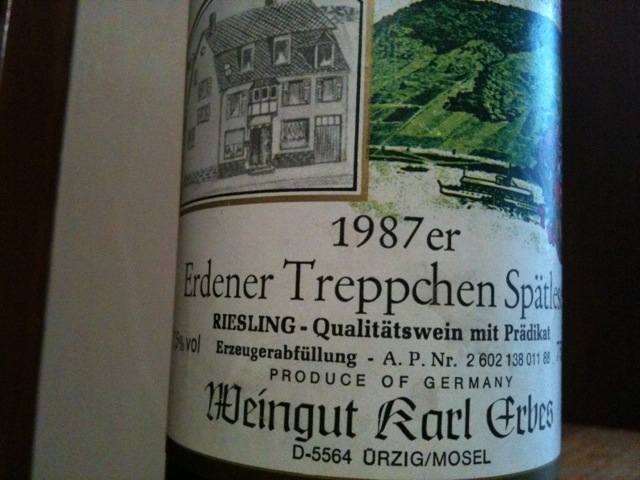
As I mentioned before, one of the things that have become a tradition at Nina’s birthday parties is that we open a bottle of 1987 Riesling, this time a Karl Erbes Erdener Treppchen Spätlese. We’re not sure for how much longer we can continue this, but for now we still have a few bottles…

Some of you might remember that one of my early posts on this blog was about the 1987 Vereinigte Hospitien Erdener Treppchen Riesling Spätlese which we had for her birthday last year (see the post here – in an aside, I am just realizing that that post only garnered one like, from my good old blogging buddy Julian at Vinoinlove. Thanks, Julian!!). Back then I explained, that 1987 is considered a weaker year along the Mosel, so it is always a bit of a surprise when the wines held up.

Trying the 1987 Karl Erbes Erdener Treppchen Riesling Spätlese was particularly interesting because the wine has pretty much exactly the same properties that the Hospitien wine had: Both from the same vineyard (albeit probably different areas within the vineyard), both 100% Riesling and both at Spätlese level, the medium category in the German wines with distinction level, which means they had comparable levels of ripeness in the grapes as measured in degree Oechsle.

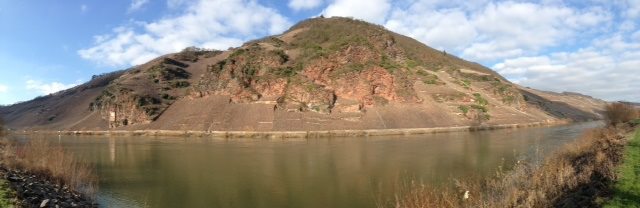
The Treppchen borders the Ürziger Würzgarten and Erdener Prälat vineyards, in the photo it begins on the far right hand side.

Three grand cru vineyards (from left to right): Ürziger Würzgarten, Erdener Prälat and Erdener Treppchen

Three grand cru vineyards (from left to right): Ürziger Würzgarten, Erdener Prälat and Erdener Treppchen

The wine had 7.5% ABV and was made by Stefan Erbes’ father Karl Erbes. One of the many wonderful things about this winery is that they retain a significant number of older vintages at the winery which are for sale. So if you ever make it there, make sure to ask for their older wines, too. They are also quite affordable still. You can find out more about the winery in my post here.

But now to the wine: The cork was in perfect condition and I decanted it for about 30 minutes. It poured in a light golden color, with some visible signs of ageing. The initial nose was very unappealing, strong musty aromas, some hints of leather, hardly any other aromas detectable. At that point, I was worried it might be flawed from that nose. On the palate, it was surprisingly fresh. The mustiness was not detectable when I tasted the wine. It was very delicate, and had contracted quite a bit, making it rather thin. It showed a good acidity structure with just a hint of sweetness. There really were no noticeable fruit aromas, I got more petrolly, aged Riesling flavors. A finish of medium length.

All in all, this was a bit weird. The nose was definitely not nice and it did not improve when I retasted a day later. The wine tasted still decently, but I thought the Hospitien wine we had last year had held up better. But another year of bottle age can also make a lot of a difference, so it is virtually impossible to compare the wines if you don’t try them on the same day. That said, this wine is most likely on its way out.

But hey, it held up for 26 years! And remember, this was “just” a Spätlese, not an Auslese or Beerenauslese. And it was from a vintage that is considered a rather weak vintage…so, absolutely nothing to complain about. The bottle cost us around $16 at the winery, if I remember correctly.

Tagged , , , , , , , , ,

2003 von Hövel Oberemmeler Hütte Riesling Spätlese

2003 von Hövel Oberemmeler Hütte Riesling Spätlese

2003 von Hövel Oberemmeler Hütte Riesling Spätlese

From one of his frequent trips to Germany, a friend of ours brought back a mixed case of German wines that my friend ManSoo had put together for us. It contained some Kurt Hain wines, a sparkler, some 1989 Auslese and three wines by von Hövel, a VDP winery at the river Saar, one of them this 2003 von Hövel Oberemmeler Hütte Riesling Spätlese.

Now, for those not familiar with the Mosel region, the Mosel has two tributary rivers, the Saar and the Ruwer that are part of that wine growing area. The Saar, as I have explained before, meets the Mosel just south of Trier, in the town of Konz. It commences in France and then flows into Germany. It is a mere 246 km (152 miles) long, but only its final stretch in the state of Rhineland-Palatinate is used for growing wine, mostly Riesling. It is known to produce more mineralic, somewhat tarter Rieslings than the middle Mosel. The microclimate is cooler than at the Mosel, so the grapes tend to ripen later and can reach acidity levels without the higher sugar levels you can find on the Mosel, which gives them a distinct character. Most of the vineyards used to belong to the Catholic church, but in the course of secularization in the 19th century, many private investors bought plots and began wine making. Rich families began to settle later in the 19th century which led to the term “Saarbarone” (baronets of the Saar, a term derived from “Ruhrbarone” which was used for the industrialists in the Ruhr area that made a fortune when the industrial revolution took off). A lot of the estates on the Saar are very grandiose, unlike most Mosel estates.

Weingut von Hövel has been owned by the von Hövel family since 1803 (just in time for secularization) and is one such rather big mansion. It is a member of the prestigious German association of quality winemakers, VDP, and owns 11 hectares (27 acres) in the Saar valley which are planted with Riesling only. Its annual production is around 60,000 bottles. Since 2010 Max von Kunow has been the owner of the estate. Besides holdings in the legendary Scharzhofberg, the winery exclusively owns the vineyards Kanzember Hörecker and Oberemmeler Hütte, the vineyard this wine was from. Oberemmeler Hütte is a South-west facing tiny plot of land. Unlike most vineyards in the area, it is quite far removed from the river, on a higher lying plateau. In the 1868 Prussian taxation map, which marked vineyards according to their property value and therefore -indirectly- quality, Oberemmeler Hütte is in the same category as the Scharzhofberg, i.e. very highly ranked.

I was excited to try this wine, because while we lived in Trier, we were only about a 7 minutes drive away from where the Saar meets the Mosel and Oberemmel is pretty close to where that happens. We actually had our wedding celebration in a BBQ hut only a couple of miles away from this particular vineyard. So this is as neighborhood as it gets for Saar wines for us.

The wine poured in a very clear pale, almost white color. Absolutely no ageing was noticeable when looking at it. The nose was delicate, with fresh aromas of citrus, white peach, cream and hints of vanilla. There were some traces of age in the nose, but not prominent at all. On the palate, the wine was light bodied and surprisingly thin in texture. It had a somewhat ethereal feel to it in its lightness in general. The taste was still clean and fresh. There were no citrus aromas, but apple and pear had come in. There was hardly any minerality noticeable which was a bit surprising. The finish was medium long.

The wine was very interesting to me, because it was a combination of still quite fresh, but also seemingly contracted from age, which were the two poles that this wine was tied to. At times, I wanted it to be a bit firmer, and at other times I enjoyed its lightness. It was a type of aged Riesling I don’t think I have experienced in the past. Good to very good, I would say.

Check out the vineyard’s location here.

Tagged , , , , , , ,