Tag Archives: kabinett

2011 Karl Erbes Ürziger Würzgarten Kabinett feinherb and Korean food

Moselriesling with Korean food

Having written about the photo exhibition in Seoul in my post last week has made me think of Korea and Korean food a lot. I spent 5 months in Seoul in 2000/2001 and fell in love with Korean cuisine there. Then later, I learned to appreciate the wonderful pairing possibilities that riesling and Korean food have. Especially the off-dry and sweeter rieslings. While Korean food tends to be very hot and also has strong notes of sour (think kimchi, 김치, the Korean marinated and fermented cabbage that tastes very sour), these semi-sweet rieslings bring fruitiness and sweetness to the dishes. This compliments the sour notes heavily. The acidity in the wines makes them refreshing relief from the heat of Korean food. They truly can form a great pair. And it works the other way around, too: Take bulgogi, 불고기, the Korean national dish. It is marinated beef that gets broiled at the table. The marinade is actually quite sweet. That is were the acidity of the rieslings gives a great counter-balance. One cannot help but think ying and yang.
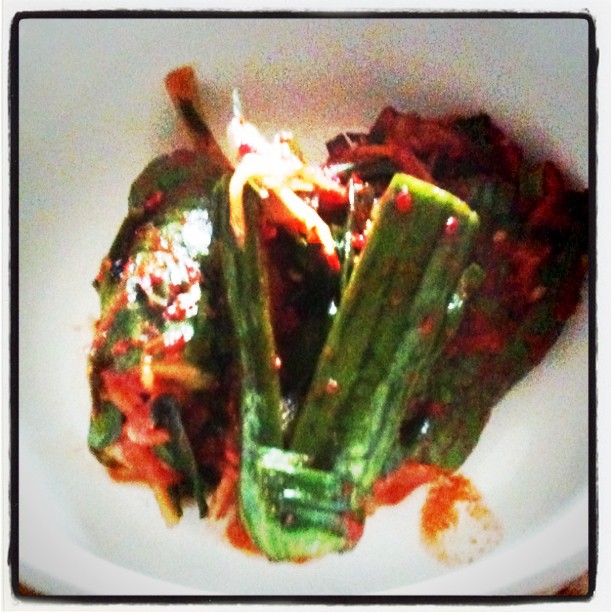
Cucumber kimchi

Luck had it, that I also discovered a Korean grocery store in Ann Arbor and finally biked there. Their selection is fantastic, truly anything a Korean stomach could ever ask for. So I bought kimchi mandu (김치만두, small dumplings filled with kimchi, the Korean fermented cabbage), japchae mandu (잡채만두, dumplings with a glass noodle filling), kimchi fried rice (김치볶음밥) and several of the traditional Korean side dishes, or banchan (반찬): marinated lotus root, radish kimchi, cucumber kimchi, and garlic roots. All of them, except for the japchae mandu were pretty hot.

We opened one of the recently arrived Karl Erbes 2011 wines that a friend of ours had brought from Germany for us. It was the 2011 Ürziger Würzgarten Kabinett feinherb. I prefer the kabinetts with Korean food, because they are a bit lighter and offer more of the refreshing relief than spätlesen. The color of the wine was very light, translucent. In the nose, I smelled the typical Würzgarten. Würzgarten translates to “spice garden” or “perfumy garden”, and these wines tend to have very floral notes in their nose, it is almost a trademark for this hill. Some alcoholic notes, grassy, a bit like the freshness of asphalt after a rain (in a good way!). The texture was velvety. It also tasted rather typical for Würzgarten: floral, some apple, very fresh. The wine seemed a bit off balance, which could be blamed on the fact that it had just travelled for quite a bit and not settled down yet. It is also still very young! It did go quite well with the food. However, a bit more sweetness would probably have helped (and that is more on me for picking a less sweet wine than on this wine!).

The next day, we had some more sips to truly appreciate the wine on its own. It is a very nice wine. The nose was still stunningly beautiful after 24 hours. The taste is incredibly fresh and refreshing. I would love to try this again in 6-9 months. Karl Erbes wine can be bought in the U.S. There are several wine merchants that offer his wines.

Tagged , , , , , , , ,

Demystifying German Riesling – WSJ 4 May, 2012

I know, another article, but this one is about German rieslings, and so I feel like I should share it with you.

Is it a trocken? Demystifying German Riesling

The author makes many valid points, among them the following four reasons why riesling is loved by sommeliers in the US:

1) Riesling is wonderfully capable of transmitting the character of a particular terroir of just about anywhere in the world, though arguably no more so than in its native Germany.

2) Ageability: A great German Riesling can age longer than just about any white wine in the world.

3) Affordability, especially relative to other great wines of the world.

4) The German wine-classification system can make the study of Burgundy seem like a proverbial walk in the park and that is why sommeliers seem to be necessary.

The author then goes on trying to explain that there are many German rieslings that are not as sweet as they tend to be perceived. She definitely has a point there. Another aspect she raises is that Americans talk dry, and like off-dry and semi-sweet. My experiences with American friends visiting us in Germany and going wine touring with us was usually the same: They would tell us prior that they wanted dry wines. The off-dryer and sweeter they got during the tasting, however, the more they fell in love. It is because of riesling’s natural acidity, that makes the sweetness play with it in a hugely pleasurable way.

Yet, the author also falls into the traps of German wine labeling that she tries to avoid: In the article she seems to equate kabinett (the lowest class of Praedikat wine, remember my post?) with off-dry or semisweet. That is not entirely true, though. There are many kabinetts that are dry. This problem, again, stems from the confusing German wine labelling. While Mosel riesling kabinetts are usually sweet, if the label does not denote anything you can assume that they will be on the sweeter side. The winemaker labels them “trocken” (dry) or halbtrocken or feinherb (off-dry) if they are not. In other regions, where tradition is different, a kabinett without any extra labelling can be dry…and if it was sweeter that would be put on the label. My point: Don’t assume a kabinett is off-dry or sweet just because it is a kabinett. If it is from the Mosel, you can safely assume it is on the sweeter end.

The article is still a good read.

Tagged , , ,

German wine classifications

Yes, admit it, you have dreaded this day, and it came sooner than you thought…but I will talk a bit about German wine classifications today.

First of all, I find this site by the German Wine Institute very helpful (as most of their other stuff, by the way! Meet, for example, the German wine queen here or check out the German wine regions here – really cool stuff!). One of the keys to understanding the categories in German wine is the amount of sugar in the grape at harvest time (that does not mean that the wine will also have to be sweet!) – it is probably the most important way how Germany measures the quality in grapes. More sugar means greater ripeness means higher potantial alcohol yield and quality. One can argue with this categorization, but it reflects the fact that Germany is a pretty northern region for wine growing with not as much sun exposure – and therefore ripening potential – as most other wine regions in the world.

The majority of wines produced in Germany fall under the broad categories of “German wine” or “German Land wine” (comparable to table wines). The quality requirements are easy to meet, grapes can come from even outside of Germany.

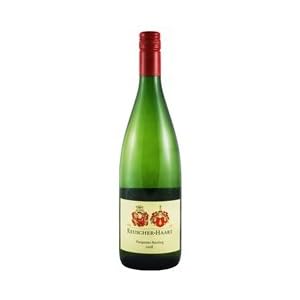
Above these wines you will find the so called “quality wines of specific regions” (“Qualitaetswein bestimmter Anbaugebiete” or short, and more memorable, QbA). All grapes for these have to come from a specific German region, and need to meet certain requirements. QbAs can be pretty yummy, although they still tend to be rather one-dimensional wines. Some of them, like the Piesporter Riesling (check out a photo of the bottle here) by Reuscher-Haart winery in Piesport provide awesome summer wines for a dime. His QbAs are widely available in the U.S. at around $15 for the 1 liter bottle (that is 25% more than your usual bottle!) – see my query results on wine-searcher.com for merchants.

Above these, you will find the “Praedikatswein” (“wine with distinction” – earlier it was called “Qualitaetswein mit Praedikat”) – and those are the wines that get me talking and indulging.  While the winemaker can add sugar before fermentation in QbAs, this is strictly prohibited in Praedikatwein. There are different grades of distinction, with Kabinett the lowest, followed by Spaetlese (late harvest), Auslese (selection), Beerenauslese (berry selection – short BA), Eiswein (the famous ice wine), and lastly, the highest of all, Trockenbeerenauslese (dried berry selection – short TBA). Please check the Wine Insitute’s site for the specific requirements.

For my purpose it is enough to say that all these can yield exceptional wines. With the summers of the last decade having become warmer and warmer, the ripeness of the grapes has also increased. This means, that a lot of the wines that are denominated as Kabinett (the lowest level of distinction) could actually have been labelled Spaetlese or even Auslese. Since the wine law only prescribes minimum sugar levels in the grape for each type of distinction (see the requirements here), the winemakers are free to label their wines lower than they actually could label them. This is usually for marketing reasons. Consumers and restaurants are looking for Kabinetts and Spaetlesen, because Auslesen are considered more expensive and exclusive…that also means that you can get Auslese wines at the price of Kabinett wines these days, quite the bargain.

All these wines come in varieties of dry, off-dry or semi-sweet, and sweet. This is at least true for Kabinett, Spaetlese and Auslese (yes, even Auslese can be dry!). BAs, Eiswein, and TBAs always come in sweet.

I personally prefer the spaetlesen and kabinett wines, mostly off-dry or sweet. As everyday wines, fruitier kabinetts can be just fabulous. Check out this awesome article on and tasting of Mosel Kabinetts by the NYT (on the 2008 vintage, but true for most others, too). Whenever I try a dry riesling, I feel like something is missing. The fruit in the wine is less pronounced in dry wines, and with some more sugar it comes out much more pronounced. But that is just me – and my taste is at least similar to what a lot of international wine drinkers like. My fellow Germans prefer their riesling dry (in the last 10 years the percentage of all dry wines produced rose from 34% to 41%).

German rieslings at spaetlese and above level are remarkably good at aging, and a lot of them actually only start developing their true potential a couple of years in. Auslesen, BAs, and TBAs can wait for decades…The oldest wine I have tried was a 1954. It was already quite dead, but still drinkable. The oldest wine I tried that was still good was a 1987 Vereinigte Hospitien Erdener Treppchen Spaetlese (tried it this year), one of the best I have had was a 1990 Auslese by the same winery (tried it last year). So, if ever you stumble across a German wine that is older than 5 years, give it a try. You might be in for a treat!

I hope this will help in the future when I talk about German wines. If you have questions, just leave a comment or send me an email at o.windgaetter (at) gmx.de.

Tagged , , , , , , , , , ,