Tag Archives: 2011

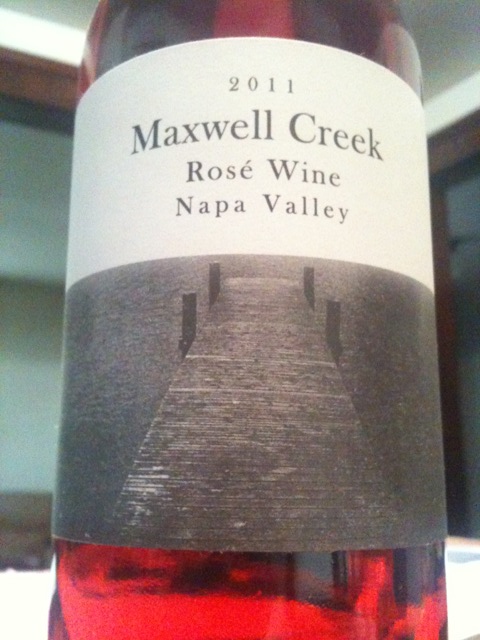
2011 Maxwell Creek Rosé Wine Napa Valley

2011 Maxwell Creek Rosé Wine Napa Valley

2011 Maxwell Creek Rosé Wine Napa Valley

I don’t know how things are going weather wise for you all, but Ann Arbor has finally had a few sunnier days and temperatures have begun to rise. All this lured me into craving a rosé (or blush) wine. I have a weak spot for Rosés. Always had. While growing up, one of my favorite wines was a Portugieser Weißherbst made by my winemaker friend Pitt Zimmermann in my hometown. Portugieser is the grape, and Weißherbst is a German denomination for a rosé wine that is made from just one grape variety and from one single vineyard. I loved that wine: It was always served very cold, was quite sweet and always hit you with strawberries all over the place.

Over the years, it has become a bit too sweet for my taste buds, but when home I still enjoy a glass or two of this wine. Let’s call it one of the gateway drugs…

For those not familiar with Rosé, it is a wine made from red grapes. Unlike red wine, the pressed must does not sit on the skins and stems for long (or at all). Since the color in red wine comes from the skin, and the juice is white just like in a white grape, this leads to just slight discoloration in the wine, hence the name rosé (or blush). Many regions produce these wines, and there are some general rules: Rosés from Southern France tend to be the most dry of all Rosés. Very dry are usually also the Spanish wines of that kind. American and German Rosés tend to be sweeter, with more residual sugar. To me, there is a place for both. While the Southern European versions are great food companions, I actually enjoy a bit of residual sugar in terrace or garden slurpers, when I have the wine on its own.

I bought four of these bottles of Maxwell Creek during a flash sale on Wines Till Soldout and this was the first of the four I opened. I paid $9 per bottle, I believe. “Maxwell Creek Cellars” is located in Rutherford, California. A bit of research showed that it is not a “proper” winery, but rather a filler of wines apparently serving as a second label to sell off overcapacity. The great news about that is that it is usually produce from good wineries just sold under a generic name which comes with a steep cut in price. I was unable to unearth much more about this wine or label, so if you know more please let me know in the comments section!

The wine had 13.7% ABV. Winehoarder declares that the grape varieties used in the wine are Cabernet Sauvignon, Cabernet Franc, Petit Verdot, Malbec and Merlot.

First off, I have to say I LOVED the color of the 2011 Maxwell Creek Rosé. It was a darker red that I associate with strawberries. I so love that color and prefer it over the more salmony or orange looking rosés. The nose was very fruity, just what I wanted and had hoped for: strawberries, gooseberry and peach, some water melon. Really draws you in if you like fruit-forward aromas. On the palate, the wine was quite light-bodied, with good acidity and some tannin giving it body. To me, peach and cream flavors dominated, later gooseberry coming in. It also reminded me of one of the ubiquitous blends in Germany of sparkling wine and vineyard peach liqueur (just without the bubbles). There was some slight bitterness in the finish, which I think might come from the pretty high alcohol level, which overall led to an unbalanced wine. Nina remarked that for her, the wine was too sweet in the middle section and then not good enough at the end. I thought that was a pretty good explanation of what is going on. There is definitely some sweetness to this wine which many will probably not appreciate. The finish overall is disappointing.

But what can I say? The wine was not impressive or anything special (except for the nose). However, I think this is another example of a wine I only want to drink on a summer afternoon, sitting in the sun. And then it will hit all the right notes and all the right points. It was definitely not the right day to open this bottle with the 45-50 F we are having right now. But I am happy that I have three more bottles to open this summer.

Tagged , , , , , ,

Trader Joe’s 2011 Floriana Grüner Veltliner

2011 Floriana Grüner Veltliner

Just a short tasting note today.

I picked up this grüner veltliner a couple of weeks back at Trader Joe’s where it retailed for $5.99. Grüner Veltliner is a white grape that is mostly grown in Austria, kind of the dry sibling of riesling, and maybe even vinho verde (notice the word “green” in both wines). I cannot recall ever having had a grüner veltliner before, so I figured I should give it a try. This particular 2011 Floriana Grüner Veltliner was made in Hungary. Given Hungary’s and Austria’s common history (they once formed the Austro-Hungarian Empire), I gathered that Hungarians should be capable of making decent wines out of this grape. The wines are generally perceived as food friendly.

I made schnitzel last weekend. My friend Tracy and her husband had prepared an amazing and detailed instruction manual for me, because Nina loves schnitzel and I wanted to be able to recreate them here. In my case the schnitzel was a thin, crusted and then fried pork steak. I had read before that grüner veltliner can be a good companion to this traditional Austrian dish (the true classic is Schnitzel Vienna, but that is made with veal).

2011 Floriana Grüner Veltliner poured into the glass in a very light color. On the nose, there were prominent apple and citrus aromas. On the palate, it is dry, with apple and citrus persisting, but eventually herbal aromas coming in, which made it a really nice partner for the schnitzel, which is traditionally served with some lemon to squeeze over it and a salad as a side. The wine was light and refreshing. It did resemble the Trader Joe’s vinho verde in its freshness (but without the fizz). The herbal aromas did give it a different feel, though. Definitely worth trying if you are looking for a refreshing dry white.

Tagged , , , , , , ,

2011 St. Urbanshof Ockfener Bockstein Riesling Kabinett

Another Korean dinner companion

As I mentioned in a previous post, last week was our anniversary, actually the first anniversary we got to celebrate together. After the dinner “fiasco” at the restaurant the night before our anniversary, I decided it was time to pull out some Korean food to give us a comforting dinner on the actual anniversary day.

Probably, Botswana food would have been more appropriate, given that we met and fell in love with each other in Botswana, and given that we got married on Botswana’s Independence Day (we actually had no clue when we set the date), but somehow Botswana cuisine has not really won our hearts…except for their steaks! Hands down, I have had my best steaks in Botswana. I don’t know what they do with their cattle, but the produce is phenomenal. Getting Botswana beef in the US, or even Europe, is near to impossible, though.

St. Urbanshof Cork Art

Our love for Korean food stems from my time in Seoul in 2000/2001, and our friendship with our good friends ManSoo and Hyekyung. There is something refreshingly honest in Korean cooking: few ingredients, you get what you order, no glutamate sauces or fancy dishes, down to earth, satisfying cooking. I really do prefer home cooked style meals, which is why the Tuscan and Burgundy cuisines are equally dear to my heart. But riesling is such a perfect match for Korean food, that it is the easiest to pair with my beloved rieslings.

So, for our anniversary dinner I made 감자 조림 (braised potatoes in a spicy sauce; a first and I used the delicious and super easy recipe available here) and 호박전 (zucchini pancakes, to which I add mushrooms and scallions). Both dishes turned out really yummy, and the only question was the pairing.

Korean braised potatoes

We went with a 2011 St. Urbanshof Ockfener Bockstein Kabinett. St. Urbanshof is a winery in Leiwen, along the Mosel (check out their website here). Their black labels are quite iconic. I was first introduced to their wines by my friend Helge many years back. The winery is an early experimenter with the spontaneous fermentation method, which is now quite popular in Germany. The initial nose of these wines tends to be rather sulfuric, but once you get through that, they are irresistibly fresh and fruity and said to age better. This particular wine is a Kabinett (the lowest level of Prädikatswein, for more information check out my at a glance tool here).

The Bockstein is a vineyard along the Saar river in the village of Ockfen. According to the Urbanshof website, it is a 50 degree vineyard slope facing southwest, without other hills blocking it from the sun. The soil is gravelly grey slate. The vineyard is a prime vineyard along the Mosel tributary Saar. More on the vineyard here. If you look at the label closely, you will see a “1” beside a cluster of grapes on the right hand side. This stands for “Erste Lage” (literally “first-class site”). It is a particular designation style used by wineries that are members of the prestigious VDP, the German association of elite winemakers (I will have to write about them in a seperate post, promised). It denotes top vineyards and higher selection standards than required by the German Wine Act.

The beauty in the glass

The wine was, as you can hopefully discern from the photo, of a very pale yellow color. The nose had the typical initial spontaneous notes (in German sometimes referred to as “Sponti-Stinker”, you get the idea). After a couple of minutes it opened up to overwhelming yellow peach, honey and whipped cream aromas. It was surprising in its intensity. On the palate, we welcomed a somewhat viscose riesling, with initial citrus and peach aromas. Despite the citrus, the wine was not overly fresh because it showed low acidity, which was noticeable, but not dominant. The wine felt very smooth on our tongues. As we kept moving it in our mouths, there were hints of banana and floral notes coming in (maybe jasmine).  It had a long finish and for a kabinett was very complex, not just an easy guzzling wine.

The higher residual sugar level in the wine worked marvelously with the braised potatoes which were quite spicy. We got the wine at Costco for $13.99, which is just slightly more than what I would expect to be paying in Germany. In other words, it is quite the steal. At 9.5% ABV, it is also a great companion for fall evenings, when the sweetness is more soothing than in summer.

Tagged , , , , , , , ,