Category Archives: Year

1997 Karl Erbes Ürziger Würzgarten Auslese* and 1999 Bonnes et Guerre Pommard AOC

Two beauties, meant for each other

Some pairings seem to be made in the heavens: Think steak and malbec, think cheese and sweet riesling, think cooked beef and burgundy wines…the list is endless. But sometimes, we have the chance to reconsider our preconceived ideas, and be surprised, because a whole new horizon opens up as we do.

On one of these days, Nina and I were visiting Stefan Erbes of Karl Erbes. We were trying our way through his newer wines and on to older wines. I mentioned it before, but the cool thing with his winery is that his father has stashed away wines of virtually every vintage. We were trying the 1996 Ürziger Würzgarten Auslese against this 1997 Ürziger Würzgarten Auslese* (they make up to a *** Auslese to distinguish between them according to what Stefan and his father consider the most stellar ones). Both tasted beautifully, unfortunately I cannot find the tasting notes for that visit. Stefan started explaining that he had had the 1997 with a grilled steak the other day and that that was amazing. This is when I intervened and told him to stop pulling my leg. I was incredulous. A steak and a Riesling Auslese? I know Riesling is versatile (think Korean food and riesling), but that versatile? Stefan just laughed, handed me a bottle and challenged me to try it out.

The next day, we did. We threw coals on the grill and seared beef steaks with friends. And, oh man, did it work. The wine nor the steak were ruined by the pairing. Incredibly, the sweetness of the wine gave the steak a new feel and aroma, and the smokiness of the steak gave the wine a certain depth. I was stunned. We stocked up on the wine (because it is amazing, steak or not) and were looking forward to the next BBQ Riesling dinner.

The occasion arose when we made plans with two good friends for dinner. She is falling more and more in love with German Riesling, while he has remained a bit skeptical, but is definitely indulging in the older vintages we’ve brought along. We agreed on steak, a butternut squash with sage risotto and baby potatoes. This was to be followed by a cheese platter, our usual routine.

I knew I wanted to take another bottle of wine, too, and my eyes fell on a bottle of 1999 Bonnes & Guerre Pommard. It was a gift by my French exchange partner and great friend Fred (another match made in the heavens). Pommard is a very well renown village just south of Beaune on the Cote d’Or and my friend knew full well that it is also the sister city of my home village Nackenheim. He had brought two bottles of this wine. I have not been able to find out anything about Bonnes & Guerre, so if any of you know them, please let me know. The first of these bottles I shared with two friends in my last weeks in Germany before heading over to Ann Arbor. It was an utter disappointment: The wine had clearly been dead, whether of cork or another flaw or just bad wine making, I could not determine it. It was just sad. So, I had been worrying about the bottle sitting here in Ann Arbor for a while, and I decided it was time to take it and see…

The Pommard and the decanter

The white was opened and left to breathe for about 30 minutes prior to tasting, the red was decanted and stood for about 45 minutes. We had parts of the Würzgarten with our steaks, and then some of the Pommard as well. That led over to the cheese course, where we also had both wines.

My notes on the 1997 Ürziger Würzgarten Auslese* (the wine had 7.5% ABV): The color was surprisingly light, not as ambered as one would expect an Auslese to be when 15 years old. The nose initially was not very prominent, I could not distinguish any particular aromas. As the wine opened up, there was peach in the nose. On the palate, the wine was very fresh, no significant indications of ageing. The peach aromas came through very nicely, the acidity in the wine balancing the reduced sugar beautifully. I guess I was most endeared by how fresh the wine still tasted. About 2 hours into the evening, the wine opened up further and there were tropical fruits coming in. The wine paired nicely with our steaks, but we were also happy to have preserved some for the cheese, because it definitely shone more on the cheese course, when it opened up and was supported more by the goat cheese we were having. It is a marvelous piece of art that Karl Erbes created…
So light…

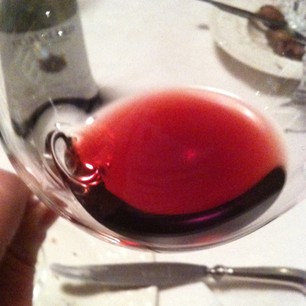
I knew this bottle of 1999 Bonnes & Guerre Pommard AOC was not flawed as soon as I uncorked it. The cork looked clean and intact, and when I poured the wine into the decanter, a full blown raspberry attack was going on. I don’t recall ever to have had such a prominent and distinct raspberry aroma in the nose. The wine was incredibly light in color, almost translucent. There was no darkening or browning on the edges when poured into the glass. It was remarkably fresh as well. In the nose, the raspberry aromas persisted, with some jam and tartness mixed in. I also smelled something like dough batter, but that might have been my brain playing tricks on me (I love raspberry tartes). There were also notes of chalk in the nose. On the palate, the wine was condensed, but very fruity. The alcohol of 13% ABV was noticeable, but at no instance was the wine heavy. Later in the evening, when we were having cheese, the wine showed cherry, plum and slight tomato notes. There was also a certain earthiness to it. The wine was such a surprise to me. I had expected it to be flawed or a heavier, darker pinot noir. The light color deceived that it was deep and subtle and strong. The finish was long, and it shone through.

Was this a pairing made in the heavens? I think it was. Trying old wines with friends, from two regions in the world that matter a lot to me, both fruity, both light, both deep. They expressed some great European wine making, and to have them side by side, was an experience I likely will not forget for quite some time…

Playing with filters to show how light it looked…
Tagged , , , , , , , , ,

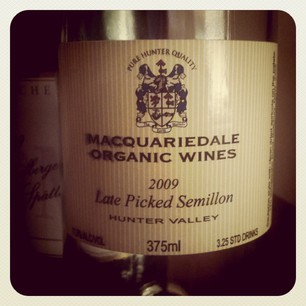
2009 Macquariedale Hunter Valley Late Picked Semillon

The black pirate

The final wine and black pirate at our Michigan vs. Mosel Riesling Tasting came from Australia, and was brought by a friend who had just arrived from Australia. She knows Nina’s and my love for wine, and she pretty much nailed it earlier this year when she brought this wine for us…

It was only after the tasting that I dove a bit further into the winery. On its website, the owners state that Ross and Derice McDonald started planting some vines in 1993 as an escape out of Sydney’s corporate world…interesting. In 1998 they went in all the way by moving to their Hunter River property from Sydney. They now own 15 hectares of vineyards and claim to make biodynamic/organic wines. I know organic wine making is quite the rage for a lot of consumers these days. I am fine with drinking organic wines, but it would never be my main criterion in buying a wine. A wine has to taste good first and foremost. If that can be combined with less intrusive methods of growing, that is fine with me. What I do not like is that equation of organic = good. To their credit, Mcquariedale does not seem to push that point too hard.

They grow shiraz (it is an Australian winery after all!), cab sav, merlot, semillon, chardonnay and verdelho grapes.

The wine description on their homepage reads as follows: “Our late picked Semillon is produced in a light style with hints of citrus peel and marmalade on the palate.  The semillon grapes are left to ripen on the vine and then fermented briefly to retain all the natural acidity and sweetness.  The wine will age gracefully and deepen in colour and flavour with extended cellaring.”

Here are my tasting notes. The wine poured in a deep orange color, and was highly viscose, as was to be expected by a fortified dessert wine. The nose had prominent pumpkin and clove aromas, then dried apricots and overripe cantaloupe. On the palate, the first and slightly overwhelming note was honey. As the earlier detected pumpkin and clove came in, so did some hints of sweet potato. I hardly noticed any acidity at all. The finish had an interesting touch with slight salty notes in the end.

I have to say, this wine did not grow on me. It was just too sweet without redeeming acidity. The pumpkin and cloves aroma did not help, because I am not fond of pumpkin pie at all (hey, I am not American, I do not have to like pumpkin pie!). I think the craftsmanship is there, and I bet there are many that like this type of dessert wine, some of the vin santo I tried in Italy was of similar style. I am just spoiled by my riesling BA, TBA and ice wines…

Tagged , , , , ,

2009 Hohe Domkirche Scharzhofberger Riesling Spätlese

2009 Hohe Domkirche Scharzhofberger Spätlese

I promised to write about this participant in our Michigan vs. Mosel Riesling tasting seperately for two reasons. First, I want to talk about the Scharzhofberg a bit more, because the vineyard matters to me, and second because I want to talk about the winery in a bit more detail.

The Scharzhofberg is a vineyard along the Saar, a tributary to the Mosel. The Saar meets the Mosel just south of Trier, in the town of Konz. The Saar commences in France and then flows into Germany. It is a mere 246 km (152 miles) long, but only the final parts in the state of Rhineland-Palatinate are used for growing wine, mostly riesling. The Saar is known to produce more mineralic, somewhat tarter rieslings than the middle Mosel. The microclimate is cooler than at the Mosel, so the grapes tend to ripen later and can reach acidity levels without the higher sugar levels you can find on the Mosel, which gives them a distinct character. Most of the vineyards belonged to the church, but in the course of the secularization in the 19th century, many private investors bought plots and began wine making. Rich families began to settle later in the 19th century which led to the term “Saarbarone” (baronets of the Saar, a term derived from “Ruhrbarone” which was used for the industrialists in the Ruhr area that made a fortune when the industrial revolution took off). A lot of the estates on the Saar are very grandiose, unlike most Mosel estates.

The Saar boasts many prime vineyards like the Kanzemer Altenberg, Ockfener Bockstein, Ayler Kupp and also, the most prominent among them, the Scharzhofberg. Technically belonging to the village of Wiltingen, the vineyard is so prominent, that the wineries do not have to list the village name on their labels. They proudly just use “Scharzhofberger”. The area stretches over 28 hectares (around 70 acres) in steep slopes (30 to 60 degrees) towards the South, the soil consisting of slate with rocky soil with iron and clay. Only riesling is grown here by a few producers that read like the who is who: Egon Müller-Scharzhof, van Volxem, Reichsgraf von Kesselstatt, von Hövel, Bischöfliche Weingüter, Vereinigte Hospitien as well as Johannes Peters and Weingut Resch.

The most prominent producer here is Egon Müller, a star among German winemakers, whose wines command the highest prices in the business. I just checked some of the prices in German online stores: a bottle of Kabinett $40, spätlese $170,  auslese starting at $250. That is a LOT for Germany…I have not had an Egon Müller, but I sure hope to try some at some point. Other Scharzhofberger are more affordable.

The Bischöfliche Weingüter, that produced the spätlese I want to talk about here, is a rather unique winery. As its name indicates (Episcopal Wine Estates), the winery belongs to the bishop of Trier. It manages and produces wines for the estates Bischöfliches Priesterseminar (Episcopal Priest Seminary), Hohe Domkirche (High Cathedral), Bischöfliches Konvikt (Episcopal Convent), and Friedrich-Wilhelm-Gymnasium (Grammar School Friedrich-Wilhelm). In the middle ages, the church partly financed itself with producing and selling wine. I mentioned in an older post that the same was true for universities. The church therefore had vast properties, often in prime locations. Separate branches of the church had separate lots. As the names of the estates indicate, the proceeds went to each separate institution. During secularization, the church was forced to sell most of its properties, but the Bischöfliche Weingüter bought back lots when the chance arose in the mid 19th century.  The Bischöfliche Weingüter today own over 130 hectares (320 acres), which is a whole lot in Germany. The Hohe Domkirche consists of 22 hectares in two locations: the Scharzhofberg and the Avelsbach estate close to Trier. They now have a modern tasting room in Trier, and their wines have gained a better reputation over the last decade.

This 2009 Hohe Domkirche Scharzhofberger Spätlese was given to me as a parting gift by one of my best friends in Trier. She knows how much I love Scharzhofbergers, and she has been a “Weinfee” (wine fairy, i.e. pourer) at the Bischöfliche Weingüter to help finance her degree. So, what better way to make me miss her than giving me a bottle of my beloved Scharzhofberger. I usually buy the Vereinigte Hospitien version, and have a couple in my cellar.

THAT is cork art!

We opened the wine and first up to admire is the beautiful cork art. The Bischöfliche print the three coat of arms of their wineries (Convent, High Cathedral, and Seminary) on the cork, and them being rather elaborate, it looks gorgeous! Pouring the wine into our glasses, it showed a light yellow color. On the nose I got very creamy, perfumy notes, then almonds. On the palate, the wine initially showed ripe strawberry and some cream. It had a very long finish, and there was a depth to it that was beautiful. After a while, I got more aromas of mango, and other tropical fruit. It was a very pretty wine. Two participants in the tasting told me later that it was their favorite of the evening, which I might sign up to, but I was still so impressed with the Michigan rieslings that I do not want to make that statement.

If you ever get a chance, give a Scharzhofberger a try. I have yet to be let down by a single bottle of it. Just beware: All vineyards in the Saar valley that do not have their own name (aka are not renown) can use the name “Scharzberg” on the label. These wines usually have nothing in common with the Scharzhofberger steep hill beauties, because they are usually from flatter plots and often lower quality land (thanks to Rob for that info!). So, watch out when you go hunting!

Tagged , , , , , , ,