Category Archives: Year

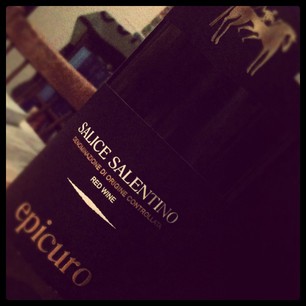
2007 Epicuro Salice Salentino Riserva

(This is a review of the 2007 vintage. The current vintage on sale is 2009, which I reviewed over here.)

Epicuro’s wines have been my go to Italian reds since I moved to Ann Arbor. They are reasonably priced ($5.99, I believe) and easily available at Trader Joe’s. I actually had my first sip of an Epicuro during my last weeks in Germany, when  my friend who gave me the Scharzhofberger, brought this wine for a dinner I had cooked. I had seen the bottles before, but it being such a mass label, I never tried it. They have a row of wines, differentiated by the color of their labels:

Red is a primitivo; blue is a nero d’avola; silver is an aglianico; and gold a salice salentino. They also produce a white, a vermentino.

I am not fond of their aglianico and nero d’avola, but I thought the 2008 vintage of their primitivo was great. A nice table wine, chewy and interesting, we had it for many BBQs and other evenings of just drinking wine. The currently available 2010 vintage, however, does not fit my taste. It is quite sweet, something that 2008 did not have to that degree. I don’t think I will keep buying that wine. But there still is the 2007 Salice Salentino Riserva…

Salice Salentino is a red wine from Southern Italy and has had DOC (denominanzione di origine controllata) status since 1976. The village it is named after is in the heel of the Italian boot. The main grape in a salice salentino is negroamaro, which is generally described as a rustic and earthy grape.

This red has 80% negroamaro and 20% malvasia nera in it. It has 13% ABV.

It poured as a medium to dark red. The nose was alcoholic and perfumy, with hints of leather. On the palate, I first noticed how nicely chewy this wine was. I then got cherries and herbal tastes, as well as rather strong leather and tobacco notes, which gave the wine depth. It had good acidity and the tannins came through well. A long finish made it a really enjoyable wine on a later evening. To me, this is definitely the star of the Epicuros.

As I indicated in Wednesday’s post, I had never had red wine with my risotto, so I gave it a try. And oh man, this really worked very well with the earthy flavors of the mushroom risotto. I wish I had paired them to begin with, but by the time we opened this one, I was already stuffed…

I will definitely be stocking up on this wine. Who knows how long it will be around, being a 2007 vintage? At $5.99, there is hardly anything wrong with it. It definitely tasted like a more expensive wine.

Photo taken from leftovers the next day. That said, I do like my risotto less creamy than most American chefs.

Tagged , , , , , , ,

2011 Be Bright Pinot Grigio (by Beringer)

Be Bright Pinot Grigio by Beringer

I think I mentioned it before, I am not the biggest fan of the white pinots, be it pinot gris/grigio/Grauburgunder or pinot blanc/bianco/Weissburgunder. Both often fail to impress me when I try the wines by themselves. I think they can be decent food companions in that they can complement certain types of food. For me, one of these foods is risotto. I usually use a pinot grigio or soave or orvieto for the risottos I cook, and the pairing for dinner works.

So, when I decided to make risotto for friends, it seemed natural to give this bottle a try. Nina had picked it up a couple of weeks back when Kroger had marked it down from an astonishing $18 to $8 in a special sale. She bought it to take to a party, but then that never happened, so we figured why not for the risotto dinner. A rather expensive pinot grigio could be nice with the risotto…

When I first saw the bottle I was skeptical. A California pinot grigio made by Beringer. Hmmm. Also, the label is way too fancy for my taste. And then, I saw the back label and it has this ingenuity printed on it:

Be. Bright.

Be sunny. Be Breezy. Be Bright!

This effortless Pinot Grigio keeps things light, with sun-ripened citrus flavors and a crisp, fresh finish. An instant taste of optimism, perfect for setting a carefree mood at any occasion. Serve chilled for total deliciousness.

I can’t tell you how much I dislike this marketing agency kind of talk on labels. This is all gibberish meant to entice the unsure to spend loads of money on this “oh so cool” product. Ugh. An “effortless” pinot grigio? Did you not put any effort into making it, Mr Beringer or whoever runs the shop? An “instant taste of optimism”? How so? From the citrus flavors? Or because you know it can only get better once you tried the wine? This is all just so pathetic …

Well, we tried the wine and here is what I think. It was light in color. The nose was dominated by very prominent bosc pear aromas, which made it hard for me to detect other aromas. On the palate, pear dominated again with some hints of peach coming in later. I did not get any of the claimed citrus flavors that could actually have helped this wine a lot. The finish was short, which is okay for a pinot grigio. However, there were also slight bitter notes which I did not fancy.

All in all, I guess this is an okay wine. It just did not do much for me, because it felt too heavy and lacked interesting notes. It also did not pair too well with the risotto I had made, a mushroom-porcini risotto, probably because of the strong pear flavor. However, I always have that risotto with white wine and never really had a problem. I don’t know. I will definitely not go and buy another bottle, it was just not my taste.

Tagged , , , , , , ,

2010 Loosen Bros. Dr. L Riesling

America’s German go to riesling with Korean pancake

Finally, you might say, finally a riesling that you have tried and you can compare my notes with your impressions. I admit that I have not tried many rieslings that are easily available here in the US. I have seen the ubiquitous bottle of this wine at Trader Joe’s but was unwilling to pay the $10.99 they were asking for it. So when, on our latest Costco run, I spotted the Dr. L for $8.99 I decided to give it a try. It seems to be the go to riesling for so many people here, and there was no reason at that price point to not give it a try.

First things first. I am usually not very optimistic when it comes to huge productions of quality winemakers, because all too often I have found them to be wanting. In Germany, I have not had many Dr. Loosen wines, so I also was not very comfortable assessing this and putting it into perspective. Then seeing the $10+ price tag for a very simple wine, I was even more turned off. Add in that I also tend to shy away from things everyone likes, Dr. L was in a bad position to start with. If you call all this over-thinking things, I guess you are completely right. I am glad that the price tag made me overcome all my preconceived objections.

When I decided to make Korean squash pancakes (hobakjeon, 호박전) with mushrooms, I figured this was the night to try the wine. I have had many good experiences with the Korean food and riesling pairing (for example here), so it seemed like a no brainer.

For those not familiar with the wine, just a few quick facts. Ernst (or Ernie) Loosen, the owner of Dr. Loosen Estate, is one of the major producers along the middle Mosel with vineyards in many prime sites (Wehlener Sonnenuhr, Graacher Himmelreich, Ürziger Würzgarten, Erdener Prälat, Erdener Treppchen). He is a charismatic figure and has done loads for promoting German rieslings. The Loosen Bros. Dr. L is his entry wine produced for a global market. The riesling grapes come from all over the place and are blended for this wine. The wine has 8.5% ABV.

Upon opening the screw cap of the beautifully dark green bottle, we poured a light yellow wine. As soon as Nina put her nose into the glass, she sighed “Aaaah, real German riesling, I missed you”. She relished the nose of what she described as summer fruits, peach, pineapple. To me, the nose did not really open up much or impress me. I got the peach and some floral notes later, but not initially (and no, the wine had not been chilled too much). The palate, though, was very nice. Peach, apples and citrus notes dominated it, with some herbal notes in the background. It had a nicely present acidity (probably owing to the vintage, 2010 had loads of acidity; read more here) that played well with the sweetness of the wine. In my view, this acidity was what carried it through and made it interesting. It is definitely a tad on the sweeter side, but the acidity makes it quite refreshing. It went great with the pancake and its soy-sauce based dips.

At nine bucks, this is a good value for a wine. We will be stocking up for sure. I am a little worried about the 2011, because if there is less acidity this could end up just too sweet. We’ll see. I will be drinking the 2010s as long as I can and then make the switch. It was nice to see that none of my worries came true. I whole-heartedly recommend this affordable, everyday German riesling.

Tagged , , , , , , , , ,