Category Archives: 2011

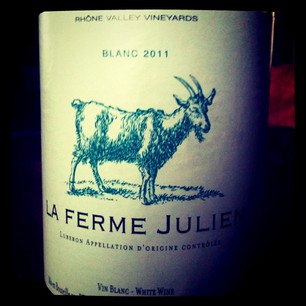
2011 Rhône Valley Vineyards Luberon AOC Blanc “La Ferme Julien”

2011 La Ferme Julien Vin blanc

I bought this wine for two reasons: First, fellow blogger Talk-A-Vino had given this particular wine an honorable mention in this post. Second, Nina and I have been on a mission to become Wine Century Club members. For those not in the know, you can become a member in this club once you have tried 100 (hence the century) different grape varieties. It is completely based on an honours system of reporting and membership is free. While I am pretty certain that I have had more than 100 grape varities in my life, I am only counting those that I actively remembered, so I am still a bit short. This wine is a blend of four grapes that I did not have on my list, so it brought us closer with even just one sip…I think it is a fun way to expand our knowledge of grapes and horizons by trying to get to the magic number.

Let me start by saying that I am not the biggest white wine fan, aside from Riesling, Gewürztraminer and Sauvignon blanc. I find a lot of the other whites I try uninspiring and lacking in exciting flavors and aromas. That said, we were excited to try four grapes we had never heard of: Bourboulenc, Grenache blanc, Ugni blanc and Roussanne.

For short, I will just call this La Ferme Julien blanc. I bought the bottle at Trader Joe’s for $5.99. The wine has 13.5% ABV, and, according to its back label, has been blended by the Perrin family, a well respected French négociant. You can find their wines on all levels of pricing and quality. I was surprised to find their name on this wine!

The wine showed a light yellow in the glass, with hints of green. On the nose, it was incredibly fruity: initial notes of yellow apple, peach and floral aromas. Later on I got banana (I think; Nina agreed). It was a really appealing and refreshing nose. On the palate, light bodied wine was dry, rather bland with light citrus aromas and a certain creaminess to it. There was slight strawberry, I think, but for me it was all overpowered by the alcohol, which also left me with some bitter notes at the finish, which I did not enjoy much.

In a way, this wine seemed to highlight my problem with higher alcohol white wines (not reds!): they become too heavy on my palate, when I want something fresh and clean. I felt like this wine would have been great at maybe 12% ABV, but that bit more made it hard for me to like it. The nose was fun, but the taste – not for me.

Tagged , , , , ,

Trader Joe’s 2011 Floriana Grüner Veltliner

2011 Floriana Grüner Veltliner

Just a short tasting note today.

I picked up this grüner veltliner a couple of weeks back at Trader Joe’s where it retailed for $5.99. Grüner Veltliner is a white grape that is mostly grown in Austria, kind of the dry sibling of riesling, and maybe even vinho verde (notice the word “green” in both wines). I cannot recall ever having had a grüner veltliner before, so I figured I should give it a try. This particular 2011 Floriana Grüner Veltliner was made in Hungary. Given Hungary’s and Austria’s common history (they once formed the Austro-Hungarian Empire), I gathered that Hungarians should be capable of making decent wines out of this grape. The wines are generally perceived as food friendly.

I made schnitzel last weekend. My friend Tracy and her husband had prepared an amazing and detailed instruction manual for me, because Nina loves schnitzel and I wanted to be able to recreate them here. In my case the schnitzel was a thin, crusted and then fried pork steak. I had read before that grüner veltliner can be a good companion to this traditional Austrian dish (the true classic is Schnitzel Vienna, but that is made with veal).

2011 Floriana Grüner Veltliner poured into the glass in a very light color. On the nose, there were prominent apple and citrus aromas. On the palate, it is dry, with apple and citrus persisting, but eventually herbal aromas coming in, which made it a really nice partner for the schnitzel, which is traditionally served with some lemon to squeeze over it and a salad as a side. The wine was light and refreshing. It did resemble the Trader Joe’s vinho verde in its freshness (but without the fizz). The herbal aromas did give it a different feel, though. Definitely worth trying if you are looking for a refreshing dry white.

Tagged , , , , , , ,

2011 St. Urbanshof Ockfener Bockstein Riesling Kabinett

Another Korean dinner companion

As I mentioned in a previous post, last week was our anniversary, actually the first anniversary we got to celebrate together. After the dinner “fiasco” at the restaurant the night before our anniversary, I decided it was time to pull out some Korean food to give us a comforting dinner on the actual anniversary day.

Probably, Botswana food would have been more appropriate, given that we met and fell in love with each other in Botswana, and given that we got married on Botswana’s Independence Day (we actually had no clue when we set the date), but somehow Botswana cuisine has not really won our hearts…except for their steaks! Hands down, I have had my best steaks in Botswana. I don’t know what they do with their cattle, but the produce is phenomenal. Getting Botswana beef in the US, or even Europe, is near to impossible, though.

St. Urbanshof Cork Art

Our love for Korean food stems from my time in Seoul in 2000/2001, and our friendship with our good friends ManSoo and Hyekyung. There is something refreshingly honest in Korean cooking: few ingredients, you get what you order, no glutamate sauces or fancy dishes, down to earth, satisfying cooking. I really do prefer home cooked style meals, which is why the Tuscan and Burgundy cuisines are equally dear to my heart. But riesling is such a perfect match for Korean food, that it is the easiest to pair with my beloved rieslings.

So, for our anniversary dinner I made 감자 조림 (braised potatoes in a spicy sauce; a first and I used the delicious and super easy recipe available here) and 호박전 (zucchini pancakes, to which I add mushrooms and scallions). Both dishes turned out really yummy, and the only question was the pairing.

Korean braised potatoes

We went with a 2011 St. Urbanshof Ockfener Bockstein Kabinett. St. Urbanshof is a winery in Leiwen, along the Mosel (check out their website here). Their black labels are quite iconic. I was first introduced to their wines by my friend Helge many years back. The winery is an early experimenter with the spontaneous fermentation method, which is now quite popular in Germany. The initial nose of these wines tends to be rather sulfuric, but once you get through that, they are irresistibly fresh and fruity and said to age better. This particular wine is a Kabinett (the lowest level of Prädikatswein, for more information check out my at a glance tool here).

The Bockstein is a vineyard along the Saar river in the village of Ockfen. According to the Urbanshof website, it is a 50 degree vineyard slope facing southwest, without other hills blocking it from the sun. The soil is gravelly grey slate. The vineyard is a prime vineyard along the Mosel tributary Saar. More on the vineyard here. If you look at the label closely, you will see a “1” beside a cluster of grapes on the right hand side. This stands for “Erste Lage” (literally “first-class site”). It is a particular designation style used by wineries that are members of the prestigious VDP, the German association of elite winemakers (I will have to write about them in a seperate post, promised). It denotes top vineyards and higher selection standards than required by the German Wine Act.

The beauty in the glass

The wine was, as you can hopefully discern from the photo, of a very pale yellow color. The nose had the typical initial spontaneous notes (in German sometimes referred to as “Sponti-Stinker”, you get the idea). After a couple of minutes it opened up to overwhelming yellow peach, honey and whipped cream aromas. It was surprising in its intensity. On the palate, we welcomed a somewhat viscose riesling, with initial citrus and peach aromas. Despite the citrus, the wine was not overly fresh because it showed low acidity, which was noticeable, but not dominant. The wine felt very smooth on our tongues. As we kept moving it in our mouths, there were hints of banana and floral notes coming in (maybe jasmine).  It had a long finish and for a kabinett was very complex, not just an easy guzzling wine.

The higher residual sugar level in the wine worked marvelously with the braised potatoes which were quite spicy. We got the wine at Costco for $13.99, which is just slightly more than what I would expect to be paying in Germany. In other words, it is quite the steal. At 9.5% ABV, it is also a great companion for fall evenings, when the sweetness is more soothing than in summer.

Tagged , , , , , , , ,